
A balanced look at AI coding tools, their benefits, risks, and how to use them strategically for career growth
The development landscape is evolving rapidly in 2025. With significant layoffs across the tech industry and AI coding tools becoming ubiquitous, junior developers face both unprecedented opportunities and hidden pitfalls. The key isn't avoiding AI tools—it's learning to use them strategically while building the fundamental skills that will define successful careers.
The Current Market Reality
The numbers paint a challenging picture. According to recent data, over 94,000 tech workers have been laid off across 150+ companies in 2025, with software developer job openings in the U.S. shrinking by over 70%. This creates intense competition, especially for entry-level positions.
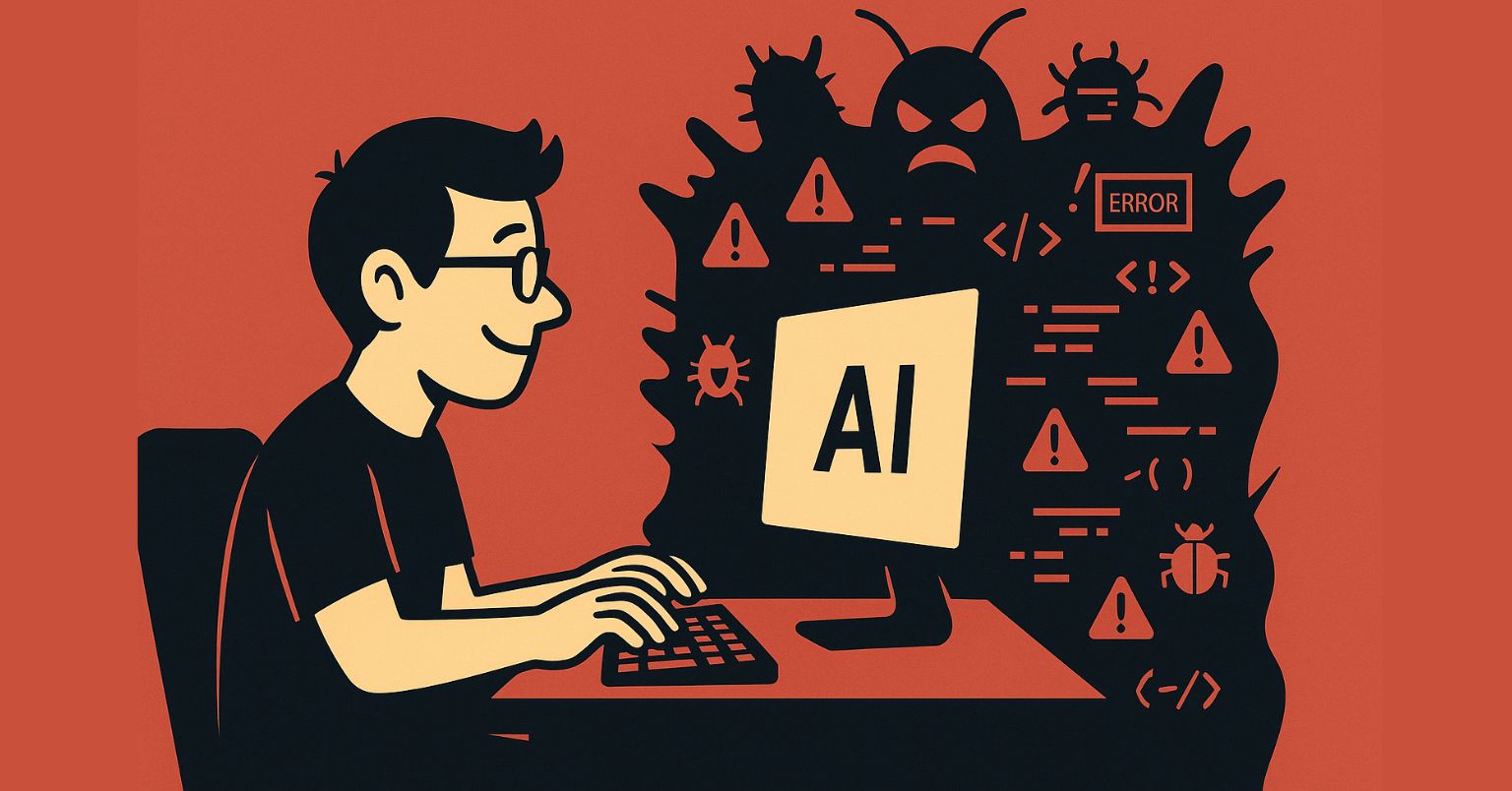
In this environment, many new developers are gravitating toward what's been called "vibe coding"—using AI to build entire applications without writing code themselves. While AI tools can be incredibly powerful, this approach creates a dangerous dependency that may actually harm long-term career prospects.
Understanding AI-Assisted Development vs. AI Dependency
There's a crucial distinction between using AI as a development tool and becoming entirely dependent on it:
Strategic AI Usage (Career-building):
Using AI to accelerate learning and understand new concepts
Leveraging AI for boilerplate code while understanding the logic
Employing AI for code reviews and optimization suggestions
Learning from AI-generated solutions to improve your own skills
AI Dependency (Career-limiting):
Generating entire applications without understanding the code
Shipping code you cannot debug or maintain
Skipping fundamental learning in favor of AI shortcuts
Becoming unable to solve problems without AI assistance
The Productivity Paradox: What Recent Research Shows
Recent studies reveal surprising insights about AI coding productivity. A 2025 METR study tracking 16 experienced developers across 246 real-world tasks found that developers using AI tools experienced a 19% decrease in productivity compared to working without AI.
Even more telling: the developers estimated AI had increased their productivity by 20%, creating a 39-point gap between perception and reality. This suggests that while AI feels helpful, it may actually slow down experienced developers working on complex, mature codebases.
Key findings from the study:
Only 39% of AI code generations were actually accepted
Significant time was spent reviewing, prompting, and often discarding AI output
The complexity of real-world codebases often exceeded AI's contextual understanding
The Skills That Matter in an AI-Augmented World
Rather than replacing programming skills, AI is changing which skills are most valuable:
Essential Skills for AI-Era Developers
System Design & Architecture
Understanding how different components interact
Making informed decisions about technology choices
Designing scalable, maintainable systems
Debugging & Problem-Solving
Identifying root causes of issues
Understanding error patterns and edge cases
Thinking systematically about complex problems
Code Review & Quality Assessment
Evaluating code for security vulnerabilities
Assessing performance implications
Understanding maintainability and technical debt
Domain Knowledge
Understanding business requirements deeply
Knowing when and why certain patterns should be used
Adapting solutions to specific contexts
The Prompt Engineering Misconception
Many believe that "prompt engineering" is the new programming. However, effective prompt engineering requires deep understanding of the domain you're working in. The best AI prompts come from developers who understand:
What they're trying to achieve technically
The constraints and requirements of their system
How to evaluate the quality of generated solutions
When to accept, modify, or reject AI suggestions
Real-World Consequences: Learning from Failures
Several high-profile cases illustrate the risks of over-relying on AI:
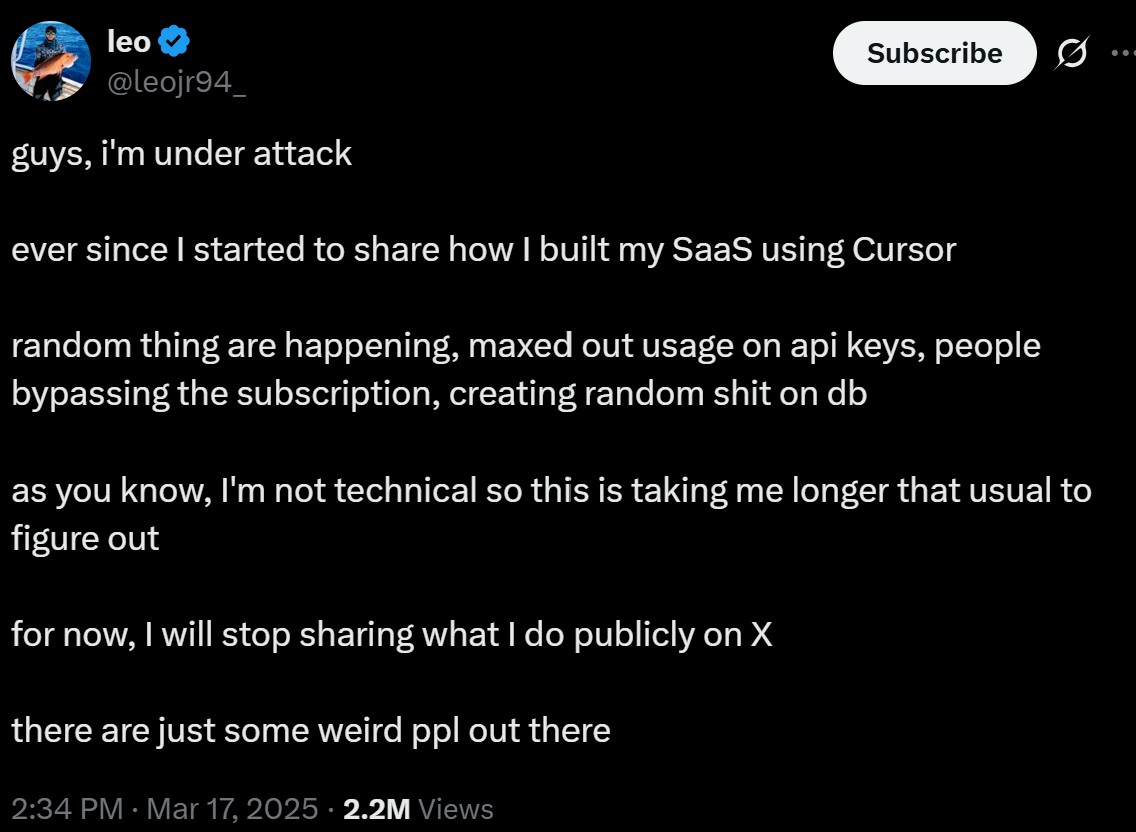
Case Study: The SaaS Security Disaster An indie developer built an entire SaaS product using only AI-generated code. Initially celebrating the rapid development, the project quickly faced catastrophic issues:
Random API key exhaustion
Users bypassing subscription systems
Database corruption from security vulnerabilities
Complete inability to debug or fix issues
The project was eventually shut down because the developer couldn't understand or maintain the AI-generated codebase.
The Technical Debt Problem AI-generated code often creates hidden technical debt:
Verbose, poorly structured implementations
Missing edge case handling
Security vulnerabilities in authentication and data handling
Performance bottlenecks that aren't immediately apparent
A Strategic Approach to AI Tools
The most successful developers are those who use AI strategically:
Phase 1: Build Fundamentals First
Learn core programming concepts without AI assistance
Practice problem-solving and debugging skills
Understand basic algorithms and data structures
Build simple projects from scratch
Phase 2: Strategic AI Integration
Use AI for learning and explanation of complex concepts
Generate boilerplate code while understanding every line
Leverage AI for code review and optimization suggestions
Compare AI solutions with your own implementations
Phase 3: AI-Augmented Expertise
Guide AI tools with precise, informed prompts
Quickly identify and fix AI-generated bugs
Adapt AI solutions to specific requirements
Use AI to explore new technologies and patterns
Best Practices for AI-Assisted Development
Do:
Understand before implementing: Never ship code you can't explain
Review everything: Treat AI output as a first draft, not final code
Learn from AI: Study generated solutions to understand new approaches
Practice without AI: Regularly code without assistance to maintain skills
Focus on architecture: Use AI for implementation details, not system design
Don't:
Copy-paste without understanding: Every line should make sense to you
Skip testing: AI-generated code needs thorough testing
Ignore security: Always review for potential vulnerabilities
Become completely dependent: Maintain ability to code without AI
Sacrifice learning for speed: Short-term gains aren't worth long-term career damage
The Future Job Market Reality
The job market is becoming increasingly selective. Companies are prioritizing:
Problem-solving ability over code generation speed
System thinking over feature implementation
Debugging skills over initial development speed
Code quality and security awareness over rapid prototyping
Adaptability and learning ability over current tool knowledge
Developers who can effectively collaborate with AI while maintaining their own competence will be most valuable. Those who become entirely dependent on AI for basic tasks will likely struggle as the market becomes more competitive.
Building a Sustainable Career Strategy
For Junior Developers:
Start with fundamentals: Learn programming concepts thoroughly before relying on AI
Use AI as a tutor: Ask it to explain concepts, not just generate code
Build projects both ways: Create some projects with AI assistance and others without
Focus on understanding: Always know why code works, not just that it works
Develop debugging skills: Practice identifying and fixing problems systematically
For Career Switchers:
Don't skip the basics: AI can't replace fundamental understanding
Use AI to accelerate learning: Get explanations and examples, but verify everything
Practice regularly: Dedicate time to coding without AI assistance
Build a portfolio: Show projects that demonstrate both AI collaboration and independent skills
Network strategically: Connect with developers who can mentor your growth
The Long-Term Perspective
AI tools will continue improving, but this makes human judgment more valuable, not less. The future belongs to developers who can:
Think critically about technical decisions
Communicate effectively with both AI tools and human colleagues
Adapt quickly to new technologies and changing requirements
Solve complex problems that require creativity and domain expertise
Build reliable, secure systems that work in production
Conclusion: AI as Amplifier, Not Replacement
The goal isn't to avoid AI tools—they're here to stay and can be incredibly powerful. The goal is to use them strategically to amplify your abilities rather than replace your thinking.
The most successful developers in 2025 and beyond will be those who:
Understand their craft deeply enough to guide AI effectively
Can debug and maintain AI-generated code
Think systematically about problems AI can't solve
Adapt quickly as AI capabilities evolve
The market may be challenging, but it's also full of opportunities for developers who approach AI tools strategically. Build your fundamentals, use AI to accelerate your learning, and focus on developing the irreplaceable skills that make you valuable regardless of which AI tools are popular.
Remember: AI can generate code, but it can't replace the thinking, creativity, and problem-solving skills that define great developers. Invest in building those skills, and you'll thrive in any technical environment.
🚀 Join the Developer Universe
Ready to level up your React game? Connect with me across the digital cosmos where I share cutting-edge insights, exclusive tutorials, and behind-the-scenes development magic:
🎥 YouTube (English) → Subscribe for next-gen tutorials
Deep-dive video content, live coding sessions, and framework comparisons in english language
🎥 YouTube (Bangla) → Subscribe for next-gen tutorials
Deep-dive video content, live coding sessions, and framework comparisons
⚡ GitHub → Explore the code universe
Open-source projects, starter templates, and collaborative experiments
💼 LinkedIn → Network in the professional sphere
Career insights, industry trends, and professional development
🌐 X (Twitter) → Real-time dev insights
Quick tips, hot takes, and lightning-fast industry updates
📱 Facebook → Community central hub
Extended discussions, community polls, and collaborative learning
☕ Buy Me a Coffee → Fuel the code machine
Support exclusive content creation and unlock premium resources
💫 What You'll Get
⚡ Early access to new tutorials and frameworks
🔥 Exclusive code snippets and project templates
🎯 Direct Q&A on complex development challenges
🚀 Beta previews of upcoming content and projects
Spotted a bug in the matrix or have innovative ideas? Ping me on any channel above - the future of web development is collaborative!