
Protecting sources is not a stylistic choice in investigative journalism; it is the precondition for trust. In authoritarian contexts, the decision not to publish leaked documents can be the difference between safety and retaliation, and between future revelations and silence.
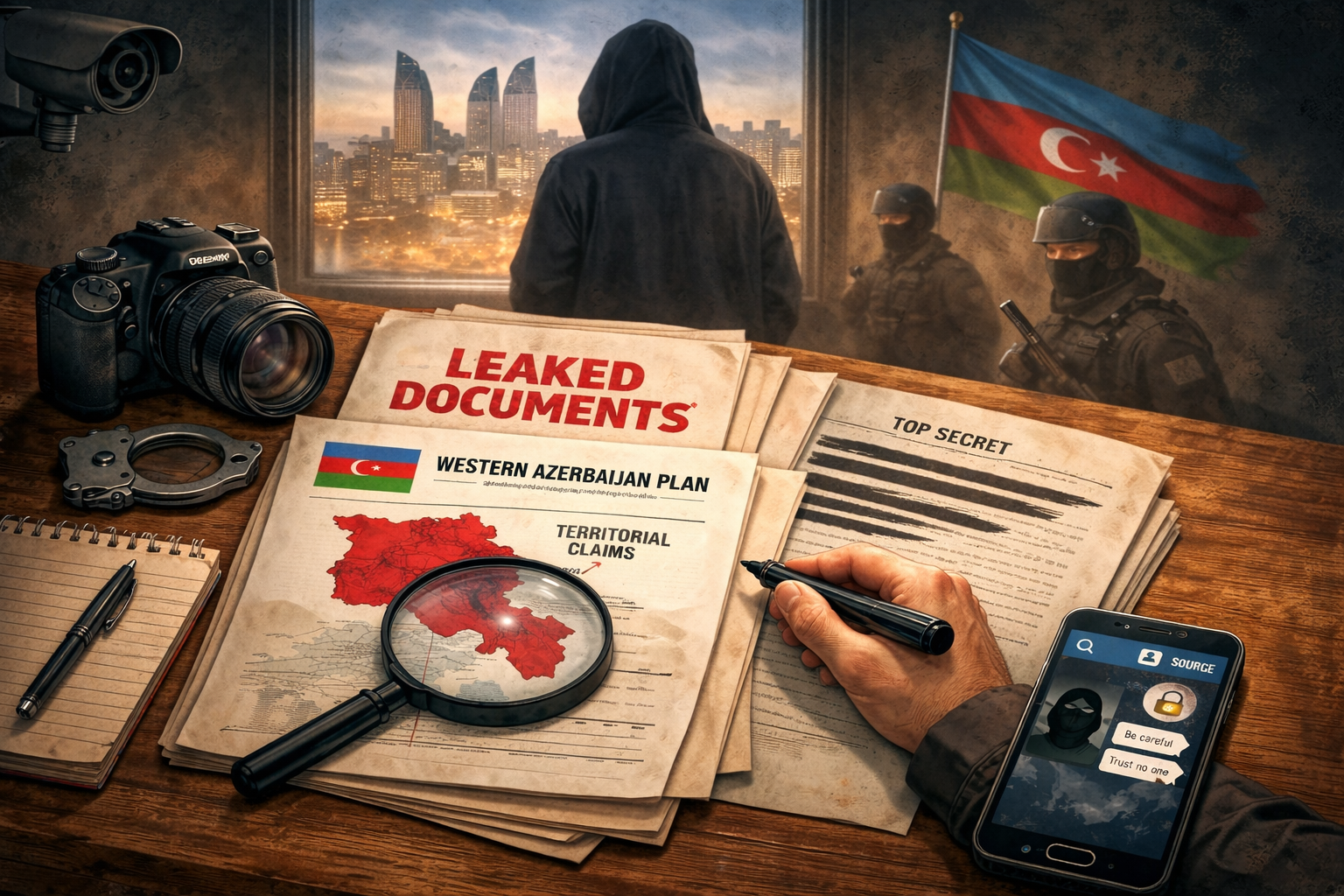
In the summer, I obtained leaked documents from within the Azerbaijani government. They showed how the Presidential Administration had designed and funded the “Western Azerbaijan” campaign – an irredentist project implying territorial claims on Armenia and used as leverage in the peace negotiations.
For various reasons, it took several months before the story was finally published in OC Media. Once released, it attracted considerable attention. Azerbaijan did not refute the reporting; on the contrary, officials have since intensified their promotion of the Western Azerbaijan concept, which in practice reinforced the story’s central findings.
After publication, several people contacted me asking to see the documents, arguing that it is customary to publish leaks in full. I refused. Making the documents public could have exposed my sources. I argued, if the Azerbaijani security services knew precisely which documents I had accessed, there was a risk that they could identify the original leak and punish the person behind it.
I also disagree that it is standard practice to publish leaked documents when doing so serves no purpose beyond demonstrating that they exist. In this case, the editorial judgement was clear: source protection outweighs transparency.
Publishing the material would not have added substantive information beyond what was already reported. I shared the documents only with a very limited group of people – a few editors and an expert assisting with Azerbaijani-to-English translation – and later restricted access to minimise further risk.
 So why write this now?
Another outlet has since decided to publish the same documents that I chose not to disclose, likely obtained from someone dissatisfied with my decision. Different editorial choices are legitimate; my more conservative position may or may not have been the “right” one, but I stand by my position.
Nevertheless, the different approaches is a useful opportunity to discuss journalism, source protection, and press ethics.
Journalism in the South Caucasus relies fundamentally on trust. The media landscape includes (sometimes dominated by) state propaganda outlets, heavily politicised platforms of various alignments, and limited public understanding of journalistic methods.
Unlike in Sweden – where source protection is constitutionally guaranteed, government attempts to identify sources are illegal (even though it happens), and a robust self-regulatory press ethical system exists – there is little realistic prospect of courts in Azerbaijan, Georgia, or even Armenia reliably protecting journalists.
In this context, independent outlets must be exceptionally rigorous, fact-focused, and professional. Due to this challenging environment, many already are often exceeding standards seen in the Nordic countries.
With that said, reporting on Azerbaijan poses particular risks. Over the past years, I have stopped interviewing sources inside the country on sensitive topics. The reason is simple: quoted experts are at risk of retaliation. There are documented cases, including one person who was beaten during interrogation after speaking to me for an article. Increasingly, family members of exiled Azerbaijanis are also targeted; parents have faced harassment because of their children’s activism abroad.
It is inherent to authoritarian systems that governments are responsible for a wide range of abuses. This makes the role of journalists critically important: to continue uncovering corruption, exposing arbitrary decisions, and holding power to account.
Investigative journalism is distinct from daily news reporting. It goes beneath the surface, reveals facts governments prefer to keep hidden, and may directly challenge official legal or political positions.
Building trust with readers is essential. That trust is earned through systematic verification, ethical practice, and strict editorial standards. Anonymous sources must be corroborated, documents cross-checked, and claims triangulated. For investigative journalists, principled sources are indispensable; without them, there are no stories.
A better public understanding of how professional and independent journalism operates also strengthens confidence in the work. When readers recognise the rigour behind the reporting, trust does not depend on how many sources can be publicly disclosed.