
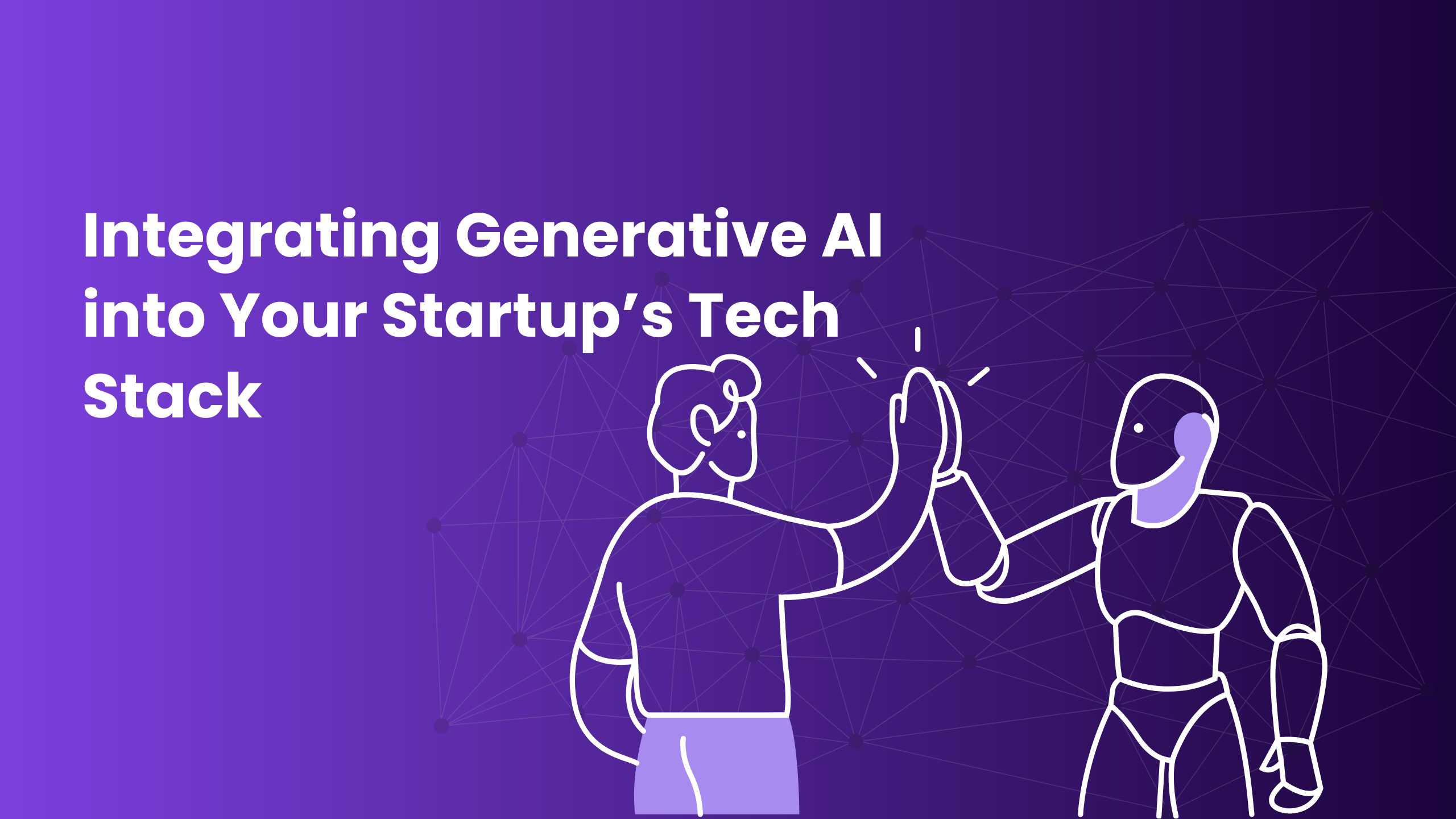
Generative AI has rapidly evolved from a futuristic concept into one of the most transformative technologies for startups today. Whether you are building a SaaS product, scaling customer support, or automating internal operations, integrating generative AI into your existing tech stack can offer speed, precision, personalization, intelligence, and unmatched competitive leverage. But successful adoption isn’t just about “adding AI.” It requires structured integration, system compatibility, scalable infrastructure, and strategic deployment aligned with your business goals.
Why Generative AI Integration Matters for Startups
Unlike traditional AI models that mostly classify or predict, generative AI creates—responses, code, designs, recommendations, summaries, content, workflows, even strategic insights. For resource-limited startups balancing deadlines, hiring constraints, and growth expectations, generative AI can become an invisible team member that executes faster and smarter. Startups can use AI to reduce manual bottlenecks, accelerate product development, automate support, enhance user experience, and unlock personalization without scaling headcount aggressively.
Step 1: Define Core AI Use Cases Based on Immediate Business Needs
AI integration should not begin with model selection—it should begin with problem selection. Identify what you must solve first, not what sounds impressive. For example:
If support costs are growing → deploy AI chat automation
If marketing output needs scale → auto-generate content drafts and ad variations
If product roadmap needs acceleration → use AI to auto-generate code snippets or run test automation
If onboarding is slow → build AI-driven self-help user training flows
Clearly defined use cases ensure your team avoids unnecessary complexity, cost overruns, and integration failures.
Step 2: Decide Build vs Integrate vs Hybrid
Your integration path depends on budget, expertise, and urgency.
Build (from scratch): ideal if IP ownership, data control, or algorithmic uniqueness is priority, but expensive and complex.
Integrate (using existing APIs, platforms, cloud AI): fastest, lowest-cost setup that accelerates time to value through ready-to-use models like GPT, Claude, or Gemini.
Hybrid: combine pre-trained models with custom enhancements for personalized intelligence, domain-specific training, or proprietary product logic.
Most startups succeed by beginning with integrations and shifting to hybrid as usage demand increases.
Step 3: Assess Your Current Tech Stack Compatibility
Before integrating AI, audit your environment.
Can your backend handle real-time inference?
Do you have sufficient storage for embeddings, logs, training sets?
Does your UI allow conversational or generative interfaces?
Are APIs flexible enough to support AI-driven requests?
Is your cloud environment ready for GPU or AI-assisted workloads?
Tech stack readiness ensures AI layers enhance instead of strain your system.
Step 4: Choose the Right Infrastructure and Deployment Model
Generative AI can be deployed on:
Cloud-based AI platforms: scalable, secure, pay-per-use efficiency
Edge AI: ultra-fast, device-level processing for specific industries
Hybrid cloud models: best for balancing sensitivity, privacy, and latency requirements
Cloud providers offer AI-optimized compute environments, cost optimization, and accelerators for startups. They also introduce guardrails to prevent runaway consumption and provide monitoring dashboards that track performance, cost spikes, and usage patterns.
Step 5: Add Generative AI Layer-by-Layer
Avoid full stack overhaul. Instead, integrate AI gradually:
Automation layer (chat, email responses, docs handling)
Productivity layer (content, code, designs, workflows)
Intelligence layer (recommendations, predictions, summarizations)
Embedded AI product features (AI copilots, interactive UX)
This layered adoption keeps disruption low while proving measurable business ROI at each stage.
Step 6: Focus on MLOps, Monitoring & Optimization
Once AI is live, optimization never stops.
Track inference accuracy
Improve prompt workflows
Monitor latency and compute costs
Retrain or tune models with updated data
Document failure patterns for continuous improvement
Dedicated monitoring helps keep your AI efficient, cost-controlled, and stable across scaling cycles.
Step 7: Integrate Securely with Data Compliance & Governance
Generative AI must align with:
GDPR, CCPA or regional data policies
PII and PHI protection standards
Role-based data access and encryption
Log privacy controls
Data quality impacts how accurate and relevant outputs are. With AI touching production systems, cybersecurity becomes non-negotiable.
Step 8: Build AI-Native User Experiences
AI should feel invisible, not intrusive. Designing intelligently means:
outcomes delivered proactively instead of manually requested
conversational UX replacing static forms
predictive interfaces replacing instructions
personalization replacing generic flows
If AI doesn’t reduce effort, friction, or time for users, it’s just noise—not intelligence.
When to Bring in a Dedicated AI Partner
If integration moves beyond basic workflows and into deep model tuning, secure scaling, or product-embedded intelligence, consider partnering with an expert AI engineering team. Collaboration accelerates execution, reduces mistakes, and expands technical capacity. Partnering with a trusted generative ai development company can ensure the right model selection, infrastructure setup, guardrails, and improvement cycles.
Practical AI Use Case Scenarios for Startup Tech Stacks
FinTech: automated KYC responses, fraud detection, compliance assistance
E-commerce: personalized recommendations, smart campaign engines
HealthTech: diagnostic note summarization, patient triage automation
SaaS: AI onboarding guides, smart analytics dashboards, multi-agent task automation
EdTech: personalized learning flows, assessment generation, learning copilots
These demonstrate how generative AI enhances product value and customer experience while reducing internal operational load.
Measuring Success After Integration
Success indicators are not just performance numbers; they are transformation markers.
Lower support resolution time
Reduced manual work hours
Faster product iteration cycles
Increased personalization engagement
Higher user retention due to experience quality
AI impact should be measured against efficiency, scalability, cost savings, and ability to innovate faster than competitors.
Final Thoughts
Integrating generative AI into your startup’s tech stack isn’t a luxury upgrade—it’s a disruptive multiplier of speed, intelligence, automation, and market differentiation. With carefully chosen use cases, structured rollout, scalable infrastructure, ongoing model optimization, and the right strategic partner, AI becomes the backbone of accelerated growth instead of a technical experiment. Start small, integrate intentionally, measure continuously, and expand confidently. When executed with discipline and clarity, generative AI doesn’t just support growth—it unlocks the next level of product intelligence, operational efficiency, and competitive market advantage.