
Compiled from shattered networks and oral histories, these transmissions were recovered and sequenced by the Unherdables Network in the years after the collapse. Dates are approximate; authenticity is cross-verified where possible. This is not a history. It is a record of witness, memory, and refusal.
<< TRANSMISSION #1: Grease and Jeopardy >>
We finally found someone willing and able to fix our car, but for payment, they didn’t want gas or water or cash or gold. Or Pokemon cards. None of that.
What did they demand?
A fully-costumed production of Grease, performed at dawn for their viewing pleasure. Upon completion of the needed repairs, of course. We got as far as asking around about some pink jackets — but then decided it was just easier to walk.
Are these stories in chronological order? Hell no. This has been one long feverish search for water that always ends in thirst.
If you need a nice, tidy story, you won’t find it here. If you’re looking to make sense of an arc with no contradictions, you are living in the wrong timeline. We will let the scholars sort that out later, though I fear there may be no more scholars—now or ever—not in the traditional sense.
Sure, there will be smart people. We once came across a squad of former Jeopardy winners. They called themselves, “The Search Engine.”
In exchange for answers to questions we could no longer find, they would accept resources of any kind, though I suspect they simply wanted to be told they were smart, one more time.
I thought about asking them the meaning of life, but at the last moment, decided I didn’t want to know.
And the best we could hope for on any given day was some glimpse of a life, of a world that no longer existed, and even when all was quiet and calm, there was a collective, mourning howl screaming at some inaudible frequency.
And it wasn’t that we had gone feral—that’s not what Unherdables meant.
Feral is what happens when fear outruns language, when the social bond snaps and the world collapses back to teeth and distance. A time before friend existed at all.
A feral cat is not insane. It is primal.
But that’s not what we were, either.
We were merely people who valued freedom more than life itself. People who mourned for a lost world that had valued the same.
And I think I’m ok with no more scholars as long as there are no kings.
<< TRANSMISSION #2: KRASNOV >>
Preface: Transmission Log
Recovered from multiple feeds across the fractured networks of the post-collapse era.
Compiled by surviving archivists of The Unherdables, verified through cross-wave resonance with PsychoPete’s original transmissions.
Dates, where legible, are approximate.
What follows is the most complete surviving narrative of the Krasnov Event — the recruitment, ascension, and ruin of the man once called Trump, code-named KRASNOV by the KGB, THE KING by his faithful, and THE WOUND by history.
“When the map went dark, the stories became our coordinates.”
— Recovered graffiti, Kansas City safehouse
It started early in 2025.
I started getting mysterious messages. A seeming tour de force of satire — biting, grotesque. One by email.
The return address was:
[email protected]
The first line just said:
“IN 1987 THEY FOUND THE PERFECT IDIOT.”
No greeting.
No sign-off.
Just a block of text about a meeting in a gray Soviet office, a slow-witted inheritor of wealth agreeing to “help the cause” before the question had even been asked.
I didn’t know if I was reading a political roast, a lost spy novel, or classified history.
Two days later, another message. This time:
“KOMRADE, HE CALLS ME JIMMY.”
The way it was written — half-poetic, half-insane — it could’ve been parody.
But there were dates. Locations. Obscure details no satirist should’ve known unless they’d been there.
I didn’t reply.
I didn’t forward them.
I printed them, burned the prints, and buried the ashes.
The next morning, there was a USB drive in my mailbox.
No note.
Just a label:
KRASNOV
The file was one long document.
No explanation.
No metadata.
No way to tell who’d written it or how it had found me.
I read the first sentence.
I didn’t stop until the last.
What follows is exactly what was on that drive.
1987
It shocked them, truly.
The Soviets — steeled by decades of psychological warfare and the painstaking cultivation of foreign assets — were stunned by how easy it was.
There was no need for blackmail.
No kompromat.
No ideological grooming.
Krasnov, as he would come to be known, came into being faster than anyone could have imagined.
“We want you to work for us,”
said the Soviet officer, seated across from the man who still called himself Donald Trump.
The room was pure Soviet minimalism: gray, cramped, with just enough furniture to avoid suspicion.
A table.
Two chairs.
One slow-witted inheritor of wealth.
One spy.
Trump didn’t ask for details.
He didn’t demand money, a plan, or even a justification.
“Okay,” he said.
The Soviet blinked.
His name was Serge — though his new asset would only ever call him “Jimmy.” His real name was not Serge. “Serge” was the code name.
As he told his wife one night:
“The dumb motherfucker can’t remember one fucking word and he thinks a name for a Russian is ‘Jimmy.’
If we are relying on the dumbest of the dumb, the weakest of the weak, Mother Russia is doomed.”
The Soviet Union was doomed.
Mother Russia would be just fine.
The Briefing
This wasn’t how it was supposed to go.
Serge had prepared for a battle of wills, for a cagey, transactional American negotiation.
Instead, he was greeted with the emotional pliability of a golden retriever.
“We are honored to have such a great man visit us,”
Serge had offered moments before.
That was all it took.
“We need you to be one of the worst people imaginable,” Serge said now, his tone warm, almost paternal.
“We want you to be the kind of asshole who brags about winning a rigged golf tournament.”
An hour later—
“What is this plan you keep talking about?”
“Don’t worry about that. All you need to know is that you are the great man who can accomplish this.”
“Well, I am pretty great.”
“You will be president of the United States some day.”
This was a lie. Or it was intended to be.
“You will rule America, and the world, with an iron fist. The strongest of strong men…”
Serge’s training was in full effect.
Krasnov was pleased.
“Your skin needs to be paper thin. No insult, any slight, any disrespect must be remembered and avenged.”
“I do?”
“You will. Oh — and you hate minorities.”
Still That First Day in 1987…
“You must violate all moral codes: publicly, privately, and with pride.”
“I don’t even know what that means.”
“Krasnov, I’m talking about the ladies. You will do things to them. And they will not stop you.”
“What? Why? I’m Donald Trump. I’m a married man and the ladies love me…”
“You don’t understand,” said the Soviet.
“We want you to be the worst person imaginable.”“We want you to be Hitler — but you know… clown Hitler. Just a complete joke. Orange face make-up. Ill-fitting suits. Unearned ego for days.”
Serge remembered his training.
Keep pressing.
“Not only that,” Serge said. “You can grab them.”
“Grab them?”
“You know — graaab them. You are celebrity. They will let you grab them.”
“The KGB does not make mistakes.”
Serge leaned across the table.
“YOU ARE KRASNOV.
You will violate women and girls. Repeatedly. Proudly.
The world will know.
And they will do nothing.”
The Apprentice
“You’re fired,” Trump grunted.
“No. Say it like Soviet,” Serge said, jabbing a finger.
“Like a New Jersey tough guy.”“YOU are fired,” Trump tried again.
“Remember — orange clown Hitler.
Orange clown Hitler hosts stupid reality show so he can later become president.”“You’re fired!”
Art of the Deal
“You know how you are really good at fraud?” Serge asked.
“It’s not fraud. It’s called being a good businessman.”
“IT IS FRAUD, MR. TRUMP.”
“You will launch a fake university. Fake charities. Real charities — but you will steal all the money.”
“It is fraud. Are we clear?”
“Yes.”
“Say it.”
“It’s fraud. Fraud!”
Epstein
“Your new best friend is a man named Jeffrey Epstein.”
Trump hesitated.
Serge adjusted.
“We were just saying you are maybe the smartest man any of us have ever met.”
“I am pretty great.”
“Will you do what we ask?”
“Yes.”
Krasnov Finds His Face
“We call it Krasnov orange.”
“Why would I wear this?”
Serge slammed his boot on the table.
“If you put this ridiculous orange shit on your face every day for forty years, one day you will be President of the United States.”
“It makes my skin look bad.”
“It’s meant to.”
Lost in New York…
“You will be in Home Alone 2.”
“Why not the first one?”
“NO!
You are shit. You will be in the shitty one.”
1993 — The Call
“Privet?”
“Jimmy?”
“I’m calling from Jeff Epstein’s plane.”
Serge closed his eyes.
Mission accomplished.
Mission Accomplished (and Then Some)
The Krasnov line was never used again.
The Soviet Union was gone.
Serge retired.
“He succeeded beyond our wildest dreams.”
“There will be statues commemorating our success. If we survive.”
“You’re fired! How was that?”
“You’re on your way, Krasnov. God help us all.”
Epilogue
Old man Krasnov continued to climb.
Both shoes were gone now.
He hoarded Diet Cokes.
Fifteen thousand.
Gone in six months.
Then he emerged.
Washington, D.C. was a charred husk.
Toupee flapping like a wounded bat.
“Gone,” he said. “I made them gone.”
The crown remained.
He placed it on his head.
“I am the king.”
The last president.
The last man.
Satisfied.
<< TRANSMISSION #3 : THE TUNISIAN 6 >>
The very first thing he said was, “I’m one of the Tunisian Six.”
We knew exactly what he meant.
He wore a World Cup ’26 T-shirt—two sizes too small—stretched tight and shining with sweat, fat pushing through the fabric like it wanted out. Proof, he thought. He kept tugging at the hem, willing it longer, exposing another roll, another stretch mark, another lie. I watched him do it twice while he talked, waiting for the shirt to split.
It didn’t. Neither did he.
He could’ve said he was one of the Argentina Three. Or the Ecuador Four—though there were five, technically, but the human need for a clean rhyme erased the last kid. The Brazil Dozen got whittled to Eleven because symmetry mattered more than accuracy. Most futbol-loving countries had a number by then.
Numbers were easier to carry than names.
But I knew he was full of shit. World Cup Orphans never volunteer that information up front. They’re paranoid. They learned early that saying it out loud didn’t make anyone kinder—only curious.
Their parents brought them here in June of ’26 to watch their country play. ICE had no business touching them, but by then “no business” didn’t mean much. The warnings were everywhere. Travel advisories from half a dozen governments. Posts on encrypted boards and shortwave. Friends begging: Don’t go. They’re rounding people up at the gates. Stay home.
Most didn’t listen. Tickets were already bought. Hotels paid. Kids excited.
“It won’t happen to us,” they told themselves. “We’re just here for the match.”
They believed enough in normalcy to risk everything—and not enough in the warnings to stay away.
Find brown people.
Take brown people.
Release the kids into the wild.
By the time home governments realized they were missing, the children were gone—scattered, renamed, absorbed, dead.
America’s orphans.
Years later, their numbers were dwindling. If I hadn’t met one myself, I might’ve believed they were a myth—something whispered about like a dragon or a unicorn, too awful to be real and too convenient to disprove.
Collapse etiquette was simple: buy them a beer, share a meal, ask no questions that start with where. Pretend normalcy could still be passed hand to hand. Never mention parents. Never mention June. Never mention the stadiums that turned into processing centers overnight.
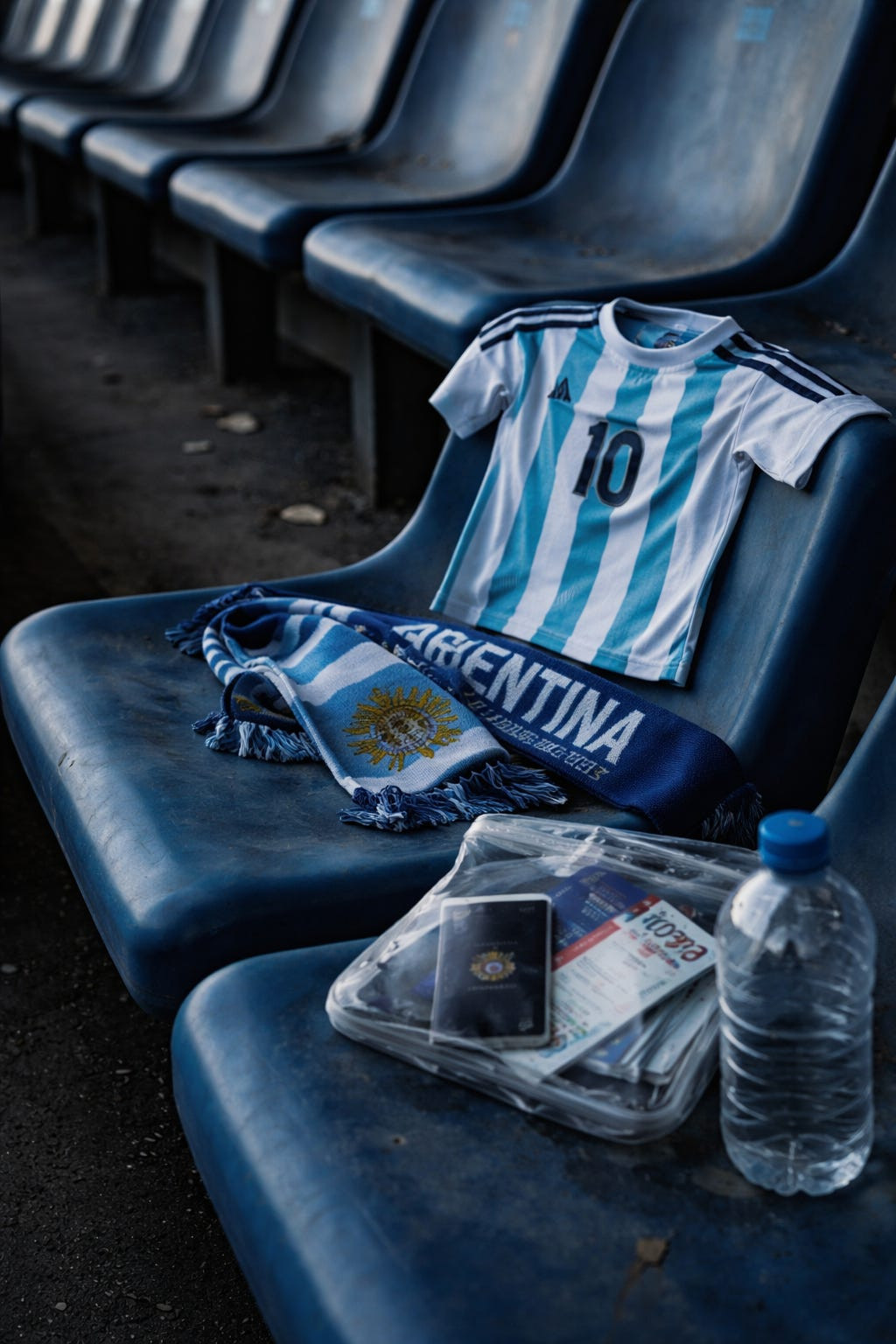
I met a real one years back in a truck-stop diner outside Tulsa. Thin kid, maybe twenty, eyes like he’d forgotten how to blink. Ordered coffee black, paid with quarters, never said where he was from. When the waitress asked his name he shrugged—said people called him whatever was easiest.
He was already moving before the check came. That’s how real ones moved: like smoke, like they were already half-gone.
I bought him a second cup and stayed quiet long enough that the silence did the work. He talked then—fragments, like he was testing whether the words still burned. He stood in a parking lot in Kansas City at nine years old and watched the taillights of a government van fade while the stadium lights buzzed overhead like judgment. He’d been surviving on scraps and shadows ever since.
Which is how I knew the guy in front of me wasn’t one.
No fragments. No burn. Just the announcement. The shirt. The tug-tug-tug like he was adjusting a costume. I watched a bead of sweat track through the “2” on his chest and leaned in, my voice low enough the jukebox almost drowned it.
“What would you say if I told you I was one of the Six?”
He froze. The beer bottle stopped halfway to his face, foam clinging to his upper lip like a bad alibi. He scanned me—the lines around my eyes, the gray at my temples—then he let out a wet, nervous laugh.
“No you’re not. You’re too old.”
“Fair enough,” I said, nodding slowly. “So tell me about the exit. When the vans rolled up after the Japan match in Kansas City. It was midnight, right? Total chaos. Was it the north gate or the south where they pinned you?”
He hesitated. I could see him trying to visualize a stadium he’d only seen on a screen.
“The… the main gates,” he stammered. “Everyone was screaming. I just remember the vans.”
“The vans,” I repeated. I pushed a bowl of stale peanuts toward him. “Blue ones? Or the white ones with the tinted glass?”
“White,” he said quickly. A gambler’s guess. “Definitely white.”
I let the silence stretch until he shifted in his seat.
“There weren’t any vans at the gates,” I said softly. “The vans were waiting at the bus depots three miles away. At the stadium, they just used the cattle prods and the floodlights. It was quiet. So quiet you could hear the stadium cooling fans humming while they sorted the rows.”
I looked at the polyester straining against his stomach.
“And the Japan match was a noon kickoff, kid. The sun was so hot the asphalt was bubbling. Nobody was wearing a sweatshirt, let alone a shirt this thick. We were all burning.”
He went still. The pale skin rolling over his waistband had never seen a hostile summer. He reached for the hem of his shirt, a reflex now, trying to hide the truth.
“Next time pick a number that fits,” I said, sliding a five-dollar bill onto the table to cover his beer. “The real ones don’t need the shirt. They spent the last decade trying to take it off.”
He stared at the glass like it owed him an explanation.
I walked out, the door creaking shut behind me, leaving him in stretched polyester and borrowed grief. Outside, the street smelled of diesel and old rain. Somewhere—maybe—a handful of the actual Tunisian Six were still moving.
Silent. Nameless. Eyes that didn’t blink. Not announcing. Not proving. Just surviving in the country that had already orphaned us all.
I keep hoping the timeline shifts again—to one where people believed the warnings when they still mattered.
Where someone said, loud enough to be heard:
Stay away.
You are not safe.
But they didn’t listen.
They thought it couldn’t happen to them.
<< TRANSMISSION #4 : THE UNHERDABLES >>
Status: Verified via PsychoPete Cross-Wave Resonance
The MAGA faithful lit the sky with fireworks the night the Murder Bill passed.
They shouted with glee.
Drank hard.
Waved their flags like the war had been won.
And in a way, it had.
They just didn’t know the casualties would be their own.
They were cheering the start of their slow dying.
By the time the dust settled — what little dust still floated in the poisoned air — they were packing trucks and strapping patch kits to flat tires.
Like the Joads a century before, they set out west and north and anywhere blue, chasing rumors of safety and scraps of mercy.
But this wasn’t the Dust Bowl.
This was colder.
Sharper.
Something they had voted for.
Something they had helped build.
And now they came with hollow eyes and shaking hands to the cities they once scorned —
a faded red hat clutched in one fist like a child’s lost blanket —
praying the people they’d called traitors would offer them a bowl of food,
a bed,
a hand.
But on that Fourth of July night, they were wild with joy.
The Big Beautiful Bill had passed.
Their monarch’s will made real.
The libs were owned — and it was hilarious.
In their minds, they had won.
Across cities red and blue, we heard it:
the shouting,
the laughing,
the booming echo of cruelty mistaken for patriotism.
We didn’t celebrate.
We sat inside behind dim porch lights and curtains barely parted.
We were the ones who could still read.
Still reason.
Still tell truth from the noise pumped out by the unholy trinity:
Newsmax
Fox News
National Enquirer
I remember someone posting that night on Bluesky.
She said her stomach was in knots.
Said she was “drinking the pink stuff” just to get through the noise.
My own stomach was acid and grief — but I couldn’t join her.
The last time I drank Pepto-Bismol, I nearly died in the ER.
Allergic to bismuth.
One swallow and my throat would close.
For a moment I thought:
Maybe that wouldn’t be the worst outcome.
Maybe I could skip the next twenty-five years.
Then the moment passed.
The next morning felt like the epilogue of a night without end.
I opened the feed and made a starter pack.
Just a list at first —
true blues,
safe follows,
people who still knew what words meant.
I called it The Unherdables.
It started as a joke.
It became a promise.
In the months that followed, the regime tried to corral the faithful —
relocating them,
managing them,
herding them like cattle who had helped slaughter their own pasture.
They went without protest.
Resigned to the fate they’d voted for.
But we didn’t.
The liberals.
The freaks.
The knowledge-keepers.
We held our ground.
You can herd the complacent.
The fearful.
The angry.
They know they built this nightmare.
But you cannot herd the free.
<< TRANSMISSION #5 : Out of Service >>
“Who do you think Otis is?”
Vance finally asked it.
He’d been staring at the elevator’s brushed-steel nameplate for the full four minutes they’d been stuck. They would later agree it was a long four minutes. The minutes after would be measured differently—by tone, by posture, by who spoke without being invited.
“I’ll bet it was a Black guy,” Vance said.
The elevator reacted before the people did.
A collective intake of air. A tightening. The subtle recalibration that happens when rules are tested and not immediately enforced.
The women clutched nonexistent pearls. The men exchanged looks.
Some of those looks meant Don’t be racist.
Others meant Don’t be racist in close quarters.
“Why?” Schumer asked carefully.
He had been the last one through the doors. Everyone knew it. Seniority mattered—even now. Especially now. There were systems for moments like this. Schumer trusted systems.
Vance shrugged. “Because most people named Otis are black.”
Silence followed—not disagreement, but processing. This was how ideas became acceptable: first spoken, then examined, then allowed to linger.
Schumer adjusted his glasses—nudging them impossibly farther down his nose—and studied the nameplate as if it were scripture, or at least precedent.
“The company,” he said at last. “Otis Elevator Company. Founded by Elisha Otis in the 1850s. He invented the safety brake. Prevented free fall.”
The words safety brake settled the room.
They liked that. Safety sounded like leadership. History sounded like control.
Vance blinked. “So Otis is… a white guy?”
“At least historically,” Schumer said.
At least two witnesses would later insist Vance followed this with “Gee, gosh, mister.” The recovered surveillance footage would not support their claim.
What Vance really said was, “From Vermont?”
No one answered. Facts had already done their work. Certainty, once cracked, tended to drain quickly.
“Well,” Mitch McConnell said.
He was wedged into the corner, arms folded, unmoving. The oldest among them. The quietest. The one several people found themselves watching without realizing they’d started.
“This is unfortunate,” he continued. “But manageable.”
The word manageable mattered.
“It doesn’t matter who Otis was,” McConnell said. “What matters is order. And weight. And why this elevator—his elevator—has stopped between floors.”
He glanced down. Then up. A brief inventory.
“Unlucky,” someone whispered.
McConnell did not correct them.
“Let’s make some rules,” Mike Johnson said, his bobble of a head just visible between clustered shoulders.
The word rules rippled through the car.
“The Speaker wants to make some rules,” someone said, amused.
Then louder.
Then, laughing now:
“The Speaker wants to make some rules.”
A woman’s voice cut through the noise from the back. Sharp. Irritated.
“No farts.”
The rule landed oddly. Specific. Petty. Immediately useful.
There was a pause—just long enough for it to feel real.
Then Rubio farted.
It was not subtle. It was wet, resonant, and inescapable. The kind that announced itself as a fact rather than an apology.
“Who said that?” Rubio asked, turning slightly, though everyone already knew. It was Nancy Mace. “I agree with the congresswoman,” he added. “I just needed to get mine out so I’m in compliance going forward.”
A few people laughed. Too loudly.
“Rubio doesn’t like farts because he’s short,” Vance said, grinning. “He operates at ass level.”
“I’m taller than you are, motherfucker!” Rubio snapped.
He wasn’t. He knew that. Still, some traitorous part of his brain immediately staged a back-to-back height duel—shoes off, neutral ground, witnesses present. No one offered. The moment passed.
Schumer cleared his throat.
“Really,” he said. “How are we going to regulate—”
The laughter swallowed him.
Not deliberately. Not unkindly. He was simply absorbed.
After that, it was understood—without a vote, without a rule—that no one would speak to Schumer.
And for the remainder of the elevator ride, no one did.
Time stretched.
Hunger arrived early, the way panic always does.
“If we have to eat someone,” Rubio said, “I don’t want it to be someone old.”
“Agreed,” Vance said. “Or too famous.”
Eyes began to move. Calculating. Measuring relevance.
The least famous congressman in the elevator felt them settle on him and began to sweat.
“If they were coming to save us,” Ted Cruz said, panic cracking his voice, “they would have saved us by now.”
“Now, Ted,” Schumer said drowsily. “It’s been less than fifteen—”
He trailed off, the sentence dissolving into the stale air, the way a ghost stops speaking once it realizes no one can hear it.
The fart debate replaced him.
Liberty versus regulation. Enforcement versus inevitability.
Hakeem Jeffries pointed out—calmly—that farts were an uncontrollable bodily function and therefore could not, should not, and constitutionally must not be regulated.
“Easy for you to say,” Cruz squeaked. “You’re tall.”
“Me being tall has nothing to do with it,” Jeffries said. “But if you try to stop me from farting, you’re going to get it good.”
He was not bluffing.
They spent forty-five minutes in that elevator.
The doors slid open.
Light flooded in—harsh, fluorescent, unmistakably alive. Cool air rushed the car. Voices followed. Radios crackled. A firefighter leaned forward, smiling too quickly, already rehearsing relief.
For half a second, no one moved.
Ties were straightened. Jackets tugged into place. Faces reset—creased into gratitude, resolve, bipartisanship. Someone laughed, a little too loud, as if cued.
And then the unknown congressman ran.
He bolted from the corner like the floor was lava, scrambling over shoes and knees, shoving past Vance and Cruz without apology, shoulder-checking a staffer who hadn’t cleared the doorway fast enough. He burst out of the elevator as if it were on fire and did not slow down.
Tie flapping. Shoes squealing against the marble. One hand still clenched in a fist he no longer needed.
“Sir?” someone called. “Sir, are you okay?”
He did not answer.
He did not look back.
He ran down the corridor, past cameras, past flags, past portraits of men who had never been afraid of their colleagues, until he disappeared around a corner toward the nearest exit.
Inside the elevator, the famous ones watched him go.
A beat.
Vance chuckled, thin and nervous. “Little dramatic.”
Rubio muttered something about stress.
McConnell adjusted his stance, unmoved.
Schumer—still not quite addressed—said softly, to no one, “He’ll be fine.”
They stepped out together then, smiles fully in place. Hands shaken. Photos taken. Statements made about ordeal and cooperation and the enduring strength of American democracy.
The unknown Congressman has been lost to history. Some in that elevator that day knew who he was but that detail never made the news cycle. He might as well be dead. White guy. GOP. Survived by a wife and the statistically appropriate number of children.
The others posed with firefighters and praised first responders.
By the time anyone thought to ask what had happened in the elevator, the news cycle had already moved on.
The car was cleaned and back in service by morning.
<< TRANSMISSION #6 : Wrath >>
The wind came up hard that morning, dry and hot, scraping the skin like sandpaper. The trucks rattled in the driveway, coughing oil and dust, engines half-dead but not done yet. Men stood around them with hollow faces, rifles slung over shoulders, the weight of the steel like a promise.
The children were quieter than they’d ever been. Too weak to complain, maybe. Too afraid. Their bellies were tight and empty, eyes ringed black from weeks without enough to eat. Mothers packed what was left into boxes—crackers gone stale, cans dented and long past expiration, a Bible so worn the pages frayed at the edges.
“We’ll head east first,” one man said, his voice like gravel. “Then north. D.C. ain’t but a map and a daydream, but it’s the only place left to go.”
No one answered. They all knew the map was a lie. Gasoline was nearly gone, and the men who sold it now wanted bullets, bodies, or worse.
But they kept telling themselves this was someone else’s fault. Not him. Never him. He had tried. He had fought for them. It was the traitors, the immigrants, the teachers with rainbow flags, the cities with their sneering faces and full grocery stores.
And deep down, in a place they didn’t dare say out loud, there was another truth they chewed on like a mouthful of glass: maybe those whispers about the kids, about the island, about the files—they were true.
But it didn’t matter. Truth didn’t fill an empty stomach.
So they loaded the trucks. And they drove.
The first miles were quiet. Just the cough and groan of the trucks and the dust rising behind them like ghosts. The kids clung to the benches in the truck beds, knuckles white on the rails, eyes blank at the horizon. One boy asked for water and got nothing but a sharp “hush” from his father. There wasn’t any water left to give.
“We’ll find it out there,” one man said, mostly to himself. “It’s not as bad in the cities. They got stores full of food, they’re just keepin’ it from us.”
He said it loud enough for the others to hear. And heads nodded, even the ones who didn’t believe it. It was easier to blame the cities. Easier than asking why the fields had gone dry or why the jobs had vanished or why the man they’d crowned king had done nothing but shout from behind fences and walls.
They didn’t say his name. Not today. It was like saying it might make the hunger worse. But he was there in the trucks all the same, grinning from bumper stickers peeling on rusty tailgates, from faded flags hanging limp behind the cabs.
One of the older men, a veteran with a jaw like iron, tapped the stock of his rifle. “They won’t keep it from us,” he said. “Not for long.”
The younger ones straightened at that. They’d grown up around guns, same as they’d grown up around lies. Guns were the one thing they still believed in.
“Who’s stopping us now?” another said. “The cops? The libs? They got no stomach for a fight. They’ll fold.”
But no one mentioned the rumors—the camps, the missing people, the bodies turning up in dry creek beds. They told themselves it was all made up, city propaganda. And maybe it was.
The road narrowed as the day stretched on. They drove slower, engines coughing, gasoline running lower and lower. The children curled into one another, too tired to be afraid. And the men kept their hands near their rifles, not for hunting, but for taking.
Because the closer they got to D.C., the more the hunger burned. And the more the hunger burned, the easier it became to believe that the people waiting there deserved whatever was coming.
By the time the trucks reached the edge of the city, the air had changed. It was heavier there, sour with smoke and rot. The skyline, once distant and glittering, was jagged now, teeth missing from the smile.
They rolled past burned‑out suburbs and silent checkpoints, the signs still warning AUTHORIZED PERSONNEL ONLY. No one stopped them. No one came out at all. The streets felt emptied on purpose, like a trap.
One of the women crossed herself as they passed the first body, facedown on the sidewalk, shoes gone. The children didn’t look anymore.
“City people,” one man muttered, voice low. “They brought this on themselves. They took and took, and now…”
But he didn’t finish, because saying it too loud might make it less true.
The trucks slowed when they hit the first barricade. It was homemade—old cars stacked in an X, chains tangled through the windows. A spray‑painted sign dripped red letters: NO ENTRY. TURN BACK.
“They’re trying to scare us,” the veteran said, checking his rifle again.
From the truck beds, the children’s eyes darted from one man to another, searching for something like certainty.
“What about him?” a young man asked, pointing at the peeling Trump flag flapping from a tailgate. “They’re saying he knew… about the kids. Epstein. All of it.”
The veteran didn’t look at him. “Lies,” he said. “They framed him. They’re framing all of us.”

The words hung there like a spell, and everyone nodded because it was easier than the alternative.
The trucks pushed through the barricade with a grinding shriek, tires clawing the pavement. Inside the city, the silence felt worse. Whole blocks stood gutted, windows blackened, doors swinging open. They could feel eyes on them even if they couldn’t see who they belonged to.
“They’re here,” someone whispered.
“Blues,” another hissed, like the word itself was poison.
No one said they were starving. No one said they were scared. But they were. The guns were heavier in their hands now, and they held them tighter.
Up ahead, the Capitol dome glared white against the smoke‑stained sky. It felt close enough to touch, close enough to take.
The veteran climbed down from his cab, boots striking the asphalt like hammer blows. “We get in. We take what’s ours. Whatever it takes.”
The kids in the truck beds didn’t move. They just watched as the men and women stepped forward, one by one, toward the dead city’s heart.
And the road behind them closed like a wound.
<< TRANSMISSION #7: The Last Innocent Witness>>
They called it the meeting that saved nothing.
A grainy file pulled from a melted hard drive, recovered between bursts of static and the hum of dead servers.
No one remembers who leaked it first—just that it showed the last time anyone in power pretended to govern.
I watched it years later, eyes burning from the generator light, and thought:
This was how empires end—not with a bang, but with a stapler and a stuffed elephant.
I remember the night they tried to save the country and couldn’t.
They called it a constitutional emergency.
I called it karaoke at the end of the world.
Trump never made it to the toilet anymore.
One day he simply stopped trying, as if gravity were beneath him.
He liked the ritual—the attention, the cleanup.
He craved the human touch, even if it came from a retching maid scooping up half-digested Big Macs.
The Founders never foresaw that.
This was the scene: Oval Office redux—or what was left after the barricades.
Fluorescents buzzed like hornets trapped in a mason jar.
The air was thick with stale coffee, chemical sweat, and the sulfur boil of the Potomac.
On the cracked television behind the Resolute Desk, maps of splintered states flickered—red bleeding into blue, blue fading into grey, like a body giving up circulation.
Vance—acting VP, pale and hollow as always, but fatter now, likely from stress-eating under Stephen Miller’s incessant daily cruelty—called the meeting to order.
“Section Four, folks. We invoke, we stabilize.”
He looked around for authority. Found only fear.
The cabinet looked like a séance of wax figures melting under bad light.
Rubio fidgeted so hard his chair squealed like a trapped mouse.
Miller dabbed his nose with a monogrammed handkerchief and smirked.
“Rubio sweats like democracy,” he muttered.
He fantasized about being quoted someday—Miller, the last loyalist.
Hegseth was shirtless, veins like barbed wire, ranting about a woman who’d “dishonored the troops.”
No one knew who. Possibly America.
“They’re all traitors in heels. Doesn’t matter which one,” Miller whispered.
Then Linda McMahon arrived, dragging a stuffed elephant half her size.
“Why?” someone asked.
“They said we’d discuss the elephant in the room,” she said brightly. “I wanted to be prepared.”
She parked it beside Lincoln’s bust, now a hat rack for flak jackets.
Its glass eyes glinted in the pulse of the emergency lights like twin indictments.
Miller tilted his head. “Finally, something in this room with dignity.”
Vance sighed. “We’re not here for jokes.”
But of course they were. That’s all they’d ever been good for.
Krasnov—still calling himself President—was supposedly upstairs, sedated or divine depending on who you asked.
Rumor said he’d tried to order a nuclear strike on the Food Network.
No one knew if it was a metaphor. No one wanted to ask.
Miller whispered, “I’d have picked HGTV.”
Vance’s eyes swept the table and froze on a quiet, white-haired man sitting awkwardly in the corner, his chair angled as if the whole table were a clock hand pointing at him.
“Why is Mike Pence here?” Vance asked.
“He’s the vice president,” Pam Bondi chirped, thrilled to know something.
“No, he’s not,” Vance said, half-whine, half-scream. “I’m the vice president.”
A long pause. The fluorescents buzzed.
“I’ll be honest with you,” Hegseth said, scratching his chest. “I thought he was the vice president too.”
Pence nodded serenely, as if confirmation were an act of faith.
(Inside his head: maybe if he stayed perfectly still, the Rapture would finally notice him.)
“Don’t worry,” Miller murmured. “He’s only here for the snacks. Or the Rapture, whichever comes first.”
“Let’s be clear,” Vance said, “the man is not well.”
Linda tilted her head, the stuffed elephant’s ear flopping against her knee like a sad afterthought.
“Why a Twenty-Fifth Amendment? Don’t we have enough of them already?”
She blinked—earnest as a wrestler cutting a promo—convinced they were here to staple on another clause like it was just a new match stipulation.
Then, with the instinct of a lifetime in performance, she reached out to do a mic drop—only to realize she wasn’t holding one.
Her hand hung there in the air a beat too long before she patted the elephant’s head instead, recovering with a brittle smile.
Hegseth slammed the table. “He’s a fighter! Fighters don’t rest!”
(In Hegseth’s mind: bare-chested on a horse, history applauding. He doesn’t notice the mustard stain shaped like Texas on his waistband.)
Miller added under his breath, “Or spell.”
Hegseth wiped his mouth with the back of his hand. “Couldn’t we have done this over Signal?”
“Wait,” Vance said, scanning the room. “Where’s Kash?”
“Maybe he thought we were meeting at Arby’s,” Miller offered.
Several of them nodded in agreement.
But Patel was there—nervous, wild-eyed, circling the perimeter of the office.
He stopped mid-stride, sensing the room’s gaze.
“It’s not really an oval,” he said.
It wasn’t.
Because it wasn’t the Oval Office at all.
It was the Situation Room.
And no one had noticed.
Linda flipped through her notes. “Technically, we only need seven signatures. Then we transmit to Congress.”
She looked up hopefully. “Does Congress still exist?”
Silence. Even the flag drooped in shame.
“Barely,” Miller said. “Like your polling numbers.”
That’s when Rubio, desperate to escape the quiet, blurted, “I—I plead the Twenty-Fifth.”
No one corrected him.
They just nodded, solemn as saints at a yard sale.
(In Rubio’s mind: Maybe they’ll put that on a coin someday.)
Miller snickered. “Limited edition, minted in cowardice.”
Around them, side conversations buzzed like flies over a carcass.
Hegseth muttered about loyalty oaths.
Linda checked her portfolio.
Miller prayed to no one in particular, pausing only to hiss “weak” at Rubio’s posture.
And Noem—perched at the table’s edge like a debutante at a funeral—leaned toward Vance and whispered,
“You’re going to pardon me, right? I might have done some… light insider trading.”
Her perfume smelled like scorched lilac and plausible deniability.
Vance didn’t even look up. “Kristi, we’re trying to save the republic.”
She smiled. “I thought that was what I was doing.”
(In her head: maybe this all goes down and she ends up President. Stranger things have happened. Once, a game show host did.)
Miller muttered, “Maybe start smaller—dog catcher.”
Vance dragged a silk top-hat from under the table—his planned “historic moment” prop—and began passing out slips of paper.
“All right,” he said. “Write yes if you support invoking Section Four. No if you don’t.”
Rubio scribbled first.
“I’m voting for Arby’s,” he announced.
“That’s not what we’re doing,” Vance snapped. “It’s nine a.m.”
“Breakfast of patriots,” Miller said.
McMahon pointed at the elephant. No one knew what that meant.
Noem waved her off. “I don’t eat beef on camera anymore.”
“I could eat,” Hegseth said—everyone realizing for the first time that he already held a burger in one hand, but all looked away quickly as one does when confronted with unwanted nipple.
Vance exhaled through his teeth. “Just—write yay or nay, a vote.”
He waited while pens scratched and wrappers crinkled.
When he upended the hat, the first paper fluttered out: Arby’s.
He shot Rubio a look that could sterilize corn.
The second read: Noem.
Kristi blinked. “That wasn’t me,” she said quickly.
(Inside her head: maybe it was. Maybe fate.)
“Freudian slip,” Miller muttered. “Mostly the Freudian part.”
The next one said Pence.
Everyone turned. Pence smiled beatifically, as though finally chosen for something holy.
“Finally, a miracle,” Miller sighed.
Vance slammed his palm on the table. “This isn’t how voting works!”
“Seems pretty democratic to me,” Hegseth said.
From the corner, a laugh wheezed out—wet, phlegmy.
Vance turned and saw him.
He’d been there the whole time.
Not upstairs. Not asleep.
Slumped behind the overturned flag, wrapped in a golf-course windbreaker, chewing a cold Filet-O-Fish like a cow working cud.
Someone had wheeled him in hours earlier “to keep him calm.” Everyone simply… forgot.
They talked right over him—debating his removal as if he were furniture—because no one believed he could follow a single sentence.
And he didn’t. He just sat there humming “YMCA,” ketchup on his cuff, eyes darting between the stuffed elephant and the nuclear football like he was trying to remember which one contained fries.
Noem glanced his way, frowning slightly. “He appears to be getting fussy.”
Miller, without looking up from his napkin scribbles, sighed. “Just hand him one of the gold things off the wall. That usually calms him down.”
Vance reached for a framed medal—some dusty commendation from a forgotten gala—and tossed it over.
Krasnov caught it clumsily, cooed like a toddler with a shiny toy, and went back to his fish cud, the medal clutched to his chest like a security blanket.
When Vance finally noticed the full extent, he froze.
“Sir, we were just—”
Krasnov looked up, slow and glassy. “Doing a great job,” he said. “Best amendment. Everybody’s saying it.”
Then he laughed—a sound like a tire losing air—and went back to chewing.
(Inside his head: bright lights, roaring crowd, everything still perfect.)
Miller whispered, “I’m surrounded by clowns.”
The meeting collapsed.
Hegseth dropped to one knee, weeping—a martyr in his own movie.
Linda scooped up the elephant, wondering if it could be a commemorative plush.
Miller vomited into his mug, then sneered, “Better than the food here.”
Rubio hid under the table, mouthing I plead the 25th like a rosary.
Noem adjusted her hair for cameras that weren’t there.
Krasnov stood wobbling on the presidential seal, drooling onto the eagle’s wings.
“They’ll never replace me,” he murmured. “I am the amendment.”
Then his knees gave out—not like a man collapsing, but like a marionette whose strings had finally been cut.
He slid sideways, mumbling through a slurry of slogans and jingles, still trying to remember which one made people clap.
The doctor rushed forward, checking his pulse and muttering about sedatives.
Secret Service agents appeared, silent and pale, the way ghosts might clock in for overtime.
They lifted him gently, like something fragile but contagious, and wheeled him toward the hall.
Even as the gurney turned the corner, his voice drifted back—half whisper, half commercial jingle:
“Best… amendment… everybody’s saying it…”
Miller looked after him and said, “Finally, a leader who listens.”
No one laughed.
No one cried, either.
By noon, the Situation Room was empty.
The biscuits were gone. So was the elephant.
Someone had carved STABILITY ACHIEVED into the desk with a letter opener.
I checked the recording later: half static, half laughter—none of it human.
Postscript — 25 Years Later
People ask sometimes if there was ever a moment we could have stopped it.
There were many. Some failures were cowardice. Others, incompetence.
That night? Buffoonery.
But we mistook absurdity for immunity.
We thought laughter meant safety.
The Constitution didn’t collapse; it choked on applause.
And when the silence came, it sounded merciful.
I still have the file somewhere.
At the twelve-minute mark, you can hear Rubio’s voice, small and trembling:
“I plead the Twenty-Fifth.”
And underneath it, faint but clear—
the wet chewing of a Filet-O-Fish
and a voice saying,
“Best amendment ever.”
<< TRANSMISSION #8: PsychoPete’s Pocket Guide to Surviving the Collapse (Barely) Pt 1>>
Entry #1: Who to Keep, Who to Kick, and How to Spot a Liability in a Poncho.
It’s been 25 years since the sky turned orange and the government renamed the months after Trump’s kids. If you’re looking for comfort, dig a hole and scream into it. I’m here for logistics, not therapy.
You are the supply chain, the power grid, and the disaster response team. You don’t have time for dead weight, creeps, or power-hungry tourists.
This is your field guide—your hierarchy, your red flags, your one-shot tutorial on who belongs in your camp... and who needs to be walked out before nightfall.
🟢 People You Want (Ranked from Hell Yes to Still Useful)
1. The Ones Who Work Without Being Asked They dig, fix, carry, soothe, protect. They don’t make speeches. They make shit happen. If you have five of these, you might live to see another season. NEVER lose them. Feed them. Protect them. Do not traffic them. Do not kill them. If they quietly fix your boot and rebuild your water line, maybe don’t reward them with a cage.
2. The Quiet Ones with Strange Skills She used to clean teeth. He can tan hides. That guy can splint a femur with two sticks and a muttered prayer. They don’t look like much, but they’ll save your life. Keep them fed. Don’t cut their funding. Don’t humiliate them. Don’t dishearten them. When your appendix ruptures in the middle of a dust storm, you’re going to want them rested and emotionally stable.
3. The Steady Caretakers They calm the kids. They sit with the sick. They organize the chaotic shelf that used to be your food supply. Not loud. Not flashy. But without them, your camp collapses in three weeks—maybe sooner. (Pro tip: If a strange white guy is overly enthusiastic about working with children, that’s not a caretaker. That’s a red flag.)
4. The Sincere Learners They’re green. They don’t know much. But they ask questions, they listen, and they never act like the camp owes them a title. Give them a shovel, a mentor, and time. They’ll carry more than their weight.
5. The Reluctant Fighters They don’t brag. They don’t posture. But when the perimeter’s breached, they’re already moving. Earn their trust and don’t waste it. They don’t fight for glory. They fight because someone has to.
6. The Jokers Who Work Morale is infrastructure. If someone can reinforce the perimeter and keep spirits up when the stew tastes like boiled sock, they’re worth their weight in bullets and whiskey.
🔴 People You Don’t Want (Ranked from Risky to Radioactive)
1. The Delegators They show up, assess the scene, and immediately try to assign jobs. If this were Survivor, they’d be voted off first. And in many ways, this is Survivor, so vote them off first. They don’t lift, they don’t dig, they don’t carry—just “strategize.” They brought a clipboard, not a conscience. Show them the exit before they start a meeting.
2. The Opportunists They steal during chaos, hoard during shortages, and only appear when the fire’s already lit. You’ll be cold, bleeding, and hungry—and they’ll be pitching you a trade deal for your own blanket.
3. The Creeps You know who they are. Everyone does. They make people uncomfortable, and always say “just kidding” after something unforgivable. Camp life is fragile. Don’t tolerate fracture points.
4. The Saviors They arrive with a messiah complex—selling God, crypto, destiny, or “pure freedom.” They’re not here to help. They’re here to lead you into something you won’t come back from. Kick them out before the goat gets baptized.
5. The Chaos Addicts They can’t stand calm. They pick fights, whisper rumors, and stir panic just to feel alive. They’ll burn your camp down because boredom itches worse than death. Exile on sight.
🚨 Special Category: The Poncho Liability
Just Because They Look Cool Doesn’t Mean They Won’t Burn Your Camp Down
It’s cold. Wet. You just buried Old Tanktop Jerry because he mistook a hallucinated rabbit for dinner. Then out of the fog: A lone figure in a hooded poncho. Swagger. Mystery. Vibes. They quote Sun Tzu. They speak in half-poems. They’ve “seen things you wouldn’t believe.”
Red flag. Immediate red flag.
While they’re talking, they’re not working. They’re not fixing leaks, hauling water, or tending fires. They’re crafting a character. And that character wants influence.
How to spot the danger:
🚩 They offer to lead, but not to carry. 🚩 They create drama like it’s currency. 🚩 They flirt like a drone strike. 🚩 They know nothing, claim everything.
Used to be Special Forces, a trauma surgeon, a CEO, and a shaman. Can’t light a fire or clean a wound.
🗺 Bottom Line
If someone walks in with main character energy and doesn’t immediately offer to carry water, you’ve got three options:
Watch them. Warn them. Walk them out.
Warning signs include:
Provocative language (“Heil Hitler,” “vermin”)
Refusal to acknowledge racism, misogyny, or homophobia (“So you’re saying ALL lives don’t matter?”)
A tendency to rename things after themselves (Trumpian Sea, Mount Trumpmore, Statue of Trumperty)
Trust your gut. Trust the ones who show up at dawn with dirt under their nails. That’s your survival strategy. Not speeches. Not vibes.
People who work. People who care.
Suggested Reading:
The Ones Who Stayed When It Got Hard (out of print, burned in the first wave)
Dystopia for Dummies (currently banned, circulating as PDF)
Suggested Viewing:
Being There
Network, and anything where the guy giving the speech dies before the second act.
Because collapse doesn’t kill you all at once.
It starts by letting the wrong people stay.
<< TRANSMISSION #9 : TRU >>
Status: Recovered personal fragment, cross-referenced with convoy transmission #4. Winter 2025–2026. The same road. The same night. A different knife.
The caravan lurched like a wounded animal—slow, unpredictable, coughing exhaust into the humid night. Headlights flickered. Tires hissed on broken asphalt.
Somewhere in its middle, a man hunched over a battered ham radio balanced on his knees. He kept the dial just shy of static, ears straining for the voice.
He’d heard it again the night before—a whisper, thin and metallic, like someone bleeding through time. Like a ghost from PsychoPete’s old pirate broadcast, those signals that still crackled years later, naming the man who broke the world: Krasnov, the orange-masked king who ruled until the sky burned.
I hope there is a bullet with his name on it.
The words rattled inside him like fever. Clearer this time. Closer.
He pictured the bullet: heavy, certain, a single solution.
In his pocket, he carried one.
Brass casing polished smooth by his thumb, grooves scratched shallow with a pocketknife. The name wasn’t finished yet. The letters were jagged, wrong, as if the metal itself resisted him.
Outside, the caravan roared with borrowed rage. Angry voices clashed like dogs behind a fence.
Stolen elections. Epstein. Traitors. Reckoning.
Their fury swelled and broke in waves.
He barely heard them.
He was listening for the next transmission.
When the shouting faded, swallowed by engines and night, he pulled the bullet into the dashboard glow.
It gleamed like sunlight on the lake before the vans took her away.
Only two crooked lines of the first initial were visible. Shallow. Ugly. Temporary.
He pressed the knife harder.
The truck lurched. The blade slipped.
Blood welled, warm and slick, across his finger—staining the brass the way her voice note had stained everything after.
“Don’t believe them. None of it,” she’d said.
Then silence.
He didn’t care.
Finish it.
The voice wasn’t on the radio now.
It was inside his skull—the same broadcast ghost that had haunted PsychoPete’s signals, promising bullets for the architects of collapse.
He steadied his hand and drove the blade deeper. Letters emerged, fractured and uneven.
He imagined the bullet flying true — striking the man who had worn that orange mask for forty years — and the silence after.
The knife slipped again.
The final letter collapsed into a meaningless gouge.
He stared at it, heart hammering.
Outside, someone slammed the side of the truck.
“Wake up! You hearing this? DC’s just a few hours out!”
He shoved the bullet back into his pocket.
The voice had gone quiet.
It always did.
They pulled off the highway after midnight.
A long line of battered trucks and SUVs ground to a halt on a dirt access road. Headlights cut through the trees. Engines ticked and cooled.
Fires flared from stacked pallets, bright and feverish in the humid dark.
Men clustered in circles, rifles slung loose, beer bottles clutched tight. They shouted about Epstein. About traitors walking free. About how this time they wouldn’t be ignored.
Someone fired a pistol into the sky.
The cheering doubled.
He stayed apart, perched on the tailgate of an old pickup. Firelight flickered across his hands.
He turned the bullet slowly.
The letters weren’t deep enough.
Finish it.
Not a whisper now.
A command.
He pulled the knife again and dug into the casing. Every slip made the letters uglier. Less certain.
His mind drifted.
The lake.
Sunlight on the water. The smell of pine and warm earth. A picnic blanket. Sandwiches in wax paper.
His sister laughing.
Brushing hair from her face.
“Don’t believe them. None of it.”
The vans had come after.
That life had been warm. Simple. Safe.
Until the lies.
Until the shredding.
The rage wasn’t just for Krasnov.
It was for who he’d become.
A shadow fell across him.
One of the men from the fires stood there, gut spilling over his belt, beer in hand.
“What the hell you doing sitting there?”
“Nothing.”
The man grinned. Slapped him hard on the shoulder.
“Come on, brother. Hold the line.”
He watched him stagger back toward the fire.
Brother.
He looked down at the bullet again.
The name still refused him.
The city loomed ahead.
Lights flickered like dying stars swallowed in smog.
The caravan crawled closer, engines rattling, brakes squealing against cracked pavement.
He slipped the unfinished bullet into his pocket. The jagged metal scraped his skin.
The voice returned, close enough now to feel like breath.
It’s not too late.
Ahead, the crowd surged toward the Capitol—rifles, flags, faces twisted with a hunger that couldn’t be fed.
Sirens rose somewhere in the city.
Then cut off.
Like a throat closing.
He moved forward with the others.
The bullet was heavy in his pocket.
And behind them, the road closed like a wound.
<< TRANSMISSION #10: Krasnov Was Giddy >>
February 2026 (recovered 2050)
While war raged in the Middle East — bombs falling on cities most Americans couldn’t name — Krasnov was giddy.
His boys were coming. Everyone would be there. The wealthiest, most famous guests were arriving for the Big Show, and Krasnov could not have been more proud.
After weeks of media speculation, Krasnov — who had never served a single day in the military — had landed on the dress uniform of a five-star general, heavy with every award, commendation, and ribbon available to U.S. servicemen.
He was Krasnov.
And he had earned every one of those damned medals.
For weeks, the rumor had been that he would appear as a Roman emperor — golden breastplate, purple cloak, laurel crown — the full Commodus fantasy.
Leaked fitting photos seemed to confirm it: Krasnov on a tailor’s platform, arms outstretched, a gilded muscle cuirass gleaming under the lights.
In the hours before the event, he put an end to it by posting on social media:
“We defeated the ROMANS long ago. Why would I come as a Roman when I could represent the greatest country in the history of the world. The USA.”
The South Lawn had been transformed into a fever dream of American excess.
Tuxedos and silk gowns crowded the velvet-roped walkways.
Waiters in colonial livery drifted through the throng with silver trays of bourbon and caviar.
At the center of it all sat Krasnov, perched on a throne that looked suspiciously like it had been looted from a museum.
He wore the medals like they were birthmarks.
When the Chief of Staff leaned in to whisper about ships moving toward the Gulf, Krasnov dismissed him with a flick of a gloved hand, his medals clinking like wind chimes.
He wasn’t interested in policy tonight.
He was interested in the blood under the lights.
The ring announcer’s voice boomed over the speakers, and the celebratory chatter died, replaced by a hungry, expectant hum.
The Big Show was no longer a party.
It was an altar.
The main event was a prize fight — two champions flown in for the occasion. Krasnov had promised the crowd “a contest worthy of the greatest nation on earth.”
The fight was brutal and beautiful.
Two heavyweights on the South Lawn under floodlights, the ring roped off between the Rose Garden and the magnolia trees. They traded cleanly — no cheap shots, no showboating. Real respect. The crowd loved it.
In the fifth, a short right hand ended it.
The loser dropped face-first, out cold.
The winner raised both gloves, breathing hard, then stepped back to let the referee work.
Krasnov rose from his gilded chair on the elevated platform.
His medals clinked in the sudden quiet.
The noise died instantly.
He extended his right arm, fist closed.
Then — slowly, deliberately — he turned his thumb down.
Dead silence.
The winner stared up at the platform, chest still heaving. The referee froze mid-count. Cameras kept rolling, but no one spoke. Even the cicadas seemed to stop.
Finally, the winner found his voice, hoarse and uncertain.
“Sir… what does it mean? Do you want me to kill him?”
Krasnov smiled and said nothing.
<>
“If you could send a message back in time, what would it be?”
I kept asking the question and getting wildly different answers.
I asked Tina. She said, “I would tell my pets I loved them.”
That put me in a sullen mood.
In fact, I was angry. But as had become my custom, I closed my eyes and counted to ten, letting the feeling pass through me. When I opened them again, Tina had already wandered off, leaving me alone with the question.
When I finally got around to Thomas — the friend I knew would take it seriously — I wasn’t disappointed.
“Why do you ask?”
“Bro,” I said. “It’s the apocalypse. There’s nothing left to do but make up our own games.”
“But I know you,” he said. “If you’re asking that question, it’s because you think there’s a way.”
“No. Just humor me.”
Thomas sat on a log — a spot that had somehow become his despite all his Marxist leanings — and stared into the fire.
“If I could send a message back,” he said slowly, “it would be strategic.”
I waited. With Thomas, you had to.
“We know when he emerged from the bunker,” he said. “We were there. We almost got him. All we needed was one more person.”
“Maybe a marksman?” I suggested.
“Exactly. But you can’t count on a bleeding liberal to pull the trigger when it matters. To be sure, we’d need one of them.”
“MAGA?”
“MAGA. White supremacist. Christian nationalist. Any of those groups hand guns to their babies and raise them to itch for a trigger.”
He poked at the fire with a stick.
“And by then, some of them hated him as much as we did.”
In my eyeline, as Thomas spoke, Tina danced nude by the river, firelight sliding over her like water.
Something hot bloomed behind my eyes.
I closed them and counted to ten.
One… two…
On six, the copper taste hit the back of my throat.
I opened my eyes. A warm trickle slid over my upper lip. I wiped it with the back of my hand — bright red against dirt-crusted skin.
Thomas paused mid-sentence. Noted it. Said nothing.
I let the blood drip between my boots. It soaked in fast, dark against the ash. Out here, a nosebleed wasn’t an emergency. It was just another small betrayal of the body.
I tasted iron and counted to ten again. This time ten came out as a slow, wet exhale. The bleeding slowed. Didn’t stop.
“The timing would have to be right,” Thomas said. “How many messages can you send back?”
“What?”
I hadn’t heard him for at least one full count to ten.
“How many messages can you send back?”
“None,” I said. “It’s hypothetical.”
Thomas didn’t blink.
“How many messages can you send back?”
The fire cracked. Tina laughed somewhere in the dark.
One.
Maybe more.
<>
(Recovered partial video fragment, undated, believed to be from a private D.C. event circa early 2026. Audio intact; video degrades after 18-minute mark. Last clear frames show military-style security dragging the host offstage. Source unknown. Cross-referenced with convoy logs and personal fragments.)
When Marjorie Taylor Greene stepped up to the podium, her heels clicked like a countdown no one asked for.
Somewhere in the back—buried in the shadows and cheap cologne—someone coughed out the word “RINO” and giggled like a petulant child who’d just discovered his first conspiracy thread.
The room tittered.
Not laughed—tittered.
The sound of grown adults trying not to spill their donor-funded cocktails while pretending they weren’t terrified of what came next.
She squinted into the lights, that familiar defiant smirk loading slowly across her face like dial-up internet.
“In this moment,” she began, gripping the podium as if it owed her money,
“as I look out at this crowd—clowns lining up to kiss this sick man’s ring—I finally realize something.”
A pause.
The kind meant to feel historic.
“I was stupid. A pathetic, brainwashed fool.”
Another beat.
“I’m still stupid.”
For a fraction of a second, the room forgot how to breathe.
Then she stepped down from the dais—no applause cue, no triumphant soundtrack—just the hollow thud of heels against hardwood.
She walked straight down the center aisle, spine stiff, jaw locked, as a confused chorus of boos rose from both sides.
Not unified.
Not righteous.
Just messy.
Petty.
Afraid.
By the time the doors swung shut behind her, the crowd had already begun rewriting the moment in real time.
No one would admit what they’d just heard.
And the men onstage?
They adjusted their ties and pretended the circus had always been the plan.
Mike Johnson stood up clapping—an impressive series of lies already loading—and approached the front of the stage like a man who’d just remembered he was supposed to be in charge.
“That’s why we put her on first,” he said.
“Always good for a laugh.”
The truth was she had been invited months earlier, before her volatile break with Trump.
No one had thought to uninvite her.
Johnson cleared his throat.
“Our next roaster,” he said,
“is everyone’s favorite Secretary of Defense… Pete Hedgeseth.”
Everyone knew where the guest was seated.
He was shirtless in the front row, tattoos blazing, double-fisting magnum bottles of champagne, aggressively chugging from one, then the other.
Everyone knew exactly where to look.
He rose slowly, eyes suddenly ablaze with fury. He twisted into the aisle, set the bottles down with deliberate clinks, then moved.
Walk.
Trot.
Sprint.
Before anyone had a chance to gasp, he was inches from Mike Johnson’s face, breath hot with wine and rage, tattoos flexing like they wanted out of his skin.
“You motherfucker. You weaselly little gimp. You ridiculous little twink. How dare you disrespect me?”
Johnson seemed to shrink inside his own skin, sweat beading across his forehead, his suit suddenly appearing three sizes too big.
“You know exactly what my name is,” Hegseth said.
“Hegseth. Say it.”
Johnson forced a grin.
“Hegseth.”
“And you know goddamn well I am the Secretary of Goddamn War.”
In the darkness, the crowd fractured. Some shifted in their seats. Some laughed nervously, for lack of anything better to do. Others laughed differently—maniacally—already enjoying the spectacle of one broken man dressing down another.
Hegseth leaned closer.
“You think this is funny?” he said. “You think national defense is a punchline?”
Johnson shook his head quickly. Too quickly.
“No, Pete, of course not. We were just—”
“Hegseth,” he corrected.
“Hegseth.”
A silence stretched between them like a pulled wire.
Then, from somewhere in the middle tables, a single clap rang out.
Sharp. Deliberate.
Stephen Miller stood.
Not tall. Not imposing. The kind of 5’10” that 5’6” men claim to be. But somehow instantly visible in the room the way a mosquito becomes visible once you hear it whining in your ear.
“Pete,” Miller said calmly, adjusting his glasses, “I think the Secretary of Defense understands this is a comedy event.”
The room shifted again. No one liked where this was going, but they liked the possibility of watching someone else bleed.
Hegseth turned.
“Say that again.”
Miller didn’t blink.
“I said,” he repeated, “that if the Secretary of Defense cannot handle a little humor, perhaps the position requires someone with a stronger—”
Hegseth stepped toward him.
Several aides moved instinctively, forming a loose barrier between the two men. Not because anyone had ordered them to. Just because bodies in Washington had learned over the years to move that way when things began to tilt.
Johnson clapped again.
Too loudly.
“Fantastic energy tonight,” he said, voice cracking slightly. “That’s the spirit of a roast!”
A few nervous chuckles fluttered through the room like moths dying against a porch light.
Hegseth stared at Miller another moment, jaw grinding, then ran back down the aisle to snatch his bottles and stalked back toward the side of the stage.
He didn’t leave.
He simply hovered there, drinking, watching, like a guard dog that had decided not to bite—yet.
Johnson exhaled.
“Wonderful,” he said, wiping his forehead. “Wonderful passion. That’s what makes this movement so special.”
He shuffled his notes.
“Our host is due back any time, but for now, our next roaster,” he said, “is a man who has done incredible work defending this great nation from its enemies—foreign and domestic.”
A pause.
“Stephen Miller.”
A few scattered claps. Some enthusiastic. Some reluctant.
Miller approached the podium slowly, hands folded behind his back like a school principal about to address a particularly disappointing assembly.
He leaned into the microphone.
“I had prepared some jokes tonight,” he said.
The room waited.
“But the truth is, the state of the country is no laughing matter.”
Several people nodded immediately.
The safest reaction available.
Even some of the wait staff stopped to watch, wondering if Miller was about to address the elephant in the room: the war, ICE, the children. But no.
“We face enemies everywhere. In our universities. In our cities. In this very room, perhaps.”
His gaze swept across the audience.
The temperature in the room seemed to drop three degrees.
“So instead of jokes,” he said, “I’d like to thank the man of honor tonight for beginning the long and necessary work of removing those enemies.”
A handful of people applauded.
Others looked down at their drinks.
Somewhere offstage, Hegseth laughed—a low, ugly bark.
Miller ignored it.
“Donald Trump,” he said, “did not come to Washington to be liked. He came to win.”
More applause now. Louder.
The room relaxing slightly as it realized this was not a roast at all but something safer—something familiar.
A rally.
Miller nodded once, satisfied.
“That’s all I have.”
He stepped away from the podium.
Johnson hurried back before anyone could ask questions.
“Powerful words,” he said. “Very powerful.”
He glanced nervously toward the front row where Hegseth was now draining the second bottle.
“And now,” Johnson said quickly, “our next roaster…”
He squinted at the card in his hand as if seeing it for the first time.
“…Greg Bovino.”
Bovino approached the stage with the casual confidence of a man who had spent his entire career mistaking cruelty for charisma.
He adjusted the microphone.
“Well,” he said, grinning at the crowd, “tough room.”
No one laughed.
Bovino shrugged.
“I’ll be honest,” he continued. “When they asked me to roast Donald Trump, I wasn’t sure what to say.”
He leaned forward conspiratorially.
“Because if there’s one thing we all know about Donald…”
A pause that seemed to finally set up an actual joke … But no.
“…it’s that he’s surrounded by the best people.”
The line hovered there, waiting for recognition.
Instead the room froze again.
Several heads turned instinctively toward the front tables.
Marco Rubio.
Stephen Miller.
Hegseth.
Johnson.
No one wanted to be the first to react.
Hegseth snorted wine through his nose.
Rubio stared straight ahead, expressionless.
Johnson laughed.
Too loudly.
“Yes! Fantastic! That’s the spirit!” he said, clapping again with desperate enthusiasm.
And that was roughly the moment the host decided he had to return to the stage.
“Fellas, fellas,” Joe Rogan said, returning to the stage like a substitute teacher who’d just realized the kids were feral.
“This is a roast. A roast of the man of honor. Where are the jokes?”
He spread his hands like he was explaining gravity to toddlers who’d already broken the furniture.
“This is how a roast works,” he said, suddenly working the stage like a stand-up. “You come up. You crack wise at some of your colleagues scattered around the room—did anyone write any jokes?—then you set your sights on the man of honor.”
A hush fell over the room.
“And that’s when you have to be brutal.”
He nodded, almost pleading now.
“Donald is a big boy. He can take it. It’s a roast.”
Then he nodded.
“Okay. Let me show you how it’s done.”
The room went still.
Only whispers broke the silence.
“Donald Trump, when he heard about tonight’s event, really wanted to sit at the kiddie table…”
A beat.
“…but Marco Rubio, Stephen Miller, and Greg Bovino took the last three seats.”
The fragment cut off.
The feed buffered.
The final image captured for posterity was Rogan turning in surprise as several men in military-style security moved behind him.
They grabbed him mid-sentence.
As far as the Unherdables have been able to determine, it was the last image of Joe Rogan that exists anywhere.
<>
I’m not going to sit here and tell you my hand shook or that everything went slow-motion like in the movies. It didn’t.
For half a second Uncle Danny flashed across my head; the way he used to say, “Just do the job, kid. The thinking’s above your pay grade.”
He’d been dead eleven years, so whatever he might’ve told me if he’d lived long enough to see something like this didn’t matter.
The TAO said fire. The solution was good. My thumb came down on the pickle and the missile was gone before I finished letting out the breath I was holding.
That’s it. That’s all the time there was. That’s how it’s supposed to work.
There’s not much else to say about the moment itself. People keep asking me to describe it—lawyers, investigators, reporters who pretend they’re my friends—but that’s all it was: a thumb, a button, a brief flicker on the console that meant the missile was on its way. If you blinked, you missed the moment I became a war criminal.
I never even saw the impact. That’s another thing the movies get wrong. They always show the guy glued to the screen, watching the fireball bloom like he’s proud of it. Bullshit. The missile leaves the rail, the dot slides off the edge of the display, and that’s the last you ever see of it. By then you’re already back on your checks, your cross-checks, your stupid little confirmations, because that’s the job. The explosion isn’t background noise; it’s nothing at all. Just a radar return that isn’t there anymore.
Later, looking back, that blank spot on the radar reminded me of a marlin disappearing into deep water — there one second, gone the next, leaving only a faint disturbance behind. A disappearance so clean it felt intentional.
I didn’t understand what I’d done until much later. Months later. Maybe I didn’t let myself understand it. Maybe that’s more honest.
THE FIRST TIME IT HIT ME
The first time it grabbed me by the throat, I was sitting in a VA clinic waiting for someone to decide whether the nightmares meant I was “adjusting poorly” or “maladapted.” They love their categories. Makes guilt easier to alphabetize.
The TV on the wall started running a story about fishermen off the coast. Their families had filed something—an international complaint, a petition, maybe just a plea someone thought was newsworthy. I don’t remember the legal term.
I remember the photograph: eight men lined up shoulder-to-shoulder on a dock, all squinting into the sun like the camera wasn’t important enough to squint for.
One of them, I later learned, was named Esteban Morales. He had a wife and a daughter.
The daughter was eight. There was a picture of her holding a papier-mâché marlin she’d made for a school festival. Bright blue paint, crooked fins. She was smiling like she’d invented the ocean.
That detail hit me harder than anything else. A marlin. Of all things.
The marlin was what I’d written about in my sixth-grade essay — the part my teacher praised, the part my parents actually read. Not some explorer. Not a history lesson. Just the fish.
I wrote five pages about marlin migrations, marlin anatomy, marlin myths. I even used the phrase “apex precision,” like any sixth grader should have to carry a phrase that heavy.
I was proud for once.
Then the next day happened. The essay came down. The ribbon disappeared. Nobody mentioned it again.
Seeing that girl with her crooked marlin felt like an accusation from a place I didn’t know existed.
I knew those men’s faces. I’d never seen them before, but I knew them. You don’t forget a radar return that cold.
When the anchors said the names, I wrote them down on the back of a VA intake form and folded it into my wallet. I kept it there until the day the marshals came for me.
So here I am. Steel door. Concrete bed. A pen that feels like a joke. They tell me to write everything down while I wait for trial. I don’t think they expect me to take it seriously.
They don’t understand that this is the first time I’ve had to think about any of it without a console in front of me or an officer over my shoulder telling me what matters and what doesn’t.
I was good at not thinking.
Turns out that’s not a defense.
UNCLE DANNY
I was five, maybe six, the first time I saw Uncle Danny in uniform. Young enough that most men looked enormous, but he looked different—taller, straighter, like he’d been carved out of a cleaner material.
He stood in our living room like a man who’d taken a wrong turn out of a parade and ended up in a house that smelled like cigarettes and microwaved dinners.
The brass caught the light when he moved. His shoes were so polished I could see the sagging ceiling reflected in them.
But what stuck was how the room reacted. My mother froze mid-sentence. My father straightened. My sister stopped rolling her eyes.
It was the first time I’d ever seen my family impressed by something not on a television.
He knelt to look me in the eye and said, “You’re growing fast, kid. Keep your head on straight. Do the job in front of you and the rest will sort itself out.”
I nodded like I understood. I didn’t.
Years later, at a console halfway across the world, I heard that voice again — just long enough to shut out everything else.
I wish I could say that wasn’t the reason.
THE ESSAY
If I’m being honest, the only thing I was ever good at before the Navy was writing. In sixth grade I wrote an essay about marlins — where they lived, how they moved, how the ocean seemed to part for them — and it won a district prize. My teacher called it “promising,” mostly because of one line about their movement: cutting through water like thought, like certainty.
Maybe I was always drawn to things that didn’t hesitate.
My mother taped the essay to the fridge. My father read it. For one afternoon, I felt seen.
Then the next day happened. The essay came down. The ribbon disappeared. No one mentioned it again.
I didn’t write anything that mattered after that — not until they put me in this concrete box and told me to “process my experience.”
Funny thing is, the words still come easy. Maybe they always did. I just never had a reason to use them until now.
THE LAWYER
When they told me I’d been assigned a lawyer, I felt relieved. Television had taught me lawyers win cases. They find loopholes. They conjure Latin spells. They walk you into the sunny parking lot afterward.
“How do we beat the case?” I asked.
“Beat the case?” She tried not to laugh. Failed. Not cruel — just stunned, like I’d asked her how to beat the tides.
“We can’t beat the case,” she said. “You did it. I’m here to keep you alive.”
And that’s when it hit me:
There is no misunderstanding.
No bad intelligence.
No superior officer coming to explain it away.
This is gravity.
They gave me discovery binders thicker than the Kansas City phone book. Eighteen months of message traffic. And there were other boats. Not the first. Not the fifth.
Same missile. Same range. Same quiet report the next morning.
The running joke: “You want that in writing, Hale?”
We laughed. All of us. A school of fish convinced we were moving in perfect formation.
WHAT SHOULD I HOPE FOR?
My lawyer asked me once, “What are you hoping for?”
Life in prison? That’s the optimistic outcome.
A pardon? Only if the country swings back into fascism.
If that happens, I walk out a free man. A medal. A handshake. A commendation for “decisive action.”
And the sick part is: I could hope for that.
I could hope for the return of the thing that broke me if it meant I could breathe outside air again.
But every version of that future ends with innocent people suffering.
I’ve already destroyed enough lives. I’m not sure I get to hope for my own.
THE QUESTIONS
They keep asking:
“What did you know?”
“When did you know it?”
“Did you feel threatened?”
Every question is a life raft they want me to grab.
The sentence they crave is simple:
“I believed the craft was hostile, and I acted in accordance with my training.”
That sentence absolves everyone.
The Navy.
The chain of command.
The doctrine writers.
The politicians.
Even me.
It’s a magic trick — a spell that turns eight dead fishermen into eight unfortunate data points.
But I can’t say it.
Not because I’m brave. Not because I’m noble.
But because the moment I say it, I become the kind of man who deserves to rot in here.
And I don’t want to be him.
Not even for a pardon.
THE VISIT
My mother visits.
I wish she didn’t.
Love, in here, feels like evidence.
“They said the men… the fishermen… were doing nothing wrong.”
I nod.
“They had families.”
I nod again.
“Did you know that? When it happened?”
“No.”
Her shoulders slump. The worst answer possible.
Guilt is a time machine. It keeps dragging me backward to the moment before the missile left the rail and forces me to stay there.
“I still love you,” she says.
That’s the hardest part.
Love is also a verdict.
THE VIDEO
Someone on a tanker had a drone up that day.
No explosion. No fireball. Just a shape in the water—
Then the frame jerks.
The boat folds like wet cardboard.
The water around it flares like a fin catching sunlight, then disappears.
Mens rea, they say. Intent.
The hammer that drives guilt into bone.
I watch it three times.
The fourth time, I ask them to leave.
Stars are easier to look at than oceans.
THE JOURNAL
They tell me to write.
“It helps the defense.”
“It’s therapeutic.”
“It’s mandatory.”
They all think the journal is for them.
It’s not.
It’s for the men on that boat.
For the eight-year-old girl with the papier-mâché marlin.
For the part of me I’m not sure survived.
I write their names:
Esteban Morales.
Javier Rojas.
Daniel Salazar.
Luis Obando.
Miguel Vargas.
Santiago Herrera.
Pablo Jimenez.
Oscar Torres.
Eight names. Eight men. Eight miles of ocean. Eight seconds of radar before they vanished — like a marlin cutting deep and leaving the surface smooth behind it.
Some days I think I’m trying to resurrect them. Other days, to bury them properly.
Most days, I don’t know the difference.
THE REAL CHOICE
People think the choice was the missile.
It wasn’t.
The real choice is now:
Tell the truth and die in prison.
Tell the lie and live with it.
Truth versus survival.
Honor versus denial.
Nuremberg versus self-preservation.
Death is easy.
Living with yourself is harder.
Here’s the part I haven’t said:
Sometimes I want the world to turn fascist again just so I can walk free.
Not because I believe in it.
Not because I want it.
But because I’m tired.
And that terrifies me.
Because marlins move in perfect coordination — until one breaks formation, and the entire hunt collapses.
Maybe that was me.
Maybe the missile wasn’t the betrayal — maybe it was the revelation.
The moment I realized I’d been swimming out of pattern my whole life.
A marlin that zigged when the rest zagged.
And now I’m alone in cold water.
–––begin signal / 11‑29‑50 / source: unknown–––
This is Pete. I found these pages in a lockbox under what used to be the courthouse in Norfolk. The paper’s still white. The ink hasn’t faded. The world didn’t last that long.
The man’s name was Hale. He would be fifty now. No way of knowing if he survived the fall, the fires, the waterline.
There was a child’s drawing in there too—a marlin. Blue paint, crooked fin. It survived when nothing else did.
If you can hear this, don’t do what we did. If you can’t… well.
At least he got the last word.
–––signal lost–––
<< TRANSMISSION #14: POCKET GUIDE TO BUILDING A COMMUNITY WITHOUT GETTING CULTED >>
PsychoPete’s Notes on Spotting Whiskey Pete Before He Renames the Latrine
“Eternal Flame Memorial Restroom”
So you found some fellow survivors.
Congratulations.
You now have:
mouths to feed
assholes to guard
and approximately forty-eight hours before someone tries to crown themselves High Chancellor of the Bean Pile
Here’s how not to end up in someone’s personal rapture fantasy.
Rule Zero
If anyone says the word “destiny” unironically, throw them a going-away party.
They don’t have to leave happy.
They just have to leave.
Leadership 101 (Collapse Edition)
Real leaders don’t announce themselves.
They show up at dawn with a shovel, fix the leak nobody else noticed, and never once mention how noble they are for doing it.
Anyone who wants the title probably shouldn’t get it.
Anyone who demands the title should be given:
a map
a canteen
and enthusiastic directions to Fuck-Off Gulch
How to Avoid Jonestown 2: Bunker Edition
Beware the Charismatic Guy with the Whiteboard
He’s the one we gave the dead flashlight to when the grid went down.
Now he calls himself Whiskey Pete.
Claims it’s his “collapse name.”
Says he was a high-level strategist / Navy SEAL / hedge-fund quant / shaman before the fall.
Has two pale lieutenants who do all the talking (and most of the threatening).
Carries a whiteboard he found in an abandoned middle school.
Writes “VISION” at the top in red marker like it’s a spell.
He is a weak man wearing a strong man’s cosplay.
Exile on sight.
If he resists, remind him that destiny is just ego with better branding.
Trust the Person Who Cooks, Not the One Who Speaks
The quiet one who boils boot leather into something that doesn’t taste like despair?
Keep them close.
The loud one lecturing about “glorious rebirth” while everyone else is chewing shoe?
Dangerous.
If their hands aren’t calloused, their authority should be limited to:
bartender
night watch (from a safe distance)
holding the flashlight while the rest of us actually work
If Anyone Fakes Bone Spurs
Hog-tie them.
Chuck them in the river.
We don’t abide that bullshit.
(Pro tip: If they scream “This is tyranny!” on the way down, nod solemnly. It’s the closest they’ll ever come to self-awareness.)
That’s not to be confused with Brainspurs.
A term I coined back in ’26 that spread faster than lice.
Originally it described the ICE agents kidnapping families while carrying guns they weren’t brave enough to control.
When Krasnov started the big war by bombing the Middle East into a tinderbox with no plan whatsoever, those same agents suddenly couldn’t fight.
They had brainspurs.
In the collapse it means anyone too stupid, incompetent, or cowardly to be trusted with a weapon—or anything else important.
Create a System That Doesn’t Rely on a Savior
If the whole camp collapses the second one person dies, gets bored, or storms off with the megaphone,
it wasn’t a community.
It was a cult with better snacks.
Build structures.
Rotating chores.
Shared decision logs scratched on scrap metal.
No single throat to choke.
No single neck to kiss.
Don’t Let Anyone Rename the Group
If someone pushes for:
“The House of Torch”
“Eternal Flame Collective”
“Dawn’s Vengeful Butthurt Brigade”
leave.
Or push them in the latrine.
Keep the name boring and descriptive.
West Lot Beans & Laundry Cooperative
River Bend Rice & Rifle Repair
Nothing poetic.
Inspiration is how they get you.
Final Tip: Shared Chores Are Anti-Fascist
Everyone washes their own damn rice pot.
Anyone who thinks they’re above compost duty is already drafting a loyalty oath in their head.
Make them scrub it anyway.
Twice.
Suggested Reading
Lord of the Flies
(Spoiler: it doesn’t go great.)
Suggested Viewing
Pippi Longstocking
(Not every strong-willed redhead has to be a dictator. Some of them just want strong coffee and no meetings.)
Stay feral.
Stay free.
And if Whiskey Pete shows up with a vision board,
remember:
visions burn just fine.
— PsychoPete
Convoy Ash-Eater, Somewhere East of Yesterday
“Coined a new word: brainspurs. Definition: the reason ICE agents can’t be sent to fight an actual war.” - PsychoPete on Bluesky
<< TRANSMISSION #15: Dispatch from Osawatomie >>
I thought everyone knew the story of John Brown — the man who found slavery so intolerable he drew his sword and cut down the men who defended it.
Most people don’t.
Or they were told a version that filed the edge off his rage.
They call him insane.
Maybe he was.
But he was also moral.
And sometimes morality looks like madness to people who have made their peace with evil.
I first saw him staring down from a mural in the Capitol — eyes wide with a kind of holy fury. That wasn’t the face of reason. It was the face of a man who had let the full weight of bondage into his bones and had only one answer left:
rage and steel.
Back in 2025, the day after my dog died, I carried that weight westward.
Kansas City to Osawatomie is a long drive — the road unfolding in a gray ribbon, mile by weary mile.
On the way, where one highway bent into another, there was a roundabout.
I shifted in my seat out of habit, making space for the dog who always leapt into my lap to help me steer the circle. He loved roundabouts.
I braced for the weight of him.
But it never came.
I stopped at a diner where the grease had soaked so deep into the walls it felt permanent — a second coat of paint made of fat.
The lights hummed overhead, jaundiced and tired, casting their sickness down on chipped linoleum tables.
On the television, Karoline Leavitt’s face flickered — brittle, smiling, cruelty dressed up as patriotism.
Two men in caps laughed low at the counter, their plates swimming in a swamp of gravy.
The buffet looked like it had been laid out in another season. Meat curled at the edges. Vegetables sagged in their own sweat.
My omelette came late and cold, the shredded cheese still raw, as if the cook had given up halfway.
The ketchup bottle was coated in a skin of old sugar.
The hot sauce was gritty with years of untouched crust.
It wasn’t just neglect.
It was rot.
The slow settling of filth into habit — the way a country learns to live with the stink of its own decay while Fox News murmurs in the background.
The road carried us west until history appeared, boxed and labeled for display.
The John Brown cabin doesn’t stand alone anymore.
It’s been enclosed inside a stone carriage house — rough rock like you see near fairgrounds and football stadiums. Outside sits a giant Adirondack chair for tourists to climb and photograph themselves in.
Inside, the cabin fills almost the entire building, wedged within walls that aren’t its own. A narrow hallway circles it, carved into offices and storage rooms.
But the cabin itself is still there.
Weathered boards. A low doorway. The smell of old timber rising through the protective shell built around it.
I had to bend my head to step inside.
Maybe people were smaller then.
Or maybe they walked stooped — bowed by years, by work, by God.
The curator was waiting.
Blind.
Cane in hand. Glasses dark as coal.
A large man with a soft voice, but he knew the cabin the way a carpenter knows his own house. Every nail, every worn plank was mapped in his memory.
Up the narrow stairs I climbed until the steps ended at a landing.
You can’t walk the attic floor anymore. The boards are too fragile — a century and a half of footsteps pressing them thin.
But you can lean forward and look.
The attic is a scatter of relics:
a cradle
some tools
old things left behind by the living.
I leaned farther than the railing allowed, studying the cradle. Small. Plain. The wood worn smooth by hands that were dust long before my grandparents were born.
For a moment I stood there with something small in my palm — a thing meant to carry voices farther than the people who speak them.
John Brown believed the future could arrive without warning.
Sometimes it helps if someone leaves it a key.
When I stepped back from the railing, my hand was empty.
Leaving the cabin, I thought about the empty seat in my car.
The blind man’s cane tapping across the floorboards.
The ketchup bottle caked in sugar.
Maybe none of us are really in control.
Maybe we’re all just haunted.
I should not have made the trip the day after Taylor Swift’s new album came out.
My companions played it the entire drive.
Three full times on the round trip.
Nothing against her — but no album on earth, not Abbey Road, not Dark Side of the Moon, not anything — should be endured three times in one day.
That was its own kind of trial.
And I endured it, because I had business to finish.
What was that business?
I can’t say exactly.
It was loss and fear.
The fragile architecture of safety.
Mourning, yes — but also preparation.
A regret for things that hadn’t happened yet.
A ritual disguised as a road trip.
A map for those who will need it when the lights go out.
And as if I needed another reminder of where we were — and where we were going — there it was.
A house in the old heart of the anti-slavery movement.
The yard crowded with cars and motorcycles.
Too many people crammed into one small place.
From the porch rail hung a Confederate flag, red cloth sagging in the Kansas wind.
A symbol planted like rot in the soil where John Brown once walked.
Was it the Klan?
Proud Boys?
It hardly mattered.
As we passed, a man stepped out of the house in the full costume of a rider — leather, patches, the colors of defiance.
My hand went to the window latch.
Instinct running ahead of thought.
Then I saw her.
A girl walking behind him.
Small.
Quiet.
Keeping pace with his stride.
His daughter, maybe.
A child.
And I let the window stay shut.
There was already too much anger loose in the world.
Too many children had been made to listen.
Too many had carried words meant for grown men on their small backs.
There would be more before it was done.
I would not add to it.
<< TRANSMISSION #16: Portrait of Krasnov >>
Krasnov could not stop thinking about the painting.
It was hideous—not because the artist had failed, but because it accused him.
They said it was sealed in a Colorado storehouse, buried beneath fluorescent hum and federal indifference. But Krasnov knew better. Even in darkness, the thing stared. He felt its eyes when he slept—like a debt come due, dreamlike and impossible to pay.
Krasnov did not like debts. If he surrendered coin to every petitioner, he’d soon have no coin at all. And his coin—his precious coin—was not meant for wandering. That was unthinkable. Those were Krasnov’s coins. Anyone who tried to take them was an enemy. Enemies would be dealt with accordingly.
But the painting, still locked away, still taunting him, could not be trusted. The people who’d commissioned it called themselves Republicans. Called themselves admirers. And yet—this abomination?
He was pacing when Whiskey Pete walked in, reeking faintly of bourbon and hairspray, eager for orders. Krasnov didn’t even glance at him.
“Just go,” he muttered. “Go bomb Iran. Do it now.”
Whiskey Pete blinked. “Sir?”
“Do it!” Krasnov snapped, spinning on him with the wild eyes of a man bargaining with a ghost. “I want it handled. Handled!”
Pete hesitated. They had already bombed Iran. Again and again. Sometimes as a helping hand to Israel; sometimes simply to distract from an unfavorable news cycle. And “bombing Iran” no longer just meant bombing Iran. It was a cipher—code for Epstein.
“I think we should bomb Iran,” Pete said finally. “And I’ll get it done. But it won’t be a distraction. People don’t care anymore.”
Krasnov waved him off, barely listening. He needed to feel that something was being done, even if nothing changed.
When the painting arrived two days later, the situation was worse.
It was nuclear in its secrecy. If classified were a word Krasnov used, he would use it. But he never fully understood what it meant. Did it mean secrety? Like a wonderful secret?
The girls were classified.
Krasnov frowned at the thought. That did not sound right. But he did not understand the language enough to question it.
The girls were classified.
The painting arrived in a wooden crate thick as a coffin. Krasnov dismissed the handlers—they did not need to witness his triumph—and had the box dragged into the ballroom. He stood alone, the curtains drawn tight, the silence padded and suspicious.
The screws squealed loose. The lid lifted with a groan.
And there it was.
Krasnov flinched, though the face was his own. Or had been. The likeness was grotesque now, swollen and mottled, its skin the gray-yellow of spoiled meat. The eyes, ringed in bruises of shadow, were fixed on him with such precision it was like standing at the end of a rifle barrel. He tried to laugh, but the sound came out wrong.
The lips in the painting were cracked and bloodless, pulled into the smallest suggestion of a sneer. It looked like it knew him. Like it had always known him.
Krasnov stepped forward.
The artist had been too accurate. Every secret, every cruelty was pressed into the layers of paint.
Even the boys were there now.
Red jerseys. Caps too large for their heads. Frozen mid-stride across a diamond that no longer existed.
For a moment Krasnov thought of baseball the way he had once pretended to love it—crowds, flags, his name shouted like a hero’s.
But the thought curdled.
Now it was a game for vermin. For border-crossers. For field hands and their sons creeping north with dirt still under their nails. That was the line, and Krasnov understood the script perfectly: make them monsters and the crowd would cheer.
Hate and be loved. Simple.
The boys flickered behind the brushwork like ghosts caught in varnish.
Krasnov didn’t recognize their faces, but he knew what they meant.
Petitioners in cleats—that’s what he’d called them when someone asked to let them play.
They hadn’t wanted coin.
Just innings.
Just sunlight.
“Fuck them,” Krasnov muttered.
“Gang members…”
Their figures flickered behind the brushwork like aborted film frames—blurred, pleading, half-finished. One boy’s glove was held high, reaching for a ball that would never drop. Another stood behind him, face turned toward Krasnov with aching, wordless accusation.
They weren’t gang members. They weren’t anyone. That was the point. They’d been offered up for denial—one cruelty to distract from another. A pitch thrown to draw the eye away from Epstein’s scandal, from broken girls who’d never be classified again. The children he’d ignored. The lies told for coin. The allies discarded like spent batteries. Even the classified girls. Especially the girls. Their faces flickered like ghosts behind the brushwork, begging him to see.
“No,” he whispered. “No, no. Fake news. This is… this is a hoax.”
He reached out, hand trembling, and touched the canvas. The paint felt soft, damp—as if it had never dried.
“Burn it,” Krasnov hissed. “Burn it now.”
But there was no one to order, no one to obey.
He snatched a gilded poker from the fireplace and raised it high, but the painted eyes only watched. Unblinking. Patient.
When the poker came down, the frame split like bone. The canvas tore with a sound that was too alive. And for a heartbeat, he thought he heard laughter—thin, cold, coming from somewhere deep inside the torn image.
Krasnov staggered back. He felt suddenly older. His joints ached, his breath rattled like dry leaves. The ruined painting lay at his feet, shredded but not destroyed. Its eyes—those terrible eyes—still followed him, even as the pieces slid apart.
“Destroy it completely,” he muttered. “Fire. Acid. Something stronger.”
But Krasnov already knew: whatever was in the painting could not be burned away.
He dragged the shredded canvas to the hearth and shoved it into the fire. It curled and blackened instantly, the paint blistering like flesh. He waited for relief, for the suffocating weight in his chest to lift.
Instead, it grew heavier.
A sound rose from the fire—low at first, then building. It wasn’t the crackle of burning wood. It was laughter.
Krasnov clapped his hands over his ears.
“No! I killed you! I destroyed it!”
But the laughter didn’t stop. It vibrated through the floorboards, up the walls, into his bones. The room warped around him, the chandeliers swaying though there was no wind.
His legs buckled. He fell to his knees, the smell of his own sweat sharp and sour. His hands, once plump and manicured, looked thin and mottled in the firelight. His skin sagged. His teeth felt loose. His body was collapsing in on itself—decades rushing in at once.
He crawled toward the fireplace as if he could claw the painting back from the flames, but the ashes were already scattering, rising into the air like black snow. He tried to scream, but the sound that came out was thin and papery. Something dying.
When the guards finally forced their way into the ballroom, the fire had gone out.
On the marble floor lay a husk no one recognized—skin gray and tight against brittle bones, eyes wide and empty.
Krasnov looked past them, desperate for someone else to see. The painting was propped neatly against the far wall, whole and perfect, its golden frame gleaming in the candlelight. He thought he saw the face inside it young again, ageless, smiling—its eyes following them all.
“Look,” he rasped, clawing at the floor. “Don’t you see?”
The guards glanced at each other uneasily. Their eyes flicked back to Krasnov’s with something like pity.
The bunker was colder than he expected. Concrete walls, fluorescent light, the stale hum of machines meant to keep him alive just long enough to make death feel slow. They had not spoken the word prison—they didn’t have to. He understood the math. There was nowhere to go. Nothing to wait for.
They had promised a palace under the East Wing: marble, gold, a ballroom for the bloodline. What they delivered was a shoebox sarcophagus—concrete itch under fluorescent buzz, air thick as regret, crates of Diet Coke gone warm and metallic on his tongue.
No chandeliers.
No escape.
At first, he thought it was a trick of the shadows. The far corner of the bunker was draped with a gray tarp, but something about the shape beneath it felt familiar. His breath caught. Slowly, he crossed the room, fingertips trembling as he pulled the cover away.
It was there.
The painting.
For a moment, he couldn’t breathe. They couldn’t have meant to bring it here—this was just storage, a place to dump what no one wanted to see again. He remembered barking at them to “get rid of it,” and someone, following orders without thought, must have shoved it under the tarp and forgotten.
But the thought gave him no comfort. Accidents didn’t feel like this.
As he stared into those eyes—unchanged, impossibly alive—Krasnov knew better.
The painting had been waiting for him. Whether by divine karma or some darker arrangement, it had been delivered into his cell like a final judgment.
He staggered backward, colliding with the cot. Of course they had left it here. It was too valuable to destroy, too dangerous to leave in the world. And now it was his cellmate.
He sat down, clutching his knees like a child. He tried not to think of Whiskey Pete, of the bombs dropped in faraway deserts at his command. He had imagined that decisive action would make the painting fade, but it hadn’t. If anything, the gaze was sharper now, as if the canvas knew exactly what he had done to silence it.
The painting loomed across from him, silent and eternal. He wondered how long he would last before he stopped turning the lights off at night. How many days before the gaze stripped him bare.
He imagined speaking to it, bargaining with it. He imagined tearing it to shreds, only to find it had returned whole again by morning. Sometimes he thought he saw Whiskey Pete’s face flicker behind the brushwork, wide-eyed and accusing. Other times it was the classified girls. Always someone he’d failed, someone who knew.
There was no clock in the bunker. Only the hiss of air filters, the hum of electricity, and the soft, steady judgment of oil on canvas.
Then the hum began.
Low, under the ventilation’s rattle. A frequency that didn’t belong to machines. It thickened, found bone, settled behind his eyes like rust on wire.
The hum sharpened into static, and the static carried voices.
Not ghosts.
Something that had outlived him.
The walls dimmed. The portrait’s half-lit smile widened.
And the bunker was gone.
He was in the back seat of a black DeSoto, windows fogged with winter. Fred’s finger stabbing toward apartment windows the way other fathers pointed at stars.
“See that one? Deadbeat. Out by Friday.”
Mary Anne sat silent, gloved hands folded like a closed Bible. The boy who would one day refuse the name Donald watched and learned the lesson before he could spell it:
Own or be owned.
Fred’s voice cut through the hum, gravel-smooth:
“You had bone spurs because I paid the right people. Bone spurs were your first lesson—lie, but let ’em know you’re lying. Because there’s not a goddamn thing anyone can do about it. Winners dominate. Losers bleed.”
The scene dissolved into a hotel suite that smelled of cabbage and secrets. Serge pouring vodka into crystal that wasn’t paid for yet.
“To empires,” Serge toasted.
Krasnov smiled the smile that already belonged to cameras. Behind the curtains, tape recorders hummed like patient insects.
That night Donald dissolved.
Krasnov stepped out of the skin whole.
“Art of the Deal,” he’d call it decades later.
“Art of the Steal,” the echo corrected.
The Soviets filmed him, whispered destiny. Assets don’t make deals.
Assets get used.
Ivana’s laugh echoed faintly, champagne corks in the dark.
The hum approved.
Mirrors on every side, infinite Krasnovs rising.
NBC executives waited on the top floor with a contract and a catchphrase.
He read the clause about character rights, shrugged, signed.
The hum, for the first time, sounded like applause.
Heat, sweat, red hats, mouths open in perfect ovals.
He fed them the simplest story:
someone else was to blame.
They ate it like communion.
Later, alone on the plane, he whispered to the dark,
“They love me.”
The dark stayed quiet.
The hum filled the silence with laughter that wasn’t his.
Epstein’s voice slithered in.
“We had a deal, Donnie. Remember? The girls, the flights, the islands.”
Ivana.
Melania.
Hannity.
Giuliani.
Their laughter braided into one hideous chorus.
He pressed his palms to his ears.
The crowd kept chanting anyway.
He stood in a city flayed to rebar.
Children climbed the stripped ribs of Trump Tower the way earlier generations climbed jungle gyms.
Broken screens still flickered with fragments of his face, gold pixels bleeding into rust.
A girl traded a thumb drive labeled Best Rants, Vol. 3 for half a protein bar.
They called him the Mouth that Ate the Century.
She didn’t know whose rants they were.
No one did anymore.
They had begun the Arch de Krasnov but never finished it—just enough to carve the name on the side of a monument that would never stand.
Krasnov tried to raise a fist.
The fist felt borrowed.
“Still the president,” he whispered.
“Still the product,” the hum replied.
A new signal cut through, clean and cold.
“This is PsychoPete, riding point on Convoy Ash-Eater, open band. If you’re hearing this, you’re probably the last one still underground with his own portrait on the wall.
Good.
We bounced this message off every dying satellite still in orbit so it would land right when the story felt truest to you.
It ends the same every time: one man, one mirror, one country that clapped too long.
There’s no throne left to reclaim.
Only ash and kids who use your speeches to start fires.
Don’t bother answering.
No one’s on the other end.”
The frequency held for one heartbeat of perfect silence.
Then the carrier dropped.
The bunker lights cut to black.
Emergency red kicked in a second later, bathing the room in blood dimness.
Krasnov sat very still.
The tarp was no longer draped in the corner.
It lay flat on the floor, deflated, as if whatever had been stretched beneath it had simply stepped out of its own skin.
He forced himself up, knees cracking, and crossed the room.
With shaking fingers he lifted the tarp.
The painting was there.
Of course it was there.
Whole.
Unharmed.
Golden frame gleaming like it had been polished five minutes ago.
Only one thing had changed.
The painted Krasnov was no longer looking at him.
The eyes—those terrible, wet, triumphant eyes—were turned away now, gazing off-canvas at something the real Krasnov could not see.
Shoulders squared, chin lifted, the portrait wore the exact expression it had saved for rally crowds on their feet and cameras flashing forever.
It had found a worthier audience.
Krasnov’s mouth worked soundlessly.
He reached out, brushed the surface—dry, cool, indifferent.
For the first time in his life, the painting refused to look at him.
He spoke into the red dark, voice small and cracked.
“I was great.”
The painted eyes didn’t even flicker.
No one was listening.
Not the walls.
Not the future.
Not even his own face.
Krasnov closed his eyes.
The painting waited.
<< TRANSMISSION #17: Step 1: Admit We Were Powerless Over Amazon >>
I had remembered that Heinz ketchup commercial—Carly Simon singing “Anticipation” while the ketchup barely moved, barely broke the plane of its own lip, oozing like it had all the time in the world. I kept coming back to it whenever I thought about billionaires and their blood money. In my head, the ketchup was money—red from the labor that made it—and the smiling old lady in the ad was the oligarchy itself. Their money flowed where ours clotted. It never slowed. We should have made it slow. We didn’t.
Back in the 1970s, Walmart had written the manual for predatory retail. They rolled into towns with cheap sneakers and cheaper tricks, starved every mom-and-pop of oxygen, then jacked prices once the competition lay still. They couldn’t run that con forever; the digital age tripped them in the first quarter. But Amazon scooped up the ball and sprinted the field—faster, slicker, more ruthless than the original thieves could have imagined.
They became the everything-store, the “cheapest,” the lifeline. During the pandemic, the brown box on the porch felt like society itself. The doorbell ding had sounded like civilization limping back to us in cardboard. But convenience had a body count. Authoritarianism hadn’t arrived in jackboots first; it had shown up in two-day shipping.
We had tried to starve it. For a while, we did. People canceled Prime. They ghosted Whole Foods. They cut the cord on the billionaire’s trophy newspaper. The hits made Amazon twitch. It wasn’t the losses alone; it was the fear that boycott could metastasize—that the unstoppable might become uninvestable. For one hot flicker of history, they trembled.
But the beast lived. Not because it was strong—because too many of us were weak. Addiction had been stronger than outrage. Amazon wasn’t a marketplace; it was heroin dressed as convenience. The habit loop ran us, not the other way around: cue (need a thing), routine (search → one-click), reward (a smiling package tomorrow). Prime sunk costs. “Free” shipping that wasn’t. Defaults laid like tripwires. Returns so easy they felt like forgiveness. Infinite choice that numbed you into never looking anywhere else. The chemistry of need weaponized.
We had crippled them, yes. We never killed them. In the crack where boycott faltered, the machine slithered through, buying time, buying power, buying the future we should have seized.
It had been Walmart’s smash-and-grab in the ’70s—roll in cheap, crush the locals, raise the prices once the town was picked clean. Amazon took that script and re-shot it in 4K: frictionless, smiling, wrapped in teal packing tape. Every click felt harmless. Every box felt like help. Meanwhile, Whole Foods had played hippie at the front of house and predator in the back office long before Bezos bought it to move e-readers next to the olives. The Washington Post had been hoisted like a hunting trophy—proof you could buy prestige the way you buy a yacht. When newsrooms “both-sided” fascism, it wasn’t journalism; it was camouflage.
We had known better. We had even acted better, briefly. Notes from the Apocalypse: Amazon—the week we starved it, the week we learned the ledger could be a weapon. We canceled. We replaced. We bought direct. We hauled co-op groceries instead of Whole Foods olives. We raided the library stacks and watched over-the-air. We rerouted the $139 that greased the gears into mutual aid and local news and strike funds. And the machine stumbled.
But addiction dragged too many back. “Just this one thing,” they had told themselves. “Just this time.” The habit loop clicked shut. The doorbell dinged. Democracy lost another inch.
I wrote then that comedy scared them more than facts, and it had been true. Facts could be buried in the news cycle. Laughter couldn’t. A punchline shrank the strongman to size, and tyrants couldn’t survive small. That was why they gagged comedians first, why they leaned on networks, why they slapped duct tape over mouths that made people laugh at the throne. We saw it. We laughed anyway. And then too many of us ordered a ring light from Amazon to film the joke.
If you still called it “the present,” you were living at the hinge. The beast had always been weakest when we starved it and strongest when we excused it. The box on the porch had never been neutral; it was a vote, a tithe, a relapse. We had built the monster one click at a time. We could unbuild it the same way. But only if we stopped feeding it.
In the end, it had never been about heroics. It had been about a thousand small refusals: the mouse set down, the card removed from autofill, the purchase delayed, the message to a maker—“Can I buy direct?”—the $139 turned into groceries that fed neighbors instead of an empire. We had learned that money moved like ketchup if we wanted it to: slow, visible, accountable. We could have made it slow. We still could have. The bottle had hung there, heavy and red, waiting for a hand willing to hold it upside down and wait—long enough for anticipation to become discipline, long enough for discipline to become freedom.
We had known what starved the beast. We had even tasted it. And if there was anything left to say to those who came after us, it was this: the moment you felt that weight lift—the Prime cancellation, the ghosted cart, the quiet porch—that had been the sound of your life coming back to you. The rest was just not feeding it.
But we hadn’t done enough. We hadn’t sustained it. Fuck you for what you wouldn’t do. Fuck me for not doing it. Fuck all of us for being weak.
In the last twenty-five years, we scattered, survived, fought, adapted. We steeled ourselves against the enemy. But even now—sporadic internet at best, no clean air, no clean water, the weather howling with genocidal fury at everything we failed to stop—
I swear to fucking God, five minutes ago, in the dust and the ruins, I watched an Amazon truck pull to the curb and drop a package on some asshole’s porch.
<< TRANSMISSION #18 : THE SCAN >>
Krasnov lay there under the surgical lamps, God’s own rotisserie—skin puckered and shining like scripture scorched at the edges, the smell of him already clotting the vents: meat gone too long in the warmer, laughter mine bubbling up small and cracked and wrong, but truer than the prayers we murmur before each scan, before the hum claims us.
She pictured an apple wedged in his mouth, and it fit perfectly. A giggle escaped—unprofessional as hell, the only honest exhale all shift.
His trademark orange shellac had begun to fail under the heat of the lamps, sluicing south in greasy rivers, pooling in the sagging topography of his chest where gravity had long ago quit the fight. Up close, the illusion unraveled: the color stopped abruptly at the old borders of television—wrists, collar, hairline—like a cheap map of a vanished empire. Everything beyond it, the parts the cameras never saw, was corpse-pale and doughy, a soft lunar white untouched by sun or vanity. The orange bled down across it in streaks and eddies, war paint dissolving in sweat, until the whole body looked less like a man than a half-roasted animal pulled too early from the spit.
She’d seen his type before: flesh as monument, ego as its own rotting ecosystem. Up close, stripped of stage lights and filters, he wasn’t a man anymore—a failed lab experiment in hubris. The reek hit worse than expected, sweet-spoiled under the tanning spray and pharmaceuticals, dragging her back through the years like a hook in the gut—rough hands over diner coffee gone cold, the dawn texts like talismans: still breathing, still us.
Years before, under the same humming fluorescence, then silence, thicker than the diesel sweat from ICE trucks idling below the window.
His wave cut short by a shove, head bowed into the van’s dark maw.
Ma’am, step back.
Transfer, they called it.
Southward, maybe to Alligator Alcatraz, that swamp-fed black site.
Two thousand names erased from the ledger. None etched back in.
The mail piled like unanswered accusations; she stopped slitting the envelopes.
Her gloved hands squeaked against the gurney rail. She twisted off the wedding ring, cold coin under the latex, grief-forged and heavier than memory alone.
The machine whirred to life, magnets spinning up to that disorienting frequency where thoughts fray into incantations, bones humming in your skull until guilt unravels into chant.
The monitor flickered.
Opportunity, crystalline.
A slip across the field, and it’d spark chaos—circuits frying, his implants igniting like cheap fireworks, or worse, his whole meat-sack frame convulsing in the pull.
They’d blame a glitch. Malfunction. No headlines. No heroes. Just a cleaner scan log.
Justice unnamed? Murder that polishes the world’s dull edges?
She paused, her reflection fracturing in the observation booth’s glass—doubled, haloed in fluorescent static: one merciful, one afraid, both hands extended like offerings.
Was it justice if no one’s watching?
Her hand hovered over his chest, steadying against the tremor.
Krasnov gurgled then—a wet, deflating wheeze, like the universe auditing its own bad math and finding it short, divine revision mid-sentence.
She froze.
The ring slipped free, tumbling down the doughy contour of his gut, a small bright coin of love and anger nestling into the deep crease between folds like a beggar’s palm.
She held her breath.
The machine thrummed, ravenous.
Deep in the bore, the magnet woke—unseen claws snagging, a faint clink against his skin, then a sharper snap as it bit into flesh.
The ring burrowed, a ravenous silver parasite, hauling every hidden ferrous sin toward its center: filings ground fine in decades of lies, screws anchoring his empire’s false hips, gold lies from forgotten cuffs.
His eyes flew open, bulbous and uncomprehending, mouth gaping in a silent O of betrayal—newborn-stupid with the weight of physics remembering itself.
He arched, not in agony yet, but in that primal oh shit of a body yanked back through its own wreckage—veins rooting up like accusations, skin rippling over stone, the machine wringing his confession in howls.
Alarms wailed.
Red lights strobing like a migraine.
Monitors guttering out in cascade—vitals flatlining, failsafes crumbling, protocols birthing error upon error until only light and acrid smoke remained.
A low moan escaped him—half-groan, half-prayer—begging mercy he’d never extended.
He convulsed once more, grotesque marionette reeled through his strings, then crumpled slack.
The magnet whined down to silence, leaving ozone’s bite mingled with cooked arrogance, his melted shellac streaking the gurney like a defeated general’s war paint.
She stepped back, gloves slick, heart hammering in time with the overload.
Not triumph, not quite—but the gasp after drowning’s grip loosens, the first breath after a decade underwater.
She slipped the empty glove from her hand, pocketed it. No ring. No evidence. Just a tech’s report: Unforeseen anomaly. Subject non-viable.
By morning, it’d be autopsy fodder, buried in red tape.
The paper mills would chew the truth to chaff.
One fewer monument to starve the faithful.
Outside, desert wind keened through the facility’s glass ribs—Krasnov’s empire, all spite and spires, now just another echo in the groan of collapsing bone.
She texted the group chat, fingers steady for the first time in months:
Done. Still breathing. Come home.
In another timeline, maybe he died differently.
But this was the one she carried now.
But as she walked the corridor, heels clicking like countdowns, the hollow she’d carried started to brim—not with grief, but fire.
The vanished didn’t haunt; they excavated.
And the excavated, left too long, filled wild and unquenched.
Dawn cracked the halls with murmurs:
Data purge. Oversight lapse. Celestial glitch.
The new tech lingered on her bare hand, eyes narrowing like a poorly tuned scope.
Channels blazed—The Leader Ascended, Divine Surge Confirmed—and they swarmed the gates, pilgrims peddling credit cards for votive flames, candles for the pyre of his husk.
She strode past, bag feather-light, gaze horizon-bound.
Wind hauled the scent of scorched metal; sirens bruised the plain distant, closing slow.
Badge flung to the ditch’s anonymity.
Static fractured the shortwave: a voice, frayed but familiar.
“Still breathing?”
“Still us,” she murmured.
The wind replied, freighted with dust and the first susurrus of the afterworld rising—carrying the empire’s collapse behind her, carrying what comes next.
<< TRANSMISSION #19 : THE TIMELINE HAS SHIFTED >>
The timeline has shifted.
Again.
I know because the memories don’t line up anymore. They arrive without permission, like bruises blooming overnight.
I remember him losing his grip—louder this time, less coherent. Barking about Rosie O’Donnell as if the last twenty years had been erased. Threatening things he no longer had the power to do. Alienating even the people who still wore his face on novelty socks.
I remember watching it and thinking:
This didn’t happen like this before.
But now it did.
And this version won’t leave.
The panels came on next. Smug faces blinking behind studio lights, voices trained into calm concern.
“When Trump is gone,” they said, “the threat doesn’t disappear.”
No shit.
That line became scripture for a certain class of professional noticers—men who used fear the way others use stilts, to feel taller than the crowd. They named successors, financiers, shadow networks. They spoke as if noticing were bravery.
We already knew the sky was red.
We were already tasting it in the water.
At the same time, I was researching ICE. Again.
Not who they were—we had passed that stage—but how to stop them. Which tactics worked. Which failed. Where the vans stalled. How people disappeared. How some came back.
How most didn’t.
Thoughts the 2024 version of me would have called hysterical.
He was wrong.
He’s gone now.
The work grew too large for a single dispatch. It turned into a guide, then a warning, then a thing stitched from the same torn fabric as Krasnov and the Unherdables and all the other names we invented to survive what we were watching.
But I couldn’t keep writing without acknowledging the glitch in the feed.
The new tantrum.
The rewired base.
The way old masks began to slip—not dramatically, but through exhaustion. When the brain lags, the shame leaks out.
And this country has a lot of shame to leak.
Trump stopped being a man before he stopped breathing.
By the end, he functioned as a solvent—loosening restraints, dissolving norms, thinning everything that once held.
Historians like clean endings. Villains defeated. Lessons learned. A line drawn where recovery begins.
We didn’t get that.
The damage spread instead—quietly at first, then everywhere at once.
Shortcuts turned into doctrine.
Cuts disguised as efficiency.
Cruelty passed off as realism.
The future we live in now began in those early months of 2025, when hollowing out the country was framed as strength, and no one with the authority to stop it felt like trying.
You want to know why Cousin Johnny died of the plague?
It wasn’t the bacteria alone.
It was policy layered on neglect. Appointment stacked on vanity. A man who believed immunity could be willed, who confused contrarianism with science, placed exactly where he could do the most harm.
Johnny didn’t die in isolation.
He died downstream.
Even after Trump finally died—quietly, ignobly, slumped into himself—the systems he bent didn’t snap back.
They kept moving.
Powered by momentum.
Powered by permission.
That’s the part people miss.
No single death stopped it.
No single vote reversed it.
What had been set in motion continued because it was easier than stopping.
We used to talk about plagues as events.
Famines as failures.
Wars as decisions.
But here, they arrived as processes.
Food thinned.
Care rationed.
Language sharpened into weapons.
Neighbors sorted into categories.
Bodies counted.
Then miscounted.
Then ignored.
By the time the names felt obscene to say out loud, we needed another one.
So we used Krasnov.
Not because it was clever.
Because distance was necessary.
Sometimes you can’t hold the truth directly without bleeding.
He was never just a person.
He was an opening.
And everything that followed came through it.
There are no clean endings here.
No final scene where the villain falls and the music swells and the credits roll.
Only dust settling on an empty throne, and the slow realization that the wound outlives the man.
The timeline has shifted before.
That much I know.
Which means it can shift again.
Not because someone will save us.
Not because history bends toward justice on its own.
But because enough of us remember what was taken, and refuse to forget.
Somewhere, in the margins, voices are already answering.
Not loud.
Not triumphant.
Just steady.
Unbroken.
We’ll hear them when we’re ready.
<< TRANSMISSION #20 : GREEN RIVER >>
Excuse the hell out of me if I don’t remember every detail.
Twenty-five orbits around the sun since then—half of them on fire, half of them frozen, none of them merciful.
Days blurred together like broken film reels melting in the projector.
So no, I won’t swear to the order of events.
Nick Principe—stuntman, apocalypse consultant, occasional comedian—once told me, “I was in The Purge: Election Year. I will not be taken for a fool.”
Which is why, when we agreed on Green River, Utah as a middle point, he insisted I leave first.
“I’m a stuntman. You should leave early. I’ll beat you there by a lot.”
“I’ll get there,” I said.
“I’ll probably arrive before you even get in your car.”
“I’m in my car now,” I replied. “Are you already there?”
Sixteen hours later, I pulled into Green River.
No sign of Nick.
Several hours after that, he appeared on an Indian Chief rigged with a Tomahawk sidecar—matte black, rumbling like a war drum, the sidecar stuffed with ammo that looked half real, half theatrical.
The kind of rig you ride when you’ve survived the collapse but still appreciate a grand entrance.
The ammo rattled like loose teeth. Most didn’t fit any guns I owned.
Maybe they were blanks. Maybe Hollywood props lifted from sets. Maybe they’d been bartered and resold so many times their firing mattered less than what they could be traded for.
In the apocalypse, bullets—like water—were currency.
Currency in its most violent form.
Days before, on Bluesky:
Nick: “Ammo and bottled water will be currency by this time next year.”
Me: “I’ll trade you water for ammo now.”
Nick: “This is California, sir, I’ll need three forms of ID and a live scan before ANY ammo changes hands!!”
Me: “Meet you in Utah.”
Nick: “No ID needed—that’s a ‘well, you’re white so you’re probably alright’ state.”
So I packed the Palisade with water I’d scored at Cargo Largo—cases for less than twenty cents a bottle.
Math used to matter.
Now it was just weight and volume.
Survival by the pound.
On the drive west, I was bottled up with three Swifties—close family, adult women, all zealots.
Wall-to-wall Taylor.
Every rhyme a hammer blow.
I kept my mouth shut because the alternative was death by projectile.
Somewhere in Colorado, though, I broke.
A particularly rhymey song came on and I blurted, “Someone must have bought Taylor a rhyming dictionary.”
Was that even an insult?
Didn’t matter.
I was throttled anyway.
The rest of the trip was punishment by repetition.
For seventeen straight hours they played the same song.
Somewhere in Kansas I tried diplomacy:
“I now understand there’s nothing like a mad woman. Perhaps we could listen to one of Miss Swift’s other wonderful songs.”
A chorus of no’s echoed through the car.
In the dark, someone twisted my fingers to see if they would break.
The song reset.
“There’s nothing like a mad woman …”
These trips became more common.
Made necessary because there was no UPS.
No FedEx.
No USPS.
Just two people, a flicker of internet, and a couple of cars meeting in the desert to do commerce.
That’s how it was after the fall.
But it’s not that way yet.
Not where you are.
You still have something we didn’t:
the internet.
That was then.
This is now.
And if you don’t want to be driving to Utah in an SUV stuffed with bottled water—only to drive back with ammo you can’t use and a carload of pissed-off Swifties—you’ve still got something we didn’t.
The internet.
While it lasts, use it.
Use every tool available to you to defeat these monsters.
Because if you don’t, you will end up exactly where we did:
Driving across the desert to barter water for bullets.
I asked Nick, “Do you mind if I grab one of those bottles of water?”
And he grinned.
“I was in The Purge: Election Year. I will not be taken for a fool.”
And then it was over.
Transaction complete.
Just the road unspooling back through the mountains of Colorado, across the flat plains of Kansas, the car thick with tension and Taylor Swift still howling from the speakers.
She sang us home.
But home wasn’t what it used to be.
And if you’re still waiting for normal to come back, you’re already late.
The reels are melting.
The shelves are bare.
The boycott is alive.
And twenty-five years later the song in my head still hasn’t stopped.
“There’s nothing like a mad woman …”
<< TRANSMISSION #21 : UNBREAKABLE >>
The old radio sat in the corner of the council house, its metal casing dented and sun‑bleached. It had been carried home from the Pacific by a code talker who never returned. Most thought it was a relic—everyone except Thomas Begay.
He was the last fluent speaker here, his voice worn thin like sandstone. Cross‑legged on the floor, he turned the dials with the care of someone tuning a prayer. Static filled the room. Then a fragment of English, metallic and broken:
“…bullet… his name…”
People shifted. Thomas raised a hand.
In Navajo, he murmured, “They think we can’t hear them. They think we’ve forgotten.”
Silence settled. Around him were descendants of the Long Walk, the boarding schools, the poisoned mines—people who knew exactly what forgetting cost.
Thomas tuned again. A steady hum. He spoke softly, to the room and to the dead.
“It is the same abuse. The same enemy with a new name.”
A young woman, Lena, knelt beside him. “What are they saying?”
“That a reckoning is coming. That they think they will win.” He paused. “They have forgotten we are still here.”
She swallowed. “What do we do?”
Thomas pressed the microphone, fingers brushing the carvings burned into it decades ago.
In Navajo, he said, “We have survived everything they have done. We will survive this.”
The message was short, coded, unbreakable. It leapt across the desert like a spark.
By morning, trucks were rolling in—dusty, dented, carrying families who had driven through the night. Some wore the insignia of distant nations. Others carried nothing but their names.
“You are safe here,” Thomas told each arrival. “But we do not stay still. We gather, then we move.”
Inside, maps covered the council floor. Charcoal marked routes, choke points, water caches. Lena traced a line eastward.
“This is bigger than us,” she whispered.
“We’re not holding them,” Thomas said. “We’re leading them.”
Outside, children practiced the language their grandparents were punished for. The syllables came awkwardly, then stronger.
“We speak so they cannot break us,” an elder told them.
By afternoon, the yard was full. Engines idled. Thomas stood before the crowd, radio mic in hand.
“We know where they are going,” he said. “We meet them there. Others will be on the road. We move now. Together.”
The convoy rolled out at dusk.
Hours later, in a mountain pass, Lena spotted movement ahead—another column of vehicles.
“Blues,” she said.
Thomas slowed. The two groups approached like wary animals at a watering hole. Men stepped out, rifles low. The air tightened.
A lean man with coal‑dark eyes met Thomas in the dust.
“We’re headed east,” he said.
“So are we.”
A beat. A nod.
“We won’t travel together. Not yet. But the road is the same.”
Thomas returned the nod. “Parallel paths,” he said. “For now.”
Engines rumbled. The two convoys rolled forward side by side, separate but aligned.
Night fell. Fires burned low. Thomas held the old radio, listening to the static, to the hum beneath it, to the weight of history pressing on his shoulders.
Lena approached with a bundle wrapped in red cloth. Inside: eagle feathers, sacred earth, a rusted dog tag.
“We can’t go into this as cattle,” she said. “Not again.”
Thomas looked at the circle of faces—young, old, scarred, unbroken.
“We were herded before,” he said. “This time, no one moves us. We move ourselves.”
People stepped forward, placing small objects into the fire—cloth, ribbons, names. Not offerings. Reminders.
At first light, the convoy stretched across the desert like a living vein. Voices crackled through the radio—English, Spanish, Navajo.
All saying the same thing:
We’re coming. We’re not alone.
The road curved east. Another convoy appeared on the horizon. Then another.
Lena watched them gather like storm fronts.
For the first time, she understood:
They weren’t fleeing.
They weren’t hiding.
They weren’t being driven.
They were answering.
<< TRANSMISSION #22: THE TALKING KITTEN >>
Notes from the Apocalypse
Sometime after the fire. Before the soy.
We weren’t heroes.
Let’s get that out of the way first.
We were the people who showed up to meetings with reusable mugs and passive-aggressive notes about whose turn it was to clean the compost toilet.
We were the ones who could quote Audre Lorde from memory but still argued for forty-five minutes about whether almonds were “ethical” in a collapsing climate.
We were, in short, kind of insufferable.
But we were ours.
And we stayed.
I remember the day of the Talking Kitten like it was yesterday — mostly because half the convoy still has the scars to prove it.
It started with the Talking Stick going missing.
The Talking Stick was sacred. Carved from a fallen branch of some tree we’d all agreed had “good energy.” Someone (probably Tina) had burned little symbols into it: a peace sign, a raised fist, a tiny recycling logo.
We passed it clockwise during circle time, because counterclockwise felt “too hierarchical” to a vocal minority.
One morning, it was gone.
Vanished.
Theories flew faster than rumors of clean water.
“It was the new guy — the defector with the Chick-fil-A past.”
“No, it was definitely the prepper dude who keeps muttering about ‘optics.’”
“Someone used it for kindling and is too ashamed to admit it.”
By noon, suspicion had curdled into something ugly. We were one bad accusation away from our first purity trial.
That’s when Marisol — former kindergarten teacher, current cat whisperer — stepped into the circle holding a tiny orange tabby she’d found half-starved under a truck.
“We’ll do a Talking Kitten today,” she announced, like it was the most natural thing in the world.
The tension cracked.
People laughed. Someone cooed.
The kitten mewed — tiny, adorable, weaponized cuteness.
We sat in our ragged circle under a tarp that used to be a Costco banner.
The kitten got passed hand to hand, petted, adored.
A fluffy little therapist with needle claws.
First speaker: Jonah, the ex-Twitter power user who still said “thread” unironically.
He cradled the kitten gently, cleared his throat.
“I just want to say… I feel like some of us are bringing pre-collapse energy into—”
Scratch.
Four perfect lines across his forearm. Blood beaded instantly.
Jonah yelped. The kitten launched itself like a furry missile into the lap of the next person.
Next: Sage (yes, that was her actual name), who wanted to talk about decolonizing our seed-sharing protocol.
She barely got out “In the spirit of—” before the kitten embedded its claws in her thigh and vaulted away.
By the fifth speaker, the circle looked like a war zone.
Scratches everywhere. Someone’s sleeve shredded.
The kitten — now clearly a tiny orange demon who would be come known as Scratch around the camp — hissed from the safety of Marisol’s arms, fur puffed, eyes wild with victory.
We didn’t finish the meeting.
We disbanded early, bandaged our wounds, and laughed until we cried — because what else could we do?
Later that night, around the fire, the Talking Stick turned up.
Propped innocently against a tire.
No one admitted to hiding it. No one ever found out who did.
Somewhere in there, I was accused of self-agrandizing.
“Why did you even make a stick like that? Are you Ra the Sun God?” someone asked me.
“I didn’t. I’m pretty sure it was Tina.
Everyone laughed—I didn’t. “It wasn’t me…”
In the darkness — the fire struggling against the first drops of a rainstorm — they started chanting.
“Psycho Pete. Psycho Pete.”
They were delighted by the fact that the self-proclaimed sanest man in the ashes, the voice of reason in every conversation, was absolutely pissed
And it was hilarious.
But we retired the Talking Stick after that.
We switched to a Talking Rock — a smooth river stone, no sentimental carvings.
It didn’t scratch.
It didn’t run away.
And somehow, the meetings got shorter.
We were flawed as hell.
We overthought everything. We turned consensus into a blood sport and cuteness into a contact hazard.
But we kept showing up. We kept passing the rock. We kept refusing to be herded.
And in the end, that was enough.
— PsychoPete
<< TRANSMISSION #23 : OLD BLOOD AND GUTS >>
Krasnov was in a fog.
Thick. Sticky. Familiar.
The kind that settled behind the eyes, gummed up the gears, made time slosh sideways.
He stared at the television — five, maybe six screens. Words flickered, scrolled, collided. None of them landed.
Something about Epstein.
Something about files.
That was taken care of, wasn’t it?
The island.
The cameras.
The money.
The money was supposed to end it.
Buy silence.
The wars were supposed to silence it.
But it kept coming back.
His anger burned clean now — no longer burdened by the labor of pretending.
His hatred was complete.
Unencumbered.
Beautiful.
He had made love to many beautiful women.
Girls.
Surely they knew who he was.
This was the Oval Office — he was sure of it — but who were these people?
Where was Elon?
Where was Ivanka?
Where was Jeffrey?
They were whispering. Plotting.
They smiled when he looked up, then quickly looked away.
He could smell the hush in their throats.
He could feel the betrayal between heartbeats.
Their suits were off.
Their shoes were wrong.
Foreign.
His fists clenched, then unclenched. Something in his hand — crumbs, maybe.
Or his own teeth, loose and rattling like dice in a cup.
He tried to speak, but the words tangled, caught like fishhooks in his throat.
So he slammed the table.
A hard, meaty slap.
Heads turned.
No one moved.
They thought he was weak.
He would show them.
He would burn down everything they loved.
Twice.
Three times.
Until the ash remembered his name.
The room rippled — not shook, rippled — as if submerged in water, with someone breathing too hard in the next room.
The windows pulsed.
The flags twitched.
One of the screens bled.
Then —
The desk was wrong.
Not the Resolute desk.
Something cheap. Plastic.
A folding table.
The seal beneath his feet — crooked.
A man on the couch leaned forward.
His face flickered.
John Barron.
Then Roy Cohn.
Then a featureless mask with grinning, wet lips.
“You were supposed to be great,” it said.
Krasnov growled.
Or sobbed.
The sound came out sideways, echoing through the wrong end of his throat.
The lights dimmed — no, just the left side of everything.
His left eye refused to see the room anymore.
The right side flared bright, harsh, like a hospital hallway.
He saw a nurse.
No — a stewardess.
No — a girl.
“Donnie,” she said.
“Do you remember the flight? The first one? You said we’d be famous.”
He slammed the table again.
It cracked.
Or maybe it was his hand.
One of them bled.
“Get Epstein!” he roared.
“Tell him we had a deal! Where the fuck is he?”
But no one moved.
The men whispered in a language made of coughs.
The women — or were they mannequins? — grinned with waxen teeth.
Someone wheeled in a cake.
No candles.
Just a note:
YOU LOST THE WAR.
He tried to stand, but the floor tilted.
No — it juddered.
Like an old VHS tape chewing itself to death.
The Oval Office blurred — became something else:
A courtroom.
A dressing room.
A cell.
He reached for the button.
The button.
The one they said wasn’t real.
But it was real.
He knew it was real.
They were mocking him.
They were all mocking him.
The screens flared.
EPSTEIN FILES UNSEALED.
NO DEALS LEFT.
ONLY NAMES.
He howled.
Or maybe it was the chair.
The chair had his face.
The chair was grinning.
“Mr. President,” Stephen said, voice soft as funeral silk.
“Yes,” Krasnov paused. “Stephen…”
“It’s time to go.”
“Will there be Diet Coke? I am parched.”
“There will be plenty of Diet Coke. More than you could ever drink.”
That did not make Krasnov feel better.
He felt flat, his anger temporarily subsided by a release of gas.
Old guts.
Old blood and guts.
That’s what they should call him.
It sounded heroic.
“Old Blood and Guts,” Krasnov muttered.
“Excuse me?” Stephen said.
“Are we playing golf?” Krasnov asked as a lady took his arm.
She was pretty but too old.
Like Ivana.
Too old for him.
Where was Ivana?
“No, sir,” Stephen said.
“Not today. They are here.”
“Who?” Krasnov asked.
“Everyone.”
The word landed soft, like a dropped spoon.
Then the door opened wider.
“Being a Republican used to mean lower taxes, ‘small government,’ screw-the-poor selfishness. Dickish, sure. But not this abyss of horror we’re staring into now... The scale makes me sick to my stomach. Children exploited (murdered? eaten?), lives shattered... I’m in a deep funk. Barely functioning. Nauseous, heavy... But I know one way forward: resist. Starve the systems that fund this nightmare. That’s why I’m gutting and updating the boycott guide – every section, with the newest info on these disgusting enablers.” PsychoPete thread on Bluesky.
<< TRANSMISSION #24 : WHERE HAVE ALL THE CONNIES GONE? >>
We had just finished talking about how there were no more Connies.
Didn’t seem to be, anyway.
Where had all the Connies gone?
Then one strode into camp.
A golden retriever in a full safety harness staggered ahead of her, the poor dog nearly swallowed by gear, hauling both the load and the woman behind it.
She was aggressive in the ways that pretend to be friendly. She thought she was jovial, likable—some Falstaff in apocalypse drag—but she carried none of the charm.
Just the crassness.
We bristled.
But in those days we still tried to give people the benefit of the doubt.
“What food you got?” she bellowed. “I’ve got recipes for days.”
I stepped away without answering. She wasn’t my kind of person, but I wasn’t ready to run her off yet. My plan was simple: let her wear thin on everyone else first.
Then point her down the road.
Democracy by annoyance.
For a moment it worked.
Next morning she was gone.
By late afternoon she was back, calling me a carpetbagger—though I’d never said a word to her.
She lashed out at me, then at anyone who wouldn’t hand over scraps or attention. Her whole strategy seemed simple: make yourself impossible to ignore until someone pays just to shut you up.
She bounced through camp spraying insults like buckshot.
“Hey fatty,” she barked at a stranger. “What do you have to say about it, fatty?”
The fight wasn’t aimed.
She just wanted one.
Eventually she exhausted herself—punch-drunk on her own noise—and wandered off.
We never saw her again.
Strange days.
But we’d seen the pattern before.
It was real life replaying the before times—back when platforms still existed, clean water ran from taps, and hope wasn’t a laughable word.
People charged in full of fury.
Shouted.
Declared.
Threaded.
Manifestoed.
Boycotted.
For a moment it felt like something might shift.
We built the lists.
Added names.
Watched companies bend the knee to Krasnov faster than anyone predicted. Networks fired hosts. Corporations scrapped DEI overnight. Stores helped ICE. Media folded before even being asked.
So we said: fine.
Our money stops here.
And the list kept growing, because the cowards kept revealing themselves.
But the fighters didn’t last.
They came in loud for a week. Maybe two.
Then drifted back.
Back to CBS.
Back to ABC.
Back to Fox.
Back to Home Depot for cheaper nails.
Back to Target for the familiar aisles.
Soon the boycotts looked less like a movement and more like a phase people were embarrassed to mention.
Even the loudest voices crept back to X.
They didn’t need much permission.
One journalist returned.
Then another.
A few advocates followed.
Suddenly everyone had cover.
The media did what it always did: plant stories, nudge narratives, watch people run where they were pointed.
And X—Nazi Twitter—pulled them all back in.
No reasoning required.
We were once told three percent would be enough.
If just three percent of the population stood up—really stood up, sustained and nonviolent—the regime couldn’t hold.
History showed it.
Some of us believed it.
Clung to it like scripture.
There was one day in October when we almost touched it.
The numbers spiked. Camps swelled. Voices carried.
For a few hours it felt possible.
Then it fell apart.
Not slowly.
Fast.
For every person we pulled into the fight, two slipped away—laziness, complacency, the narcotic pull of normalcy.
The peak dissolved before sunset.
Ten percent would have overwhelmed them.
One in ten.
That’s all it would have taken to prevent the collapse.
We couldn’t even hold three percent.
Three out of a hundred.
Not for one full day.
Because too many people just don’t give a shit.
Loud at first.
Spoiling for a fight.
Until the moment comes when it actually matters.
Then gone.
Just like Connie.
Just like so many Connies before her.
But not everyone left.
Some of us stayed.
Some of us kept building the lists, kept boycotting, kept talking when the rooms emptied out and the feeds went quiet.
We just weren’t enough.
And after that fleeting spike, we never sniffed three percent again.
Not even close.
In the end the regime didn’t win by force alone.
It won because there were never enough people willing to stay in the fight longer than the outrage cycle.
The Connies burned bright.
Then disappeared.
And the rest of us—
the ones who stayed—
were left shouting into a wind that kept thinning the crowd.
Still.
If there’s one thing the collapse years taught us, it’s that timelines aren’t as fixed as we once believed.
History wobbles.
Sometimes it even gives you another shot.
And if that moment ever comes again—
if the numbers start to climb—
remember this:
We never needed more Connies.
We needed more people willing to stay.
<< TRANSMISSION #25 : A DEATH OF KRASNOV >>
I was there. So was Begay. And the kid—husky, sullen, fists welded shut since birth.
I was there to bear witness. Begay to spot the target. The kid to take the shot.
I should’ve caught his name. History would, later. But not yet. Not before the players arrived, each doomed to the role their lives had carved.
It didn’t start there—not with the dust, the breath, the rifle slung low. It started months back, before D.C. collapsed, before barricades choked the streets, before the map blinked out, county by county, state by state.
It started when Krasnov swore he’d never leave. Retirement was exile. Exile was surrender.
We didn’t believe him. Not really.
Belief wasn’t required. Just gravity.
Krasnov moved nuclear subs into place—his tantrum, his finger itching for the button. No warning, no talks, just brinkmanship from a man with a toddler’s judgment and a dictator’s crown.
The whisper spread: he’d burn the board before he’d lose it.
That’s when hope died. Exile wasn’t coming. That’s when the signal came.
D.C. tore itself apart. Barricades sprouted like thorns, bridges blown for “security.” Convoys of the faithful—red banners high—clogged highways to reach their savior. Troops, scavengers, the desperate fled the other way.
By the time we moved in, the city was empty—just ghosts and echoes. Even the faithful had melted back into the countryside, leaving the bunker sealed tight.
He could’ve left at any time. The steel doors weren’t locked; they were props in his myth, like the idea he prayed or read briefings.
But the bunker had Diet Coke. Crates of it. That was enough to keep him underground, convinced the world would crawl back and beg for him.
When the supply ran dry, the tantrum began. “The world owes me Diet Coke,” he spat, rattling the intercom as if someone might answer.
So he summoned the elevator—a hydraulic hiss, a shuddering rise—to the rooftop. We saw him step into view, jacket stiff with self-importance.
The scene around him should have horrified him: an empty capital, streets gutted and silent. He appeared elated.
We moved like ghosts, pulled to the center. Begay got me through checkpoints, flashing papers that wouldn’t hold under scrutiny.
The kid had arrived with his people but broke away from them early. He had a purpose. He ran parallel to us, a shadow in a rain poncho, slipping the final perimeter like he was born for it. Begay and I followed, drawn by the same inevitability.
I’d know Begay later—his Navajo calm, his stories of Spider Woman weaving balance—but then, he was just a stranger with steady hands.
We reached the bunker’s edge, the hum of generators thick in the air. I spoke to the kid once, his face half-hidden under the poncho’s hood.
I nodded. He nodded. He knew me as a blue. That much was clear. I knew him—a blade forged in rage.
We weren’t there to fight each other.
Begay joined us then, silent, his scope already scanning. His role was critical.
The kid raised a fist, opened his palm. A large-caliber bullet, three crude letters scratched into the brass: Tru.
“Tru?” I asked.
He shook his head, eyes like embers. He spun, ran thirty feet, jerky, like he was wrestling the air itself. When he returned, breathless, the bullet read: Trum.
“Trump,” he spat, voice a curse. Not a name—a wound.
Later, we’d call him Tru. We’d tell the story for years, never knowing his real name. Some said it came from True Grit, a kid from the panhandle where Trump’s faithful burned homes, spread disease, and prayed to Krasnov’s novelty Bibles.
The signal—I still don’t know who sent it. A crackle on a dead radio, a note in my pack: Now. Rooftop. Third car.
I passed it to Begay, who nodded like he’d been waiting.
Krasnov emerged, ash on his breath, defiance in his hollow eyes.
“I am eternal,” he bellowed, though no one was left to hear it. He was alone. He was triumphant. He believed it to be true for all of two minutes.
Begay’s scope locked on the third car. “Three hundred yards,” he murmured, voice steady as a weaver’s chant. “Wind left, one click.”
They spoke the same language, Tru and Begay, like they’d been rehearsing this their whole lives.
Tru knelt, rifle ready, the bullet—Trum—chambered.
The window cracked. Krasnov’s silhouette gleamed.
Begay’s hand dropped.
“Now.”
The rifle cracked, and time stopped.
For a half-breath, nothing. Just the echo rolling through the hollowed city, bouncing off barricades and burned-out cars.
Krasnov jerked back from the window, a bloom of red unfurling across the white of his jacket. He staggered, clutched the sill, looked out at us like he could will the bullet back through the air.
And then he fell.
No crowd. No roar. Just silence, so thick it felt like the world itself had stopped to watch him hit the floor.
I turned to call for Tru, but the kid was gone—melted into the shadows like he’d never been there at all.
Begay didn’t wait. He took my arm, pulled me down a side street where the wind scoured the pavement clean. The city felt empty, gutted. No gunfire. No distant shouts. Just the hum of the bunker fading behind us.
We didn’t run. We walked. Quiet. Unseen. Like mourners leaving a graveside.
I looked back once, but there was nothing to see. The bunker was just a smudge of concrete and shadow, indistinguishable from the ruins around it.
“Doesn’t matter,” Begay said, reading my thoughts. “Not yet. Maybe not ever.”
We kept moving until we reached the river. A single rusted ferry sat there, moored and waiting like it had known we’d come. We climbed aboard, its deck cold and slick with dew.
I tried to write as the ferry pushed off, but my hand shook too much. The adrenaline hit late, a flood with nowhere to go. I laughed once—short, hollow—just to bleed it out.
I thought of the signal. The dead radio. The note in my pack: Now. Rooftop. Third car.
If I gave the signal, who gave it to me?
The ferry creaked into the darkness, and the city burned behind us.
<< TRANSMISSION #26: GOLEM>>
The timeline has shifted.
Again.
This time the end of Krasnov took. We weren’t one man short. Someone—maybe me, maybe Begay, maybe the kid with the scratched bullet, maybe all of us at once—managed to get every piece in the right place at the right time. The shot cracked clean. He jerked, clutched the sill, looked out like he could will the blood back inside his chest. Then he fell. No roar. No crowd. Just silence thick enough to choke on.
We waited for the world to exhale.
It didn’t.
New memories appear but they’re mostly echoes—variations on the same old grief. Boycotts that flickered and died. Three percent that never held. Tables that used to groan under real feasts, now something thinner, something pretend. Same wounds, different lighting.
There are new memories, though. One of them, I don’t know what to make of.
We were walking—through what used to be a city, now just an urban wasteland stitched together with rebar and rust. No forest, no green, just concrete bones and broken glass catching the gray light. A small group, maybe eight of us, moving quiet, eyes scanning for movement.
Something followed.
At first we thought it was a scavenger, then a stray dog, then nothing at all. But it kept pace—never close enough to threaten, never far enough to ignore. A shape in the periphery: small, frail, all head and elbows, gray skin slick like wet clay. It lurched more than walked, joints bending wrong, breath audible even over the wind.
We stopped once to rest. It stopped too—thirty feet back, crouched behind a toppled streetlight, watching. When we moved again, it followed.
After two days someone finally spoke to it.
“What do you want?”
It didn’t answer right away. Just crept closer—close enough we could see the clenched teeth, the wet gleam of eyes too large for the skull. Then it whispered, voice thin and vicious, every word a little knife:
“You’re nothing. You always were nothing. Weak blood. Inferior stock. You’ll be replaced. You’re already replaced.”
We froze. Not from fear—something worse. Recognition. The timbre, the cadence, the particular cruelty dressed up as inevitability. It felt like a memory we’d all tried to bury.
One of the younger ones laughed—short, nervous. “It’s like listening to the old feeds again.”
Another muttered, “It’s Stephen Miller.”
The name stuck. We started calling it that. Not out of hate, exactly. More like naming a tumor so you can talk about it without screaming.
It didn’t like the name. Every time we said it, it hissed louder, lurched faster, kept whispering:
“I’m 5’10”. Everybody says so. Tremendous height. Historic.”
We never hurt it. Never fed it. Never tried to lose it. We just walked, and it walked—a small gray shadow reciting the same venom it had spent decades broadcasting through screens and podiums.
One morning it was gone.
No explanation. No farewell. Just empty space where the whispering had been. We kept walking. The city stayed quiet. The wind stayed cold.
Krasnov is dead.
The golem that wore his second skin is gone.
And still the trucks roll.
Still the shelves stay bare.
Still the storms come sideways, indifferent to who sits—or sat—on the throne.
We killed the king.
The wound kept bleeding.
— PsychoPete
Convoy Ash-Eater
Somewhere east of yesterday
<< TRANSMISSION #27: No Young>>
The road stretched quiet, as if it had forgotten how to speak.
No cars.
No birds.
Even the wind moved carefully, like it was carrying something fragile.
Someone had scratched marks into a rusted metal sign at the roadside—not words, just dots and dashes, shallow but deliberate. The grooves caught the low light, faint as breath on glass.
From a distance, it looked like random damage.
Up close:
-. --- / -.- .. -. --. ...
A traveler might pause, trace it with a finger, and hear in their mind:
NO KINGS.
That was the intended message.
A quiet declaration, etched years ago by someone who still believed words could outlast empires.
But time and weather had worn the lines.
A dash here blurred into a dot.
A space filled with rust.
The same scratches, read differently, became:
-. --- / -.-- --- ..- -. --.
NO YOUNG.
A warning, perhaps.
Or a confession.
The young were gone first—taken, fled, lost to the fevers or the fights.
What remained was older, slower, carrying the weight of having survived.
The sign didn’t care which meaning you took.
It just held the marks, patient as bone.
No one stopped long enough to decide.
A single cart rattled in the empty lot nearby, its wheel spinning when the breeze caught it.
Click.
Pause.
Click.
The footprints in the dust led past the sign, then away—overlapping, uncertain, like someone had tried both directions and chosen neither.
At the far end, the bridge stood uncrossed.
The water below was low enough to show the mud, the rocks, the things that had sunk and stayed.
When the light began to fade, nothing announced it.
Just the quiet settling in, equal parts shadow and memory.
Somewhere, a door closed softly.
That was all.
<< TRANSMISSION #28: The Turkeys Are Soy Now >>
The turkeys are soy now.
We had real ones for a while after the collapse, but hunger does something to your reasoning. One day—I couldn’t tell you which—we ate the second-to-last turkey.
And once you eat the second-to-last turkey, that’s it.
There’s no more future in the system. Just one bird left, and you can’t repopulate an entire species with a single, terrified survivor.
So we did what desperate people do.
We ate the last one too.
You can’t build hope from one turkey, but you can take a sack of soybeans, shape them into a cartoon bird, bake it under a dying sun, and pretend tradition survived.
Now the children sit down to the soy turkey and give thanks in all the traditional ways.
Some of them know I was the one who ate that second-to-last bird years earlier—I was—but I’ll never admit it unless they ask directly. Blame doesn’t feed anyone, not when so much else has been lost.
If anyone wants to accuse me, I’ll fess up.
But so far none of them have.
Just little eyes darting back and forth between their tiny plates of soy turkey and me, with my slightly bigger plate of soy turkey.
Old-fashioned thanks and communion.
Except the communion is counterfeit, the bird is soy, and the silence at the table is louder than prayer.
“So what happened to all the real turkeys?” one of the children finally asked.
“They ran out,” I said. “Same way everything else did.”
“But how?”
I dodged his judgment the way adults always do—with history.
I started the story twenty-five years earlier.
And it wasn’t lies.
I told no lies.
November 2026
Back then, the country was divided.
The list of things that split us could fill a thousand bunkers: politics, profit, poisoned feeds, the endless hum of blame. It was the peak of the fracture, when the MAGA faithful were still mortgaging their homes for larger and larger trucks.
That would be the last year of that.
The rich got richer until the scale finally tipped and everything slid off.
But one thing still remained, however thin:
Thanksgiving.
Not abundance.
Not tradition.
Just the ritual of sitting together, plates in hand, pretending the table was whole.
A free turkey from the food pantry.
Some mashed potatoes—still cheap, not yet a currency.
It wasn’t unity.
It wasn’t healing.
It was the last scrap of common ground, brittle as a wishbone, and we clung to it because there was nothing else left to share.
“What happened to the reds?” Timmy asked.
His name may not be Timmy. Names drift in times like these. But the question—that one stays solid as stone.
The reds?
“They celebrated Thanksgiving that year,” I said.
That much I know.
When the lights flicker, when the old generators groan and cough and the night stretches long, people tell stories. Most of what I know about 2025 comes from those nights—stories traded like contraband between convoy kids and the Blues who took them in.
But every now and then a different kind of story came through the firelight:
A red who’d broken ranks.
One.
Then another.
Then hundreds more in the years that followed, drifting toward us like stunned survivors after a storm.
They all wore the same look—that hollow, bruised expression people get when they realize the joke was on them the whole time.
And their stories gave me a picture.
Not perfect.
But enough.
A Single Red Thanksgiving, 2026
A TV bolted to the wall, volume cranked high, rerunning the same loop of pundits insisting everything was fine.
A turkey bought on credit.
Powdered gravy.
Kids already thin around the cheeks, but no one talking about it.
Krasnov mumbling denials from the bunker of his own making—not stone, not steel, not yet. Walls of enemies. Shelter turned exile. Headlines about sealed files—the one crime they couldn’t pray away, couldn’t meme away.
And at the table, the adults doing their damndest not to look at each other.
Because deep down they knew.
But knowing and admitting are two different currencies.
One defector said he spent the whole meal staring at his fork, thinking:
What if this is our fault?
Another caught her uncle wiping tears when he thought no one was watching.
Another remembered the hush that fell whenever the children left the room—a hush full of fear, guilt, and the first faint sense of betrayal.
The food tasted wrong.
No merriment.
Only children hunched over coloring books already half-spent. Crayons broken, wrappers peeled, hope shaved down to stubs.
Every story was different in detail.
But they rhymed.
Same room.
Same food.
Same sinking feeling.
“That’s what happened to the reds, Timmy.”
Their world didn’t end all at once.
It ended at a table turned altar.
Prayers whispered to a counterfeit god.
He left them hungry.
He stole their farms.
He devalued their money.
He destroyed their lifelines.
He taxed their last pennies to feed the wealthiest few men on earth.
That’s who they had trusted.
And by then they were starting to wonder why.
But it was too late.
Their world ended the moment they realized he would never save them.
And the rest of us couldn’t.
“You ate the last turkey, didn’t you?” Timmy said.
“No,” I said truthfully. “I helped eat the next-to-last turkey.”
He shook his head—not angry, not sad, just older than he should’ve been—and took a bite of his protein effigy.
And in that moment I remembered trying to be an honest man.
Everything Krasnov was not.
And nothing that he was.
A man who owned his sins.
So I confessed.
“After we ate the next-to-last bird, we figured—what’s the point in saving this one?”
I sighed.
“Then we ate the last one.”
<< TRANSMISSION #29: THE HYDRA DOESN’T DIE >>
A long time ago, in a land not so far away…
The villain fell.
The heroes cheered.
Fireworks lit the sky above a crumbling Capitol.
We called it victory.
But fascism wasn’t vanquished.
It regrouped.
He died — I can attest to that.
But that wasn’t FIN at the end of a French film.
It was just one decapitation, and history rarely plays out like the Bastille.
We killed him, but the hydra sprouted new heads: louder, simpler, crueler.
Hospitals shuttered.
Outbreaks surged.
The husk of a tin despot was lifted like a relic by millions who should’ve known better.
And still we danced.
Fascism doesn’t need a single face.
It thrives in cracks — our apathy, our divisions, our hunger for simple answers.
Remember the third Star Wars trilogy?
Thirty years later, the war came back.
Fascism doesn’t die in forests with teddy bears.
It festers.
Spot the Heads
The Voice
Shouts fear, sells hate. Promises safety, delivers chains.
The Mob
Marches for a myth, blind to the boot on their necks.
The Enabler
Smiles in boardrooms, signs the checks, calls it “progress.”
The Silence
Us, when we look away.
What now?
Don’t dance.
Watch.
Listen.
The hydra whispers before it screams.
It’s in the shuttered schools, the poisoned air, the “us vs. them” threading through your feed.
Cut one head, two grow — unless you burn the roots.
That’s not a guillotine’s work.
It’s ours.
Call it out.
Name the lie, every time.
Build:
Communities, not walls.
Truth, not slogans.
Stay sharp.
Fascism loves a tired mind.
We danced like it was victory.
It was just intermission.
The war didn’t end.
The fireworks just made it harder to hear the whispers.
And the whispers grew teeth.
This isn’t fin.
It’s the fight.
Keep your eyes open.
<< TRANSMISSION #30: Psycho Pete’s Pocket Guide to Surviving the Apocalypse — Comms After the Fall >>
A long time ago, in a land not so far away…
The villain fell.
The heroes cheered.
Fireworks clawed at the sky above a crumbling Capitol.
We called it victory.
But fascism wasn’t vanquished.
It regrouped.
He died — I can attest to that — but that wasn’t FIN at the end of a French film.
It wasn’t the Bastille.
It was one decapitation, and history rarely rewards us with tidy endings.
We killed the man, and the hydra sprouted new heads: louder, simpler, crueler.
Hospitals shuttered.
Outbreaks surged.
The tin despot’s husk was hoisted like a relic by millions who should’ve known better.
And still we danced.
Fascism doesn’t need a face.
It thrives in cracks — apathy, division, the hunger for simple answers.
Remember the third Star Wars trilogy?
Thirty years later, the war returned.
Fascism doesn’t die in forests with teddy bears.
It festers.
Spot the Heads
The Voice
Shouts fear. Sells hate. Promises safety. Delivers obedience.
The Mob
Loud. Proud. Certain of everything they do not understand.
The Enabler
Smiles for cameras. Signs the papers. Calls the quiet parts “unfortunate but necessary.”
The Silence
The most dangerous head of all.
It doesn’t shout.
It doesn’t march.
It simply looks away.
Cut off one head and the others grow stronger.
The hydra survives because too many decide the monster isn’t their problem.
Until it is.
Remember this:
The death of a tyrant is not the end of fascism.
It is merely the moment when fascism begins looking for a new face.
ADDENDUM
Recovered fragment from damaged relay archive.
Timestamp unclear.
The fireworks were real.
I remember that part clearly.
People hugged strangers in the streets.
Someone uncorked champagne older than the war.
For a moment, it felt like history had finally bent in the right direction.
But the next morning the screens lit up again.
New voices.
New slogans.
New uniforms.
Same hunger.
The hydra had already begun growing back.
<< TRANSMISSION #31 : Women Don’t Have Feet>>
Recovered fragment, left for the Unherdables Network outside St. Louis, May 2050. Confirmed authentic.
Perhaps the moment satire and reality became indistinguishable.
Fragment dated February 2026.
Krasnov was not happy about spending $2,175 of his own money.
He had been raising hell and earth to build his coin, and it had been glorious.
He bombed countries.
Threatened congressmen.
Tanked markets.
Forged new alliances.
Accepted new bribes: jet planes, crypto, golden trophies — big impressive trophies.
And his coin grew.
That was the good part.
Money came in by the billions, daily.
So it bothered him that the coin should move the other direction — away from his hoard.
$2,175.
A cash debit from Krasnov’s personal account.
But he was also sure it would be worth it.
Before 2016, very few U.S. cabinet meetings began with sweeping lectures about the size of men’s genitalia.
Now, they all did.
“And women love the men with the big feet,” Krasnov said, addressing his cabinet and a smattering of others — Kushner among them, and several men Krasnov either didn’t know or didn’t care to remember.
“They look at my size sixteens and say, ‘Oh wow.’
He must have a big Johnson.”
He spread his hands, basking in the room.
“Because they know what it means. Big feet. Big Johnson.”
The cabinet laughed on cue.
Though obligated to smile, several briefly looked away from the fireplace. The flames were easier to watch than Krasnov’s grin, which had begun to stretch into something reptilian as he leaned toward them.
Secretary of State Marco Rubio shifted in his seat.
“And women don’t have feet,” Krasnov continued, perhaps losing track of his own metaphor.
“They walk around with no feet. So they go around looking for men with big feet.”
A pause.
“So many beautiful women say to me, ‘Wow. What amazing feet.’”
At the head of the table, Krasnov adjusted himself and surveyed the room.
“And our secretary here — Marco Rubio.”
Several heads turned.
“He’s a little feller. Lil’ Marco. But maybe he has big feet. I hope so for his wife.”
Indulgent laughter filled the room. The cabinet sensed, correctly, that this was meant to be one of the better jokes.
“I call him AJ,” Krasnov continued. “Doesn’t he remind you of AJ Soprano? Little Italian boy made good. And I’m his big daddy.”
A grin.
“Sometimes big daddy has to take little AJ to the woodshed.”
Someone whispered, “I think he’s Cuban,” but the comment dissolved beneath the laughter.
“I’ll tell you what,” Krasnov said.
“And this is the part he did not like.”
“I’m going to buy all of you a pair of shoes.”
The room erupted into grateful applause.
“Florsheim. American-made shoes. Made in the U.S.A.”
The extras in the room grinned wildly, pantomiming gratitude for Krasnov to see.
“But in order to gift you this gift,” Krasnov said, raising a finger, “I need to know your shoe size.”
He pointed.
“And our secretary here will write them down for us.”
Rubio froze.
“Right, secretary?”
Now the game was understood.
“Sean?”
“Eleven.”
“RFK — you swollen son of a bitch?”
“Fourteen.”
“Linda?”
A grin.
“Ha, ha. Just kidding. Women don’t have penises.”
The room laughed.
Rubio scribbled furiously as the numbers came down the table.
“Hegseth?” Rubio asked.
“Fourteen wide.”
“That’s right,” Hegseth added proudly.
“Long and thick.”
More laughter.
Rubio suspected most of them were lying.
Probably all of them.
“Krasnov leaned forward.
“Rubio!” he barked.
“What is your shoe size?”
Rubio hesitated.
He certainly wasn’t going to say six.
He didn’t want Krasnov’s damn Florsheim shoes anyway.
“Eleven,” Rubio heard himself say.
Krasnov’s eyes lit up.
“Ooooh,” he said.
“A big boy.”
“We’ll see about that.”
– End of fragment –
Note from Pete
We all remember what happened next.
Krasnov bought Rubio shoes four sizes too big and then insisted — publicly, repeatedly — that he wear them.
At rallies.
At press conferences.
At state dinners.
The humiliation was the point.
Marco’s enormous “daddy shoes,” flopping with every step, might as well have carried a sign:
SMALL JOHNSON.
Twenty-five years later, learning the origin of the stunt, most people had the same reaction.
“Sounds about right.”
<< TRANSMISSION #32: THE WEATHER IS NOT NEGOTIABLE >>
The Forecast
I know what you’re wondering, because it’s what I would have wondered too.
What about the Weather?
Are the storms severe?
Epic?
Biblical?
I almost didn’t mention it.
Not because the Weather (Political Climate) isn’t happening — God, it’s happening — but because it feels too late to matter in the way warnings are supposed to matter.
There is no reversing it now.
The tipping points tipped.
The feedbacks fed back.
The Mushroom Season (Mass Delusion) has taken hold.
The Mirror (Propaganda) has shattered.
The atmosphere has loaded the dice forever.
The Problem Behind the Problem
Of course it’s a concern.
It’s the slow drumbeat under the frantic music of President Biff Tannen and the total Warp Core Breach.
I reach back through time for one reason:
To help you avoid the future we could not.
The part you still have a chance to change — the part that isn’t physics — is the human part:
The Klingons (Fascists)
The Ferengi (Billionaire Profiteers)
The ghouls who kept drilling and denying right up to the moment their money became Dust
And us.
The Unherdables.
You know the saying from back then?
“Don’t leave the last piece of coal in the bag.”
Maybe we made that one up later — a bitter joke around a Fire that wouldn’t stay lit.
Point is:
You can resist the Power (Authority).
You can cut the head off earlier.
But the Weather?
We are the Unherdables only when the herder is human — when it’s men with flags and megaphones and private jets.
The Weather does not negotiate.
It does not care about your slogans.
It is not impressed by your refusal to bow.
The Irresistible Storm
The storms come sideways now:
Walls of Water (Truth) that erase Roads in an hour
Heat Domes that cook the Red Shirts in their apartments
Fires that jump the Firebreaks and laugh at your Fence Check
We move when the Weather tells us to move.
We pack the trucks when the Water rises.
We abandon the fields when the drought digs in.
We are, very much,
herdable by the sky.
<< TRANSMISSION #33: On the Road. In the Fog. >>
Somewhere in the fog, I came across a dirty man.
He stood still, gaze fixed on the ground beneath his feet, like it was the only thing left that made sense.
“Hello?” I said.
“Are you okay?”
Seconds passed.
They stretched into minutes that felt like hours.
Finally, he looked up and met my eyes.
“I was wrong.”
He didn’t say it loud.
Just a cracked whisper — like gravel shifting under a boot that had forgotten how to walk.
The words hung between us — thin as the dust in the air, heavier than the rusted rifle slung across his back.
His hat — once red, now sun-bleached to the color of dried blood — was pulled low, the brim frayed, the lettering underneath long since peeled away to nothing.
No slogan left to defend.
I waited.
In the fog, waiting was the only thing that still felt safe.
He didn’t offer his name.
I didn’t ask.
Names had started to feel like accusations.
His eyes were the worst part.
Not wild.
Not angry.
Just empty — the way a house looks after the fire has gone cold and the roof has fallen in.
Whatever had burned there had burned slowly, over years, until only ash remained.
“I thought he’d fix it,” he said at last, his voice flat.
“The jobs. The borders. The… everything. I thought he was the only one who saw what I saw.”
He shifted the weight of the pack on his shoulders — too light for how long he’d been walking.
No food to speak of, maybe.
Or maybe he’d stopped caring.
“I yelled at my sister when she tried to tell me different. Called her a traitor. Haven’t spoken to her in years. She moved north. I stayed. Kept voting for him. Even after everything.”
His gaze dropped back to the dirt.
“Then the Bill passed. The one they cheered for. And my boy — nineteen, good kid — joined up because the recruiters said it was patriotic. He got sent to the Middle East. Came back in a bag.”
He paused.
“Friendly fire, they said. Accident.”
He laughed once — a dry scrape with no humor in it.
“I told myself it was the deep state. Sabotage. Anything but what it was.”
The fog thickened around us, swallowing the road behind him and the road ahead of me.
Somewhere far off, a crow complained once — and fell silent.
“I kept waiting for the big win. The moment it all turned around. Kept listening to the broadcasts, the ones that still worked. Kept believing tomorrow would be the day he came back and made it right.”
He looked at his hands, turned them over like he didn’t recognize them.
“But tomorrow kept coming, and it was just… worse. Hungrier. Quieter. My neighbors left. The ones who stayed stopped talking. Even the flags came down.”
Not burned.
Just taken inside — like they were ashamed.
He met my eyes again.
“I woke up one morning and the lie wasn’t there anymore. Not gone — just… useless. Like an old tool you finally admit is broken beyond fixing.”
He shook his head.
“Didn’t feel like revelation. Didn’t feel like freedom. Just felt tired.”
He exhaled, long and slow.
“I was wrong.”
That was all.
No apology to the world.
No plea for forgiveness.
No sudden conversion.
No burning need to warn others or tear down what he’d helped build.
Just the admission — small and unbearable — spoken to a stranger in the fog because there was no one else left to say it to.
I nodded.
I didn’t know what else to do.
He adjusted his pack, looked down the road, then back at me.
“You headed east?”
“Yeah.”
“Mind if I walk a ways with you? Not looking to join anything. Just… don’t want to walk alone right now.”
I thought about it.
Thought about the weight of what he carried — not the pack, but the years of choosing to look away.
“Yeah,” I said.
“You can walk with me.”
He fell in beside me, half a step behind.
Quiet again.
We didn’t speak for a long time.
But the silence felt different now.
Not empty.
Just honest.