
They say every empire gets the protest it deserves.
For decades we shouted into microphones, into the void, into algorithms that learned our anger better than our language. Now the void’s answering back—armored, deputized, and draped in flags it doesn’t deserve to carry.
October 18 matters.
Not just because it’s the No Kings protest, but because it’s the first coordinated, nationwide show of defiance since they tried to turn the word citizen into a brand loyalty tier. It’s the line in the sand between the world we might still save and the one we’ll have to rebuild from ash if we don’t.
If turnout is small, they’ll call it proof that we’ve accepted the crown.
If it’s large—loud, disciplined, defiant—it reminds them that power still belongs to the living, not the gilded corpses clinging to it.
This isn’t just about one rally.
It’s the rehearsal for every act of resistance that follows—the ground game that decides whether we fight as neighbors or scatter as refugees. Whether the next chapter is written by the people or by whatever algorithm the oligarchs plug into the Oval Office.
So show up.
Stand where history can see you.
Because silence has a body count.
⚖️ Before the Protest
Know Your Rights (and Their Limits)
Review the ACLU’s “Know Your Rights” guide.
Peaceful assembly is still protected under the First Amendment—but police may use “disorder” or “safety” as pretexts for force.
Watch for local “mass gathering” ordinances (like the one proposed in Conroe, TX) that require permits, fees, or insurance for groups over 25. Even unpassed bills can embolden overreach.
Public spaces—streets, sidewalks, parks—are legal venues. But blocking operations, traffic, or access may void those protections.
Make a Plan
Tell someone trustworthy where you’re going, when you’ll return, and what to do if they don’t hear from you.
Go with others; stay in visual contact.
Map exit routes, rally points, and safe spaces (churches, libraries, friendly businesses).
Assign roles: medics, watchers, legal observers, and communicators.
Write emergency contacts and a local legal hotline on your arm in Sharpie.
Minimize Your Digital Footprint (Especially in Red States)
1️⃣ Best Option: Go Analog
Leave your primary phone at home.
The easiest data to protect is the data you don’t carry.
If you must bring a device, treat it like contraband:
Use a secondary phone stripped of personal data.
Prepaid “burner” flip phones are cheap, legal, and widely available.
If you have an old smartphone, factory-reset it and buy a new SIM (paid in cash).
Don’t link it to personal accounts, loyalty programs, or cloud backups.
Disable biometrics. No Face ID. No fingerprints. Passcode only.
Turn off GPS, Bluetooth, and Wi-Fi unless absolutely necessary.
Use encrypted apps (Signal, Briar, or Session) with disappearing messages.
Sign out of all personal accounts.
Delete old photos, contacts, notes, and location history.
Avoid filming faces of other protesters. Blur or crop before posting.
Assume surveillance is everywhere: drones, license-plate scanners, IMSI catchers (tower spoofing).
Analog alternatives: walkie-talkies, paper notes, pre-agreed visual or sound signals.
2️⃣ Conceal Identifiers
Surveillance isn’t just digital—it’s physical.
Cover visible tattoos (hands, neck, legs) even if it’s hot.
Avoid identifiable accessories—bright hair, piercings, jewelry, or unique backpacks.
Loose clothing helps: it conceals form and protects skin from irritants.
Skip flashy or symbolic items that could be used to identify you in photos.
If you sit, cover your face. Boots and batons aim high.
3️⃣ Dress for Mobility and Protection
Shoes: Wear ankle-supportive boots or sturdy sneakers (no sandals).
Clothing: Long sleeves, long pants, neutral colors, and layers you can shed fast.
Bring meds: Asthma inhalers, EpiPens, daily prescriptions—enough for a full day.
Extra clothes: Keep a clean shirt/pants in your car or bag.
If exposed to pepper spray or gas, change immediately—don’t trap residue against your skin.
Carry analog tools:
Small notepad + Sharpie for writing badge numbers, legal aid contacts, or notes for detainees.
Write legal aid numbers directly on your arm, ankle, or inside clothing—Sharpie survives water.
4️⃣ Vehicle and Exit Safety
Park smart: in public, well-lit areas. Avoid alleys or dead ends.
After the rally: check tires and undercarriage for damage or trackers.
Travel in groups when leaving; avoid solitary routes.
Choose the most public, visible path back to your vehicle or transport.
5️⃣ Mobility & Sit-In Caution
If you participate in sit-ins, do so only if coordinated by trained marshals or medics.
Protect your head and face. Eye and dental injuries are common in crowd dispersals.
Keep awareness of escape routes—sitting should be strategic, not trapped.
🎒 Pack Smart
Water + electrolytes
Snacks (salt + sugar help under stress)
Goggles, face mask, and bandana (vinegar- or water-soaked for tear gas)
Basic first aid (bandages, saline, burn gel)
Legal info card + emergency contacts
Cash (for transport or bail if needed)
Whistle or noisemaker for emergencies
Neutral clothing (no logos, slogans, or bright colors)
Closed shoes, long sleeves, hair tied back
🚨 During the Protest
Stay Aware
Keep your head on a swivel—police movements, crowd shifts, counter-protest activity.
Stick near the edges; it’s easier to move if things escalate.
If you see riot gear or mounted units forming, begin a slow, calm retreat.
Avoid getting kettled (trapped); move diagonally toward open space.
Be Peaceful, Be Prepared
Don’t engage with provocateurs or trolls.
Film misconduct safely; don’t argue with officers on camera.
If approached by police, ask clearly:
“Am I being detained, or am I free to go?”
If detained, say: “I want to remain silent and speak to a lawyer.”Don’t physically resist. Even minor contact can be twisted into a charge.
Keep your group together. If someone is arrested, document names, badge numbers, and the time/place for legal aid later.
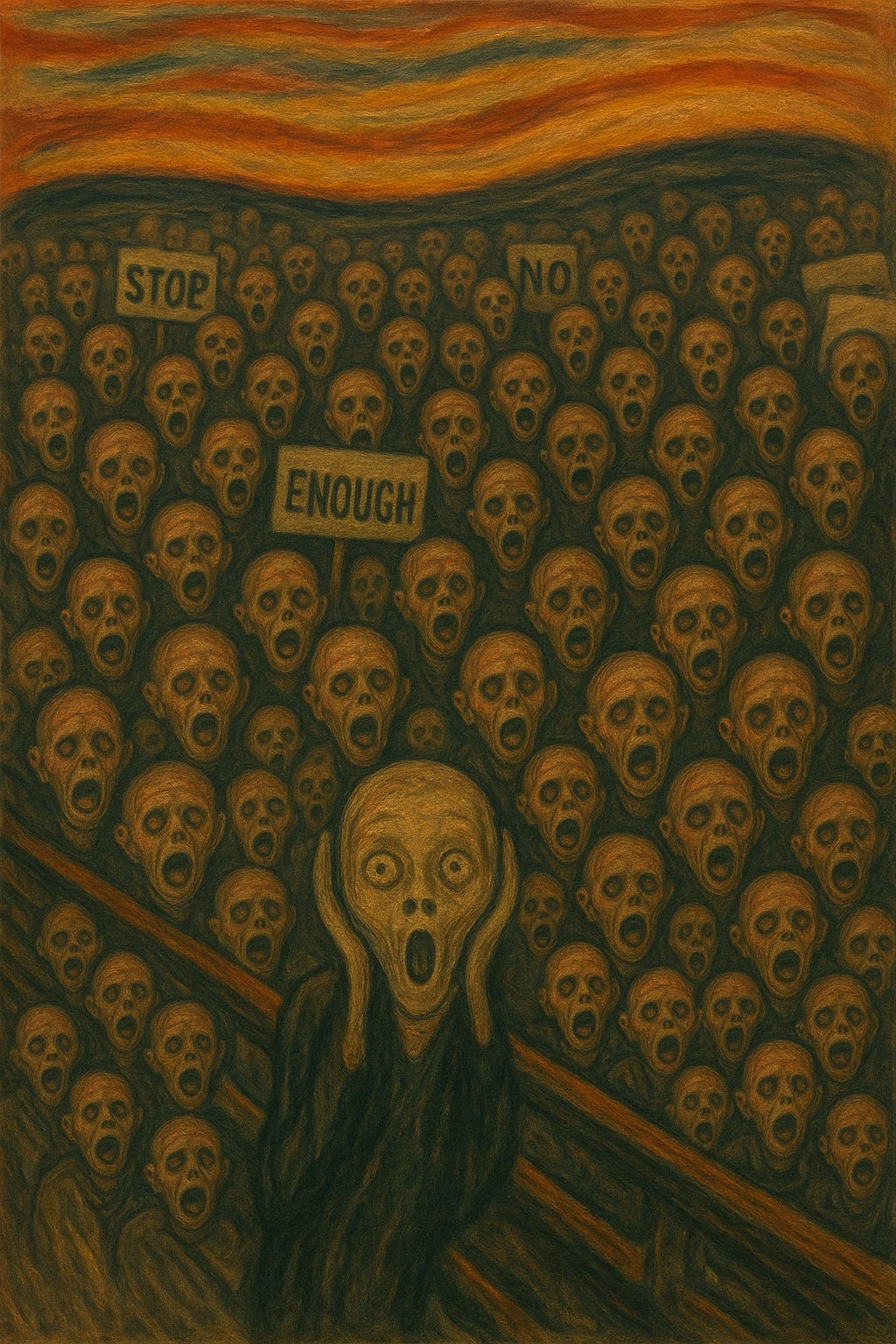
🧨 Dealing with Agitators and Violence Starters
Every movement has a weak point: the spark that wasn’t ours.
Agitators, infiltrators, and the simply unhinged will show up hoping to bait cameras, enrage cops, or fracture the crowd. They want footage, not freedom.
How to Spot Them
Arrive late, wearing masks or heavy gear that doesn’t match the weather.
Drift between groups, whispering about “getting even” or “taking it up a notch.”
Carry bricks, bottles, fireworks, or tools.
Try to start chants of aggression or direct the crowd toward police lines or property.
Film in people’s faces while urging conflict.
What to Do
Do not engage. No shouts. No shoves. No replies. They want confrontation—don’t give them their headline.
When agitators appear, calm coordination wins. Your body is a signal. Use it wisely.
Stay mobile. If you choose to sit, do so only with trained marshals nearby and clear exit paths. Sitting is symbolic—but mobility is survival.
Link arms or hold hands. Unity is harder to fracture.
Face away. Deny them the audience they crave.
Sing, hum, or chant unity cues (“Stay together,” “Peaceful protest,” “No Kings, no chaos”). These actions shift energy, confuse provocateurs, and refocus attention.
Alert marshals or de-escalation teams. Most large protests have safety volunteers—signal them.
Document discreetly. Record from a safe distance. Note time, place, behavior. Pass footage to legal observers—not social media.
Stay calm and unified. If agitators start damage, respond with visible solidarity—not chaos. Optics matter. So does safety.
Reminder: Police will use any outbreak of violence as justification for mass arrests. Don’t hand them the excuse.
Scenario Tip If someone starts destruction or tries to stir aggression, organizers might call: “Sit and sing.” “Face away and stay calm.” These small, practiced actions protect everyone and deny agitators their optics.
Every revolution has its arsonists. But the real ones bring light, not flames. Protect the story you’re writing with your presence.
🕊️ If You’re Arrested
Stay calm. Do not resist.
Ask again if you are free to go.
Request an attorney and stop speaking.
Do not consent to searches beyond what’s required.
Memorize or keep written: National Lawyers Guild or ACLU legal hotline for your area.
🌒 After the Protest
Decompress. Eat, hydrate, talk to someone. Protests are emotionally heavy work.
Document injuries or abuses: photos, names, badge numbers, timestamps.
Report misconduct: ACLU, NLG, or civil rights orgs.
Share responsibly. Never post identifiable photos of others.
Keep showing up. One protest doesn’t fix it—but it builds the muscle that does.
⚠️ Final Notes from the Edge
Federal escalation: Multiple agencies are now labeling peaceful actions as “security events.” Assume surveillance.
Local laws shift fast: What was legal in June might be criminalized by October. Check your state ACLU page before you go.
De-escalation is strategy, not surrender. Every protest that ends without arrests or injuries is a tactical win.
Your safety is the movement’s safety. The goal is endurance, not martyrdom. Survive to organize again.
If October 18 feels like a test, that’s because it is—of courage, of coordination, of whether we still remember how to stand upright together.
History won’t remember who stayed home because they thought someone else would go.
But it will remember who refused to kneel—and who stood shoulder to shoulder when it mattered.