

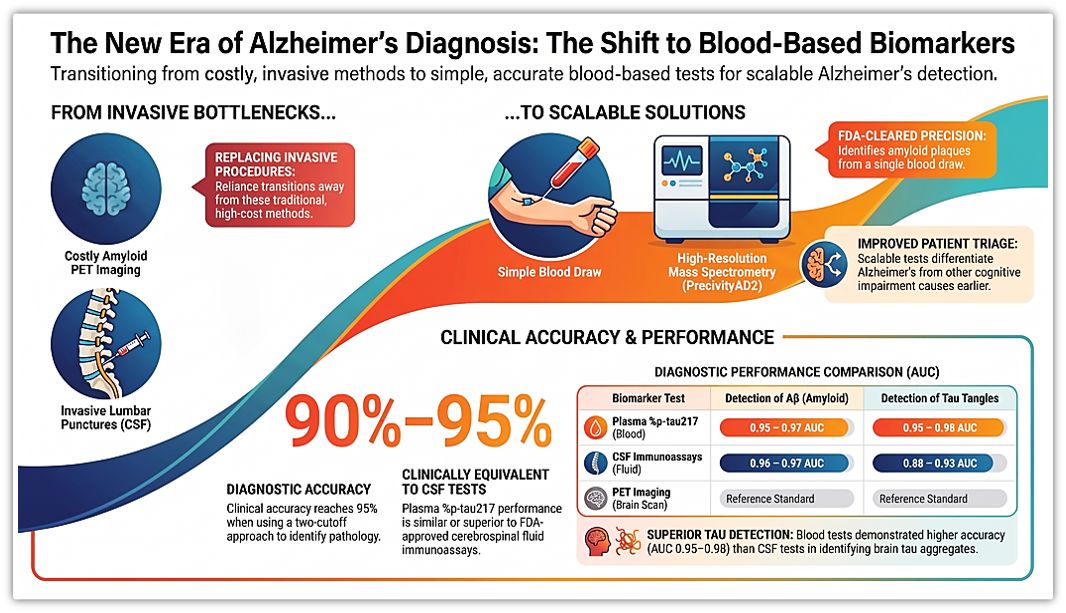
 🩸 BLOOD TESTS: HIGHER ACCURACY FOR ALZHEIMER'S 🧠
Alzheimer’s Disease affects millions globally and is often misdiagnosed in Primary Care settings.
- Identifying TOXIC BRAIN PROTEINS, AMYLOID AND TAU, is now critical for starting new disease-modifying treatments.
- Diagnostic gold standards like PET scans and spinal fluid tests (CSF) are often expensive, invasive, or unavailable to many patients who need timely care.
- This study evaluated a HIGHLY PRECISE BLOOD TEST called Plasma %p-tau217 (which is the RATIO OF PHOSPHORYLATED-TAU217 TO NON-PHOSPHORYLATED TAU).
- Researchers studied this Test over 1,700 participants across two major cohorts in Sweden and the US.
📈 The study compared Blood results directly against FDA-approved Spinal Fluid (CSF) Tests and advanced Brain Imaging to determine if a simple blood draw could provide a reliable diagnosis.
✅ RESULTS INDICATE THE BLOOD TEST IS CLINICALLY EQUIVALENT TO OR SUPERIOR TO INVASIVE SPINAL FLUID (CSF) TESTS.
- In patients with COGNITIVE IMPAIRMENT, the blood test predicted Brain Protein Status with approximately 90% ACCURACY.
- This range of performance (90% Accuracy) is considered outstanding for detecting the physical changes associated with Alzheimer’s disease in a clinical setting.
The Image below shows the main differences between the tests currently used for diagnosing Alzheimer´s Disease.
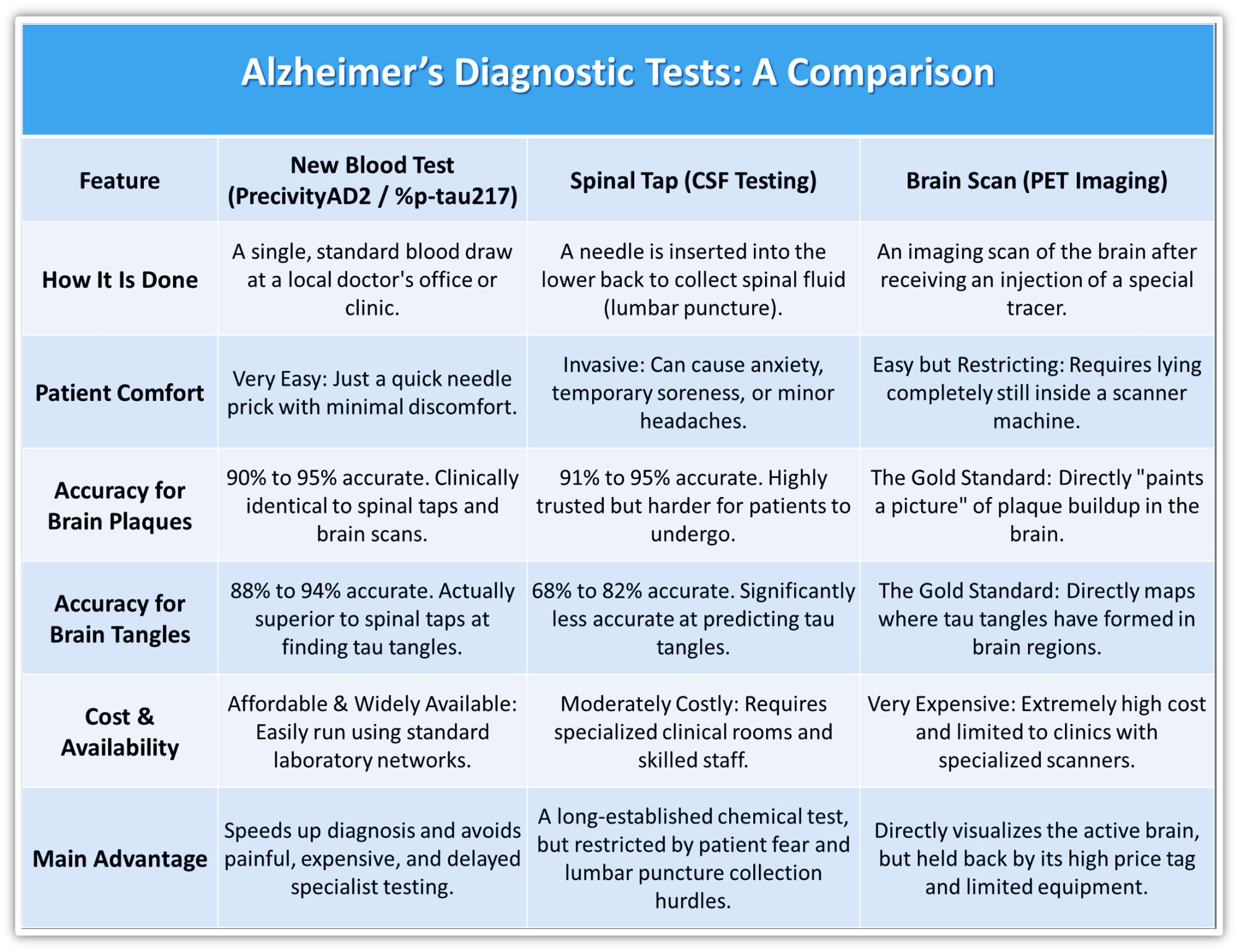 - THIS NEW BLOOD TEST is a critical milestone for health systems and insurance coverage. It helps clinicians determine if patients are eligible for new disease-modifying therapies or clinical trials.
- However, * THIS IS NOT A STANDALONE DIAGNOSTIC TOOL. Results must be interpreted alongside a patient's clinical history, cognitive exams, and other neurological evaluations for a complete picture.
- Easier access to biomarker data will improve patient triage and reduce diagnostic delays. Specialists can now focus more intensive testing where it is most clinically necessary.
- The focus now shifts to implementation. Medical communities must integrate these tests into clear care pathways, guiding primary care and memory clinics on managing results.
- Ultimately, this technology aims to transform how Alzheimer’s is managed. By moving from symptom-led to biologically defined care, patients receive more accurate and timely interventions.
- The Blood Test used in the study (%p-Tau217) offers a scalable and cost-effective solution for global Alzheimer’s care. Integrating this tool into routine clinical practice will bridge the gap in diagnostic access.
It ensures more individuals receive an accurate diagnosis and timely treatment, regardless of their proximity to specialized imaging centers or clinics.
✅ 🌐 See the full research at 👀 👉 https://www.nature.com/articles/s41591-024-02869-z
🔽 Please Read the Note Below 👇
🎯 SUBSCRIBE FOR FREE in our Trusted Open Version >
JUST CLICK HERE 👇
💥 Join us in contributing to the dissemination of knowledge and Research with Precarmed Summaries...!!
🙏 Your DONATION can make it possible to continue sending you these Summaries directly to your INBOX....📬 for FREE....!! 📬