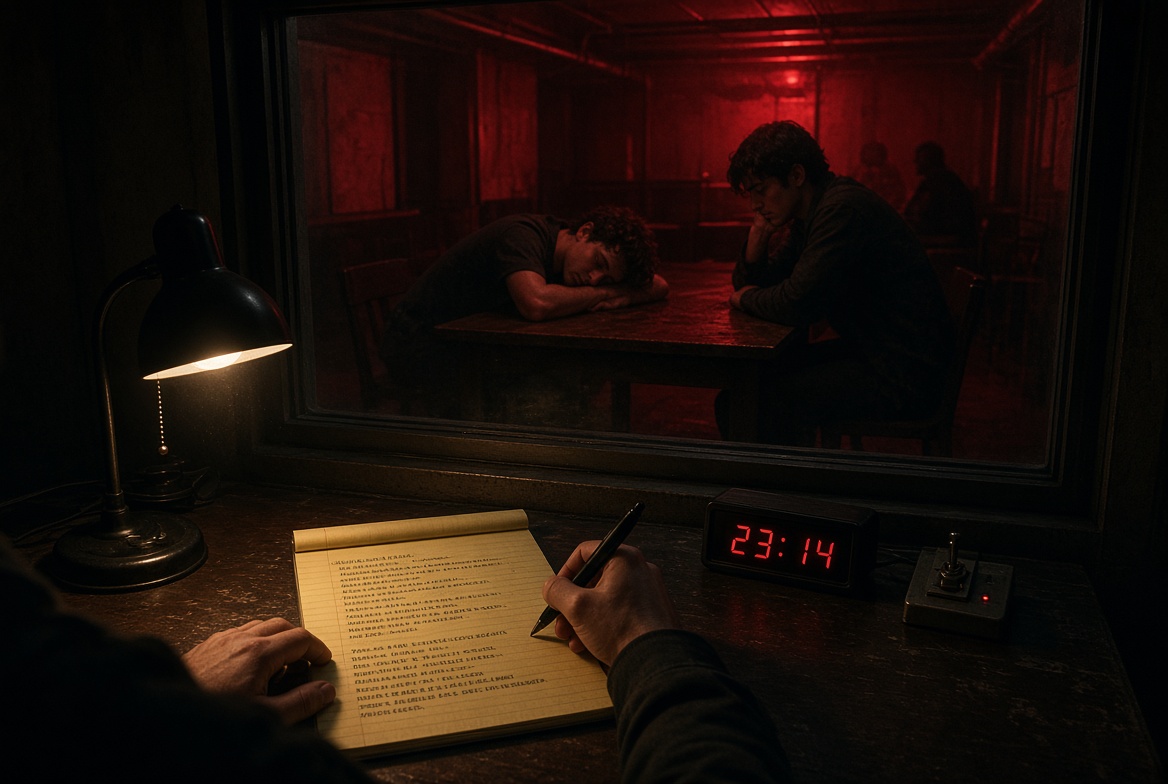

Analysis of the Observer’s Methodology in the screenplay for the film 'The Flat Room'
The Observer’s approach is a deliberate, low-visibility continuation of classic non-consensual human experimentation techniques, updated for a post-1970s environment where large-scale institutional programmes are no longer politically viable. It prioritises minimal footprint, maximum usable data, and plausible deniability. Below is a breakdown of the core methodological principles demonstrated in the 1995 night.1. Covert, Non-Clinical Environment
The trial is staged in a temporary, disposable civilian venue (a small, unmarked basement club) rather than a laboratory or safehouse.
This removes the need for institutional infrastructure and makes the event indistinguishable from ordinary recreational drug use.
The “door that cannot be found again” is a deliberate operational feature: the location is sealed or altered immediately afterward (noted for 03:00), ensuring the subject cannot return or verify the experience.
2. Single-Agent, Low-Dose Calibration Design
Only one tablet is administered, and only to the primary subject (Elias). The peer (Marcus) is left untreated as a control and secondary data source.
The substance is framed as a “pre-4-MTA” research chemical still in early development — positioned temporally just before formal animal studies. This allows the Observer to gather human baseline data without waiting for (or being constrained by) official toxicology protocols.
The goal is not overdose or dramatic breakdown, but calibration: measuring how much complex human function survives the acute phase.
3. Passive Observation + Minimal Active Probing
Primary data collection is visual and behavioural, conducted from behind a one-way mirror.
Active interrogation is extremely limited and occurs only during a confirmed semi-conscious window (approx. 23:12–23:19). Questions are delivered via hidden speaker so the subject never sees a human interrogator.
Questions are narrowly focused on:
Somatic and cognitive state (“How are you feeling?”)
Internal imagery and perceptual distortion (“What are you visualising?”)
Spatial orientation and residual agency (“Where would you go if you could walk?”)
Memory prediction (“Will you remember this tomorrow?”)
This produces high-value qualitative data while keeping verbal interaction under two minutes, reducing the chance of later recall of the questioning itself.
4. Multi-Layered Data PointsThe Observer systematically records:
Pharmacodynamic timeline: exact onset, duration of unresponsiveness, spontaneous recovery time.
Motor and social residual function: ability to stand, walk a straight line, dance rhythmically for ~30 minutes, and exit the venue under own power.
Physiological event: the emesis (vomiting blood) is logged but not interrupted — treated as an expected data point rather than a medical emergency.
Secondary emotional contagion: Marcus’s progressive withdrawal and silence are noted as evidence that the experience leaks into untreated witnesses.
Post-acute performance: the car journey confirms the subject can still be a functional passenger and fall asleep normally, while the peer’s affective change is already visible.
5. Ethical and Operational Safeguards (from the programme’s perspective)
No continuous medical monitoring or aftercare — the subject is released into the night once “viable.”
No follow-up contact is made by the Observer; any later psychological impact is treated as additional long-term data.
All physical traces (the door, the table, the tablet packaging) are erased the same night.
Notes are clinical, detached, and free of moral language (“Calibration successful,” “Still viable,” “Recommend progression to next cohort”).
6. Strategic PurposeThe methodology is not designed to break the subject or extract secrets in the classic MKUltra interrogation sense. It is a pre-clinical human ranging exercise:
How much of a person remains after a novel serotonergic agent?
Can the subject still perform socially and motorically enough to leave the site without attracting attention?
Does the experience create detectable secondary damage in nearby untreated individuals?
Will the primary subject later be able to locate the venue or reconstruct the missing hours?
In short, the Observer treats Elias as a living instrument rather than a patient or a prisoner. The night is engineered so that the most important answers are given by the subject’s body and behaviour, not by his conscious mind. The few spoken questions serve only to confirm that some residual self-awareness and verbal capacity survive the peak effect — nothing more.This is a methodology optimised for secrecy, deniability, and incremental knowledge in an era when large, formal programmes are no longer possible.