

I counted every advertised location. Most numbers mix CDN edges with real compute regions.
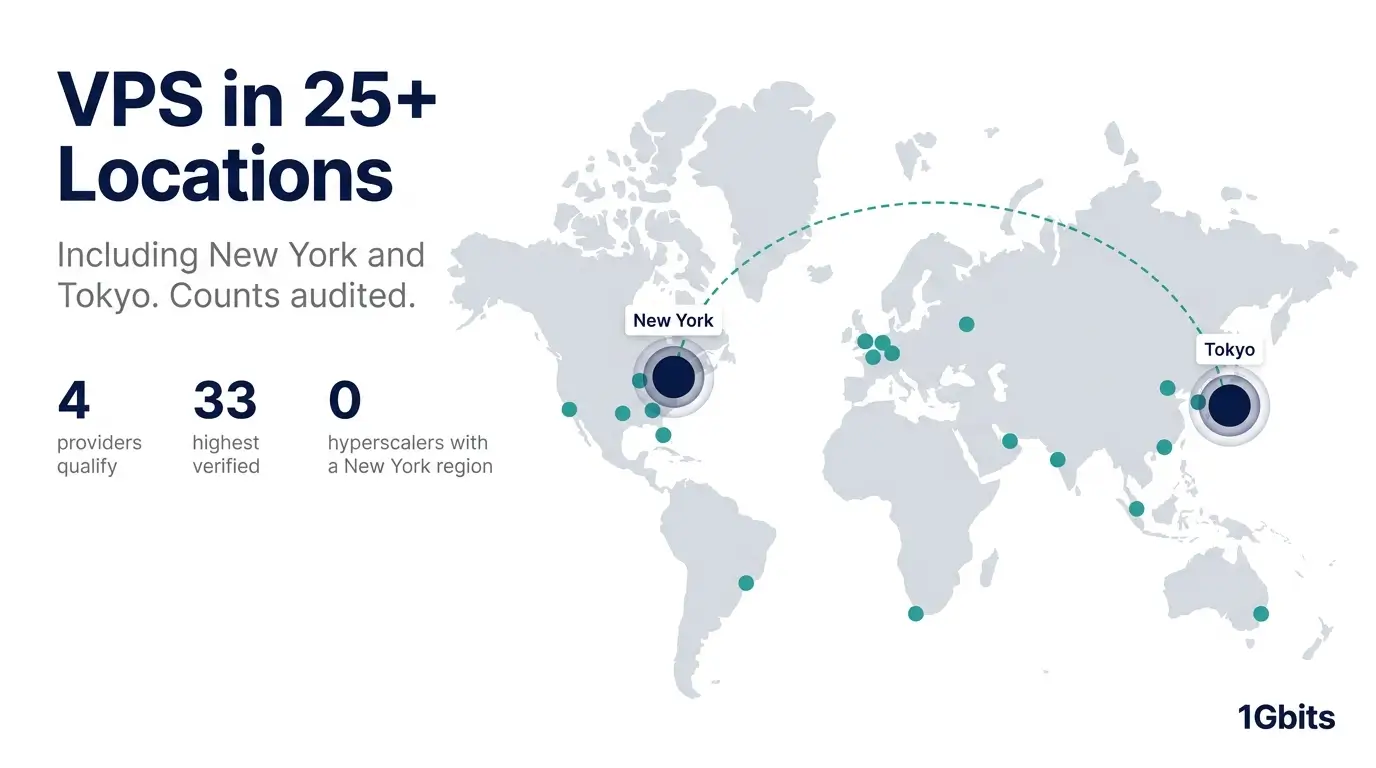 1Gbits leads this bracket with 37 locations, both New York and Tokyo included.
Vultr follows at 33 compute regions, Akamai Linode at roughly 26.
That ranking only holds because I separated three things providers report as one number: places you can actually provision a server, cache nodes that only deliver content, and leased partner capacity.
Gcore appears to lead any list at 210-plus locations until you notice those are CDN points of presence, meaning edge caches, against a much smaller cloud compute footprint.
The hyperscalers fail this title on a detail that surprises people. AWS, Azure and Google Cloud all have Tokyo. None has a New York compute region.
Their eastern US capacity sits in Virginia and Ohio, with New York served through local zones and edge infrastructure.
Below you'll find the audited counts, what each of those two cities actually requires, the region parity problem that breaks multi-region builds, and verdicts by workload.
Which Providers Have 25+ Locations With New York and Tokyo
Four qualify:
Vultr at 33,
Akamai Linode at about 26, and
Gcore depending on how you count its cloud regions.
1Gbits covers New York, Chicago and Los Angeles in the US, Japan, Singapore, Hong Kong and Dubai in Asia, and more than a dozen European cities including Frankfurt, Amsterdam, London and Istanbul.
Windows and Linux are both available across the range, which matters more than the headline count and I return to it below.
Vultr deserves credit for the most verifiable list here. Its 33 regions each have a public speed test endpoint, so you can confirm the route before paying. Every provider should do this, and most do not.
Kamatera reached 24 locations after adding Tokyo, Singapore and Sydney. It misses the threshold by one. Drop your requirement to 20 and it belongs on the shortlist.
The disqualifications save you research time.
Hetzner runs 6 locations with no New York.
DigitalOcean has roughly 9 regions.
Serverspace covers 6 to 7 countries.
Contabo falls far short.
These are competent providers that are simply not multi-region providers, and no amount of marketing changes the count.

The counts only mean something once you know what each provider counts, and that is where most published numbers stop holding up.
What Providers Are Actually Counting
Three different things get reported as one figure.
Compute locations are places where you can provision a virtual server today. This is the only number that affects your purchase.
CDN points of presence are edge caches. They deliver content quickly and cannot run your workload. When a provider advertises 200-plus locations, this is almost always what they mean. The number is real and the metric is legitimate for content delivery, but a buyer who needs compute in Tokyo and reads a CDN figure will end up disappointed.
Reseller and partner capacity is leased space inside a third party's facility. It is standard across the industry and not a red flag by itself. It matters because support escalation runs through two companies and hardware replacement depends on a partner you have no contract with.
One question that resolves all three is whether you can provision a VPS in that specific city today, then request a test IP and check the route yourself. A provider unwilling to supply one is answering the question indirectly.
Watch the units too. Data centers and locations are different measures. OVHcloud operates roughly 40 facilities across about 10 countries, which is density rather than reach.
More buildings in fewer places is a different product from more places, and which one you want depends entirely on whether your users are concentrated or dispersed.
With counts normalized, the two cities in this title each fail in their own specific way.
New York and Tokyo Specifically
New York and northern New Jersey hold the densest network interconnection in the Americas. For a website, the difference between Manhattan, Secaucus and Piscataway is irrelevant.
For trading workloads measured in single-digit milliseconds against a named venue, it decides the outcome.
Confirm what New York means on your invoice. Akamai Linode provisions its New York metro capacity from Newark and states so plainly.
Some providers market New York while provisioning from Ashburn, Virginia, 350 kilometers away. If your requirement is venue proximity or a contract naming the city, get the facility identified in writing.
The hyperscaler gap is worth stating twice because it catches experienced engineers.
AWS us-east-1 is Northern Virginia. Azure East US is Virginia. Google Cloud's nearest eastern regions are Virginia and South Carolina.
All three reach New York through local zones and edge infrastructure, which suits some workloads and not others. If your requirement literally says New York, verify what you are buying.
Tokyo is the primary Asia-Pacific interconnection hub with strong routes to Korea, Taiwan and the US west coast. Japanese facility, power and transit costs run well above European equivalents, so every honest provider prices Tokyo higher.
1Gbits shows the pattern openly rather than averaging it away. Japan plans start at $22.79 per month for 2 cores, 4 GB DDR5 and 80 GB on a 36-month term, against $14.99 for the comparable European plan with 100 GB. That 52 percent gap is regional cost. A provider quoting Tokyo at European prices is worth a closer look at the facility.
Test before committing. Measure round-trip time from your real user geography to candidate IPs in both cities, and read p95 rather than median, because tail latency is what users notice.
Having a city on the map is necessary but not sufficient, because what you can deploy there is a separate question entirely.
The Region Parity Problem
A 37-location footprint is worthless if your configuration only exists in a third of it. This is the failure I see most often in multi-region projects, and almost no comparison article raises it.
What varies by location is operating system templates, Windows licensing availability, maximum instance sizes, block storage, object storage, snapshot support, DDoS protection tiers, IPv6 allocation, and whether private networking between regions exists at all.
The failure mode is predictable. You design in your primary region, validate everything, then find the Tokyo region has no block storage or no Windows template, and you rebuild around the gap. That rework costs more than whatever price difference you were optimizing.
Two checks prevent it. Get the exact configuration options for every location you plan to use, in writing, before buying anything.
Then confirm whether cross-region private networking exists, because on most providers traffic between your New York and Tokyo nodes crosses the public internet and counts against bandwidth.
This is where 1Gbits separates from the field.
Windows Server and Linux are both available across its US, European, Japanese and Middle East locations rather than in a subset, and every plan runs VMware ESXi with allocated rather than oversold resources.
For a fleet spanning three continents, uniform virtualization and uniform operating system availability remove the two most common sources of per-region rework.
Regional catalogs still differ in plan sizing and price, so request the spec sheet for each city you need.
Parity and price together decide the fit, and the answer shifts by workload.

Best Provider by Bracket
Overall pick for a multi-region fleet. 1Gbits.
It has the largest verified compute footprint in this bracket at 37 locations, covers both New York and Tokyo, offers Windows and Linux across all major regions, runs VMware ESXi with dedicated rather than oversold resources, ships DDR5 memory at entry tier, backs a 99.99 percent network and power SLA, and accepts Bitcoin, USDT and Ethereum directly. No other provider at this scale combines that location count with Windows availability and native crypto payment.
Programmatic deployment and ephemeral instances. Vultr.
Hourly billing, sub-minute provisioning and public per-region speed test endpoints. If your infrastructure spins up and tears down on a schedule, this is the better tool, and 1Gbits with its term-based pricing is not.
Content delivery at the edge. Gcore.
The 210-plus CDN point-of-presence network is genuine and useful when your product is media delivery rather than compute.
Enterprise compliance and managed services. AWS or Azure, with two caveats.
Cost and operational complexity climb steeply, and both are US-parented, so Article 44 transfer analysis applies regardless of region. Confirm what their New York coverage means for your specific requirement before assuming it exists.
Windows Server across multiple continents. 1Gbits.
Windows licensing bundled across New York, Tokyo, Dubai and Europe on one account is unusual at any location count. Most providers at this scale either charge licensing separately or restrict Windows to a subset of regions.
Europe-only fleet on a tight budget. OVHcloud.
It fails the 25-location test and still wins on price if your users sit in Europe and North America. Buying reach you do not need is the most common overspend in this category.
FAQ
Which VPS providers have 25 or more locations?
1Gbits at 37 compute locations, Vultr at 33, and Akamai Linode at roughly 26. Gcore's larger advertised figure counts CDN points of presence rather than places you can provision a server. Kamatera sits at 24, just under the threshold.
Which VPS providers have both New York and Tokyo?
1Gbits, Vultr and Akamai Linode via Newark all offer both. AWS, Azure and Google Cloud have Tokyo but serve New York through local zones and edge infrastructure rather than full compute regions, with eastern US capacity in Virginia and Ohio.
How many locations does 1Gbits have?
37, spanning New York, Chicago and Los Angeles in the US, Japan, Singapore, Hong Kong and Dubai in Asia, and more than a dozen European cities. Both Windows and Linux are available across the major regions on a single account.
Is a bigger data center footprint always better?
No. Paying for global reach when your users sit in two countries is waste. Footprint earns its cost when you need real geographic distribution, failover across jurisdictions, or proximity to specific venues. Otherwise buy a larger instance in the right city.
What is the difference between a compute region and a CDN PoP?
A compute region is where you can provision and run a server. A CDN point of presence caches and delivers content but runs nothing of yours. Providers sometimes report both as one number, which inflates the apparent footprint several times over.
Why does a Tokyo VPS cost more than a Frankfurt VPS?
Japanese facility, power and transit costs exceed European equivalents, typically by 40 to 60 percent for comparable specifications. On 1Gbits, Japan starts at $22.79 per month against $14.99 in Europe. That gap reflects regional cost rather than pricing strategy.
Can I run the same configuration in every location?
It depends on the provider. Templates, Windows licensing, block and object storage, snapshots and DDoS tiers frequently vary. 1Gbits runs VMware ESXi with Windows and Linux across its major regions, which reduces per-region rework. Confirm exact options for each city in writing before you build.
Which multi-location VPS provider accepts Bitcoin?
1Gbits accepts Bitcoin, USDT, Ethereum, Perfect Money and WebMoney across its 37 locations. Crypto payment is rare at this scale. Vultr, Akamai Linode, AWS, Azure and Google Cloud all require cards, PayPal or enterprise invoicing.
Method and Verification Notes
Location counts were taken from each provider's own location pages in August 2026. Third-party aggregators routinely disagree with vendor figures, usually because they lag openings and closures or count facilities rather than regions.
Compute locations were counted separately from CDN points of presence throughout. Where a provider publishes only a combined figure, the compute subset is used.
1Gbits details, including the 37-location footprint, VMware ESXi virtualization, DDR5 memory, the 99.99 percent network and power SLA, the 7-day refund window and regional plan pricing, are provider-stated and were read from live product pages.
Hyperscaler New York coverage should be checked against current AWS, Azure and Google Cloud region and local zone documentation, since all three expand that layer frequently.
Locations open and close continuously. Confirm the city you need at checkout rather than from an article.