
 I have to make a confession to all of you:
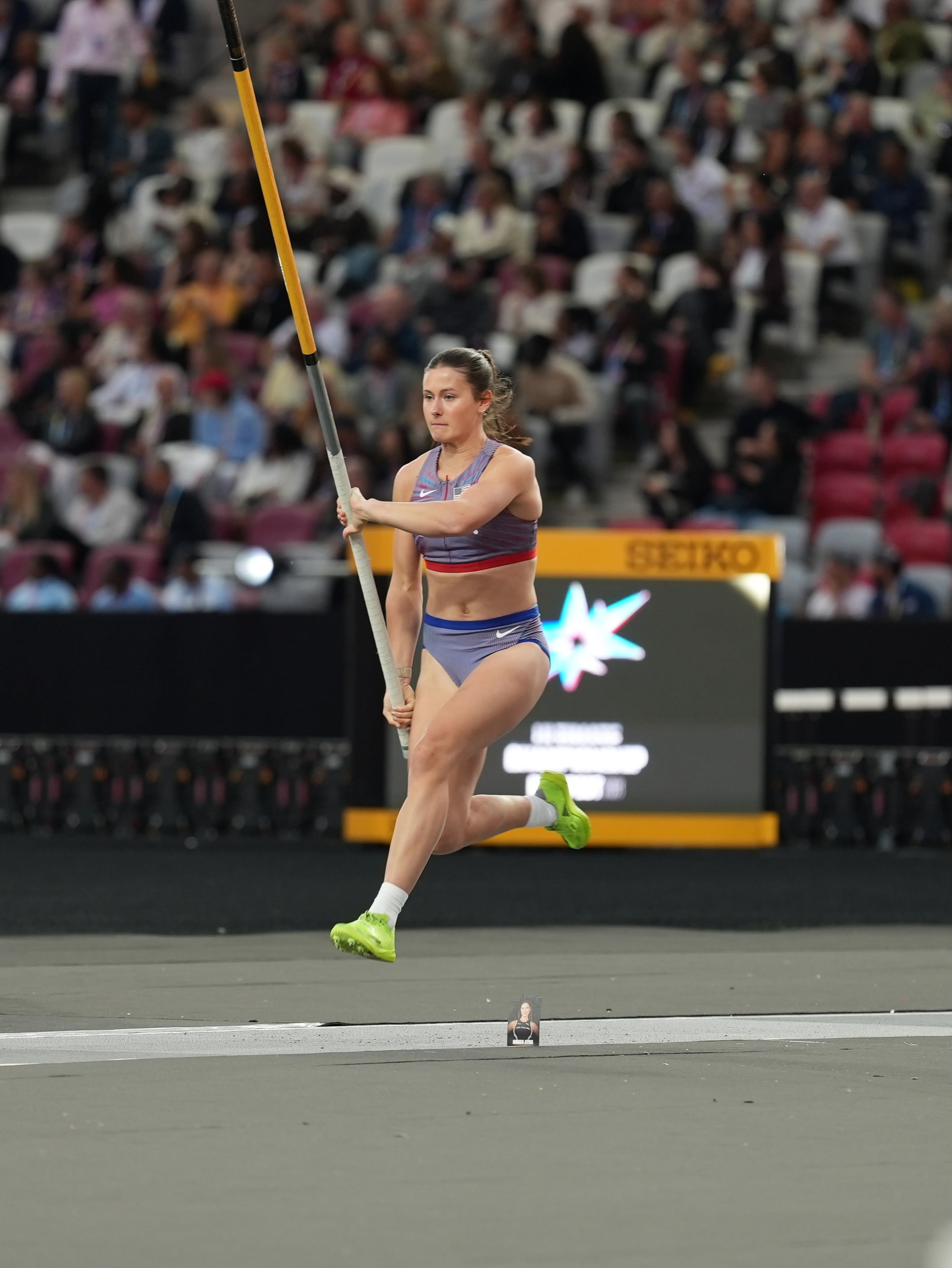
I had a large case of FOMO (fear of missing out) from not going to Budapest to cover the World Athletics Ultimate Championships after seeing University of Washington rising senior and Olympia native Hana Moll's (photo courtesy USA Track & Field) late surge in winning three straight Wanda Diamond League meets in the pole vault, including the finals in Brussels after going through a full collegiate season at the University of Washington, along with Josh Kerr in the men's 1500 after the way he broke the world record in the mile in London back in July.
It was a difficult decision to sit out the Ultimate Championships, but in the end, I feel everything worked out. I did contemplate getting out of the two football games I was scheduled to cover, but in the end, everything worked out.
From my perch in Seattle, along with some communication with people who were actually there at the 'Pest, here's my observations about the meet:
A) At least on television, having a black infield made following the long throws easier from a visual standpoint. Then again, it was my understanding that they wanted competitors in the men's hammer paint their implements a different color to help spectators in the stands track it. Don't know how it went for those in the stands. In theory, a solid idea...the execution?
B) The meet schedule made watching it more palatable over three days. I liked that there was more time between races to watch field events.
I did see a post by Alison Wade of Fast Women, who said that, particularly in the women's 800, that the semis did nothing but make the top eight advancing to the finals a formality.
However, in the lane events (100, 200, 400, 800, and both hurdles), where 16 athletes were invited to the meet, the only way you could do that is only invite eight to the meet.
C) I liked that in the distance races, there were no pacing lights and designated "rabbits" in the field, and that the contestants had to actually race, instead of having to rely on someone to do the work in the early stages of the race.
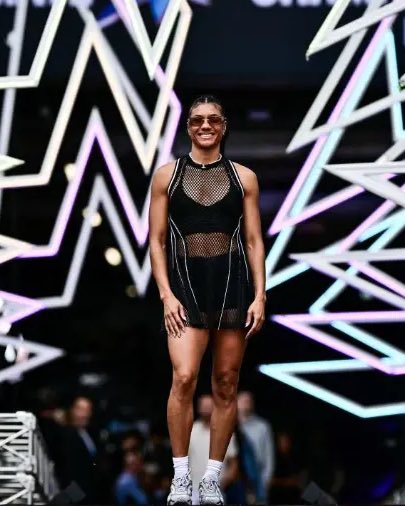 D) Having a red carpet on the Thursday before the meet allowed the athletes to show off their personality. While it wasn't required of the athletes to show, about 200, including Washington alum and 400 meter hurdler Gianna Woodruff (photo courtesy UW Athletics) made themselves available to members of the media and influencers.
E) For once, the money paid out to the athletes was decent, including $150,000 to the winner, $75k for second, then going 40k-25k-16k-14k-12k- and 10k for eighth. All 16 in lane events, and 12 in the 1500 and 5000s received money.
That said, the 2001 Golden League finals (the predecessor to the Wanda Diamond League finals) in Melbourne paid $50k-30k-20k-10k-8k-7k-6k-5k for places 1 through 8, according to an article in the November 2001 edition of Track & Field News. When you factor in inflation, the $150k first prize this weekend was only worth $80,000 in 2001 dollars.
F) I liked the fact that entry into the meet was based on the current world rankings that World Athletics has tried to implement over the last few years, and that there were no entry limits per country. In theory, you had the best of the best entered in the meet, even if some of the ranking methodology seems flawed.
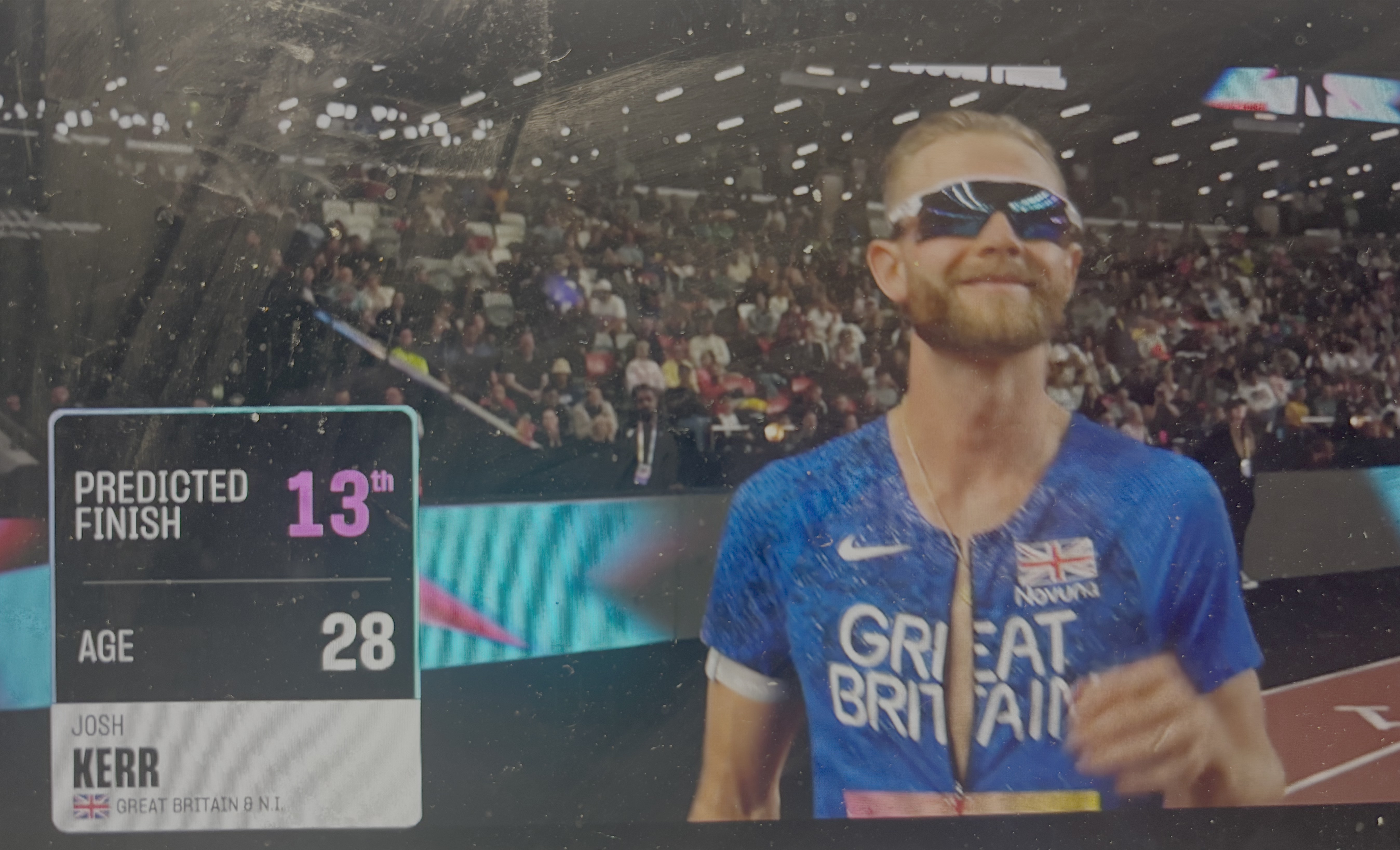 G) What was up with the "predicted finish" graphic posted next to each athlete?!? In my opinion, the graphic posted next to Josh Kerr (World Athletics/NBC Sports screenshot) was one of the most ridiculous graphics. Who came up with that projection? And how did they project him to finish 13th in a 12-man field (accounting for the fact that Jakob Ingebrigtsen of Norway scratched out of the 1500 after winning the 5000 on Friday)?
I'm guessing that this graphic was based on their world rankings entering the meet. Even though Josh broke the world record in the mile in London, and had the fastest time in the world over 1500 meters (3:27.62 1500m split en route to his 3:42.66 mile), Kerr was only ranked 84th in the world.
If those were real betting odds posted, whoever came up with these projected finishes would have lost their asses on this. Let me put it to you this way--I would have made a bet on Josh on Draft Kings.
H) I felt bad for some of the athletes in the events that were excluded from the meet, such as the women's hammer, both discus, steeple and 10000. An argument could be made for the combined events, but the reality is that this was a made-for-television event.
Maybe some of those events can be implemented in the next edition of the meet, which will be held in two years, with the venue to be determined by World Athletics.
I don't know how much the Hungarian government had to pony up to contribute to the $10 million prize money pool, and the costs of paying to conduct the meet. But whoever stages this meet next had better be ready to put up more money. Also, Dentsu and/or whoever is World Athletics' marketing agency, had better be ready to pound the pavement and sell some sponsorships.
All in all, World Athletics president Sebastian Coe, and all those working for the governing body, as well as the Budapest local organizing committee, should be proud of the job pulling off this meet. I know that this was one of Seb's pet projects to make the sport more relevant to the masses between world championship and Olympic years.
Whether or not World Athletics can build upon this remains to be seen. If the athletes are willing to extend their seasons to mid to late September, and if enough TV sports fans can be drawn away from the start of the NFL season, college football, the Premier League and the US Open to watch high quality track and field, and World Athletics can attract companies to invest, this concept has a chance to succeed.