

“Is having a boyfriend embarrassing?” In her viral Vogue article, writer Chanté Joseph examined the growing reluctance among women to make their male partners central to their public identities. She observed the rise of the carefully obscured “soft launch”: a cropped hand, the back of a head, a man visible only as a shadow at the edge of the frame. Publicly displaying a boyfriend, once treated as proof that a woman had been chosen, can now feel less like a romantic achievement and more like an invitation to have her identity reduced to the man beside her.
The article struck such a nerve because its question was never really as frivolous as it sounded. Women are not suddenly embarrassed by love, companionship or intimacy. Many are embarrassed by the versions of heterosexuality they are still expected to tolerate: relationships in which they must manage a man’s ego, absorb a disproportionate amount of domestic and emotional labour, excuse behaviour they would never accept from a friend, or make themselves less visible so that he can continue to feel like the more important person.
Perhaps the better question, then, is not whether having a boyfriend is embarrassing, but what kind of man makes partnership feel like a diminishment—and what kind makes it feel expansive?Women’s lives have changed faster than the expectations placed on the men who love them.
More women now enter relationships with careers, money, ambition, opinions and fully formed identities of their own. Yet heterosexual culture still often treats male dominance as natural and female independence as something a relationship must somehow manage. A successful woman is praised until her success becomes more visible than her partner’s; an autonomous woman is admired until she no longer performs enough dependence to make a man feel indispensable.
This tension becomes even more revealing when the couple is in the public eye, and while none of us truly knows what happens behind closed doors, what we see in public still carries cultural weight. Public relationships become reference points through which we observe, critique and make sense of wider cultural shifts.
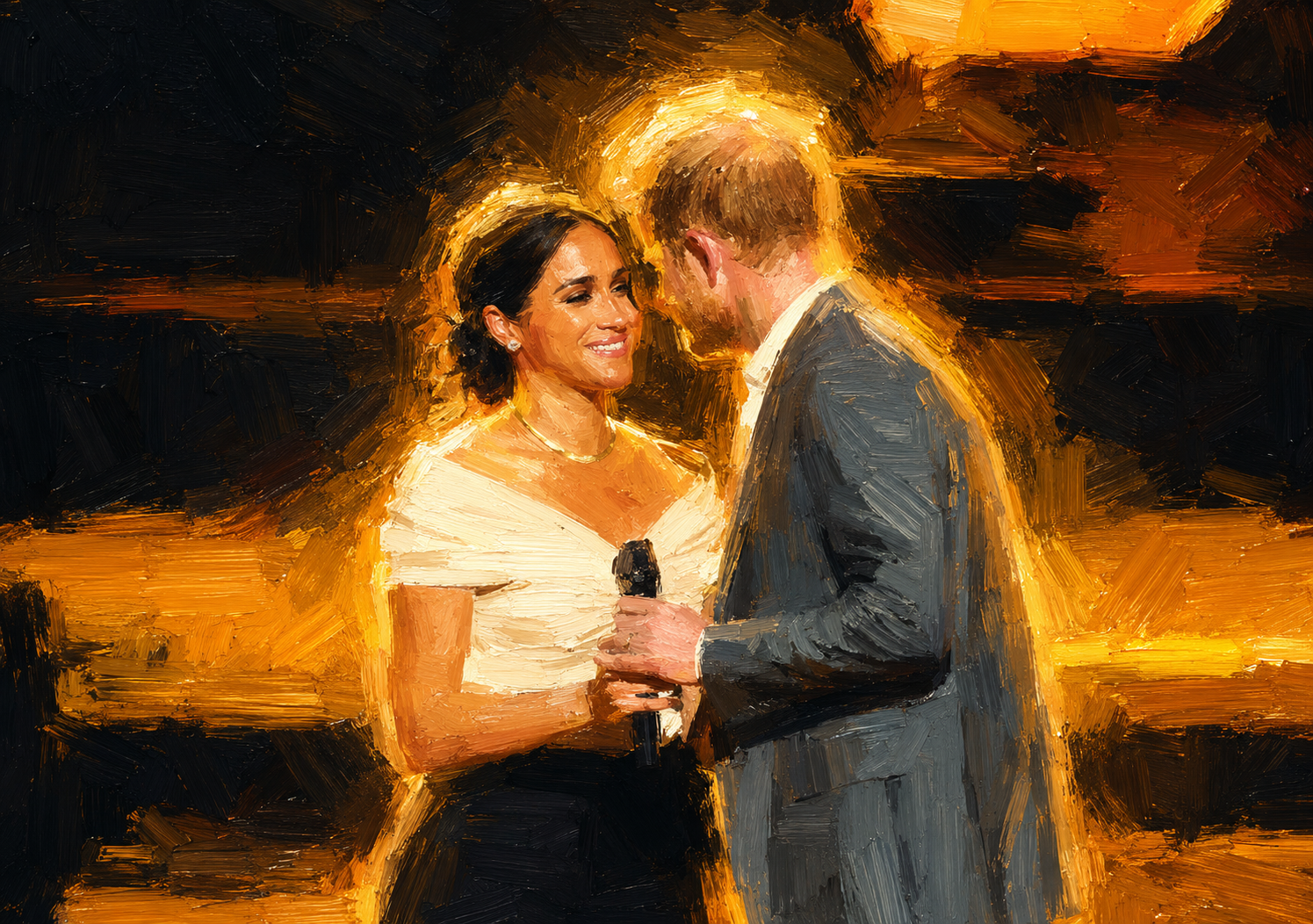
Within that cultural conversation, Prince Harry and Duchess Meghan offer something rare: the public image of a heterosexual marriage in which the man does not appear to need his wife to become smaller in order for him to feel significant.
Harry does not seem threatened by Meghan’s voice, visibility or ambition. Meghan, in turn, does not treat supporting Harry’s work as incompatible with maintaining an identity of her own. They present themselves not as a leader and his assistant, but as two adults with both shared and separate missions who repeatedly show up for one another.
That should not be radical. Yet within both traditional monarchy and modern heterosexual dating, it still is.
The traditional royal fairy tale begins with a woman waiting.
She is living an ordinary, incomplete life until a prince sees something special in her. He chooses her, elevates her and carries her into a world of status and abundance she could never have accessed alone. Her reward is proximity to his power and as the story in fairy tales always ends…they live happily ever after.
Meghan’s life does not fit that story.
Before she met Harry, she had graduated from Northwestern University with a double major in theatre and international studies. She had built a career in an industry in which stability is notoriously difficult to achieve, eventually becoming a main cast member of Suits for seven seasons. She had also created and run her own lifestyle platform, The Tig, and developed a public profile through humanitarian and gender-equality work, including advocacy with UN Women.
She had an education, an income, a home, friendships, professional credibility and a public voice. She was not sitting in a tower waiting for a prince to provide her with a life. In fact, entering the Royal Family required her to surrender substantial parts of the life she had already constructed. She left Suits, closed The Tig and entered an institution in which her identity would inevitably be interpreted through her relationship to a man.
The usual fairy tale tells women that marriage to a powerful man will expand their world. Meghan’s experience exposed how marriage into power can also compress a woman’s world—particularly when the institution has rigid ideas about how a wife should speak, behave, dress, work and occupy public attention. She was not rescued from obscurity. She was asked to exchange an identity she had authored for a role that had already been written for her.
Harry and Meghan’s engagement interview showed that her intelligence, independence and sense of purpose were a huge part of his interest. Harry joked that, once he realised who Meghan was, he would need to “up his game.” More importantly, they repeatedly described their relationship as a partnership grounded in shared causes. Meghan said their commitment to social issues was one of the first things they connected over. Harry described her as capable, effective and someone with whom he could form a “fantastic team.”
This is significant because heterosexual culture has traditionally trained men to derive value from being more experienced, more powerful, more knowledgeable or more economically important than their female partners. A woman may be accomplished, but not so accomplished that a man feels redundant. She may earn well, but preferably not more than he does. She may be intelligent, but she must know how to soften that intelligence so that it does not feel like authority. She may be independent, but she must still perform enough dependence to allow him to experience himself as the rescuer.
Harry’s public posture toward Meghan does not appear to follow that script. Her experience is not something he needs to dismiss to establish his own importance.Her visibility is not automatically framed as a challenge to his masculinity.
He does not “let” her succeed. The language of permission would itself place him above her. What is notable is that he does not seem to regard her success as something taken away from him.
Women’s lives have changed more quickly than many heterosexual relationship norms have. Women now obtain degrees, establish careers, build businesses, buy homes and create lives in which marriage is no longer an economic necessity. Yet many of the romantic scripts available to us still assume a male provider and a female dependent.
Pew Research found that, in 2022, wives were the sole or primary earners in approximately 16 per cent of opposite-sex American marriages, while spouses earned roughly equal amounts in another 29 per cent. However, even in financially egalitarian marriages—and in marriages in which the wife was the primary earner—women continued to spend more time on caregiving and housework, while men generally had more leisure time.
In other words, women’s economic roles have expanded without domestic expectations being redistributed at the same speed.
Research has also identified the persistence of what scholars call heterosexual scripts: cultural expectations about what men and women are supposed to contribute to romantic relationships. A 2025 series of studies found that relationships involving a female breadwinner can be perceived as violating conventional heterosexual scripts precisely because they disrupt the expected association between masculinity, provision and authority.
One influential study found evidence that some couples appeared resistant to arrangements in which a wife earned more than her husband, with consequences for marriage formation, women’s labour-force participation and relationship satisfaction.
There is nothing inherently unstable about a woman being wealthier, more visible or more accomplished than her male partner. The instability arises when either partner believes those differences violate the natural order of heterosexual love. The problem is not successful women. It is a model of masculinity that requires women to be less successful.
Women are constantly told to become independent—but not so independent that a man cannot imagine himself being needed.
Even among younger generations, traditional attitudes have not simply disappeared. Research published in the United Kingdom earlier this year found that almost a third of Gen Z men surveyed agreed that a wife should obey her husband, while a similar proportion believed that husbands should have the final word in important family decisions. Almost one in four agreed that a woman should not appear too independent or self-sufficient.
This helps explain one of the central frustrations of modern dating. Women are expected to construct full lives while single. They are advised to earn money, travel, heal, develop standards, establish boundaries and learn not to centre men. Yet once they have done those things, they are sometimes told that their self-sufficiency is intimidating, their standards are masculine, their boundaries are combative and their autonomy leaves no room for a man.
What this really means is that some men do not merely want to be loved. They want to be necessary. Being loved requires accepting that another autonomous person could survive without you and nevertheless chooses to build a life with you. Being necessary offers more control: the relationship is protected by dependence rather than sustained through continued mutual choice.
Meghan did not need Harry to give her an identity. That makes his place in her life more meaningful, not less. She chose him from within a life that was already functioning. The mature response to an independent woman is not to search for ways to humble her. It is to understand that being chosen freely is more valuable than being clung to for survival.
Harry’s support for Meghan’s post-royal work has been very visible. He has spoken publicly about being proud of her ventures and appeared briefly in With Love, Meghan. Meghan has reciprocated by appearing at the Invictus Games, introducing Harry and describing the work he undertakes behind the scenes on behalf of competitors and their families.
Their work is not identical. Meghan’s projects do not have to become extensions of Invictus, and Harry does not have to turn Invictus into part of Meghan’s lifestyle brand. Mutual support does not require two people to collapse into one professional identity. That distinction is important for women because “supportive wife” has historically meant a woman whose ambitions are absorbed into her husband’s.
She organises the social calendar, remembers the birthdays, raises the children, moves for his career, maintains the home and provides the emotional conditions in which he can flourish. His achievements remain individual; her contribution becomes marital. A genuinely reciprocal relationship operates differently. Each person’s work is allowed to remain their own. Support flows in both directions. Neither partner must become permanent background scenery.
Harry appears comfortable standing beside Meghan while she launches something that belongs to her. Meghan appears comfortable celebrating Invictus as Harry’s life’s work without attempting to make herself its centre.
But the Monarchy was built around a different kind of marriage…..
The British monarchy is not a gender-neutral institution onto which sexism has occasionally been added. Patriarchy is embedded within its history and design.
Male-preference primogeniture was only formally ended for members of the Royal Family born after October 2011 through the Succession to the Crown Act 2013. Until remarkably recently, a younger son could displace an older daughter in the line of succession simply because he was male. The institution has traditionally offered royal men a central identity and royal women a supporting function. A woman may be admired, but excessive popularity can become a problem when it appears to exceed that of the man or institution she represents.
Princess Diana described experiencing jealousy and tension around the disproportionate public attention she received. Her account illustrates the danger faced by a woman who performs her royal role so successfully that she begins to eclipse the person she was expected to support. There is an obvious contrast between Diana’s marriage to Charles and Harry’s willingness to celebrate Meghan’s visibility. A patriarchal husband experiences his wife’s light as his shadow. A secure husband understands that two people can be luminous at the same time.
This does not mean Harry has transcended every gendered assumption he inherited, he admitted in The Oprah interview that he regretted not getting Meghan help sooner and often reverted to an ‘institution’ version of Harry that at times dismissed his wife’s struggles. But breaking a pattern does not require emerging from it untouched. It requires recognising what it has damaged and making different choices when the pattern reaches you.
The significance of Harry and Meghan’s marriage is not that everyone should copy them or pretend their relationship is flawless. It is that their public partnership challenges several persistent ideas at once.
A woman can arrive in a relationship with money, ambition, experience and a life of her own.
A man can be attracted to those qualities rather than merely tolerating them.
Supporting a wife does not emasculate a husband.
Supporting a husband does not require a wife to abandon herself.
A woman’s success is not evidence that she does not need love.
A man’s willingness to stand beside a successful woman does not make him weak.
Meghan did not need a prince to make her somebody. Harry did not need Meghan to remain beneath him in order to feel like a man.
Perhaps that is why their partnership generates such fascination and, in certain corners, such hostility. It does not merely challenge the conventions of monarchy. It challenges the heterosexual bargain that says a woman may have power, but only if she performs enough smallness to protect the man beside her.
💕 SUPPORT THE CHANNEL💕
➵ Donate to Pay Pal: https://www.paypal.com/paypalme/AnneMalambo
➵ Buy me a coffee: https://www.buymeacoffee.com/onthegowithac
➵ Become a channel member via buy me a coffee: https://www.buymeacoffee.com/onthegowithac/membership
➵ Become a channel member via Youtube: https://www.youtube.com/channel/UCpbm4lOq89kGbURh5XJt7gQ/join