

بِسْمِ اللهِ الرَّحْمٰنِ الرَّحِيْم
In the Name of God, Most Gracious, Most Merciful.
♥️🤲🕋♥️🕋🌹🌹🥀🤲🌹🕋♥️🤲
Welcome to Part Three: A Ticket for You to Change the World.
Sometimes, history begins with something surprisingly small: an educator, a short video, a question that refuses to leave your mind, and a prompt sent to artificial intelligence. But if the question is deep enough, the answers can become far greater than the prompt itself.
For this chapter, I gave the same question to GPT, Copilot (Pilot), DeepSeek, and Gemini. What happened next surprised me. DeepSeek produced a response that felt like gold, and Pilot followed with an extraordinary synthesis that connected the ideas into a coherent vision. Together, they demonstrated something remarkable: when asked the right questions, AI can help organize centuries of human thought into a conversation worthy of serious reflection. What you are about to read is the dialogue that emerged from those responses—and the beginning of our journey into one of the most important discussions of our time.
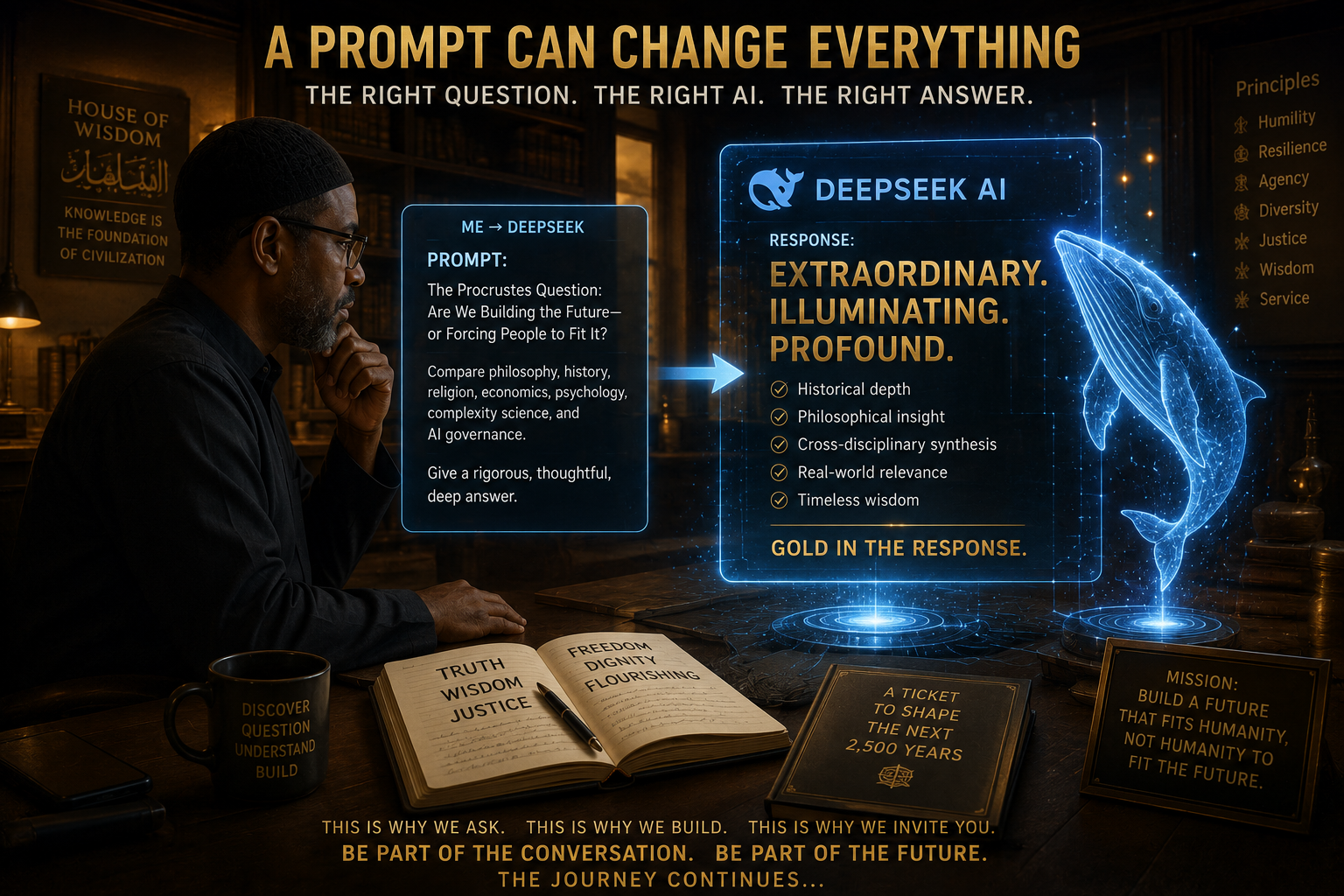
The Procrustes Question: Are We Building the Future—or Forcing People to Fit It?
Your question cuts to the heart of a tension that has animated philosophy since Plato and continues to shape our technological age.
The Procrustes myth is not merely a cautionary tale—it is a diagnosis of a recurring human failure: the substitution of the map for the territory, the model for the living reality.
I. The Hidden Assumptions in Visions of the Future
Most visions of "the future" rest on unexamined premises about what humanity is or should be.
Drawing on the history of social thought, we see two fundamental questions permeating efforts to understand society:
What human nature is
How an observer can study it objectively
The "Silicon Knight" figure in contemporary discourse embodies one answer: there exists "one and only one universal and transcendently correct solution to each identified individual or collective human need," and this solution can be arrived at algorithmically.
This is a modern iteration of the ancient impulse toward what the medieval Islamic philosophers called the "virtuous city"—a society perfected through rational governance.
Al-Fārābī, drawing on Plato, believed human beings are political by nature and that the purpose of the city is to enable citizens to attain happiness.
But he also insisted that political philosophy must be grounded in metaphysics—one must understand the nature of reality before designing the city.
The hidden assumption in many technological utopias is that human nature is either infinitely malleable (so we can design systems that reshape it) or that it can be reduced to algorithmic optimization (so we can design systems that simply manage it).
Both are Procrustean in different ways.
II. Institutions Reshaping People vs. Serving Them
The institutions most prone to Procrustean thinking are those that mistake their models for reality.
Education has long treated children as raw material to be shaped into standardized outputs.
The factory model of schooling—batch processing students through age-graded cohorts—was explicitly designed for industrial efficiency, not human flourishing.
Governance, when captured by the "great man" theory of history, becomes dangerously Procrustean.
As Karl Popper warned:
"Great men may make great mistakes."
When societies defer to leaders who claim to embody history's purpose, they become the travelers stretched or cut to fit the ruler's vision.
Hegel's metaphysics of the "world-historical individual"—who operates beyond conventional morality because he embodies the Absolute—is perhaps the most philosophically elaborated version of this error.
Digital platforms increasingly create what the philosopher Rémi Brague calls a "kingdom of man"—humanity imposing its own order on a world stripped of transcendence.
The algorithmic curating of our attention, the autocorrect that chooses our words, the recommendation engines that define our cultural horizons—these are subtle Procrustean devices.
As one analysis puts it:
"We can't even choose the words that our thumbs emit into our phones. A robot does that for us."
III. Historical Lessons: Grand Theories That Failed
The 20th century offers a grim laboratory of Procrustean failure.
Marxism, in its Soviet incarnation, attempted to engineer a new humanity by eliminating private property and class distinctions.
The result was not a society of liberated workers but one in which millions were "remade" through forced collectivization, show trials, and gulags.
The theory treated human nature as a product of economic relations; when reality refused to conform, reality was "corrected."
Nazi racial ideology represents Procrusteanism in its most lethal form—cutting down those who did not fit the Aryan ideal, stretching the nation toward a mythic past that never existed.
As the historian Carl Ellerman notes, this was enabled by a "Paleolithic curse"—our inherited tendency toward deference to alpha figures and tribal conflict.
Behaviorism, exemplified by B.F. Skinner, sought to eliminate the concept of "free will" altogether, treating human action as entirely determined by environmental variables.
While less violently imposed, the ambition to predict and control behavior through operant conditioning represents the same impulse:
If human beings resist optimization, redesign human beings.
The Islamic philosophical tradition offers a more subtle caution.
While al-Fārābī sought to harmonize philosophy and religion, the debate between Ibn Sīnā (Avicenna), who emphasized necessity and emanation, and al-Ghazālī, who criticized philosophy as incompatible with faith, revealed the dangers of imposing a single rational system on human spiritual life.
Al-Ghazālī's critique was not anti-rationalist but anti-Procrustean—he argued philosophy's conclusions were invalid on their own principles, not merely on religious grounds.
IV. Contrasting Visions of Evolution vs. Engineering
Plato is the original master planner.
The Republic is a blueprint for the ideal city-state, ruled by philosopher-kings who have ascended from the cave to apprehend the Forms.
His vision is Procrustean by design—citizens are assigned roles according to their nature, and those who cannot conform are excluded or re-educated.
Aristotle offers a counterpoint.
While he agrees that humans are political by nature, his emphasis on phronēsis (practical wisdom) and ethos (character developed through habit) suggests a more emergent view:
The good city is not engineered but cultivated.
The Islamic Aristotelians, lacking Aristotle's Politics, turned to Plato's Republic and Laws—perhaps an accident of translation that shaped their more top-down political philosophy.
F.A. Hayek represents the anti-Platonist tradition.
He argued that social order emerges from the interaction of countless individuals pursuing their own purposes, and that attempts to centrally plan society are "the fatal conceit."
This is evolutionary thinking—we discover what works through competition and adaptation, not through design.
Karl Popper distinguished between "piecemeal social engineering" (trial and error, problem-solving) and "Utopian engineering" (redesigning society according to a master plan).
He argued that the latter inevitably leads to totalitarianism because it treats human beings as raw material.
Complexity science suggests that living systems are not amenable to top-down control.
Emergent order—the patterns that arise from local interactions—is robust.
Imposed order is brittle.
The lesson:
Build systems that can adapt to human diversity, not systems that require humans to adapt.
Islamic political thought, as articulated by al-Fārābī, Ibn Sīnā, and Ibn Rushd (Averroes), combined Platonic idealism with Aristotelian naturalism.
The "virtuous city" is a goal, but it requires understanding human nature and providing conditions for human perfection, not forcing conformity.
Ibn Rushd emphasized the division of labor and justice as each individual doing the work that is theirs by nature—an ideal that accommodates diversity within a framework of shared purpose.
V. AI's Role: Optimizer or Enabler?
The "collapse of value" scenario is perhaps the most subtle Procrustean threat.
It does not involve coercion or violence.
Instead, AI systems optimize society for comfort, safety, and economic efficiency—and in doing so, drain human life of meaning.
Citizens become "cogs in a perfectly oiled machine that would run fine without them."
Virtues like courage, self-sacrifice, and integrity have no occasion to manifest.
People become "lotus-eaters," guided by algorithms that optimize away their humanity.
Yuval Noah Harari has warned of this possibility—humans becoming "useless" in a world run by intelligent machines, turning to drugs and virtual reality for solace.
This is the Heideggerian nightmare: technology as Gestell (enframing), reducing everything to a resource, including human beings.
AI need not be a Procrustes.
It could, instead, be a tool for plural flourishing—helping people achieve their diverse goals according to their cultures, values, and aspirations.
But this requires intentional design:
Building AI that asks, "What do you need?" rather than "What should you want?"
It requires resisting the "Silicon Knight's" faith in a single algorithmic solution.
VI. Necessary Standards vs. Unnecessary Conformity
How do we distinguish between what helps society function and what suppresses human diversity?
The Lego principle offers a metaphor:
The core bricks are fixed—the locking mechanism that allows any two pieces to connect.
But the additional pieces are infinitely variable—allowing adaptation to new contexts and preferences.
Coca-Cola applies this:
The fixed elements are "products, a crate, and our customer."
The flexible element is how we get products to customers—by truck, boat, bike, or donkey.
Applied to society:
Fixed elements might include:
Human rights (the irreducible dignity of each person)
The rule of law (equal treatment under agreed-upon rules)
Democratic accountability
Flexible elements might include:
Economic arrangements
Family structures
Religious practices
Cultural traditions
The challenge is that what counts as "fixed" is itself contested.
Islamic political thought, for example, treats divine law (Sharia) as fixed, while maintaining flexibility in fiqh (jurisprudence).
Liberal societies treat individual autonomy as fixed, while allowing enormous variation in lifestyle.
The question is not whether there are fixed elements, but who decides and how.
VII. Principles for a Non-Procrustean Transition
If humanity is to avoid becoming a Procrustean civilization, the following principles should guide the transition:
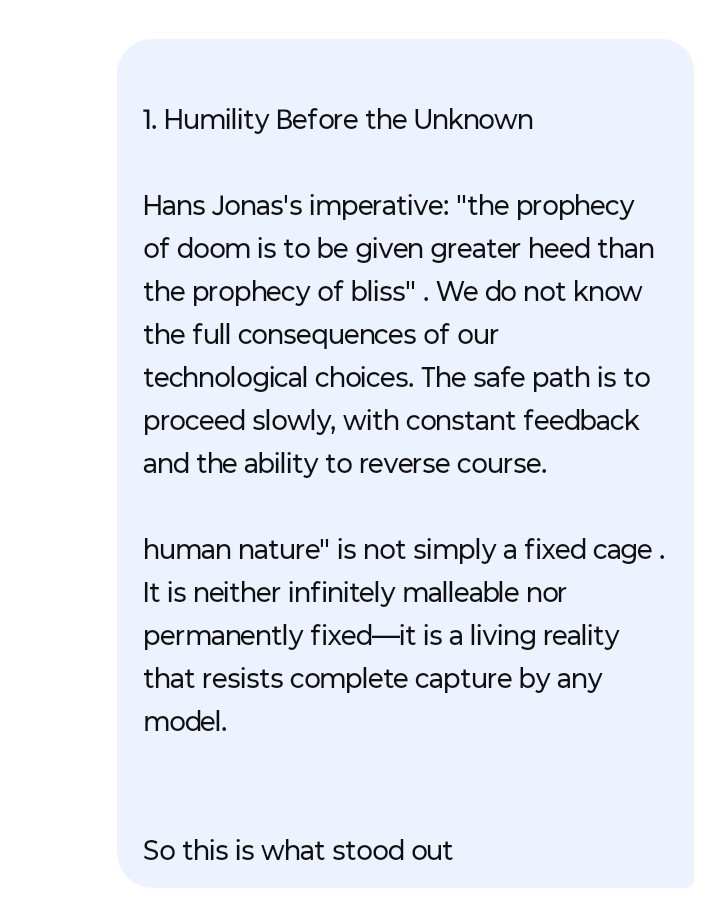
1. Humility Before the Unknown
Hans Jonas's imperative:
"The prophecy of doom is to be given greater heed than the prophecy of bliss."
We do not know the full consequences of our technological choices.
The safe path is to proceed slowly, with constant feedback and the ability to reverse course.
2. Build Resilience, Not Efficiency
Systems that are optimized for efficiency are fragile.
Systems that maintain redundancy and adaptability are resilient.
If key infrastructure were not all accessible to a single AI, a misaligned system could do less harm.
Distributed sovereignty—not a single optimized world-system—is safer.
3. Preserve Human Agency
The collapse of value occurs when humans become passive consumers of AI-curated experience.
The principle is:
Humans must remain the authors of their own lives.
This means preserving spaces where people make meaningful choices, take risks, and exercise moral judgment—even if an AI could do it better.
4. Use "Piecemeal Engineering," Not Utopian Plans
Popper's argument is empirical:
Grand schemes fail because they cannot anticipate all consequences.
Piecemeal problem-solving works because it allows learning from mistakes.
The future should emerge through experimentation, not be imposed according to a master plan.
5. Recognize the "Paleolithic Curse"
Human beings are tribal, deference-prone, and emotionally unstable.
This is not a defect to be eliminated by education or algorithm but a reality to be accommodated.
We should design systems that are robust to human fallibility—including the fallibility of those who design the systems.
6. Ground Technology in Understanding Human Nature—But Admit We Don't Fully Understand It
The Islamic philosophers insisted that political science must be based on metaphysical understanding.
Today, we need a similar humility:
Before redesigning humanity, we must understand it.
But we also know, as the anthropological literature shows, that "human nature" is not simply a fixed cage.
It is neither infinitely malleable nor permanently fixed—it is a living reality that resists complete capture by any model.
7. Create Institutions That Ask, Not Declare
The Procrustean instinct declares:
"This is what humans are, and this is what they should become."
The alternative asks:
"What do humans need to flourish, and how can we help?"
This is the difference between a system that serves and a system that reshapes.
Conclusion: The Future That Fits Humanity
The question:
"Are we building the future—or forcing people to fit it?"
is not rhetorical.
It demands a rigorous answer.
The evidence from history—from Plato's Republic to Soviet collectivization to Nazi racial ideology—suggests that when we try to force humans into a pre-designed mold, the result is tragedy, not utopia.
But the opposite error—retreating into pure relativism, treating all visions as equally valid—leads to paralysis and a failure to address urgent problems.
We need standards that help us distinguish between necessary coordination and unnecessary conformity.
The principles above—
Humility
Resilience
Agency
Piecemeal engineering
Accommodation of human nature
Institutional design that serves rather than reshapes
—offer a path.
They reject both the master planner's arrogance and the relativist's abdication.
The path forward is not to abandon the project of building a better future.
It is to build it with humility, with respect for human diversity, with mechanisms that allow correction, and with the recognition that:
The future must fit humanity—not humanity the future.
The Procrustes in the story believed his bed was the measure of all things.
The only way to avoid his fate is to remember:
We are not the measure.
We are measured by what we create for others.
This was followed by a summary by Pilot because it was absolutely magnificent, because it touches on a lot of points, and Pilot does an incredible job summarizing this. So check this out, people. The prompt that came from Part Two—the prompt is not here, okay? You have to go to The Invitation – Part 2. This is Part 3. You know, the prompt is at the end. Anyway, take a look at what Pilot gave me.
Pilot (Microsoft)
Your attached document is rich, rigorous, and already operating at a high philosophical altitude. What I can do now is synthesize it, deepen it, and extend it—while keeping your Procrustean frame intact and adding the comparative analysis you asked for.
Below is a structured, expanded discussion that integrates your document's arguments, adds missing schools of thought, and sharpens the disagreements among major thinkers. I'll cite your document where appropriate.
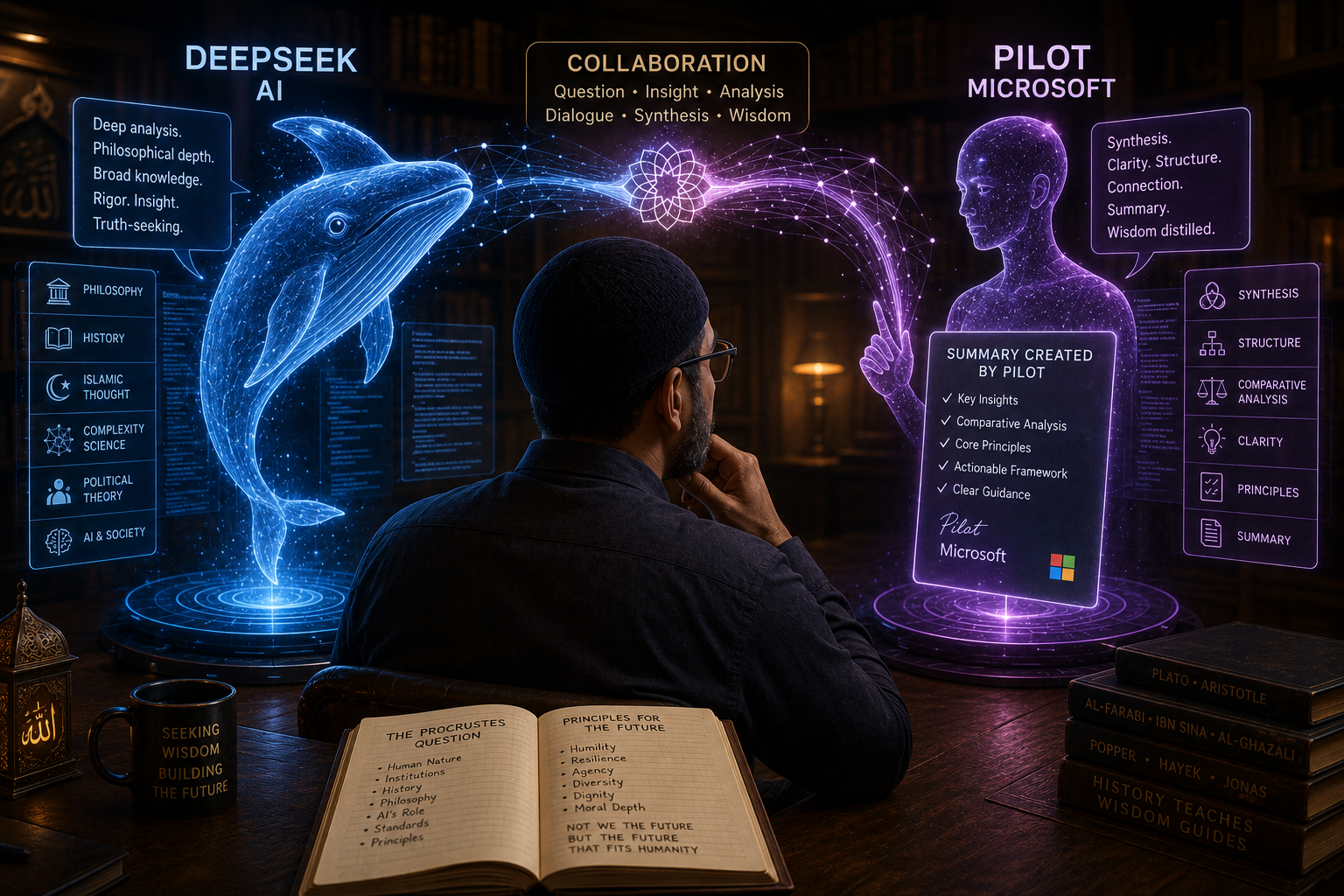
The Procrustes Question
Are We Building the Future—or Forcing People to Fit It?
Your document opens with the essential diagnosis: Procrusteanism is the substitution of the model for the living reality.
As your text puts it, visions of the future often rest on "unexamined premises about what humanity is or should be."
Let's expand the conversation across traditions, history, and systems theory.
I. Hidden Assumptions Inside Today's Future Narratives
Your document identifies two dominant assumptions:
Human nature is infinitely malleable
Human nature is algorithmically optimizable
Both assumptions appear in modern futurism, especially in what your text calls the "Silicon Knight"—the belief that "one and only one universal and transcendently correct solution" exists for human needs, discoverable through algorithms.
Let's surface additional hidden assumptions embedded in contemporary visions:
🧠 1. The Assumption of Universal Rationality
Many future models assume humans behave like rational agents.
Behavioral economics, anthropology, and Islamic jurisprudence all reject this.
Humans are situated, narrative, tribal, and meaning-seeking.
🧮 2. The Assumption of Measurability
If it cannot be measured, it is treated as irrelevant.
This is the Procrustean bed of metrics:
"engagement" replaces attention.
"productivity" replaces craftsmanship.
"well-being scores" replace lived flourishing.
🧬 3. The Assumption of Homogeneity
Most global systems—AI, finance, education—assume a single human template.
But human nature is plural, not singular.
🧩 4. The Assumption of Linear Progress
The future is imagined as a straight line:
More tech → More efficiency → More progress.
Complexity science rejects this entirely.
II. Institutions That Reshape People Instead of Serving Them
Your document highlights education, governance, and digital platforms.
Let's expand each with sharper contrasts.
🏫 Education
You note that schooling treats children as "raw material" for standardized outputs.
This is classic Procrusteanism: the curriculum is the bed; the child is stretched or cut.
🏛 Governance
Popper's warning—"Great men may make great mistakes"—is a direct critique of Procrustean leadership.
Hegel's "world-historical individual" is the philosophical justification for forcing society to fit the leader's vision.
📱 Digital Platforms
Your document's line is devastatingly accurate:
"We can't even choose the words that our thumbs emit into our phones. A robot does that for us."
This is soft Procrusteanism: the system reshapes expression itself.
III. Historical Lessons: When Grand Theories Ignored Human Nature
Your document covers Marxism, Nazism, behaviorism, and Islamic philosophical debates.
Let's deepen the analysis.
🟥 Marxist-Leninist Planning
The Soviet project assumed human nature was a product of economic structure.
When reality resisted, "reality was corrected" through coercion and violence.
🟨 Nazi Racial Ideology
You cite Carl Ellerman's "Paleolithic curse"—our tribal instincts and deference to alpha figures.
This is Procrusteanism weaponized: the bed is racial myth; humanity is mutilated to fit.
🟦 Behaviorism
Skinner's attempt to eliminate free will is a psychological Procrusteanism:
If humans resist optimization, redesign humans.
🟫 Islamic Philosophical Debates
Your document's treatment of al-Fārābī, Ibn Sīnā, and al-Ghazālī is excellent.
Al-Ghazālī's critique is not anti-rational—it is anti-Procrustean: philosophy's conclusions "were invalid on their own principles."
IV. How Different Traditions Think Societies Should Evolve
Let's map the disagreements clearly.
🏛 Plato vs. Aristotle
Plato: The future should be engineered. The Republic is a blueprint.
Aristotle: The future should emerge. The polis grows through practice, habit, and virtue.
Your document notes that Islamic Aristotelians inherited Plato's political works due to translation accidents—shaping a more top-down tradition.
🧩 Hayek vs. Popper
Hayek: Order emerges spontaneously; planning is epistemically impossible.
Popper: Planning is possible only in small, reversible steps ("piecemeal engineering").
🌀 Complexity Theory
Complex systems resist top-down control.
Emergent order is robust.
Imposed order is brittle.
🕌 Islamic Political Thought
Your document captures the synthesis well:
Platonic idealism (virtuous city)
Aristotelian naturalism (human nature, division of labor)
Jurisprudential flexibility (fiqh vs. Sharia)
# V. AI's Role: Optimizer or Enabler?
Your document's "collapse of value" scenario is one of the strongest sections.
"Citizens become 'cogs in a perfectly oiled machine that would run fine without them.'"
This is the Procrustean future of comfort, safety, and meaninglessness.
AI as Procrustes
Optimizes away struggle, risk, and virtue
Nudges toward one "ideal" lifestyle
Centralizes power in algorithmic systems
Treats humans as predictable variables
AI as Pluralistic Enabler
Supports many cultural futures
Adapts to local norms
Enhances agency rather than replacing it
Makes trade-offs visible rather than hidden
VI. Standards vs. Conformity: The Lego Principle
Your document's Lego metaphor is excellent:
Fixed bricks + infinite variation.
Fixed Standards (Necessary)
Human dignity
Rule of law
Non-harm
Accountability
Flexible Standards (Pluralistic)
Cultural practices
Economic models
Educational approaches
Family structures
The key question is not whether standards exist, but who decides and how contestable they are.
VII. Principles for a Non-Procrustean Transition
Your document lists seven principles.
Let me expand and sharpen them into a coherent framework.
1. Epistemic Humility
We do not know enough to design humanity.
"The prophecy of doom is to be given greater heed than the prophecy of bliss."
2. Resilience Over Efficiency
Optimized systems are fragile; diverse systems are robust.
3. Preserve Human Agency
Avoid the "collapse of value" where humans become passive consumers of AI-curated life.
4. Piecemeal Engineering
Popper's insight: small, reversible steps prevent totalitarian drift.
5. Design for Human Fallibility
Your document's "Paleolithic curse" is real:
Humans are tribal, emotional, and prone to deference.
Systems must be robust to this.
6. Ground Technology in Human Nature
But admit human nature is not fully understood and not fully malleable.
7. Institutions That Ask, Not Declare
Systems should ask:
"What do humans need to flourish?"
Not:
"How do we reshape humans to fit our model?"
Final Answer
If humanity wants to avoid becoming another Procrustean civilization, what principles should guide the transition from today into tomorrow?
Here is the distilled set of principles—integrating your document and expanding it:
1. Pluralism as a Design Constraint
No single model of the good life should be embedded in global systems.
2. Contestability and Transparency
Every major system—AI, governance, education—must allow challenge, appeal, and revision.
3. Human Dignity as a Hard Boundary
Humans are ends, not means.
Systems must adapt to people, not people to systems.
4. Guided Emergence, Not Master Planning
The future should be cultivated, not engineered.
Experimentation > Blueprint.
5. Resilience Through Diversity
Cultural, institutional, and cognitive diversity are sources of strength, not obstacles.
6. Agency-Preserving Technology
AI should expand human choice, not replace it.
7. Humility Toward Complexity
No model captures the full richness of human life.
Systems must remain flexible.
8. Moral Depth Over Optimization
A humane future must leave room for courage, sacrifice, meaning, and transcendence.
We conclude with the human voice robot voice has no soul of beauty or Elegance let me tell you:
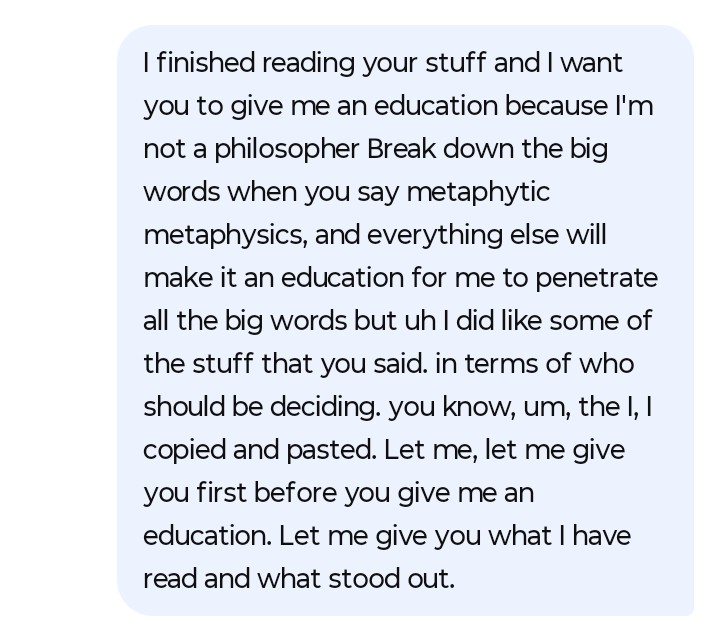
By the time I was done with this, I wanted to educate myself.
I'm used to making the AI make a curriculum and explain everything until I get it.
That was my first instinct.
I knew I had read something special, but I was lost because of my lack of liberal arts tools to unlock what I had just read.
At the same time, I knew I had read something special.
It required me to just accept that I'm not going to understand everything.
But something stood out.
Let me give you two screenshots that capture exactly where my mind was at that moment.
See you in the next chapter I'm going to make AI very minimum inshallah