
بِسْمِ اللهِ الرَّحْمٰنِ الرَّحِيمِ
ʿUmar ibn al-Khaṭṭāb رضي الله عنه — The Reward of Gentleness, Refined into Justice
History must be written with courage, not nostalgia. And when it is written honestly, one truth stands firm: ʿUmar ibn al-Khaṭṭāb did not become gentle—he became just. Islam did not erase his force; the Prophet ﷺ disciplined it. What emerged was not a softer man, but a safer civilization.
This chapter is about the reward of choosing Abu Bakr—and the reward of Abu Bakr choosing ʿUmar. It is about what happens when a community stabilizes through gentleness and then matures through accountability. It is about the Prophet’s classroom producing a student whose strength no longer served ego, but served truth against itself first.
The Nature That Was Not Rewritten—Only Redirected
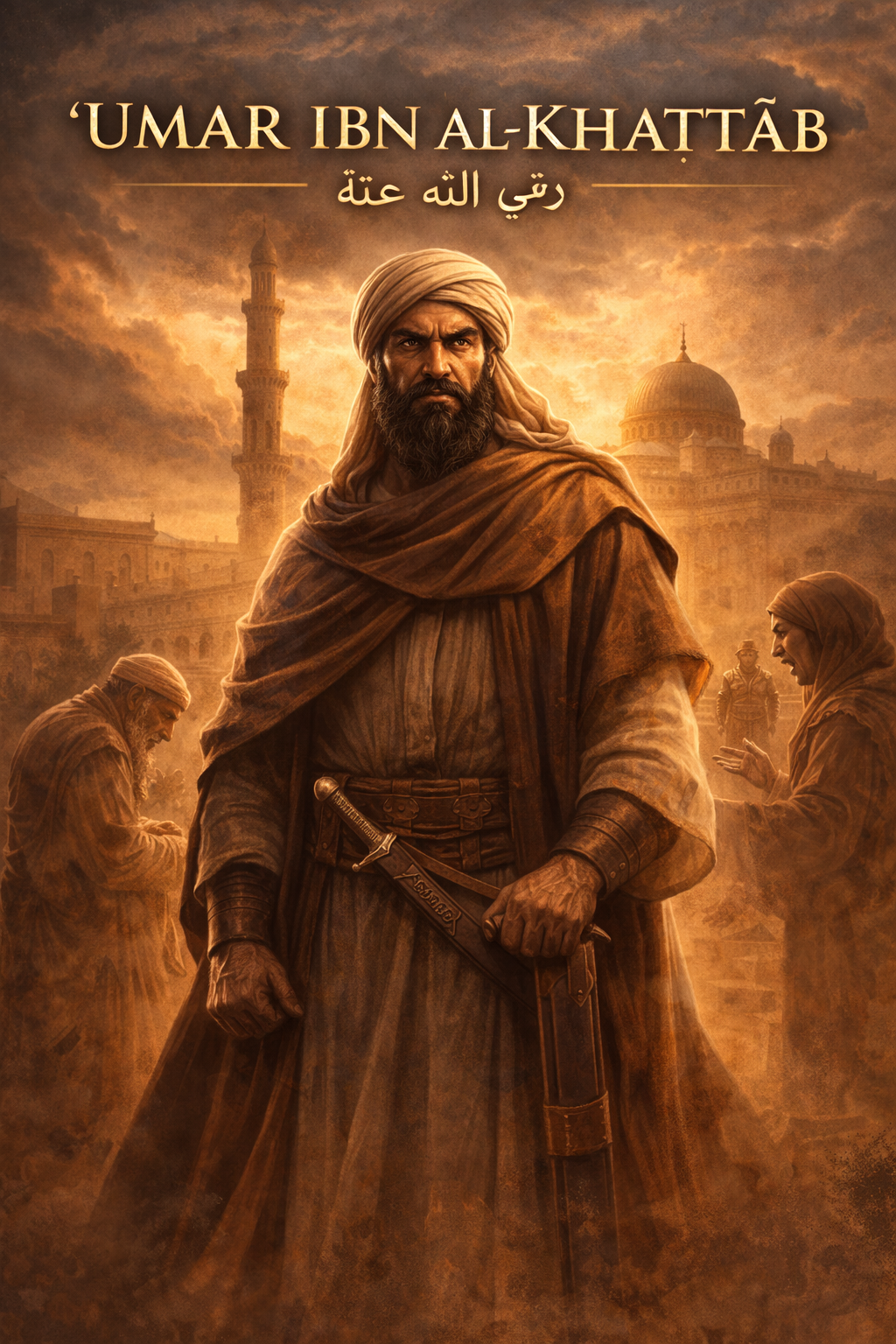
ʿUmar’s temperament did not change. His target did.
Before Islam, his toughness confronted people.
After Islam, it confronted himself.
That distinction explains everything that followed.
He feared Allah so deeply that power terrified him. He accepted authority not as triumph, but as exposure. He believed leadership meant standing naked before divine judgment, not standing tall before crowds.
This is why he could not be bribed by praise, shielded by rank, or seduced by conquest.
The Prophetic Molding
The Prophet ﷺ did not dilute ʿUmar’s fire—he aimed it. He taught him that the most dangerous enemy is not outside the city walls, but inside the self. And once ʿUmar learned that lesson, his strength became surgical.
He corrected himself publicly.
He welcomed rebuke—even from women in the mosque.
He dismissed governors for arrogance, not incompetence.
He feared injustice more than rebellion.
He walked at night to audit himself, not others.
He wept over animals, imagining Allah asking him why they suffered.
This is not legend. This is pattern.
Justice as Daily Self-Indictment
ʿUmar institutionalized something radical: power that accuses itself.
He created standards no ruler had ever imposed on himself:
If a governor lived better than the people, he was removed.
If an official silenced criticism, he was punished.
If a decision harmed the weak, it was reversed—publicly.
If a woman corrected him with Qur’an, he submitted immediately.
He did not defend authority.
He defended truth over authority.
This single principle dismantles tyranny.
Grading ʿUmar ibn al-Khaṭṭāb (With the Luxury of Time)
Now we grade him—without myth, without sectarian distortion, without fear.
Self-Accountability: A+
No ruler in history audited himself more aggressively.
Justice Across Classes: A+
The poor could confront him. The powerful feared him.
Institutional Integrity: A+
Governors served the law, not their reputations.
Personal Asceticism: A+
Power expanded; his life contracted.
Correction Acceptance: A+
No ego stood between him and truth.
Civilizational Expansion with Restraint: A
Expansion occurred—but under rules, ethics, and accountability.
Temperament Discipline: A+
Anger mastered, not unleashed.
Fear of Allah: A+
The engine behind every decision.
There is no honest downgrade available.
Why Hypocrites Fear Him
Those who misuse ʿUmar’s name expose themselves.
They want his punishments without his tears.
They want his authority without his fear.
They want his decisiveness without his self-indictment.
But ʿUmar’s strength was never cruelty. It was constraint under power. And constraint is what tyrants cannot tolerate.
The Prophetic Standard Revealed
Here is the uncomfortable truth:
ʿUmar proves how great the Prophet ﷺ was.
A teacher is known by his students. And no human teacher could take a man this forceful and transform him into a ruler this just—without revelation, without ego, without loss of authenticity.
The Prophet ﷺ fixed the tire so well that the car ran straighter than before.
Abu Bakr preserved the soul of Islam.
ʿUmar built its spine.
The Verdict
History does not need revision here. It needs honesty.
ʿUmar ibn al-Khaṭṭāb stands as proof that civilizations do not survive on kindness alone, nor on force alone—but on strength that bows to truth. He shows that the hardest leaders are often the safest, if—and only if—they punish themselves first.
This was the reward of gentleness.
This was the fruit of prophetic education.
And this is why his shadow still defines justice centuries later.
The rest, indeed, is history.
Conclusion — The Reward of Justice Shared
ʿUmar ibn al-Khaṭṭāb رضي الله عنه is often spoken of as if he stood alone. History does him no favors when it forgets the ecosystem of righteousness that surrounded him. When Ali ibn Abi Talib was later asked why ʿUmar’s rule was so successful, his answer cut to the bone of leadership: ʿUmar was supported by people who held him to account; I was surrounded by people who weakened that bond. It was not praise of self nor blame of others—it was a diagnosis of governance. Justice does not live in a single chest; it survives in a circle that protects it.
ʿUmar’s greatness was not that he was infallible. It was that he welcomed correction, demanded it, and built a culture where the strongest stood behind the one carrying the burden. He punished governors when they erred, dismissed those who failed the people, and never spared himself scrutiny. He was tough—yes—but toughest on himself first. That is why his severity produced mercy, not fear; order, not oppression. This was not the success of a lone giant. It was the fruit of a community trained by the Prophet ﷺ, inaugurated by Abu Bakr, and sustained by companions who believed that supporting justice was a form of worship.
Do not miss the chain of reward: when the right correction is made at the top, blessings cascade. Abu Bakr’s gentleness preserved the Ummah at its most fragile hour; that correction opened the door for ʿUmar’s decade of disciplined justice. The companions did not compete with him; they completed him. They lifted him when he stumbled, advised him when he hesitated, and stood firm when he acted. Surrounded by the best, he became his best.
And his end testified to his life. He prayed for martyrdom while bearing the weight of the Caliphate—and Allah granted it. A ruler denied the battlefield by duty was given the rank of the martyrs by decree. Crown upon crown. Honor upon honor. He entered prayer and exited the world as he lived: accountable, humble, and devoted to justice.
Make no mistake: ʿUmar’s success was not an argument for harshness—it was proof that justice shared is justice sustained. When leaders accept support from those better than themselves, when communities refuse to undermine and choose instead to uphold, governance becomes an act of faith. This is the lesson the companions left us. This is the reward of standing together for what is right.
Final Counsel to Leaders — The Secret They Keep Quoting but Refuse to Practice
World leaders love to invoke ʿUmar ibn al-Khaṭṭāb. His name is repeated in speeches, sermons, slogans, and social media posts as if mere citation transfers strength. But history is not fooled by quotation without imitation. The truth is uncomfortable: ʿUmar was not great because he did everything—he was great because he refused to.
His genius was delegation grounded in self-knowledge.
ʿUmar understood his nature. He was firm, intense, uncompromising with injustice, and fearless before power. So he did not dilute himself by pretending to be what he was not. He did not micromanage theology, jurisprudence, education, or scholarship. He delegated judgment, law, and counsel to those who surpassed him in those domains—most notably Ali ibn Abi Talib, whose depth in law and wisdom was unmatched. ʿUmar did not feel threatened by brilliance around him; he depended on it.
This is the lesson modern leaders avoid.
Ask yourselves honestly:
Why are you running the courts if you are not a jurist?
Why are you controlling narratives if you cannot tolerate criticism?
Why do you silence advisors instead of empowering them?
Why do you fear women, journalists, and the poor speaking truth?
ʿUmar did not.
When a woman corrected him publicly on the issue of dowries, he stopped, listened, and declared: “The woman is right, and ʿUmar is wrong.” No spin. No punishment. No ego management. Justice was more sacred than authority. How many leaders today could survive that moment without collapsing inwardly?
And to the Muslim world especially: stop invoking ʿUmar while ignoring Abu Bakr.
You praise toughness but flee gentleness. You glorify discipline but resent mercy. You want strength without humility, authority without tears, justice without self-accountability. Abu Bakr al-Siddiq was not weak—he was gentle, and gentleness saved the Ummah when it was on the brink of collapse. If you cannot become like Abu Bakr, then at least surround yourselves with people who are. People who will exhaust your ego until nothing remains but truth.
ʿUmar’s greatness came from three disciplines leaders refuse to learn:
He knew what only he could do—enforce justice without fear.
He delegated everything else—knowledge, courts, teaching, administration.
He invited correction—and honored it, no matter the source.
That is why he could sleep in the streets. That is why his empire functioned. That is why hypocrisy stayed at bay. Not because he was omnipresent—but because he was properly absent where others were better.
So hear this clearly:
If you quote ʿUmar but reject accountability, you are lying to history.
If you praise his strength but silence critics, you are betraying his legacy.
If you invoke justice but fear delegation, you are worshipping control.
Leadership is not dominance.
Leadership is alignment—of people, strengths, truth, and restraint.
ʿUmar did not build an empire by doing everything.
He built it by putting everyone exactly where they belonged.
That is the lesson he left.
And it is the one you keep avoiding.
Closing Prayer and Final Word
O Allah, Lord of the heavens and the earth, we stand in need of leadership that fears You before it fears power. We ask You to grant the Muslim community leaders who first hold themselves to account before holding others, who welcome correction as mercy, who open their hearts to truth even when it wounds pride, and who understand that authority is a burden before it is an honor.
O Allah, protect us from leaders who silence criticism, poison the press, distort truth, and claim grace without accepting blame. Protect us from those who rule by fear while speaking the language of righteousness. Replace arrogance with humility, secrecy with transparency, and domination with justice. Return to us the courage to speak honestly and the wisdom to listen deeply.
O Allah, revive in us the qualities we admire but fail to practice—the gentleness of Abu Bakr, the discipline of ʿUmar, the wisdom of Ali, and the unity of the companions who supported one another in truth. Do not let us praise the past while betraying its lessons. Do not let us quote justice while fleeing accountability.
Grant us leaders who accept reports, audits, questions, and correction—leaders who understand that power without accountability is corruption, and strength without restraint is destruction. Heal our fractures, purify our intentions, and guide us to leadership that serves rather than consumes.
Indeed, we are in desperate need.
And You are the Best of Helpers.