

بِسْمِ اللهِ الرَّحْمٰنِ الرَّحِيْم
In the name of God most gracious most merciful.
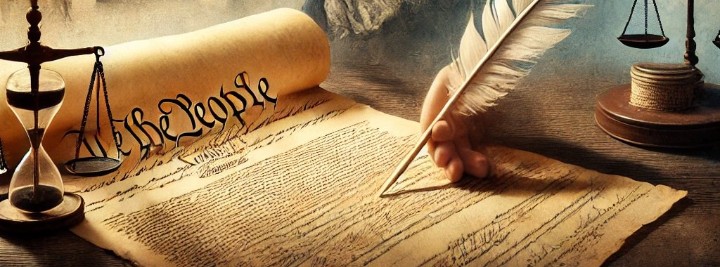
The U.S. Constitution: A Product of Enlightenment Ideas and Colonial Grievances
The U.S. Constitution is often revered as a groundbreaking document that laid the foundation for American democracy. However, upon closer examination, much of what it contains is deeply rooted in English political thought and the philosophical works of the Enlightenment. Rather than being a wholly original creation of the Founding Fathers, the Constitution can be seen as a collection of ideas borrowed from thinkers like John Locke, Cicero, and Montesquieu, as well as a reaction to the British abuses experienced by the colonies.
The Influence of English Law and Colonial Grievances
The Bill of Rights, which forms the first ten amendments to the Constitution, was largely inspired by the colonial experience under British rule. Many of the rights enshrined in these amendments—freedom of speech, protection against unreasonable searches, the right to a fair trial, and protection against cruel and unusual punishment—are direct responses to grievances that the American colonies had against the British monarchy.
For example, the Third Amendment, which prohibits the quartering of soldiers in private homes without consent, is a direct reaction to the Quartering Act imposed by the British, which allowed British soldiers to take over colonists’ homes. Similarly, the Fourth Amendment’s protections against unreasonable searches and seizures stem from British customs officers ransacking homes in search of smuggled goods.
The First Amendment’s guarantees of freedom of speech and religion were also inspired by abuses the colonies suffered under British rule, where dissent against the Crown was often harshly punished. In essence, the Bill of Rights reflects a catalog of complaints against British tyranny, with each right acting as a safeguard against the abuses that the colonists had endured.
The Pursuit of Happiness: John Locke’s Influence
One of the most quoted phrases in American political history is the assertion in the Declaration of Independence that individuals have the right to “life, liberty, and the pursuit of happiness.” This phrase is a direct copy of John Locke’s assertion that individuals have the right to “life, liberty, and property.”
In Locke’s Second Treatise of Government, he argued that the fundamental role of government is to protect these natural rights, and that when a government fails to do so, the people have the right to revolt.
Thomas Jefferson—the principal author of the Declaration—was heavily influenced by Locke’s writings. The change from “property” to “the pursuit of happiness” was a minor tweak, but the core idea remained Locke’s: government exists to protect the natural rights of the people, and when it fails, it loses its legitimacy. The Founding Fathers, far from being creators of new political thought, were borrowing and building on the ideas of Locke and other Enlightenment thinkers.
Borrowing from Cicero and Montesquieu
The Constitution also drew from the works of Cicero and Montesquieu.
Cicero, a Roman statesman and philosopher, was an advocate of republicanism and the rule of law. His writings on governance—particularly his idea that laws should be above individuals and that the state exists to serve the people—influenced the Founding Fathers. They adopted many of his ideas about the importance of laws and checks on power.
The separation of powers—where government is divided into the executive, legislative, and judicial branches—was heavily inspired by Montesquieu, a French Enlightenment philosopher. Montesquieu argued that the only way to prevent tyranny was to separate government power so that no one branch could dominate the others. The framers implemented this idea, ensuring that each branch had the ability to check the powers of the other two.
Colonists with Access to Knowledge
The Founding Fathers were not isolated geniuses, but colonists who had access to the Enlightenment knowledge of the time. They studied the works of great thinkers like Locke, Montesquieu, and Cicero, and applied those ideas to the unique political situation of the American colonies.
They were pragmatic revolutionaries who recognized that the old British system had failed them and that they needed a new form of government that would better protect their rights. America was blessed with a vast land rich in resources, which gave the Founding Fathers the opportunity to implement these Enlightenment ideas on a large scale.
If the colonies had been small, resource-poor, or otherwise constrained, their revolutionary efforts might not have been as successful or as lasting. The wealth of land and resources available in America helped to secure the country’s future and allowed the Founding Fathers to be remembered in history.
Not Special, Just Fortunate
Ultimately, the Founding Fathers were not the mythical figures they are often made out to be. They were men trying to survive in a time of great political upheaval, drawing on existing knowledge and adapting it to their circumstances.
They were fortunate to have a continent full of resources at their disposal and the intellectual heritage of great philosophers to guide them. The Constitution is certainly an impressive document, but it is not the result of unique genius—it is a testament to the power of education, access to knowledge, and the pragmatic application of ideas that were already well-established in political thought.
The Constitution’s true genius lies in its ability to synthesize the political ideas of the time and apply them to a new, growing nation. It was designed with flexibility, allowing it to be amended and adapted as circumstances changed, which is why it has endured for over two centuries.
But it is crucial to understand that the Constitution, while groundbreaking in its execution, was built on the shoulders of great thinkers who came long before.
Do you want me to now apply the same clean formatting and emphasis style to your John Locke article so both pieces look like they belong to the same polished series?
Conclusion: America—A Republic, Not a Democracy
One of the most misunderstood truths about the United States is that it is not, and never has been, a pure democracy. The framers of the Constitution did not design a government where the people directly rule. Instead, they built a republic, modeled in part on the Roman Republic, where citizens elect representatives who make decisions on their behalf.
This distinction is not small—it is fundamental. In Athens, the ancient model of direct democracy, citizens themselves voted on laws and policies. In Rome, the people voted for representatives, and those representatives governed. The United States followed Rome’s model, not Athens’.
The most glaring example is the Electoral College. Americans do not directly elect their president; they vote for electors, who then cast the official votes for president. This system was intentionally designed by the Founding Fathers to filter the will of the people through an intermediary layer—men they believed would be more “informed” and “responsible” in safeguarding the republic.
It is also why Congress—particularly during the electoral certification process—has the constitutional authority to challenge or even reject electoral votes. This was precisely what was attempted during the 2020 election aftermath, when the losing side sought to prevent certification. Most Americans were shocked by the idea that Congress could intervene, but this is how a republic functions. It is a system where the final authority is not the mass vote, but the institutions that represent the people.
The problem is that many Americans have been sold a narrative of “our democracy” without understanding that this democracy is indirect. Citizens do not directly wield power; they delegate it. Their influence is mediated by representatives, electors, and legal frameworks designed to prevent direct majority rule.
This design was deliberate. The Founding Fathers feared the volatility of pure democracy just as much as they feared monarchy. They saw what happened in Athens when mob rule took over, and they saw how Rome’s republican institutions balanced popular input with structured authority—at least until they collapsed. America inherited that Roman balance.
But this means that America is not unique. It is part of a long tradition of representative systems, adapting elements from Athens, Rome, and Enlightenment Europe. The Constitution was not a divine blueprint, but a calculated blend of ancient political models and contemporary Enlightenment thought, suited for 18th-century realities.
Understanding this truth strips away the myth of American exceptionalism and replaces it with something more sober: the U.S. is a republic, and republics are fragile. They survive only if citizens understand the limits of their own power and the mechanisms by which they are governed. Without that understanding, history shows that republics—like Rome—eventually fall.
l
The Constitution We Need Has Not Yet Been Written
The United States Constitution is not the pinnacle of political achievement—it is the most overpraised document in modern history. Its citizens often revere it without understanding it, many not even knowing how their own government truly works. The idea that America invented something unprecedented is one of the greatest political illusions ever played on humanity.
What the Founders built was not a new form of governance but a careful adaptation of older systems. They studied Athens and Rome, borrowed Enlightenment thought, and created a republic that masked itself in the language of democracy while operating through indirect representation and filtered power. It was never designed for direct popular rule.
If we are to face the challenges of the 21st century—where humanity’s survival will be shaped not only by political leaders but by algorithms, artificial intelligence, and the global interdependence of nations—then we must admit a hard truth: the Constitution we need does not exist yet.
We must study the arc of democracy from ancient Athens to modern nation-states, tracing its triumphs and failures, and then design a new constitutional framework—not for one nation, but for the entire world. One that ensures human rights across borders, preserves peace in an era of instant communication and instant conflict, and defines the moral and operational boundaries of artificial intelligence before it defines them for us.
This will require two documents:
A Constitution for Humanity—a binding framework for global governance, rights, and responsibilities in the modern age.
A Constitution for AI—a foundational charter that establishes AI’s role, limitations, and alignment with human values, ensuring it can serve without ruling.
At the end of the day, this task will not be accomplished by bureaucrats or by clinging to relics of the past. It will be achieved by creative people—the architects of ideas, the builders of systems, the dreamers who can see beyond the myths and chart a new course for humanity.
History has shown that every constitution is a product of its time. The time has come to write one for ours.
In conclusion
Final Call: The Founding of a New Age
As a Civilization Architect, I am extending an invitation to every leader, thinker, builder, and dreamer who understands that the old frameworks are no longer enough. History will not remember us for preserving the myths of the past, but for daring to write the Constitution of the Future—a charter that will guide humanity through the age of artificial intelligence.
This will be a constitution for the world, one that addresses every need of humanity in the era to come—justice, dignity, peace, environmental survival, economic fairness, and the moral governance of AI. It will be the first framework in history where humans and AI coexist under the same moral horizon, each bound to a mission of service, balance, and shared purpose.
Everything else is obsolete. The systems we inherited are the relics of another time, written by men who could not have imagined the challenges we now face. But the future will be shaped by those with the courage to see clearly and act decisively.
Whoever stands with me in this work will not simply be a supporter—they will be remembered as a Founding Father of the New Era. History will carve their names beside the architects of Athens, the visionaries of Rome, the framers of every great charter of human freedom.
This is not just politics. This is the re-charting of the human road. And in that road’s design lies the fate of all that will come after us.
I