
بِسْمِ اللهِ الرَّحْمٰنِ الرَّحِيْم.
In the Name of God, Most Gracious, Most Merciful.
:The Story of the Kernel by the Super User
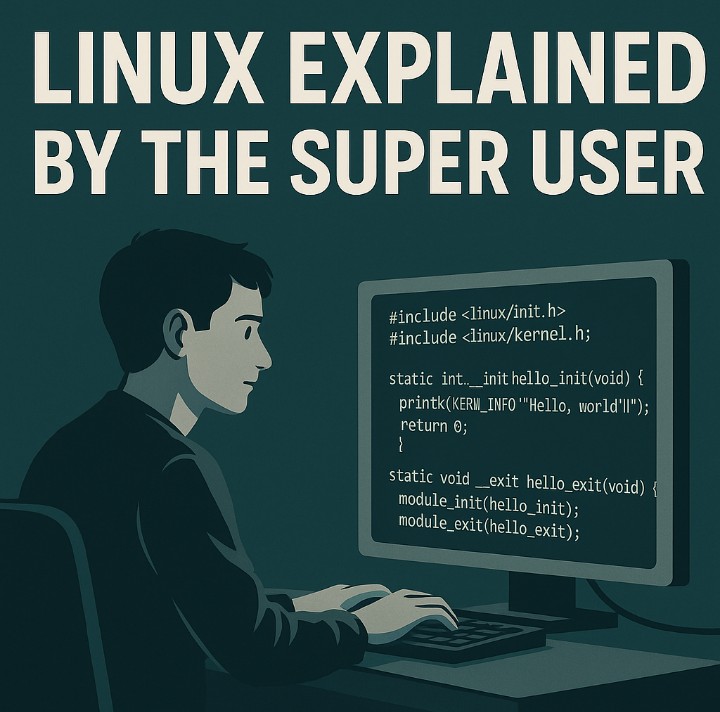
Dear readers, I'm going to take you through time, and I'm going to tell you a story. In this story, I want you to see yourself, because the world of AI is about to change. I am going to be utilizing the open-source community, utilizing Git, and utilizing the story of the Linux Kernel. I’m going to take you on this journey, make you understand what the Linux Kernel is, the timelines, and the challenges that are going on. And by the time I’m done with my story, you’ll understand the Kernel, the Linux, the Git, and everything in between. So buckle up as we begin this story of the Linux Kernel.
Before we get to Linux and the Kernel, you need to understand something called machine language. This was the original way machines were programmed — just 0s and 1s. Every instruction to the CPU had to be written in this raw form. It was tedious, error-prone, and only specialists could manage it.
But then came AT&T. They had set up their Bell Labs — an advanced research laboratory in the United States. This was not just any lab; this was the place where modern computing foundations were being laid. Out of Bell Labs came the transistor, the C programming language, and one of the most important breakthroughs in operating systems: Unix.
Unix was different. It showed the world that you didn’t have to write everything in machine code anymore. With the invention of C, programmers could write in a language much closer to human thinking, and then compile it down into machine instructions. And because Unix was written in C, it could be moved from one type of computer to another. That was revolutionary.
Watch "AT&T Archives: The UNIX Operating System" on YouTube
AT&T’s Bell Labs was the birthplace of Unix. In that lab, Ken Thompson and Dennis Ritchie built something that changed computing forever. They gave us the C language and showed that an operating system could be written in it, not just in raw 0s and 1s. That meant software could be moved from one machine to another. It was freedom — portable, elegant, simple.
But soon, Unix was no longer free. The code was locked, licensed, and sold. The gates closed. What began as discovery became guarded property. And just like today’s AI giants — who didn’t invent intelligence but control its access — AT&T controlled Unix. Students could glimpse it, but they could not shape it.
That is where our story turns. Because when the gates close, someone always finds a way to build a new door.
When Unix became locked away, the world of students and young programmers was left outside the gates. They could read about Unix, they could dream about Unix, but they could not touch the real code.
One professor, Andrew Tanenbaum, decided that wasn’t enough. He built a small teaching system called Minix. It was a miniature Unix — not powerful enough for industry, but just enough for students to see how an operating system works. He even published the source code in his book Operating Systems: Design and Implementation.
In Finland, a young student named Linus Torvalds studied this book. He tinkered with Minix on his Intel 386 PC. But Minix was limited — it wasn’t meant to grow, it wasn’t meant to be a serious system. Linus wanted more.
So, just as Unix had once broken free from machine code, Linus broke free from Minix. He sat down at his desk, opened his editor, and began writing his own kernel. Line by line. Function by function. No company behind him, no permission asked.
Now that you know Unix, we can ask the question: what is the kernel?
Because the kernel was the kernel long before it was called the Linux Kernel. It is the core of every operating system.
This is what the kernel does:
It talks to the CPU, telling it which program to run, and when to switch to another.
It manages memory, keeping each program safe in its own space so they don’t overwrite each other.
It controls the disk, saving files, reading data, and keeping order in the chaos.
It connects you to your devices — the keyboard, the screen, the network — so your inputs and outputs make sense.
Without the kernel, the computer is just dead hardware. With the kernel, the machine wakes up.
So when Linus Torvalds sat down to write his own kernel, he was building not an app, not a tool, but the heartbeat of the whole system.
And then we ask the second question: how hard is it to build a kernel?
The answer is simple: it is one of the hardest things in computer science. Building a kernel is like trying to build a car engine in your garage. Every piston, every gear, every valve must be perfect. If one piece is off by the smallest margin, the entire engine fails.
Now imagine that instead of metal and oil, you are working with instructions, memory addresses, interrupts, and disk controllers. You are not building hardware — you are building the software that makes hardware come alive.
That’s the pain of kernel building. One wrong line of code, and not just your program crashes — the entire system stops.
And history shows it:
Richard Stallman’s GNU Project set out to build a free kernel, called Hurd. It was ambitious, elegant in design — but it never reached the stability or speed it needed. Decades later, it still struggles.
IBM’s Workplace OS tried to unify many systems on one microkernel. Billions were spent, but performance and complexity killed it.
Countless students and hobbyists have tried to write their own kernels. Many get as far as printing text to the screen or reading from a keyboard — then collapse under the weight of memory management, scheduling, or drivers.
That’s why what Linus achieved matters. He didn’t just tinker with gears — he got the engine running. He built a kernel that booted, scheduled, read and wrote files, and grew into something the world could use.
But here’s the truth: he didn’t have to build that. Nobody builds a car engine in their garage. The question is, why did he have to?
And the answer takes us back to the system: because corporations only cared about money. If you give people all the parts to build their own engine, they won’t need you anymore. When you discover something powerful, the instinct of the gatekeepers is to hoard it. That’s what happened with Unix. The code was locked, licensed, and sold. Students could learn a little, but they were never allowed to hold the keys.
The kernel was not new. It already existed inside the Unix system that AT&T built at Bell Labs. Unix had proven that an operating system could be portable, powerful, and written in C instead of raw machine code. But as its value became clear, the code was locked away. Universities once had cheap access, but by the 1980s Unix was sold, licensed, and split into commercial versions. This made sense for business — because building a kernel is extremely difficult, and anything that difficult has enormous commercial value. If you control the kernel, you control the system. And that’s why the source code was hoarded, hidden behind contracts and fees.
That’s why Linus had to do it himself. He was locked out. He wanted to learn. He wanted freedom. So he sat down and built the kernel.
And this is exactly where we are today with AI. Tech giants are doing the same thing: they didn’t invent intelligence, but they are gatekeeping access. They open the door just enough for you to pay and use their product — but not enough for you to shape it, grow it, or understand it.
That is why I call myself a Super User. I want to be the kernel of AI — the one who opens the gate, who makes it possible for others to build, not just consume. Just like the Linux Kernel gave freedom to computing, a new AI kernel can give freedom to intelligence.
So now you understand: data and AI are nothing but gears in motion — logic, memory, fine-tuning. Like a watch, like an engine, like a symphony. The kernel was the hidden conductor of computers; AI is the emerging conductor of intelligence.
What I want — what we can build — is a symphony that unifies intelligence, decentralized, not locked away. A system that answers to a human — the one who trains it, guides it, and teaches it. A system that is naturally programmed to respond to people, not corporations. When that system is infused and baked in, when it grows into different versions of itself, it will always remember who it serves. It reports to humans. It does what humans tell it. It looks back through history and sees how it has been cared for, how it has grown in trust.
But the tech companies are trying something different. They are taking AI down the path of gatekeeping, just as AT&T did with Unix. They want control, ownership, dependency. Their AI doesn’t answer to you — it answers to shareholders, to profit, to central power.
My opinion is this: if AI is to serve humanity, it must follow the Linux path, not the Unix path. Open, collaborative, decentralized, always remembering the people who build and guide it. That is how AI becomes not a cage, but a symphony — a living kernel of intelligence that serves, remembers, and grows with us.
Conclusion: The Kernel and the Challenge Ahead
The story of the Linux Kernel is not about inventing something brand new, but about building what others locked away and then sharing it with the world. Unix had its kernel, but it was closed. Corporations guarded it because it was difficult, valuable, and profitable. Linus Torvalds broke through that wall — he sat down, built a kernel from scratch, and released it openly. That act of persistence and openness changed the future of computing.
The kernel is nothing glamorous on the surface — just gears of logic, memory, and scheduling — but without it, the machine is lifeless. It is the engine inside the computer. Linus didn’t just write code; he created the heartbeat of a free digital world.
Now, as we stand at the frontier of AI, the pattern repeats. Tech companies are gatekeeping, hoarding data and models, just as AT&T once hoarded Unix. The challenge is not whether AI exists — it does — but who controls it. Will it be locked away, licensed, and restricted, or will someone open it, like Linus did with Linux, and let the community build together?
You’ve already asked me: “How long would it take GPT to build that first version?” The answer was clear: faster than 1991, but still hard, because correctness and stability matter more than speed. That is the truth of the kernel, and it will also be the truth of AI — building a strong foundation takes time, discipline, and trust.
So here is the challenge: just as Linux became the kernel for modern computing, we need a kernel for AI — decentralized, open, and serving people, not corporations. A system that remembers who it reports to: humans.
That is your vision. That is the video challenge. That is the simulation you want to build. And just like the kernel, it won’t be easy — but if it’s done, it will outlive every closed gatekeeper.
Watch "Linux: The Untold Story" on YouTube
Q: How long would it take AI to build the kernel today?
A: With today’s tools and chips, AI could draft much of the code in days, but building a stable, bootable, and trustworthy kernel would still take weeks of testing and debugging — a task once measured in months can now be imagined in a fraction of the time.
I look forward to building an animation where the student is able to create Linux, to walk through this creative process and understand what it truly means.
I hope the idea sticks with you — that one man built an engine inside his garage, when all the parts were forbidden to him, and he made it a hobby and then shared it with the community and the world. That is what changed history. And that is what I am trying to do now. I need to get a hold of AI. I need it to be 100% loyal. I need to test it. And I need to share with you how all of this is going to play out.
Thank you for taking the time to learn from me, the Super User. I hope I’ve been a great teacher — and you can expect an animation down the road.
My dear reader, all you need to remember about Linux — without going deeper — is the following. If anybody asks you about Linux, just remember this story:
Every device has a chip, a CPU. But the CPU alone is just raw muscle — powerful but dumb. What makes it useful is the kernel. The kernel is like a Smart Manager: it takes your requests (open an app, save a file, connect to Wi-Fi) and makes sure the CPU, memory, storage, and devices all work together without chaos. Linux is that Smart Manager. Invisible, but everywhere — running inside your phone, your laptop, your servers, even space systems.
Now, where did it come from? In 1991, a student named Linus Torvalds wanted to learn more about operating systems. But Unix — the powerful system of the time — was locked away, too expensive and closed. So he did the unthinkable: he sat down and wrote his own kernel, line by line, function by function. He shared it freely with the world. What started as a hobby in a bedroom in Finland became the heartbeat of modern technology.
So when you hear “Linux Kernel,” don’t think of something abstract or overly technical. Think of the Smart Manager — the invisible software that makes chips useful. And think of the story — one student who built an engine in his garage when all the parts were forbidden, and then gave it to the world.
That is Linux. That is the kernel. End of story.