

بِسْمِ اللهِ الرَّحْمٰنِ الرَّحِيم
The Man Who Ended Tyranny and Enlightened Hearts and Souls with Ideas That Built democracy itself.
Abdul-Jabbar ibn Yusuf ibn Omar ibn Abdul Karim — @OmarArizona
The Man Who Ended Tyranny and Enlightened Hearts and Souls with Ideas That Built America and Stood the Test of Time
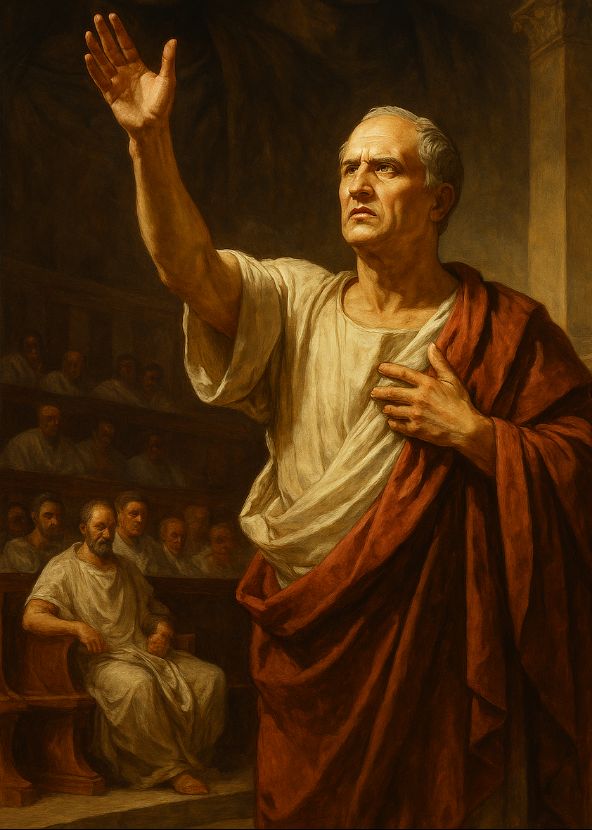
Cicero was more than a statesman; he was a beacon of wisdom who used the tools of reason, law, and virtue to defend the Republic from the forces of tyranny. His ideas, woven into the fabric of his speeches and writings, transcended his era and influenced the creation of modern nations, most notably the United States. Cicero’s dedication to the principles of liberty, justice, and moral responsibility laid the foundation for the freedoms enjoyed by countless societies today. His thoughts didn’t just build a government—they inspired hearts, opened minds, and stood the test of time as a reminder of what it means to live under the rule of law.
The Enduring Legacy of Cicero in American Political Thought
Cicero's influence transcends time, leaping from the crumbling walls of the Roman Republic to the formation of modern democracy. His belief in the rule of law, the necessity of civic virtue, and the delicate balance of power were not mere theoretical musings but lived experiences that shaped his political career—and his ultimate fate.
The Founding Fathers of the United States, inspired by his eloquence and vision, incorporated these lessons into the very fabric of the American Republic. Yet, Cicero’s influence is more than just historical; it’s a legacy that endures in the foundational principles of justice and governance today. The brilliance of Cicero lies not only in his defense of republicanism but in the timelessness of his thoughts, which continue to resonate as a blueprint for preserving freedom against tyranny.
Cicero Was a Champion Against Tyranny
Tyranny, as Cicero defined it, was the ultimate threat to liberty—the unchecked, absolute power that sought to silence reason and enslave the soul of a republic. Cicero lived and breathed the ideals of freedom and governance, believing that the greatest danger to a flourishing society was allowing any one individual or group to amass too much power.
“In a republic this rule ought to be observed: that the majority should not have the predominant power.”
He didn’t just preach these principles; he fought for them, often at great personal cost.
Cicero’s legacy as a statesman was anchored in his tireless efforts to prevent tyranny from creeping into the heart of Rome. As consul, he was unwavering in his commitment to keeping power balanced, ensuring that no single leader could dismantle the Republic’s democratic structure. His work in stopping the Catilinarian Conspiracy is a prime example—an effort to protect Rome from falling into the hands of an ambitious few.
Cicero saw tyranny not just as an assault on the state but on the very essence of human dignity. He recognized that the abuse of power stifled the intellectual and moral growth of society.
Yet, not everyone shared his vision. Cicero’s pursuit of these high ideals made him enemies, for not everyone was interested in seeing people free. Power, for many, was a tool of domination, not an instrument for the common good. Cicero understood this all too well, and his life was a testament to the belief that a republic could only thrive if its leaders were bound by law, philosophy, and a commitment to the welfare of its citizens. Today, we can draw from his example, realizing that the fight against tyranny is ongoing. We must learn, as Cicero did, that vigilance, knowledge, and balance are the cornerstones of true freedom.
The Wisdom of Cicero’s Writings
Cicero’s brilliance was not confined to the political arena alone. His writings, which have echoed through the centuries, are a masterclass in philosophy, law, and statesmanship. In works like De Re Publica (On the Republic), De Legibus (On the Laws), and De Officiis (On Duties), Cicero laid out a vision for a just society, where power is balanced, citizens are virtuous, and the law is supreme. These texts were not just intellectual exercises; they were blueprints for governance that influenced philosophers, scholars, and leaders for generations, including the Founding Fathers of the United States.
De Re Publica (On the Republic)
Cicero explores the concept of a mixed constitution, a balance between monarchy, aristocracy, and democracy—ensuring that no single branch of power dominates. He presents the idea that the best government is one in which the rule of law, tempered by virtue and wisdom, governs all. Cicero’s thoughts here were revolutionary because they captured the essence of the Roman Republic’s ideals and warned against the dangers of dictatorship. He wrote,
“The welfare of the people is the highest law.”
—a phrase that encapsulates his belief in governance that serves the public rather than the rulers.
De Legibus (On the Laws)
This complements his earlier work by focusing on the nature of law itself. Here, Cicero argues for natural law—principles that transcend human-made laws and are based on reason and morality. He famously states,
“True law is right reason in agreement with nature; it is of universal application, unchanging and everlasting.”
This work emphasizes the importance of justice as a cornerstone of society, offering a philosophical foundation that would shape Western legal thought.
De Officiis (On Duties)
Written in the final years of his life, Cicero turns to personal ethics and the responsibilities of public officials. This book was highly influential during the Renaissance and was considered required reading for anyone aspiring to leadership. Cicero’s message was clear: a public official’s duty is to act for the common good, placing moral integrity above personal ambition. He writes,
“The more power a man possesses, the more responsible he becomes for its exercise.”
Beyond his philosophical writings, Cicero’s speeches remain some of the most powerful orations in history. His Philippics—a series of speeches against Mark Antony—stand out as a fearless condemnation of tyranny. In them, Cicero risked his life to defend the Republic, famously declaring,
“I defended the Republic as a young man; I shall not desert her now that I am old.”
These speeches serve as a reminder of his unwavering commitment to liberty, even in the face of death.
Cicero’s works were not merely about theory; they were filled with practical wisdom on governance, justice, and personal virtue. They continue to be a guiding light for those who seek to understand the foundations of democracy and the delicate balance between authority and freedom.
Cicero’s Speech Against Mark Antony: A Stand for the Republic
The political landscape of Rome after the assassination of Julius Caesar in 44 BC was one of chaos and uncertainty. The conspirators who killed Caesar hoped to restore the Roman Republic, but instead, Rome was plunged into civil war. In this turmoil, Mark Antony, a close ally of Caesar, sought to consolidate power, presenting himself as the heir to Caesar’s authority.
Cicero, who had been brought back from exile by Caesar years earlier, saw in Antony the same threat to the Republic that he had seen in Caesar. Determined to prevent Rome from slipping further into autocracy, Cicero used his unparalleled oratory to challenge Antony’s growing influence.
The Philippics are a series of speeches Cicero delivered in 44–43 BC against Mark Antony, calling for the defense of the Republic and rallying the Senate to action—modeled after Demosthenes against Philip II. The Second Philippic was a blistering critique of Antony’s character, actions, and ambitions—an open declaration of war on tyranny.
“You, Antony, have done nothing with the spirit of a citizen… You seek not the welfare of the Republic, but the destruction of it… You wish to be a king, not a consul… The Republic lives, and I stand here as its protector.”
Context Behind the Speech:
Caesar has been assassinated, the Republic is in the balance, and Antony seeks to further his ambition. Cicero, an elder statesman and the last hope for the Republic, steps forward with the only weapon he has left—his voice. Though this would ultimately cost him his life, the speeches remain a powerful testament to his commitment to liberty and justice.
Sadly, Cicero’s efforts were in vain. Antony, with Octavian (later Augustus), defeated the Republic’s defenders. Cicero was declared an enemy of the state and assassinated in 43 BC. Yet his speeches live on as brilliant rhetoric and warnings about tyranny—ever-relevant reminders of the fragility of democracy.
Cicero’s Stand Against the Triumvirate: A True Patriot
After Caesar’s assassination, Rome saw the rise of the Second Triumvirate—Mark Antony, Octavian, and Lepidus—an alliance presenting itself as unity but in reality a division of power for personal gain. They carved up Roman territories to serve their own interests.
Cicero saw through this façade. He opposed their consolidation of power every step of the way: vetoing decisions, speaking against schemes, and warning the Senate. During their proscriptions—political purges—Cicero became a target. Even as death loomed, he refused to compromise.
He lived by:
“The safety of the people shall be the highest law.”
Cicero was willing to lose everything—influence, wealth, even life—because preserving the Republic was worth the ultimate sacrifice. His resolve shows that true leadership is measured not by survival in power but by commitment to the greater good.
The Final Act of Courage
In the end, it was Cicero’s actions, not words alone, that sealed his legacy. When Antony sought to silence him, Cicero had the opportunity to flee; he chose not to. He had lived for the Republic, and he would die for it. In 43 BC, as Antony’s men approached, Cicero calmly faced his assassins—his courage in death mirroring his courage in life.
Though his life ended in violence, his ideals lived on. His unwavering stand against tyranny, refusal to compromise, and dedication to freedom and justice have inspired generations. Cicero’s final chapter was not defeat but moral victory. His legacy reminds us that the battle against tyranny requires not only words but action.
Why We Must Study Cicero: The Architect of Modern Liberty
Cicero’s writings are foundational for anyone who values freedom, justice, and the rule of law. His words shaped the Roman Republic and, through it, the very idea of democracy. The Founding Fathers of the United States studied Cicero intently while constructing a government of the people, by the people, for the people.
His warnings against concentrated power, his insistence on virtue in leadership, and his defense of separation of powers influenced Jefferson, Adams, and Madison. During the Renaissance, thinkers like Erasmus, Machiavelli, and Montaigne turned to Cicero to revitalize society on reason, justice, and republican ideals.
In a world where tyranny and autocracy still threaten freedom, Cicero’s writings are as relevant as ever—a call to vigilance grounded in wisdom, reason, and justice.
A Checklist for Understanding Cicero and Liberty
De Re Publica (On the Republic) — Vision for a balanced government; power divided to prevent tyranny; welfare of the people prioritized.
De Legibus (On the Laws) — Natural law, justice as society’s foundation; influence on Western legal thought and human rights.
De Officiis (On Duties) — Ethical responsibilities of public officials; common good above personal gain.
The Philippics — Speeches against Mark Antony; a masterclass in rhetoric and a passionate defense of republican principles.
These works—studied by the Founding Fathers and Renaissance thinkers—still guide how to safeguard freedom and justice.
A Final Note of Gratitude
We owe much of today’s freedom to Cicero’s writings and the legacy he left. His warnings about the fragility of liberty and the dangers of tyranny are more relevant than ever. By studying his works, we better understand how to protect our Republics and ensure power remains in the hands of the people. Thank you for engaging with Cicero’s life and thought. With your curiosity and dedication, his words will continue to inspire future generations.
Reemphasizing the Importance of Cicero: A Call to Study and Act
If you want to stop tyranny — if you want to build something as enduring and just as the United States, or even better — Cicero is not just a historical figure you should know about; he is someone you must study with intent and seriousness. His writings contain the blueprint for protecting liberty and ensuring that power serves the people, not the ambitions of the few.
From his warnings about unchecked authority to his belief in the rule of law and the importance of moral leadership, Cicero's ideas are timeless and more relevant today than ever before. The republics of today — and those of the future — will rise or fall depending on how deeply we understand and apply these principles.
If we fail to learn from him, we will repeat the mistakes of history. But if we embrace his wisdom, we will build societies that are not only free — but also just, enduring, and worthy of the generations to come.