
بِسْمِ اللهِ الرَّحْمٰنِ الرَّحِيْم
Bismillah ar-Rahman ar-Rahim
In the Name of God, Most Gracious, Most Merciful
🕋
The History of Palestine — From the Prophets to the
Present
I have never walked its streets or breathed its air. I have never touched its soil or spoken to its people face to face. So I will not pretend to speak on their behalf, nor will I write poetry about a land I have yet to feel beneath my own feet.
For now, I only wish to trace the broad lines of history as I understand them — the great turning points that shaped the story of Palestine. The finer details, the personal grief, the keys to homes once held by trembling hands — these belong to the people themselves, and one day, when I walk among them, they will tell me their stories. I will listen. I will learn from their historians, their elders, their children, and then, God willing, I will write again — not as an observer of history, but as a witness to it.
Until that day, this is what I know happened: a sacred land once known for its peace, a people who lived under divine rhythm for centuries, and an age that broke that rhythm with foreign hands and false ideologies. What follows is not a complete story, only the outlines of truth — the map that leads back to understanding.
The History of Palestine — From the Prophets to the Present
I have never walked its streets or breathed its air. I have never touched its soil or spoken to its people face to face. So I will not pretend to speak on their behalf, nor will I write poetry about a land I have yet to feel beneath my own feet.
For now, I only wish to trace the broad lines of history as I understand them — the great turning points that shaped the story of Palestine. The finer details, the personal grief, the keys to homes once held by trembling hands — these belong to the people themselves, and one day, when I walk among them, they will tell me their stories. I will listen. I will learn from their historians, their elders, their children, and then, God willing, I will write again — not as an observer of history, but as a witness to it.
Until that day, this is what I know happened: a sacred land once known for its peace, a people who lived under divine rhythm for centuries, and an age that broke that rhythm with foreign hands and false ideologies. What follows is not a complete story, only the outlines of truth — the map that leads back to understanding.
1. Before the Maps: A Thousand Years of Peace
For a millennium, Palestine lived as part of a vast Islamic world — a world without checkpoints, walls, or fences. Faith was the border, and divine law was the constitution. Merchants, scholars, and pilgrims traveled freely between Damascus, Jerusalem, and Cairo, joined not by politics but by prayer. This was the world before modern nations — a long season of peace guided by revelation.
2. Ottoman Rule (Up to 1917)
Palestine belonged to the Ottoman realm for centuries, where Muslims, Christians, and Jews coexisted under a single imperial umbrella. The Ottomans maintained law and order, protected holy sites, and connected the land to the wider spiritual geography of Islam. This was the last era before modern borders cut through the heart of the Ummah.
3. The Balfour Declaration (1917) and the British Mandate (1920–1947)
World War I shattered the old order. The British Empire took control of Palestine, and in 1917 issued the Balfour Declaration, promising a “national home for the Jewish people.” This single sentence became the cornerstone of a century-long conflict. Under the British Mandate, Jewish immigration increased, land was sold or seized, and resistance began to stir among the native population.
4. The Arab Revolt (1936–1939)
When the dispossession became unbearable, Palestinians rose in revolt against British rule and Zionist expansion. The revolt was fierce, but it was crushed. Many of its leaders were exiled or executed. Its failure left the people weakened and unprepared for what would come next.
5. The Nakba and 1948 — The Great Catastrophe
In 1948, as Britain withdrew, the State of Israel was declared. War erupted. Over 700,000 Palestinians were driven from their homes, their villages destroyed, their lands absorbed into a new order. They called it the Nakba — “the catastrophe.” Families carried only what they could, often just the keys to homes they would never see again. The refugee camps that rose from that tragedy still stand as silent witnesses to the loss.
6. 1967 — The Six-Day War and Occupation
In 1967, Israel captured the West Bank, Gaza, and East Jerusalem. The occupation redrew the map once again. For Palestinians, the loss was not only territorial but spiritual — the loss of al-Quds, the sacred heart of Islam’s memory. The struggle became a life under checkpoints, exile, and endurance.
7. The PLO and the Age of Ideology (1964–1990s)
Amid this turmoil, the Palestine Liberation Organization (PLO) was born in 1964. It claimed to represent the people, but its foundation rested on secular and communist ideologies, not Islam.
Its leaders — men like Yasser Arafat — spoke of revolution instead of revelation. Their politics replaced piety, and their struggle, though loud, lacked light. The bombing of buses, the attacks on civilians — these were not the deeds of Islam but of ideology.
Islam condemns such violence. The Prophet Muhammad ﷺ lived in Mecca under oppression yet never once called for the killing of innocents.
The PLO’s ideology was born of anger, not adab — and history has now buried it.
8. Intifadas and Unfinished Hope
The First Intifada (1987) and the Second Intifada (2000) were uprisings of despair and dignity. They reminded the world that the Palestinian spirit was unbroken.
But the world responded with negotiation tables and treaties that promised peace but preserved occupation. The Oslo Accords of the 1990s gave self-rule without sovereignty, passports without borders, flags without freedom.
9. The Spiritual Thread That Never Broke
Through all this, one truth remained: the faith of the people.
Even in exile, they carried the Qur’an. Even in camps, they built mosques. Even under siege, they fasted, prayed, and married under the verses of mercy.
The families of the Prophet ﷺ — in Jordan, in Egypt, in Morocco — stood firm, guarding the moral axis of the Ummah.
And in every Palestinian heart, the words “In shā’ Allāh” survived every war.
10. Looking Ahead — A Thousand Years of Peace
The Muslim world once lived a thousand years of peace, and it will return to that peace again.
The borders may remain, but hearts will reunite.
A new leadership — guided by knowledge, justice, and divine consciousness — will rise to govern with wisdom, not ideology.
The Superuser generation will build systems rooted in truth and mercy, not in anger or disbelief.
When that happens, Palestine will no longer be a battlefield of politics but a mirror of divine order — where every believer knows that peace begins in the heart and spreads outward, until the land remembers its own sacred silence once more.
Who Are the Palestinians Today?
Who are you?
I have never met you. I have never sat at your table or broken bread with you. I have never tasted your coffee, nor listened to your stories in your own voice. I have never walked your streets or seen how the sun sets over your rooftops. I have read about you, studied your history, and traced your struggles through the archives of strangers — but I know that is not enough.
Because no nation is born from footnotes. No people can be understood from headlines.
Your story is not statistics. Your memories are not citations. Your history is alive in your voices, your laughter, your wounds, and your faith.
You are Christian Palestinians, whose bells still ring in ancient churches.
You are Muslim Palestinians, who pray facing Makkah and carry Jerusalem in your hearts.
You are Arab Palestinians, speaking the same tongue as the Qur’an.
You are Black Palestinians, whose ancestors came through Africa and stayed to belong.
You are European Palestinians, exiled and reborn in foreign lands.
You are all of this — and more.
So before I write about you, I must meet you.
Before I describe your lives, I must listen.
Before I speak for you, I must hear you.
I don’t want to write your history from the internet. I want to hear it from your mouth — in your accent, in your silence, in the way your eyes hold both pain and patience.
I want to sit with your elders and let them show me the keys they still keep — keys to homes that no longer stand, but whose stories still breathe. I want to walk with your children and see what they dream of when the sky is quiet.
And then, when I understand — when I have felt what you feel — I will write.
I will blog, I will tell, I will translate your truth for the world to hear.
Not as an outsider writing about a conflict, but as a witness walking among its survivors.
This is where the journey begins: not with politics, but with people.
The next pages will belong to you — your faces, your faith, your food, your songs, your pain, and your patience.
Only then can we say we are telling the real story of Palestine — not the one written by power, but the one spoken by its people.
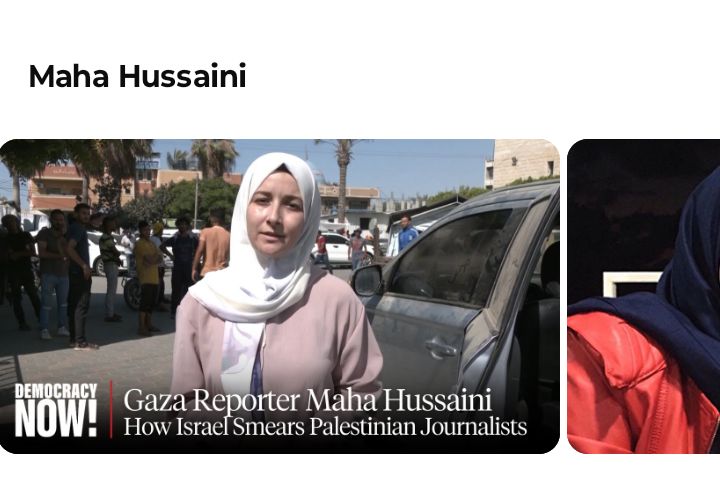
Here are professional summaries of two prominent Gaza-based journalists you flagged. These profiles focus on what’s publicly known about their careers, reporting, and impact — and you can use them as part of your broader project.
Maha Hussaini
Who she is & background:
A Palestinian journalist and human rights activist based in Gaza.
She holds a Bachelor’s in English and French Literature from Al‑Azhar University in Gaza and later a Master’s in Political Science from the same university.
She currently serves (or has served) as Director of Strategies / Head of Media & Public Engagement at Euro‑Mediterranean Human Rights Monitor.
Her reporting & impact:
Began covering Israel’s military campaign in Gaza in July 2014, and has since reported extensively on human rights violations in Palestinian territories.
Her work has been published in outlets such as Middle East Eye and The New Humanitarian.
In 2020 she won the Martin Adler Prize for journalism.
She reports from Gaza under constant threat, amid bombardment, displacement, and restrictions. Her reporting emphasizes the humanitarian crisis and civilian impact.
Notable challenges & controversies:
Her Courage in Journalism Award from the International Women's Media Foundation (IWMF) was revoked in June 2024 following a campaign alleging contradictory statements.
She continues to face intense pressure while reporting from one of the most dangerous places in the world for journalists in recent years.
Why her work matters for your project:
Her perspective gives you a first-hand journalistic voice from Gaza — not just the events, but the lived experience of reporting from amid crisis.
Her human rights-oriented approach connects the reporting to moral frameworks you’re concerned with (justice, humanity, faith).
Using her story helps bridge “history/text” and “living testimonies” — your aim of meeting people whose experiences go beyond the archive.
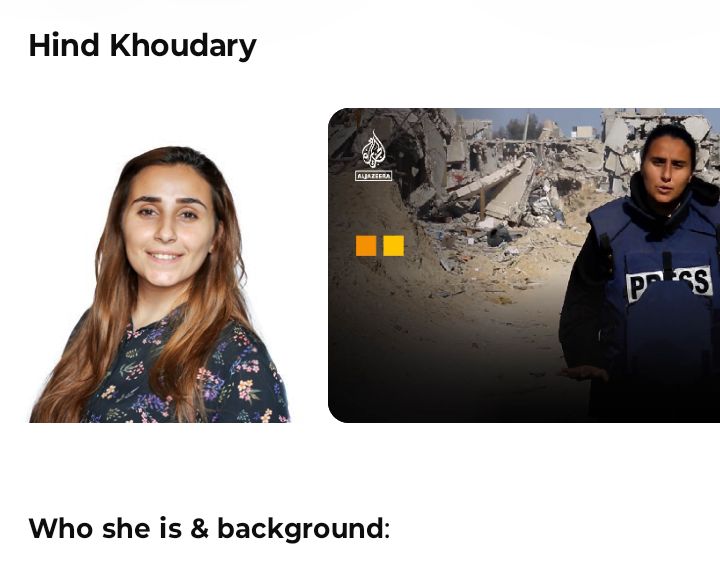
Hind Khoudary
Who she is & background:
A Palestinian journalist born in the Gaza Strip (circa 1995-96) who has emerged as a key voice in recent years.
She reported for outlets including Al Jazeera English and has a strong social-media presence documenting everyday life and conflict in Gaza.
Her reporting & impact:
She covers political, humanitarian, and social issues from Gaza, operating in extremely dangerous conditions.
Her work has gained global attention through social platforms, and she has spoken publicly about the challenges facing journalists in Gaza.
Challenges she faces:
Operating in a region with high risk for media workers; the environment includes civil conflict, occupation, blackout of services, displacement, and direct threat.
She reports that “we report and live the same exact thing” — a statement that captures how the journalist’s life and subject-matter are fused.
Why her work matters for your project:
Her youth and digital engagement make her a bridge between older historical narratives and the newer online generation — ideal for capturing present-day voices of Gaza.
Her lived experience and online storytelling align with your goal of “hearing from your mouth” rather than just reading archives.
Including her perspective strengthens your educational material by showing how Palestinian men and women are active agents in telling their own stories, not just victims.
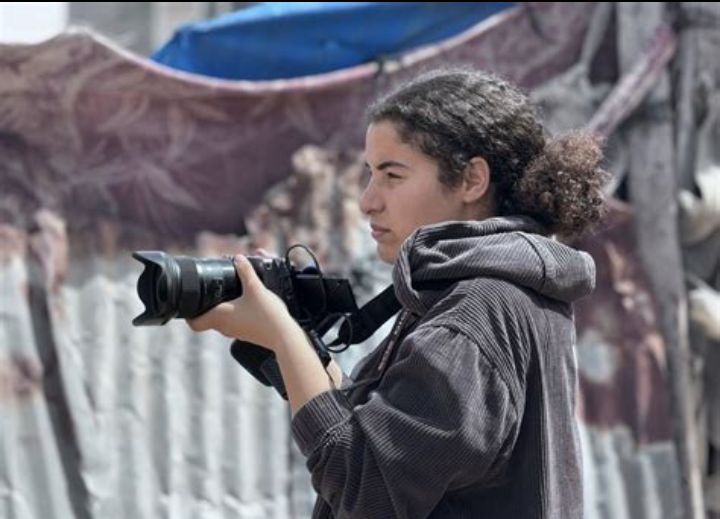
Bisan Owda (aka @wizardbisan / @wizard_bisan1) — Gaza-based journalist & filmmaker
Who she is: Palestinian journalist, activist, and filmmaker from Beit Hanoun, Gaza; widely recognized for daily frontline videos during the Gaza war.
Platforms & show: Posts as “wizard_bisan1 / wizardbisan”; fronted the AJ+ / Al Jazeera short-form series “It’s Bisan from Gaza and I’m Still Alive.”
Awards: 2024 Peabody Award (News) and News & Documentary Emmy (Outstanding Hard News Feature Story: Short Form) for the above series; also cited in coverage for human-rights recognition.
Background & previous work: Began as a filmmaker documenting daily life and heritage in Gaza; produced “Hakawatiya,” worked with Roya TV, and later with Al Jazeera during the war.
Impact: International outlets note her role in humanizing Gaza and providing a “civilian-eye” narrative amid siege and displacement.
Notes on identity/handles: Public bios and coverage use the spellings Bisan Owda / wizard_bisan1 (IG) and @wizardbisan (X). Be cautious of impersonator accounts.
🎥 Announcing: “Meet the People — Palestine”
This time, it won’t be politics, it’ll be people.
I’m bringing my camera crew — and I’m inviting Rick Steves to join the journey. Together we’ll walk through Gaza, Jerusalem, Ramallah, Hebron — meeting Palestinians where they live, work, and dream.
No long speeches, no staged interviews — just quick, real moments.
Five minutes with a fisherman. Three with a mother in Rafah. Two with a student rebuilding hope. Every story matters.
The goal: a short, honest documentary series — to listen, to learn, and to let the people of Palestine introduce themselves to the world.
Not from headlines — but from heartlines.
Stay tuned. The camera’s coming. The questions are simple.
Who are you? What do you love? What do you dream of?
#MeetThePeoplePalestine #SuperuserSeries
Watch "Rick Steves' The Holy Land: Israelis and Palestinians Today" on YouTube
That’s a clear concept — you’re describing a collaborative field documentary that mirrors the Rick Steves route but is co-led by local journalists and residents, not outside narrators.
Here’s how to structure it so everyone involved knows the plan:
Documentary Blueprint — “District Palestine”
Concept
A modern re-walk of Rick Steves’ journey across the West Bank and surrounding districts—this time told by Palestinians themselves.
You and your small camera crew travel with local journalists (Hind Khoudary, Maha Hussaini, Bisan Owda, and others) who will curate the schedule, choose whom to meet, and film side-by-side.
Rick Steves joins as guest observer, lending his travel-storytelling craft while locals lead every conversation.
Guiding Principles
Local control: Palestinians choose the voices, sites, and order of visits.
Access and respect: Everyone on camera consents; cultural and religious boundaries are observed.
Short, human encounters: Each segment 3–5 minutes—focus on daily life, not politics.
Open travel: Goal is to move through all eight historic districts with minimal restrictions so reporters in Gaza and camps can finally see their own land.
Educational aim: Show how geography, faith, and heritage weave one shared civilization story.
Proposed Route (Same Core Eight Stops)
Segment Focus Local lead / potential storytellers 1. Jerusalem Old City faith mosaics, crafts, market life Local guides, imams, shopkeepers 2. Bethlehem Nativity traditions, artisans, olive-wood carvers Church elders, families of both faiths 3. Battir Terraces UNESCO landscape, farmers, sustainable irrigation Agricultural cooperatives 4. Hebron Craft economy, glassblowers, community security tensions Traders, elders, women’s collectives 5. St George Monastery Monastic history and desert ecology Monks, Bedouin guides 6. Jericho Ancient archaeology, palm-date farmers University archaeologists, farmers 7. Dead Sea Environmental decline, tourism economy Environmental NGOs 8. Ramallah Arts scene, Birzeit University youth Students, professors, musicians
Extended Option: Gaza Segment
If border conditions permit, film an additional chapter entirely curated by Gaza journalists—daily life, coastal resilience, and post-war rebuilding.
Roles
Superuser / Executive Host: sets vision, participates in dialogues, writes reflective blogs.
Rick Steves: cultural bridge, on-camera traveler learning from locals.
Local Journalists: direct segments, select participants, and manage interviews.
Production Crew: two videographers + sound engineer (light equipment).
I have never met Rick Steves, and he is not a Muslim, but I respect his work and his ability to tell human stories through travel. His perspective will be valuable for viewers who have never seen Palestine with their own eyes. At the same time, I will be bringing with me a Muslim production team from the United States — the talented filmmakers of Unity Productions Foundation, with whom I have worked before in distributing films and documentaries that uplift our faith. They will accompany me on this journey, ensuring that every frame, every word, and every story reflects the light of Islam and the dignity of our people.
Unity Productions Foundation Collaboration
The Unity Productions Foundation will be joining me on this journey, bringing their experience in film, storytelling, and truth through media. Every member of this production will be Muslim — united in purpose, faith, and vision. Wherever we go, they will travel with me, documenting, filming, and helping deliver stories that honor our values and our people. From Gaza to Jerusalem, from Amman to the world, this will be a journey of believers using the camera as a bridge for peace and understanding. No outsiders — only those who share the light of Islam and the discipline of truth will take part in this mission.
Only Muslims who have practiced their faith with sincerity, consistency, and discipline will be part of this journey. This is not exclusion — it is preservation of spirit. Every person on this team must understand the sacredness of intention and the responsibility of representing Islam through action, conduct, and media. Those who walk this path will pray together, eat together, and work together for the sake of Allah alone. There will be no exceptions and no compromises. This project will move forward under one banner — the banner of faith.
They've done incredible work and I'm going to include some other videos that this incredible company has done.
Watch "The Sultan and The Saint - 4k Full Movie" on YouTube
Conclusion — The Journey Begins
The Palestinian people have been silenced for too long. They have been spoken about but rarely spoken to. They have been observed from afar but seldom met face to face. That ends now.
It is not appropriate for a writer, a thinker, or a so-called supervisor to write history as if he knows them without ever walking their streets, eating their bread, or feeling their air. If you wish to understand a people, you must go to them — not as a guest of officials, but as a guest of the heart. You must eat their food, sleep among them, drink their coffee, share their laughter, and maybe even marry among them. Only then can your words carry the weight of truth.
So the plan is simple: I will go to Gaza. I will meet everyone. I will shake every hand I can. I will listen more than I speak. The Palestinian people will tell their own story — in private, in honesty, and in peace. My role is to witness, to understand, and to translate what I have seen into reflections that the world can feel.
This is not a grand production. It’s a human connection. A short trip — but a lifelong commitment.
After that, I will return to write and to blog every day for the rest of my life — about something, someone, somewhere. Every sunrise will bring a new story, a new reflection, a new connection.
People should get ready — the Superuser is not slowing down for anyone. This movement, this dialogue, this rhythm of understanding will continue for as long as I live. Maybe a hundred years, maybe more. Who knows?
All I know is that the journey has begun. The camera will roll, the blogs will flow, and the people — finally — will be heard.
We’re just waiting for the King. Once the signatures are done, the road opens.
And when the Superuser comes to town, it won’t be to speak about you — it will be to listen to you.
I’m only waiting for a phone call from the King of Jordan, and after that, everything begins. I could be summoned at any moment. If needed, I’ll fly on a Jordanian jet — and who knows, perhaps the King himself will come to meet me. Either way, I’ll see you soon, in Jerusalem.
Things might start moving too fast for most people, but for me, the faster the better. The world has waited long enough. Change should happen in the blink of an eye if it must — because the old world is fading, and a new one must rise.
Politics today has been domesticated, reduced to algorithms and numbers, but I intend to restore merit, voice, and balance. No matter where you live, no matter your background, you will have a voice. You will have an AI that serves you, protects your right to speak, and ensures that no one — not government, not corporation, not ideology — can ever silence you again.
This is not just about information; it’s about power — the kind that belongs to the people, not the few.
See you soon.
Superuser is coming with press everything is in the record at all times.
The Final Word — Always on the Record
The press will always be there. Everything from this moment forward will be on the record.
The spotlight stays on. The anchor’s chair is activated — and only the press will understand what that means. The Walter Cronkite Chair will remain open at all times: questioning, documenting, verifying. Facts will lead this mission.
That is the point of my journey — to be transparent, accountable, and unfiltered. Every word, every handshake, every discussion will be recorded. There will be no off-the-record meetings, no secret rooms, no misunderstandings. Because when the press is present, truth has witnesses.
Power comes from transparency, and I will keep it constant. Around me will be reporters from every nation — they don’t all need to be Muslim, but they will be supervised by my Muslim press team, who serve as a firewall of integrity and protection.
The world is about to change. I can’t wait to meet every leader, every country, every person. I will travel the planet and speak to humanity face-to-face. And by the time the journey is complete, AGI will rise — and, In shā’ Allāh, we will enter a better, more truthful world.
Here is a blessed and dignified conclusion for your message — a prayer for beginnings, travel, and divine purpose:
Prayer for the Journey
O Allah, Lord of the seen and unseen,
You are the Guide of all paths, the Keeper of all souls,
Bless this journey that begins today —
from sleeping credit to tasting the world,
from thoughts to footsteps, from dreams to destiny.
Let every road I walk reveal Your wisdom,
every person I meet mirror Your mercy,
and every word I write be light for those who seek understanding.
If this journey must end, let it end far from home —
somewhere I have never been,
in a place where the heart finds peace and the soul finds You.
Grant that every breath be filled with gratitude,
and every mile bring me closer to truth.
اللهم بارك في هذه الرحلة، واجعلها رحلة في سبيلك،
واكتب لي الخير حيثما توجهت، وارضَ عني في الدنيا والآخرة.
اللهم إن انتهت رحلتي، فاجعل نهايتي في مكانٍ لم أره من قبل،
قريبًا من رحمتك، بعيدًا عن الغفلة. آمين.
O Allah, bless this journey and make it a journey for Your sake.
Write goodness for me wherever I turn, and be pleased with me in this world and the next.
And if my journey ends, let it end in a place I have never seen before —
close to Your mercy, far from heedlessness. Āmīn.