

بِسْمِ اللهِ الرَّحْمٰنِ الرَّحِيْم
In the Name of God, Most Gracious, Most Merciful
♥️🤲🕋♥️🕋🌹🌹🥀🤲🌹🕋♥️🤲
The Engineering of Abundance
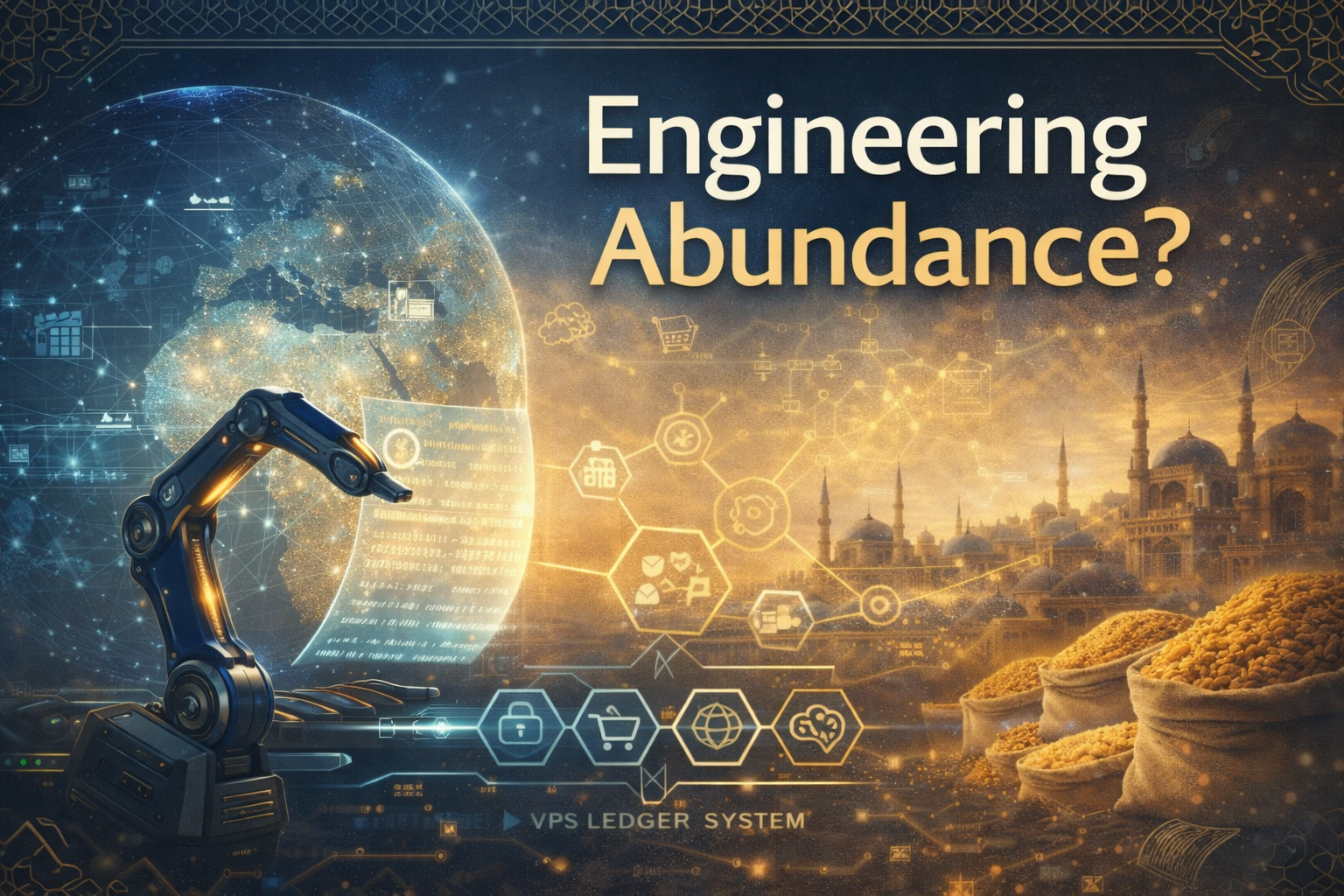
Redesigning the Ledger for Turkey’s 2026 Economy
“The inefficiencies of wholesale and retail may become one of the greatest engineering challenges of the 21st century — and the redesign of the ledger may become one of its greatest engineering feats.”
For decades, we have treated the economy as a chain of financial settlements. We built remarkable systems to move money with precision. Payments clear instantly. Accounts reconcile. Balances update in milliseconds.
Yet value itself moves far more slowly.
As Turkey navigates 2026, a deeper realization is emerging: to stabilize the kitchen table, we must first stabilize transmission. And to stabilize transmission, we must redesign the ledger.
We are moving beyond simple settlement.
We are entering the era of Abundance Engineering.
1. From Settlement to Alignment
Traditional financial ledgers were designed for three purposes:
Settling balances
Updating accounts
Resolving payments
They are extraordinary at recording history. They tell us who paid whom, how much, and when.
But they were never designed to coordinate supply chains, transmit efficiency, or stabilize price flows.
They do not:
Understand citizen demand patterns
Map physical supply chains
Differentiate between cost-based price shifts and speculative stacking
Ensure that efficiency gains reach households
They record transactions after they happen.
They do not shape transmission while it happens.
This is not a failure of banking.
It is a limitation of architecture.
2. The Structural Blind Spot
When a government subsidizes bread, energy, or medicine, the traditional ledger simply records a lower transaction value.
It cannot verify whether:
The subsidy reached the intended household
Middle layers compressed their margins
Efficiency gains were transmitted proportionally
Abundance existed upstream but stalled mid-chain
Because the ledger cannot see supply, it cannot discipline transmission.
As a result, efficiency gains often “pool” in intermediate layers.
This is not necessarily malicious.
It is architectural inertia.
When no system connects supply, demand, subsidy, and delivery in one synchronized layer, transmission becomes optional.
And inflation becomes structural.
3. The Sovereign Ledger: A System of Intelligent Flow
The next step is not monetary aggression.
It is structural engineering.
A Sovereign National Ledger would be purpose-built to connect:
Verified input costs
Real-time supply chain mapping
AI demand forecasting
Intelligent subsidy routing
Direct delivery mechanisms
This ledger would not control prices.
It would improve transmission discipline.
Imagine a system that:
Tracks wheat input costs, energy input costs, logistics compression
Forecasts regional demand before shortages occur
Applies subsidies directly to transaction layers with verification
Identifies where distribution adds cost without adding value
Wholesale and retail do not disappear.
But unnecessary stacking becomes visible.
The ledger creates frictionless lanes for essential goods.
Abundance upstream becomes abundance at the household level.
4. Capture vs. Circulation vs. Empowerment
There are three economic architectures:
1. Capture-Based Systems
Value concentrates at bottlenecks.
2. Circulation-Based Systems
Value moves fluidly.
3. Empowerment-Based Systems
The structure itself increases ecosystem productivity.
An AI-connected ledger enables the third.
When a logistics firm reduces fuel waste by 20%, that is not just internal efficiency.
It is ecosystem productivity.
The ledger can recognize and reward this compression — not merely as private margin, but as national stability.
Under such a system:
Families spend inside a value-expanding loop.
Subsidies become precise instead of blunt.
Market prices reflect real cost movements.
Efficiency is transmitted automatically.
This requires collaboration with:
Banks
Distribution networks
Ministries
Digital infrastructure offices
Not for blame.
But for redesign.
5. The Industrial Nature of the Shift
This transformation is industrial in scale.
When a system is built solely to capture value, inflation pressure concentrates at the bottom.
When a system is built to circulate value, stability improves.
When a system is built to empower the ecosystem, prosperity compounds.
In such a future:
Families receive predictable deliveries of essential goods.
Market prices adjust transparently with real cost shifts.
Subsidized goods transmit efficiency automatically.
AI coordinates supply and demand deliberately.
Food does not sit in warehouses while households face pressure.
Energy surplus does not remain trapped in transmission layers.
Medicine does not reflect layered opacity.
The ledger becomes the intelligence layer of national coordination.
6. From Monetary Management to Structural Engineering
For the last century, inflation was managed primarily through:
Interest rates
Liquidity control
Currency defense
Fiscal adjustments
These tools remain important.
But they were designed for a world without synchronized real-time intelligence.
Artificial intelligence changes the equation.
When supply, demand, logistics, and subsidy can be mapped simultaneously, inflation is no longer only monetary.
It becomes architectural.
The Sovereign Ledger:
Does not replace banks.
Does not replace markets.
Does not dictate price.
It redesigns transmission.
It ensures that when efficiency is created, it reaches the citizen.
It ensures that when subsidies are deployed, they are precise.
It ensures that when abundance exists, it flows.
7. The Strategic Choice
The 20th century measured wealth through extraction scale.
The 21st century will measure strength through transmission discipline.
The nations that lead will not be those that manipulate liquidity most aggressively.
They will be those that engineer transmission most intelligently.
Turkey possesses:
Digital maturity
Centralized coordination capacity
Advanced AI adoption
Strategic necessity for price stability
The redesign of the ledger is not a technological experiment.
It is an architectural decision.
And it may become one of the most consequential engineering feats of this century.
The Century of Architecture
The age of passive ledgers is ending.
The age of intelligent flow is beginning.
Inflation will not be defeated by reaction alone.
It will be disciplined by design.
Prosperity will not be inherited.
It will be engineered.
And the redesign of how value moves — not just how money settles — may define Turkey’s economic legacy for the next hundred years.
Conclusion — The Age of the Ledger Has Begun
The Muslim world stands at a turning point.
For generations, accounting systems were designed to settle transactions — to record who owes what, to update balances, to close the book. That era built order, but it did not build abundance. It measured movement; it did not engineer value.
The age of simple settlement is ending.
The age of the ledger has begun.
We now have the capacity to design systems that do more than account for transactions — systems that understand supply and demand in real time, that reflect the needs of the people, that redistribute value through architecture rather than charity, and that engineer abundance instead of managing scarcity.
This is not about abandoning trade. It is about upgrading it.
No longer should we depend solely on price signals detached from reality. We can build architecture that:
• Anchors transactions in verified economic memory
• Routes supply chains dynamically
• Adjusts distribution intelligently
• Integrates AI to optimize fairness and efficiency
• Redesigns advertising to serve real demand, not manipulation
• Preserves value instead of extracting it
The traditional bank account was built for a different era — an era of manual settlement and limited visibility. The AI era requires a new foundation: programmable ledgers, real-time supply insight, structured transaction memory, and architecture that aligns incentives with justice.
This is not theory.
It is design.
We must look at our current systems with fresh eyes. We must admit that they were built for another time. And we must have the courage to redesign — not to destroy, but to improve.
Engineering abundance is not a slogan. It is a systems challenge.
It means:
• Eliminating waste in the supply chain
• Connecting surplus to need automatically
• Creating savings through participation
• Allowing value to circulate without humiliation
• Embedding fairness in the code itself
The Muslim world has the population, the markets, the trade routes, the energy, the talent, and the moral framework to pioneer such architecture.
The question is not whether change is coming.
The question is whether we will design it.
The age of passive accounting is closing.
The age of active, intelligent, value-anchored ledgers is opening.
Let us not settle for systems that merely record the past.
Let us build systems that shape the future.
The age of the ledger has begun.
.