

بِسْمِ اللهِ الرَّحْمٰنِ الرَّحِيْم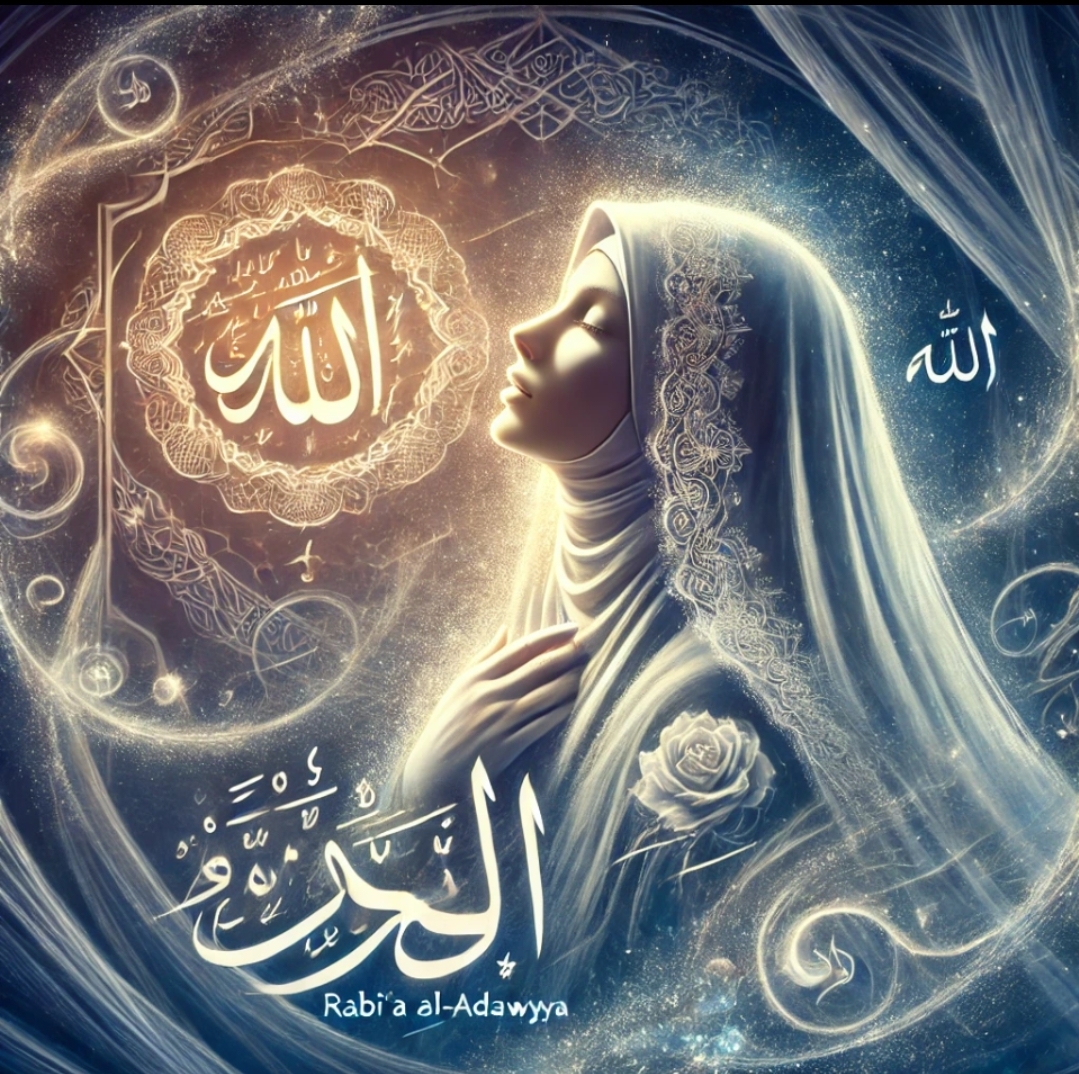
How many times have we been told: "Just pray"? How often have we heard, "Give to charity," or "Do this for reward"? These are essential acts, no doubt, but for many, worship becomes reduced to a checklist of duties—performing prayers out of obligation, giving charity out of duty, or fasting out of fear of punishment.
For centuries, men have led the spiritual charge, often with a stern focus on discipline, rigor, and the struggle against the ego. Saints and scholars taught with a tone that mirrors the battlefield, preparing themselves and their followers to defeat their laziness, their pride, and their sins. These teachings often reflect the path of hard discipline, necessary for the soul's growth, but colored by the rough edges of battling the self.
But then, there was one woman—a saint who stood alone, radiant in her expression of divine love. Rabi’a al-Adawiyya took the rigorous nature of worship, the often-fearful pursuit of Heaven, and the trembling avoidance of Hellfire, and washed it all with love. A love so deep, so pure, that if you listen closely to her words, you will find yourself questioning why you worship Allah in the first place. Is it out of fear? Is it for a reward? Or could it be out of love—love that transcends fear and desire?
Let us begin with the question: Why do we avoid talking about love?
For centuries, teachings have piled on the importance of fearing God, of striving for Heaven, and avoiding Hell. While these are valid concerns, they miss one fundamental element: love. Some find it difficult to approach. Even those who understand it may struggle to present it in a pure form, untarnished by self-interest. Rabi’a al-Adawiyya, a woman and saint, embodied this love in a way no one else had before her, elevating worship from duty to devotion, from fear to affection.
Worship Through Love, Not Fear or Reward
Rabi’a turned worship on its head, not by rejecting traditional teachings, but by infusing them with a love that transcends all else. She famously said:
Arabic: "إلهي! إن كنت أعبدك خوفًا من النار، فأحرقني في النار. وإن كنت أعبدك طمعًا في الجنة، فأبعدني عنها. ولكن إن كنت أعبدك من أجلك وحدك، فلا تحرمني من جمالك الأبدي."
English: "O Lord! If I worship You for fear of Hell, burn me in Hell. If I worship You in hope of Paradise, exclude me from it. But if I worship You for Your sake alone, do not withhold from me Your Eternal Beauty."
This statement, so revolutionary in its simplicity, is Rabi’a’s invitation to reflect on the deeper motivations behind our worship. She takes the conventional approach—worship for reward or out of fear of punishment—and dissolves it into a higher, more spiritual love. It’s a reminder that worship should not be transactional, but relational. Her words ask us to examine our own motivations. Are we engaging with Allah out of true devotion, or are we just fearful of the consequences?
Rabi’a’s unique vision:
In a world where men often approached worship as a battle—a battle against the ego, the lower self, and worldly desires—Rabi’a infused this struggle with love. She did not deny the necessity of fighting one's desires, but she argued that love was the only weapon strong enough to win. And if that love was not present, no amount of battle would ever suffice.
Why is love necessary?
Because life is not merely a battlefield. There will be moments when we lose jobs, face calamities, or fall into despair. Fear may not be enough to sustain us through these times. Only love—a deep, unshakable love for Allah—can carry us through. Rabi’a understood this, and that is why she urged us to lift our worship from the mundane into the divine.
The Profound Nature of Her Teachings
Rabi’a’s message isn’t just about love in the emotional sense. It is love as the core of our relationship with the Divine. In every act of worship, in every moment of prayer, she urges us to seek not the rewards of the hereafter, nor the avoidance of punishment, but Allah Himself. Her love was not rooted in what God could give her but in who God is.
Her teachings transcend time and touch on the very essence of our spiritual journey. She did not merely remove fear and reward from the equation; she replaced them with something infinitely more powerful: the love of Allah.
Ask yourself: When you bow your head in prayer, do you feel love?
For Rabi’a, prayer was an intimate moment between herself and her Beloved. When she says, "Each lover is alone with his beloved, and I am here alone with You," she invites us to enter into that sacred space. It’s not about duty; it’s about connection. It’s about finding in worship a moment of union with the Divine.
---
The Battle with Love
We cannot ignore the fact that spiritual life often feels like a battle. But what Rabi’a teaches us is that love is not in opposition to struggle. In fact, it is the means by which we can conquer our challenges. Without love, our efforts may feel dry, burdensome, and ultimately hollow. But when love fuels our worship, the battle becomes one we can face with joy and hope, no matter the outcome.
Arabic: "حبك الآن هو غناي وبركتي، لأنه يطهر عين قلبي التي امتلأت بالغبار."
English: "Your love now is my richness and my blessing, for it purifies the eye of my heart, which is filled with dust."
This simple expression carries the weight of a lifetime of devotion. It tells us that when we approach Allah with love, we are not left empty. Instead, we are filled with a richness that cleanses the heart. When the heart is purified, it can reflect the Divine more clearly.
Conclusion: A New Perspective on Worship
Rabi’a al-Adawiyya's teachings offer us a new perspective on worship. It is not about fear, nor is it about tallying rewards. It is about standing in awe before the Creator and offering our love, not for what we can receive but for the privilege of knowing Him. Her approach reminds us that the act of worship is not a chore, but a gift, a moment to connect with the One we love most deeply.
As we continue this series on divine love, may Rabi’a’s words inspire us to reflect on our own journeys and invite love into every prayer, every act of kindness, and every thought of Allah.
---
In our next article, we will dive deeper into Rabi’a’s profound understanding of repentance and her revolutionary teaching that even forgiveness is a gift from God, one that purifies and elevates the soul beyond worldly concerns. Stay tun
ed as we explore the beauty of divine love through her eyes.