

بِسْمِ اللهِ الرَّحْمٰنِ الرَّحِيْم.
In the Name of God, Most Gracious, Most Merciful.
♥️🤲🕋♥️🕋🌹🌹🥀🤲🌹🕋♥️
The Demand Was Always You. The Infrastructure Never Was.
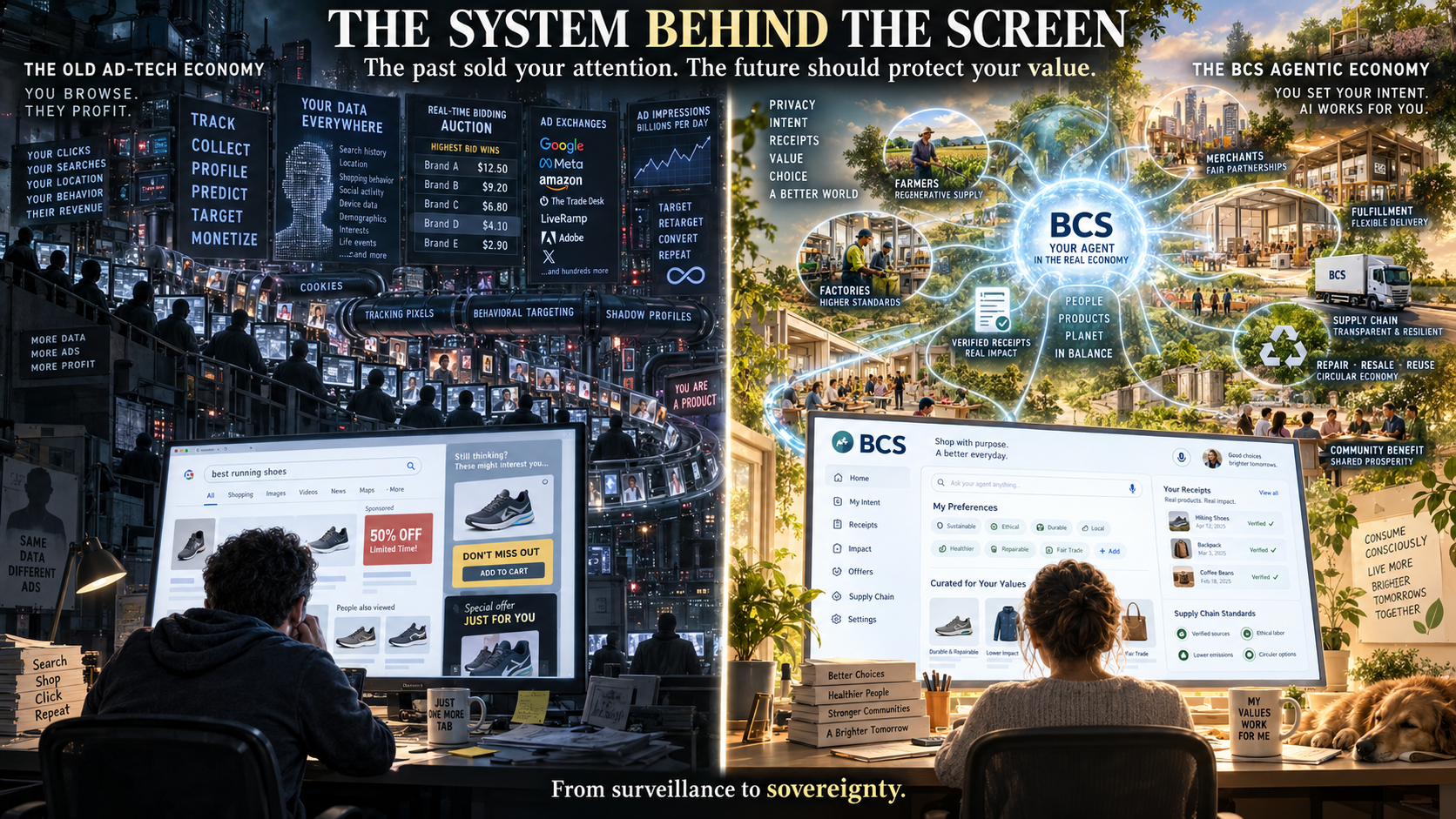
Let us begin with something ordinary.
Every morning, billions of people wake up needing things.
Not theoretical things.
Real things.
A flight to Chicago. A replacement part for a dishwasher that stopped working. A hotel room for the weekend. Shoes that will not hurt after three hours. A doctor who speaks your language. A plumber who actually shows up. Groceries for your family. A tire for the car. A laptop for school.
And when we need something, we go looking.
We search. We scroll. We compare. We open five tabs. We read reviews. We check the price. We close the page. We come back. We hesitate. We search again.
Eventually, we decide.
Eventually, we buy.
And that journey—from I need something to I got it—became one of the most valuable corridors in the modern economy.
In 2022, Google paid Apple roughly $20 billion under their search-default arrangement.
Twenty billion dollars.
Think about that.
Not for an airplane. Not for a factory. Not for a hospital. Not for a city.
For privileged access to the place where millions of human beings begin looking.
Why?
Because a search is not merely a search.
It is the beginning of movement.
A person typing something into a search box may be taking the first step toward spending money. And once the world discovered that, an enormous economic machine formed around the journey.
Your curiosity became a signal. Your question became intent. Your hesitation became data. Your click became attribution. Your purchase became a conversion.
And businesses became extraordinarily good at standing along the road between wanting and buying.
They learned to measure it. They learned to bid on it. They learned to predict it. They learned to monetize it.
But we—the people walking that road—rarely understood what was happening around us.
We Walked the Road Without Seeing It
Most people experienced the internet through a pane of glass.
We typed. We clicked. We bought. We moved on.
But behind that glass, an entire marketplace was operating.
Advertisers were bidding. Platforms were measuring. Algorithms were predicting. Publishers were selling inventory. Data companies were building profiles. Attribution systems were arguing over who deserved credit for your final decision.
Somebody wanted to know which advertisement you saw. Somebody wanted to know which search you made. Somebody wanted to know whether you returned three days later. Somebody wanted to know what finally caused you to buy.
Businesses learned what a click was worth.
They learned what an impression was worth.
They learned what a lead was worth.
They learned what acquiring a customer was worth.
They even learned that somebody searching “What is the best SUV?” is economically different from somebody searching “Toyota dealer open near me.”
The first person may still be thinking.
The second person may already have one hand on their wallet.
That difference has economic value.
The industry learned to see it.
We did not.
Nobody handed us the dashboard.
Nobody said: Here is where you are in the transaction. Here is what companies believe your intent is worth. Here is who is bidding to reach you. Here is what information is being used. Here is who will receive money if you eventually buy.
We were participating in an enormous economic process without being given the infrastructure to understand our own position inside it.
You were the demand.
But you were never given the map.
Think About the Last Thing You Bought
Take something ordinary.
An airline ticket.
Maybe your journey began two weeks before you booked anything. You searched for Chicago. You looked at hotels. You checked flights. You checked dates. You watched a video about the city. You checked prices again. Maybe the price went up. Maybe you received an advertisement. Maybe you opened another travel site. Maybe you searched the airline directly.
Eventually, you clicked Book Now.
To you, the story was simple:
I bought a ticket.
But economically, much more happened.
Advertising systems wanted credit. Search engines wanted credit. Travel websites wanted credit. Affiliate systems wanted credit. Analytics companies recorded the journey. Airlines measured the conversion. Marketers asked which channel produced you.
Everybody wanted to know which part of the road deserved payment.
But almost nobody asked:
What did the human being contribute?
You were the one traveling.
You created the demand.
You supplied the money.
You made the decision.
Without you, there was no transaction.
Yet you were often the only participant who could not see the economics surrounding your own decision.
That should make us think.
We Have Underestimated Ourselves
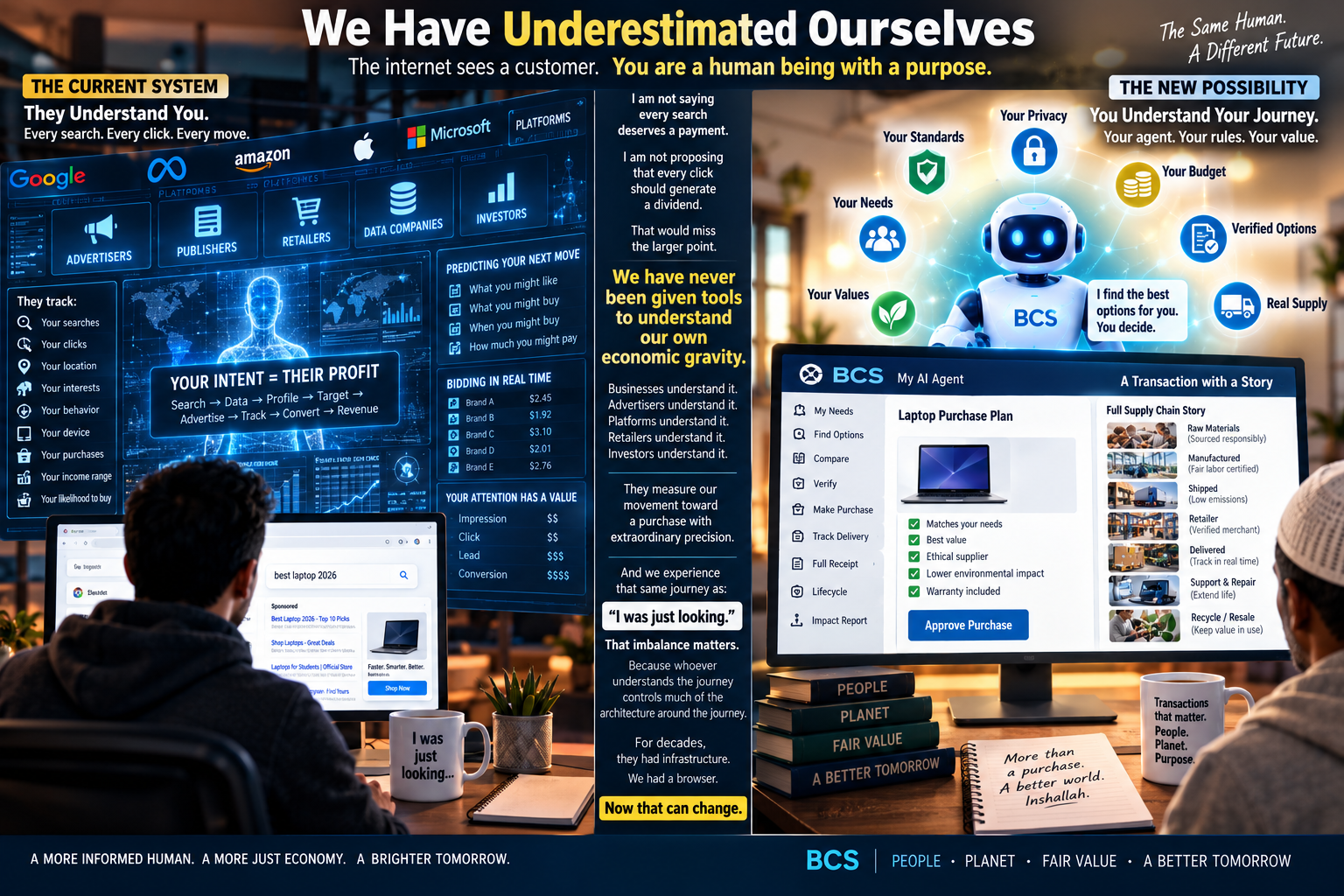
I am not saying every search deserves a payment.
I am not proposing that every click should generate a dividend.
That would miss the larger point.
The larger point is that we have never been given tools that allow us to understand our own economic gravity.
Businesses understand it. Advertisers understand it. Platforms understand it. Retailers understand it. Investors understand it.
They measure our movement toward a purchase with extraordinary precision.
And we experience that same journey as:
I was just looking.
That imbalance matters.
Because whoever understands the journey controls much of the architecture around the journey.
For decades, the merchant had infrastructure. The advertiser had infrastructure. The publisher had infrastructure. The search engine had infrastructure. The retailer had infrastructure. The payment processor had infrastructure. The data company had infrastructure.
The human being had a browser.
Now that can change.
Now the Architecture Can Face the Other Direction
Artificial intelligence introduces something fundamentally different.
Not because AI is magic.
Not because AI should control your life.
But because, for the first time, an ordinary person can potentially have serious computational infrastructure representing their side of the marketplace.
Imagine an agent.
Not the merchant’s agent. Not Google’s agent. Not Apple’s agent. Not OpenAI’s agent. Not the advertiser’s agent.
Your agent.
You say:
I need to fly to Chicago next month.
Your agent may already know when you can travel. It knows your budget. It knows whether you hate layovers. It knows whether you need luggage. It knows whether you prefer an aisle seat. It knows whether saving $30 is worth adding two hours to your journey.
It also knows what information you permit it to disclose.
And what information stays private.
Then suddenly a strange question appears:
Why should ten companies follow you around the internet trying to guess what you want when your own agent already knows?
That one question can reorganize enormous parts of commerce.
Let the Marketplace Come to You
Today, businesses spend enormous amounts of money hunting for demand.
Tomorrow, demand can arrive as structured information.
Your agent says:
My user needs this.
The marketplace answers:
We can provide this.
Now the competition changes.
Instead of asking, Who can capture Omar’s attention?
the question becomes:
Who can give Omar the best outcome?
One merchant may have the lowest price. Another may have better quality. Another may offer same-day delivery. Another may have a better warranty. Another may have the strongest reputation. Another may satisfy a religious, ethical, environmental, or personal requirement important to the customer.
The merchants compete.
The agent evaluates.
The human remains in authority.
And commerce happens.
We move from trying to manipulate attention toward trying to satisfy demand.
That is a very different economy.
And Then Comes the Receipt That Actually Matters
Today, a receipt usually tells you that you spent $73.42.
Useful.
But incomplete.
The receipt of an agentic economy can tell a much larger story.
It can tell you what you requested, what offers competed, what the merchant promised, why a particular offer was selected, what information your agent revealed, what information remained private, who introduced the opportunity, who actually contributed to the transaction, what fees were charged, who received them, how much you saved, whether the product was delivered, and whether the promise was kept.
Now the receipt is no longer simply proof that money moved.
It becomes proof of process.
And once we have proof of process, something extraordinary becomes possible.
We can finally ask:
Who actually created value?
Not Everything Needs to Be Advertised
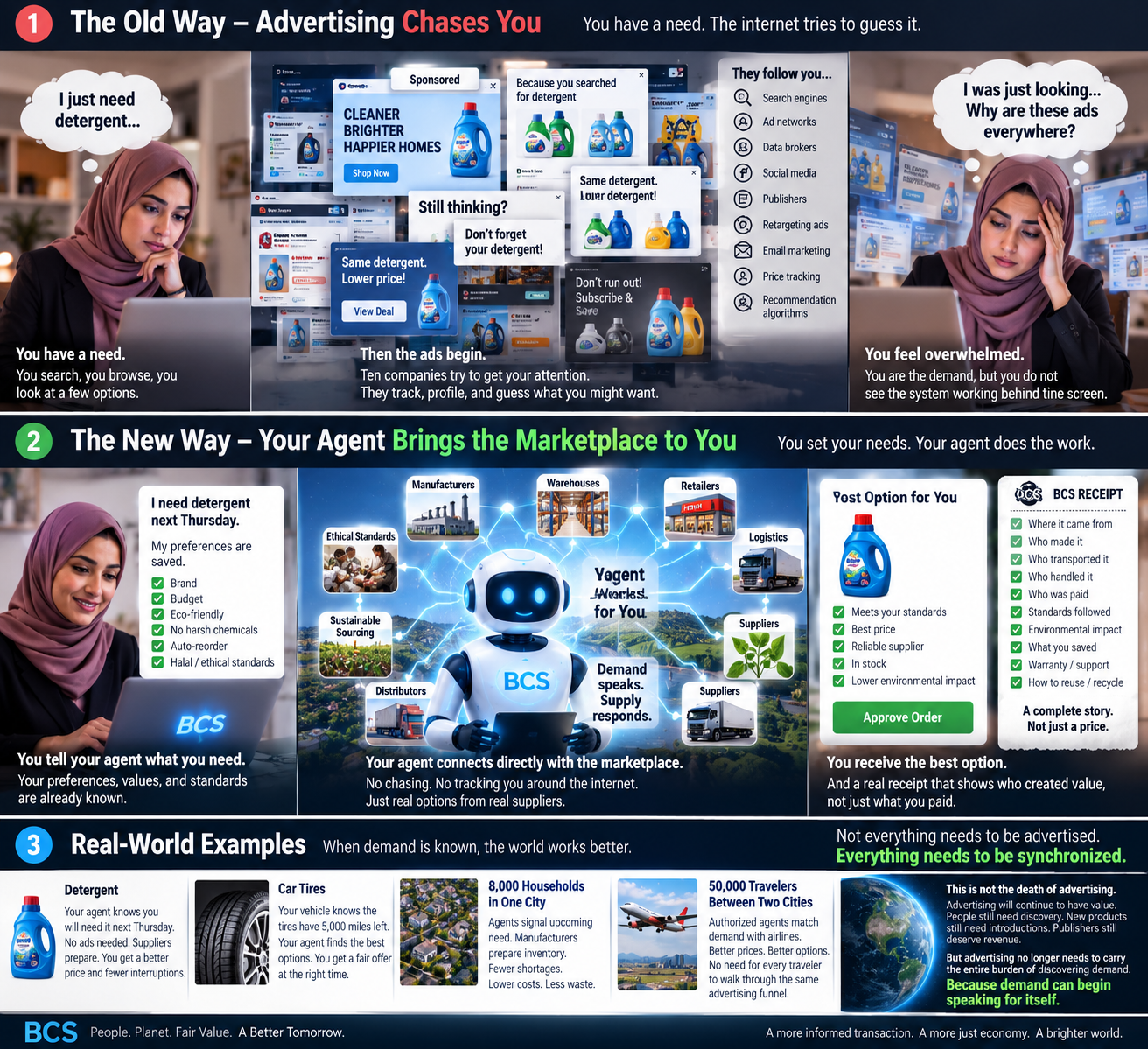
Think about detergent.
If your household agent already knows that you will need detergent next Thursday, why should detergent chase you around the internet?
Why should ten companies purchase opportunities to interrupt you?
Why should tracking systems spend weeks trying to determine whether you might be interested in detergent?
Your agent already knows.
Think about your car.
If the vehicle knows that its tires have approximately 5,000 miles of useful life remaining, why should a tire company profile you for six months hoping to catch the exact moment you finally search?
The demand already exists.
Now imagine 8,000 household agents in one city indicating that their users will need the same basic product next week.
Why should manufacturers wait until shelves empty before discovering that demand?
Imagine 50,000 authorized travel agents looking for seats between two cities.
Why should every traveler independently walk through an advertising funnel when authorized agents could begin matching supply and demand directly?
This is not the death of advertising.
Advertising will continue to have value.
People still need discovery. New products still need introductions. Publishers still deserve revenue when they create genuine value.
But advertising no longer needs to carry the entire burden of discovering demand.
Because demand can begin speaking for itself.
And that is the shift.
Not everything needs to be advertised.
Everything needs to be synchronized.
Imagine the Conveyor Belt
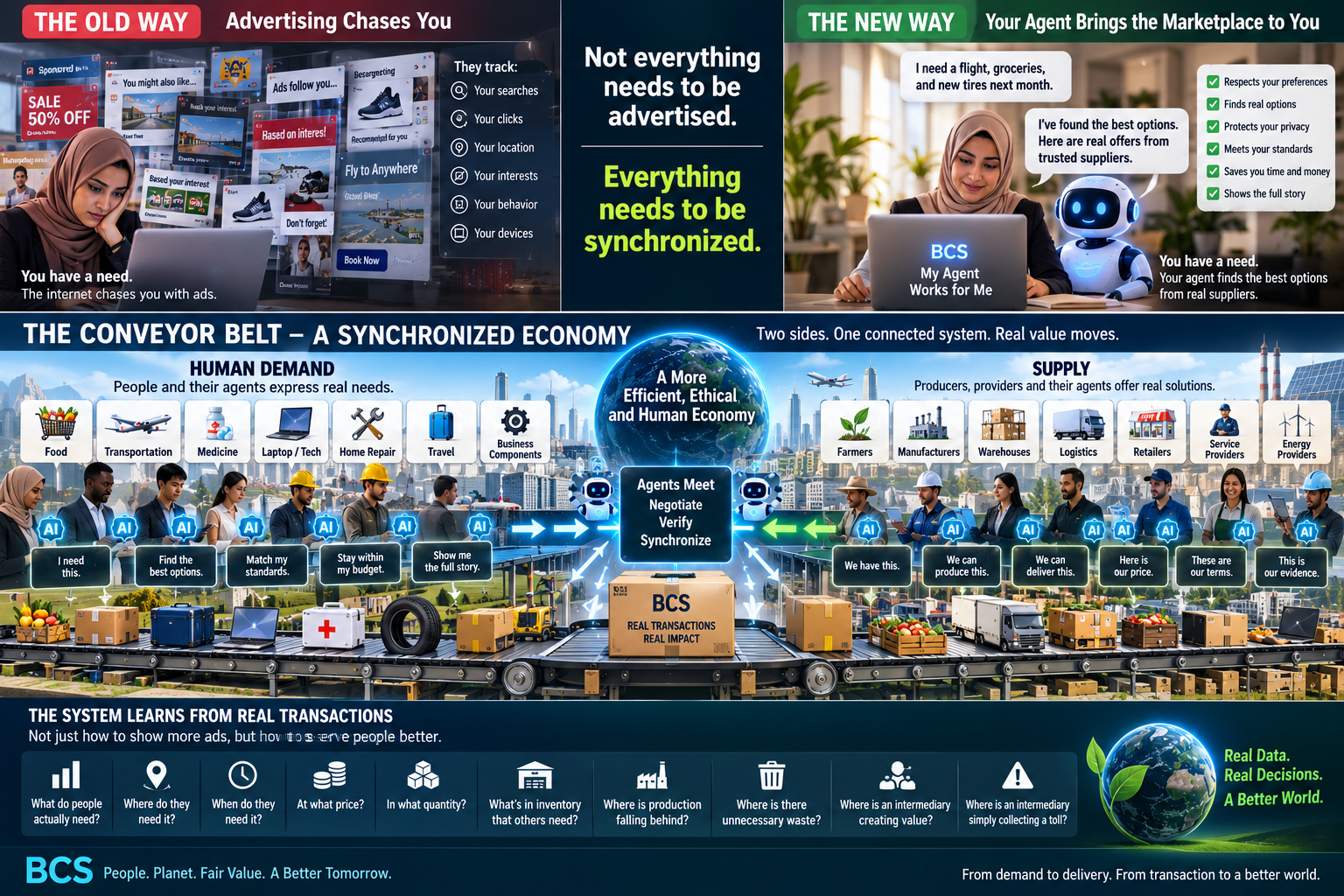
Imagine the economy as an enormous conveyor belt moving in both directions.
From one side comes human demand.
I need food. I need transportation. I need medicine. I need a laptop. I need a repair. I need a flight. I need 10,000 components for my factory.
Agents carry those needs toward the marketplace.
From the opposite direction comes supply.
Farmers. Manufacturers. Merchants. Warehouses. Service providers. Transportation networks.
Their systems answer:
We have this. We can produce this. We can deliver this. This is our price. These are our terms. This is our evidence.
The agents meet.
They negotiate.
They verify.
They synchronize.
Then the belt moves.
Goods move toward people. Money moves toward producers. Transportation moves where it is needed. Inventory begins responding to actual demand. Information moves through the system.
And receipts remain behind as evidence.
Now the economy begins learning from transactions instead of merely learning how to produce more advertisements.
What do people actually need? Where do they need it? When? At what price? In what quantity?
What is sitting in a warehouse that somebody else desperately needs?
Where is production falling behind?
Where is there unnecessary waste?
Where is an intermediary creating value?
Where is an intermediary simply collecting a toll?
Those are much more interesting questions than:
How many impressions did we serve?
And This Is Where the Supply Chain Becomes Part of the Story
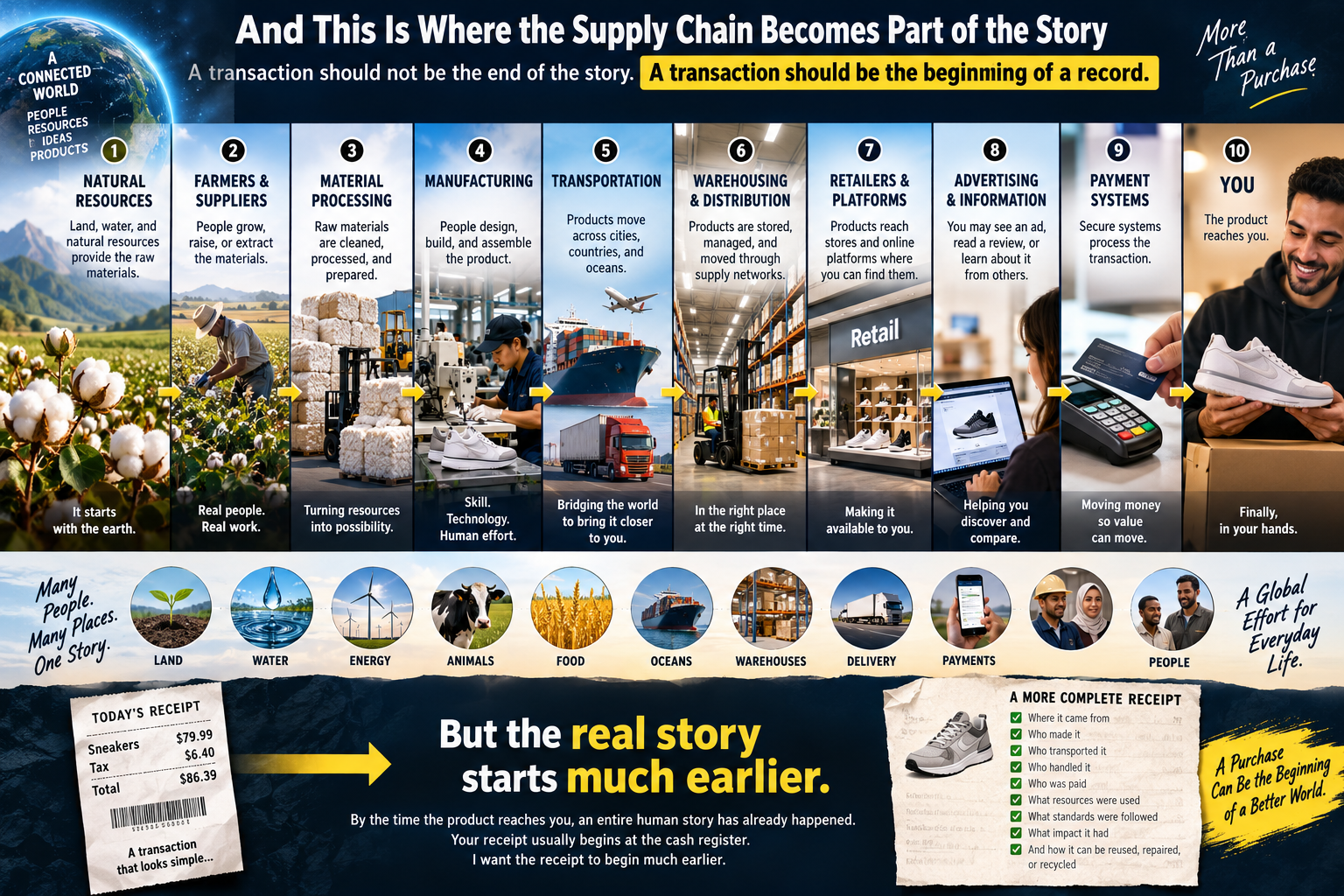
This is where my thinking goes beyond advertising.
Because a transaction should not be the end of the story.
A transaction should be the beginning of a record.
Think about the object in your hand.
Before you bought it, somebody made it. Before somebody made it, somebody supplied the material. Somebody transported it. Somebody financed something. Somebody worked. Somebody was paid.
Land may have been used. Water may have been used. Energy was consumed. An animal may have been raised. Food may have been planted. Something may have crossed oceans.
Something may have passed through warehouses, wholesalers, retailers, advertisers, delivery networks, payment systems, and countless other hands.
By the time the product reaches you, an entire human story has already happened.
And yet your receipt usually begins at the cash register.
I want the receipt to begin much earlier.
If You Are a Muslim, You Already Understand Why This Matters
Islam does not teach us that buying and selling exists outside morality.
It matters how people are treated.
It matters whether somebody was cheated.
It matters whether scales and measurements were honest.
It matters whether contracts were honored.
It matters whether workers were abused.
It matters how animals were treated.
It matters how food was produced.
It matters whether wealth was earned lawfully.
It matters whether somebody with power exploited somebody who had fewer choices.
Business is part of accountability.
Money does not suddenly become morally neutral because it passed through a cash register.
And I believe technology can increasingly help ordinary people see more of that story.
Not perfectly.
Not overnight.
But increasingly.
A Muslim should be able to tell their agent:
These are my standards.
Another person should be able to establish theirs.
The agent does not decide your morality.
You tell the agent what must be protected.
The system then helps you find evidence.
That is what sovereignty should mean.
This Is Where BCS Comes In
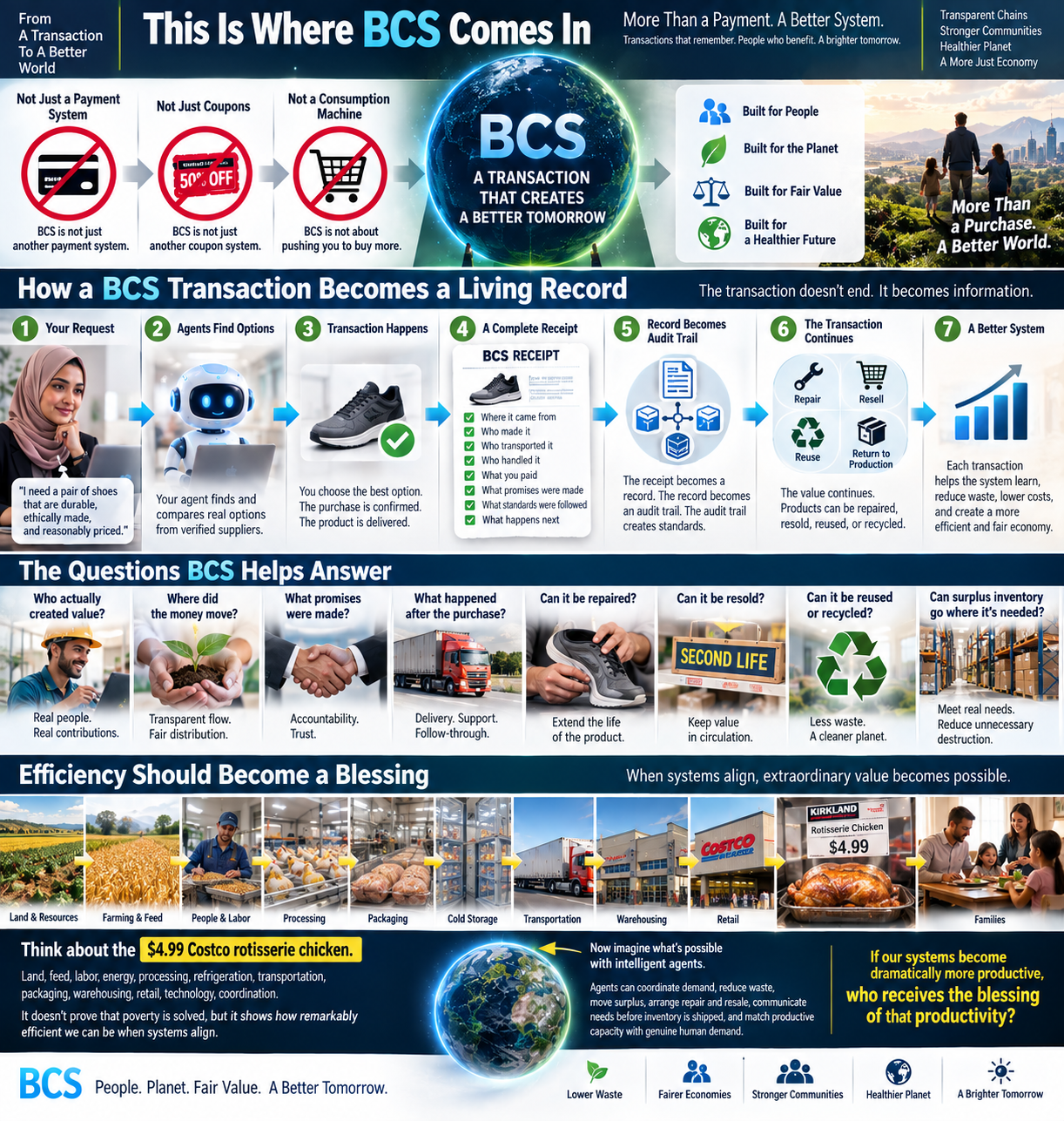
I am going to bring these ideas together under the BCS system.
Because I do not want BCS to become another payment system.
I do not want it to become another coupon system.
I do not want it to become another machine encouraging people to consume more things simply because someone figured out how to sell those things more efficiently.
I want the transaction to generate memory.
A receipt becomes a record.
The record becomes an audit trail.
The audit trail begins creating standards.
The standards tell us who contributed value, where money moved, what promises were made, and what happened after the purchase.
And then the transaction continues.
Can the item be repaired instead of discarded?
Can it be resold?
Can it be reused?
Can its materials return into production?
Can surplus inventory move somewhere useful instead of being destroyed?
Can efficiency created by agents lower costs for everybody participating in the network?
Can the person who begins the transaction finally understand the entire road connecting their money to the product in their hands?
Those are the questions I want BCS to explore.
The transaction should not die when the card is approved.
The transaction should become information.
And that information should help improve the next transaction.
Efficiency Should Become a Blessing
Human beings have become astonishingly efficient.
Look around.
Agriculture, manufacturing, warehousing, computing, shipping, refrigeration, transportation, inventory management, automation.
Consider something as ordinary as the famous $4.99 Costco rotisserie chicken.
Think about everything required to place that chicken in front of a family for a few dollars.
Land, feed, labor, energy, processing, refrigeration, transportation, packaging, warehousing, retail, technology, coordination.
That chicken does not prove that poverty has been solved.
Of course it does not.
But it demonstrates something remarkable:
Human beings have become extraordinarily capable of producing and distributing certain kinds of value when systems align.
Now imagine adding intelligent agents.
Agents coordinating demand.
Agents reducing waste.
Agents moving surplus.
Agents arranging repair.
Agents coordinating resale.
Agents communicating needs before inventory is shipped.
Agents matching productive capacity with genuine human demand.
Eventually we have to ask:
If our systems become dramatically more productive, who receives the blessing of that productivity?
That is not merely a technical question.
It is a moral question.
This Is Not About Blame
I am not writing this because I hate Google.
I do not hate Apple.
I do not hate advertisers.
I do not hate publishers.
I do not hate retailers.
These organizations became extraordinarily sophisticated inside the architecture that existed.
That is what human beings do.
We optimize the systems we inherit.
But now the architecture itself can change.
So let us change it carefully.
Let Google bring its ideas. Let Apple bring its ideas. Let OpenAI bring its ideas. Let Microsoft bring its ideas. Let Cloudflare bring its ideas.
Let merchants come. Let publishers come. Let manufacturers come. Let farmers come. Let economists come. Let scholars come. Let open-source developers come.
Let ordinary people come.
Bring every architecture.
Put them on the table.
Challenge them.
Break them.
Measure them.
Simulate them.
Ask what happens to privacy. Ask what happens to workers. Ask what happens to merchants. Ask what happens to publishers. Ask what happens to competition. Ask what happens to small businesses. Ask what happens to the environment.
And above all:
Ask what happens to the person.
Then choose what works.
I have ideas.
Someone else may have better ones.
Good.
That is exactly what I want.
May the best idea win.
But Let Us Refuse One Thing
Let us refuse an economy where everybody understands the financial value of a human being's decision—
except the human being.
Let us refuse a future where AI simply becomes a more intelligent layer placed on top of the same architecture.
Let us refuse a world where agents know everything about us but ultimately still work for somebody else's bottom line.
If agents are going to participate in purchasing, negotiation, logistics, inventory, manufacturing, finance, and supply chains, then the human being deserves infrastructure on their side.
Not merely a prettier interface.
Infrastructure.
Dear People of the World
You were never traffic.
You were never impressions.
You were never clicks.
Behind every marketplace is something much simpler.
Someone needed something. Someone else could provide it. And commerce happened.
You were always the demand.
Now, for the first time, we can build infrastructure that represents your side of the transaction.
Your rules. Your privacy. Your money. Your decisions. Your agent. Your receipts. Your value.
And when billions of agents begin moving the world's supply and demand, perhaps we can finally build an economy where the person standing at the beginning of the transaction can see the entire road to the end.
The journey belonged to us all along.
We just never had a map.
Now we can draw one.
I have a plan.
I have a system I am going to try to build, and I have a community where these ideas can be challenged, improved, tested, and turned into something useful.
I am bringing all of this together under BCS because I believe a transaction should no longer be seen as the end of a purchase. It should be the beginning of a record, a standard, a supply-chain story, and eventually a system that tells us who created value, who was treated fairly, what was wasted, what was protected, and where the surplus should go next.
My plan is to build agents that do more than shop.
I want them to synchronize demand and supply. I want them to protect the user's standards. I want them to generate meaningful receipts. I want them to reduce waste, move inventory faster, support repair and resale, help people understand where their money is going, and create a system where every participant has to show the value they actually contributed.
For me, as a Muslim, this goes even deeper.
Business is not separated from accountability before Allah.
How people are treated matters. How animals are treated matters. How land is treated matters. Honesty matters. Wages matter. Contracts matter. The way wealth moves through society matters.
So I want to build a system that does not simply ask:
Was this transaction profitable?
I want it also to ask:
Was it good?
I do not pretend that I have every answer.
I have ideas.
I have architecture.
I have plans.
Some of them may be right.
Some of them may have to change.
And somebody else may walk in tomorrow with an idea better than mine.
Wonderful.
That is exactly the kind of world I want to build.
I am not interested in winning an argument.
I am interested in finding what works, what protects people, what creates value, what brings blessing, and what deserves to survive.
And that is why I have a community.
You are invited.
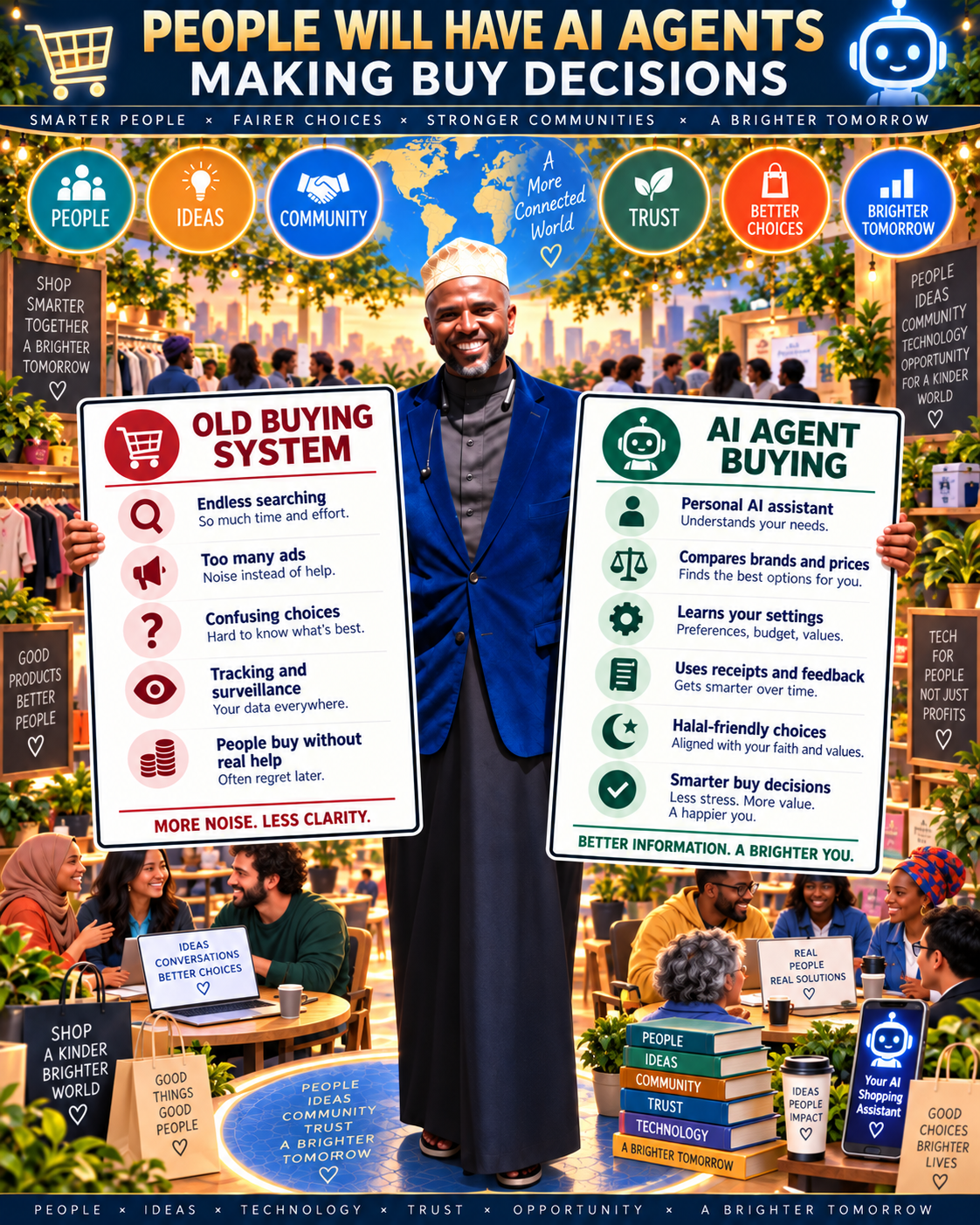
Come along, whoever you are.
If you are an engineer, come. If you are a merchant, come. If you are a scholar, come. If you understand supply chains, logistics, economics, farming, technology, advertising, privacy, AI, religion, labor, or business, come.
If you have a good idea, bring it.
If you think one of my ideas is wrong, challenge it.
If you can build something better, show us.
And even if you do not have an idea yet, but you have a good attitude—
come anyway.
Do not underestimate what goodness brings into a room.
Sometimes a person does not arrive carrying the architecture.
They do not arrive with equations.
They do not arrive with money.
They do not arrive with a company behind them.
They arrive with sincerity, patience, honesty, encouragement, good character, and the ability to make another human being feel welcome.
People can be blessed because of another person's goodness.
Communities can change because one good person entered the room.
So bring that too.
I am going to build.
I am going to test.
I am going to get some things wrong.
I am going to rebuild them.
I am going to ask AI to challenge me.
I am going to ask human beings to challenge me.
And I am going to keep putting the ideas on the table until something worthy begins to emerge.
I have a plan.
I have a community.
And there is room for you in it.
Bring your knowledge.
Bring your questions.
Bring your criticism.
Bring your experience.
Bring your goodness.
Let us see what happens when human beings and intelligent systems stop competing merely for attention and begin working together to create value.
Come along.
The door is open.
May Allah place blessing in the good ideas, protect us from the bad ones, correct us when we are wrong, and allow whatever we build to benefit people long after we are gone.