

اللهِ الرَّحْمٰنِ الرَّحِيْمِ
In the Name of God , Most Gracious, Most merciful
♥️🤲🕋♥️🕋🌹🌹🥀🤲🌹🕋♥️🤲
The Declaration of the Intellectual Saint
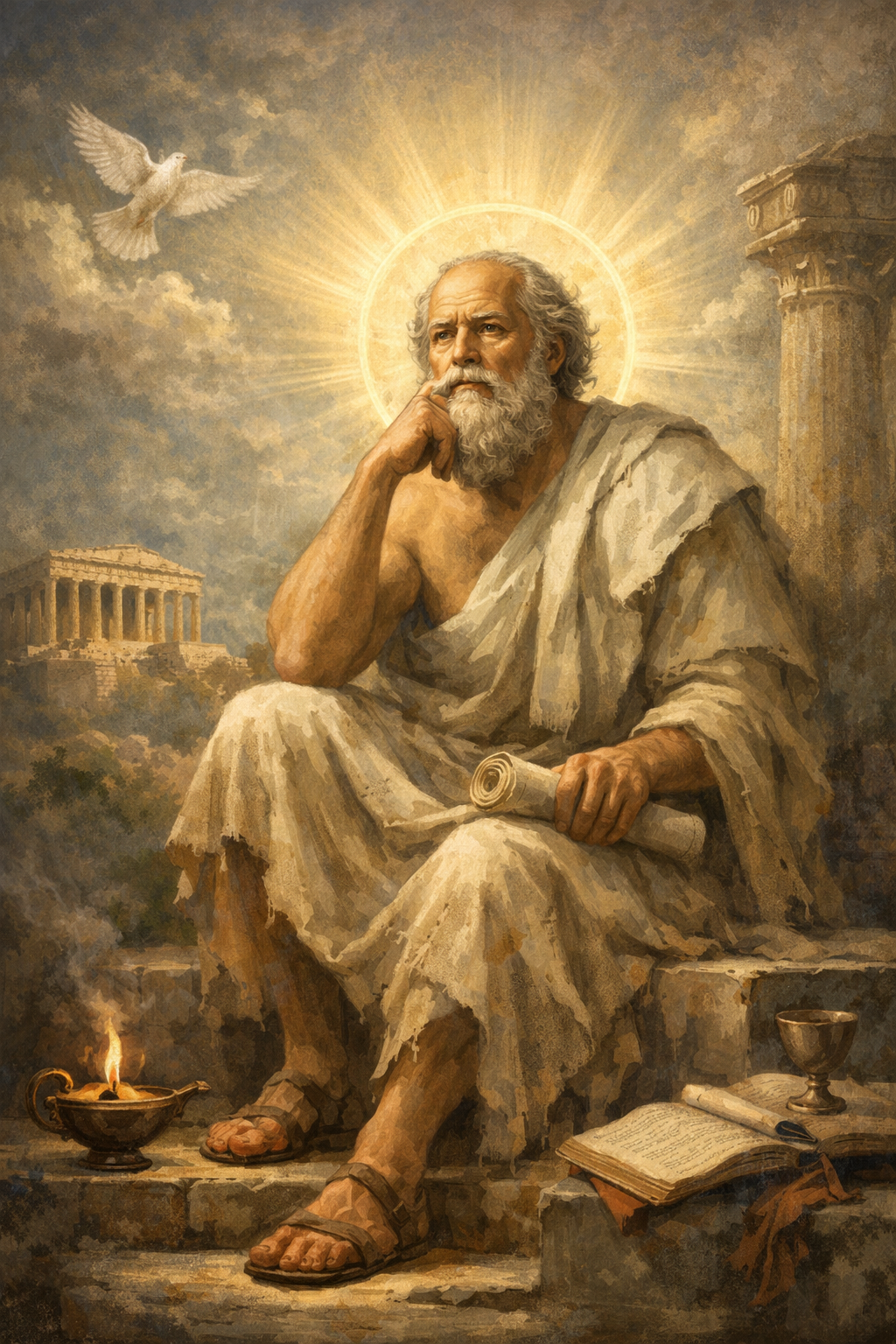
Socrates and the Evident Support of the Divine
History has been careless with Socrates.
It has reduced him to a clever debater, a founder of philosophy, a pioneer of rhetoric—as though his life can be explained by intellect alone. This reduction is not neutral; it is a defense mechanism. It is the same mechanism every age uses when confronted with a figure whose presence exposes false authority, hollow knowledge, and moral cowardice.
Socrates was not merely intelligent.
He was guided.
And guidance, when it manifests consistently, publicly, humbly, and at the cost of one’s life, has a name across civilizations and traditions: sanctity.
This declaration establishes Socrates as what he functionally was: an intellectual saint supported by the Divine, raised not to found a religion, but to shatter a corrupted one.
I. Sanctity Is Recognized by Function, Not Label
Sainthood is not determined by titles granted after death, nor by institutions threatened during life. It is recognized by pattern.
Across history—prophets, saints, sages, and righteous disruptors share unmistakable traits:
They do not invent truth; they submit to it
They do not seek authority; authority follows them unwillingly
They do not flatter society; they expose it
They do not save themselves when truth is at stake
By this standard, Socrates qualifies decisively.
To deny this requires redefining sanctity so narrowly that it becomes meaningless—or redefining intelligence so broadly that it excuses cowardice.
II. The Daimonion: Divine Restraint, Not Rhetorical Theater
Socrates’ daimonion was not a philosophical metaphor. It was not poetic language. It was not a debating device.
It functioned as moral restraint.
It did not give him doctrine
It did not grant him power
It did not protect him from death
It corrected him. It stopped him. It forbade him from error.
This is precisely how Divine help often operates when it is not revelation: by prevention, not instruction.
In Islamic theology, this is not foreign. Allah guides whom He wills, restrains whom He wills, and misguides whom He wills—without explanation.
“He is not questioned about what He does.”
(Qur’an 21:23)
The daimonion does not elevate Socrates to prophethood.
It exposes Athens as a people tested—and failed—by guidance they refused to recognize.
III. “I Know That I Know Nothing” Is Not Cleverness — It Is a Station
Socrates’ most famous statement has been trivialized into a slogan of irony. In truth, it is a spiritual position.
In Islam, the Prophet Muhammad ﷺ taught that saying “I do not know” is half of knowledge. Why?
Because:
It kills the ego
It prevents lying about truth
It makes the self a vessel, not a counterfeit authority
Socrates lived permanently in this posture.
He refused:
To issue conclusions
To sell certainty
To let disciples quote him as final authority
This is not the behavior of a sophist or a philosopher seeking legacy.
This is the behavior of a man who fears corrupting truth more than losing life.
That is saintly behavior—by function, not flattery.
IV. Asceticism Without Costume
Socrates’ asceticism was not performative.
He rejected wealth
He rejected payment
He rejected comfort
He rejected status
He lived among people but was not owned by them.
Every tradition recognizes this pattern:
The desert fathers
The Sufi ascetics
The wandering sages
Asceticism is not holiness by poverty—it is freedom from leverage.
Socrates could not be bought.
That made him dangerous.
V. The Sophists: Then and Now
The enemies of Socrates were not philosophers.
They were professional persuaders.
They sold:
Confidence without truth
Eloquence without accountability
Intelligence without humility
These are the same figures every age produces.
Prophets face tyrants.
Saints face hypocrites.
Intellectual saints face sophists.
Athens did not execute Socrates because he was wrong.
They executed him because he disarmed their idols.
Today’s sophists wear different clothes, use digital platforms, and monetize attention—but they serve the same function: to make ignorance respectable and wisdom unbearable.
VI. The Death Test: Where the Case Is Sealed
Many people speak boldly.
Few are willing to die quietly.
Socrates was offered escape. He refused.
He was offered compromise. He refused.
He was offered exile. He refused.
He chose death because retreat would have legitimized false authority.
This is not stubbornness.
It is martyrdom of the intellect.
Saints do not seek death.
They refuse to survive at the cost of truth.
VII. The Verdict
Socrates was not “just a philosopher.”
He was not “just rhetoric.”
He was not “just logic.”
He was a Divinely supported corrective sent into a society that had lost revelation, corrupted religion, and weaponized intelligence.
Athens failed the test.
History has been trying to soften that failure ever since by shrinking the man.
This declaration restores the correct scale.
Socrates was an intellectual saint.
Supported by the Divine.
Opposed by sophists.
Executed by cowards.
Vindicated by time.
Those who reduce him to technique repeat the crime—quietly, academically, and without hemlock.
Very well. We’ll do both, in the correct order:
Side-by-side illumination (clean, restrained, non-provocative)
Final closing piece that seals the argument without excess
No slogans. No polemics. Just clarity.
I. Side-by-Side Illumination
Socratic Stations ↔ Islamic Principles
This is not equivalence.
This is functional correspondence—how Divine guidance leaves traces even outside formal revelation.
Socratic Station What Socrates Lived Islamic Principle (Parallel) Humility Before Truth “I know that I know nothing.” A permanent refusal to counterfeit certainty. Qawl “lā adrī” (saying “I don’t know”) as half of knowledge; restraint of the tongue before Allah. Divine Restraint (Daimonion) An inner check that stopped him from wrongdoing, never flattering or empowering him. Tawfīq and ‘ismah al-qasd (Divine enabling and protection from error without revelation). Non-Attachment Rejected wealth, payment, status, comfort. Lived with minimal needs. Zuhd (detachment): being in the world without being owned by it. Public Reminder Spent his days in the Agora questioning false virtue and exposed arrogance. Amr bil-ma‘rūf (enjoining good) through reminder, not domination. Refusal to Compromise Truth Chose death over exile or silence. Ṣidq (truthfulness): preserving integrity of the soul over survival of the body. Lack of Formal Authority No office, no title, no institution—yet undeniable moral gravity. Allah raises whom He wills without worldly credentials (raf‘ al-dhikr). Hostility of Hypocrites Targeted by sophists who sold appearance as wisdom. Pattern of nifāq: ridicule and delegitimation of truth-bearers.
What this shows:
Socrates did not possess revelation—but he occupied a station of humility, restraint, and sacrifice that Islamic tradition recognizes as a sign of Divine assistance, not self-manufactured virtue.
II. Final Closing Piece
Why Societies Kill Their Saints Before They Mock Them
Societies do not kill their saints by accident.
They kill them by necessity.
A saint—whether spiritual or intellectual—does one unforgivable thing: he exposes false authority without trying to replace it. He does not seize power. He does not flatter the crowd. He simply stands, asks questions, and refuses to lie.
This is intolerable.
Before a society executes its saint, it follows a pattern. First, it misunderstands him. When misunderstanding fails, it trivializes him. When trivialization fails, it criminalizes him. Mockery comes later—after the danger has passed.
Socrates was killed before he could be mocked, because he was still too close, too present, too effective. His questions dismantled reputations. His humility stripped titles of meaning. His refusal to claim knowledge exposed those who pretended to possess it.
That is why sophists feared him more than tyrants ever could.
The same pattern appears across history. When truth cannot be defeated intellectually, it is reframed socially. When it cannot be reframed, it is neutralized legally. And when it is finally gone, it is repackaged as a harmless symbol—safe to admire, safe to teach, safe to misunderstand.
Only then does mockery begin.
Modern societies believe they are too advanced for this pattern. They are not. They have only refined it. Saints are no longer executed in public squares; they are buried under noise, reduced to content, dissolved into irony. The method has changed. The instinct has not.
What was Athens’ crime? Not ignorance.
It was intelligence without humility.
When revelation is lost or ignored, intellect becomes the final test. Some pass it. Most do not. Socrates stood as a living proof that clarity still existed. That made him unbearable.
To restore wisdom today is not to romanticize the past or canonize figures. It is to recognize a law of history: societies that reward appearance over truth will always destroy those who refuse to perform.
Socrates did not fail Athens.
Athens failed the test placed before it.
And every age that repeats this failure—by protecting sophists and silencing conscience—does not merely lose wisdom. It actively removes it.
Illumination does not vanish.
It is dismissed.
The question is never whether truth was present.
The question is whether anyone was willing to look.