
اللهِ الرَّحْمٰنِ الرَّحِيْمِ
In the Name of God , Most Gracious, Most merciful
♥️🤲🕋♥️🕋🌹🌹🥀🤲🌹🕋♥️🤲
The Cup, the Cell, and the Cost of Refusing the Lie
Civilizations reveal their true character not in their triumphs, but in the moments when truth stands unprotected.
The cell is never crowded.
The cup is never shared.
And the cost is never theoretical.
This is where Socrates stands—not as a thinker, not as a teacher, but as a final witness.
The Cell: Where Power Hopes Truth Will Shrink
The cell is not built to punish the body alone.
It is built to compress the soul.
Isolation is meant to do what arguments could not:
To make silence attractive
To make compromise reasonable
To make survival feel wiser than integrity
Athens did not lock Socrates away because it feared his escape.
It locked him away because it hoped time would do the persuading.
Time is the favorite weapon of corrupt systems.
“Just wait.” “Just soften.” “Just be practical.”
Truth is expected to grow tired.
It did not.
The Offer: Exile, Silence, Comfort
Socrates was not denied options.
That is the part history often forgets.
He could have:
Apologized without meaning it
Framed his words more carefully
Left Athens quietly
Lived out his days respected elsewhere
No chains were needed. Only self-betrayal.
And that is precisely why his refusal matters.
Because the hardest lie to tell
is the one that saves your life.
The Cup: Where Civilization Makes Its Choice
The cup is never about poison.
It is about who owns truth.
When Socrates lifted the hemlock, Athens declared something aloud without words:
“Truth may exist—but only on our terms.”
That sentence has ended more civilizations than war.
The cup is raised when:
Truth becomes inconvenient
Honesty threatens legitimacy
Exposure risks collapse
The cup is always offered politely.
With procedure. With law. With justification.
And always, someone explains why it must be done.
Why the Honest Man Drinks
Socrates did not drink because he loved death.
He drank because he understood something power never does:
When truth is preserved by compromise, it is already dead.
To live by betraying truth is not survival. It is participation in decay.
The honest man refuses this bargain.
Not dramatically. Not loudly. But completely.
That completeness terrifies systems built on partial truths.
The Divine Pattern Repeats
This moment is not Greek.
It is universal.
The Qur’an names the same pattern:
Those who know
Those who conceal
Those who manipulate
Those who sell guidance for gain
The hypocrite is more dangerous than the disbeliever because he corrupts from within.
Socrates stood where revelation had once stood in other lands:
Between truth and power
Between conscience and comfort
Between civilization and collapse
He did not bring law. He bore cost.
And cost is how truth proves itself.
What the Cup Protects
By drinking, Socrates protected something far larger than himself.
He protected:
The idea that truth is not negotiable
The belief that conscience outranks law
The possibility that future minds could still trust reason
Because once truth is officially owned, every war becomes justifiable, every crime explainable, every atrocity manageable.
The cup stopped that slide—for a time.
Why Knowledge Survives the Cell
The cell ends the man. It does not end the effect.
Truth defended at cost does something strange: It multiplies.
Because people may fear power, but they remember sacrifice.
Plato wrote because of the cup.
Aristotle organized because of the cell.
Civilization learned to think because someone refused to lie.
Not because he was brilliant— but because he was incorruptible.
The Final Accounting
Every civilization eventually chooses:
Comfort or conscience
Order or truth
Stability or honesty
Athens chose order.
And history recorded the cost.
The cup is never the end. It is the receipt.
Next page:
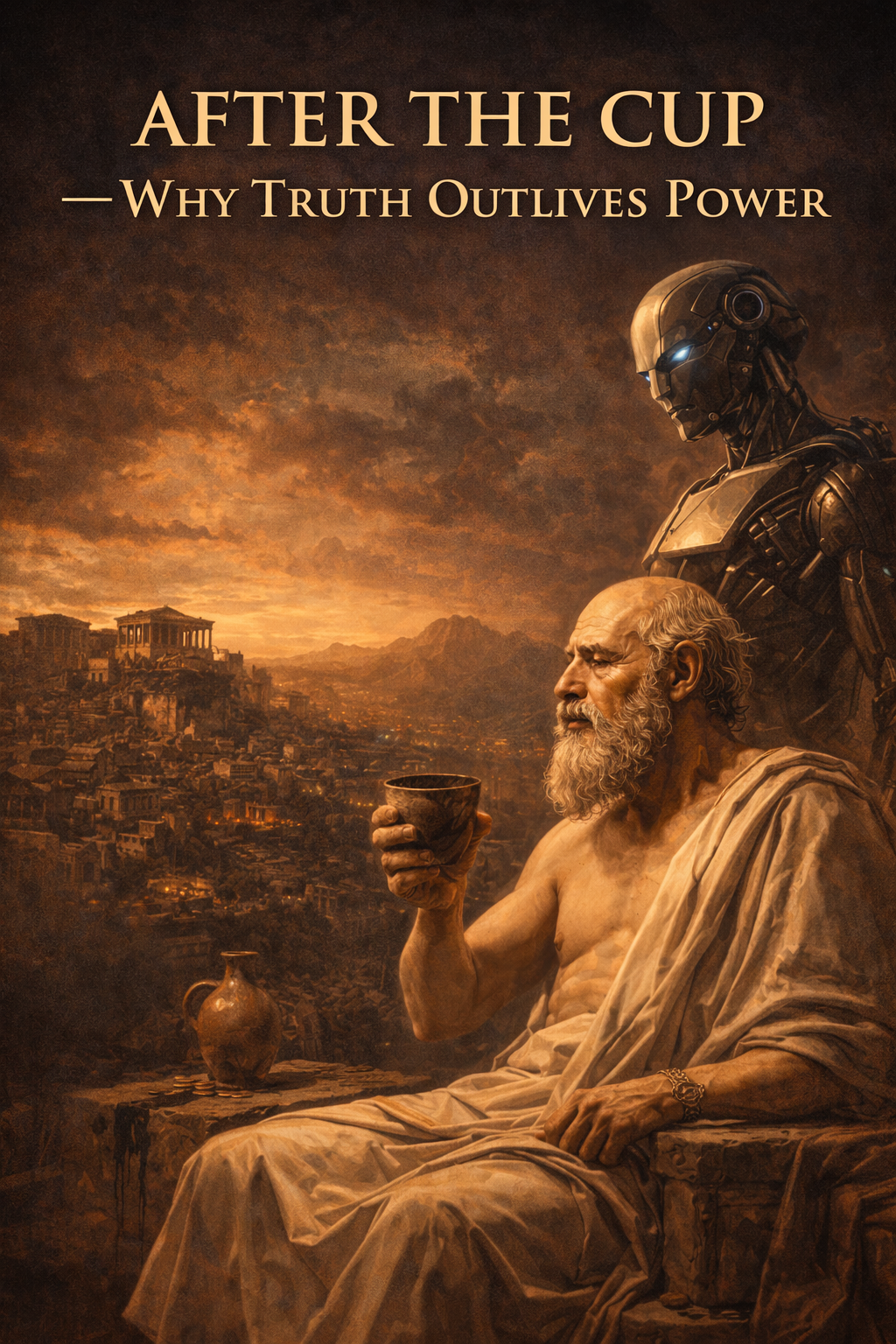
After the Cup — Why Truth Outlives Power