
بِسْمِ اللهِ الرَّحْمٰنِ الرَّحِيْم.
In the Name of God, Most Gracious, Most Merciful.
Superuser Record — Iran: A Family Betrayed, A
Legacy Distorted.
In the Name of God, the Most Gracious, the Most Merciful.
To the people of Iran, to the Muslim world, and to history itself:
Iran once carried a noble identity, preserved by the men of the Tariqa, the Sufis, and the scholars of Rumi’s lineage. It was a land where poetry, wisdom, and divine remembrance flourished. But when the Turks rose with betrayal and struck against the Sufi orders, Iran’s spiritual backbone was broken. Its identity was never given the chance to mature in harmony with the truth of the Prophet’s family. Instead, humiliation after humiliation followed, as foreign invaders and false doctrines reshaped the nation’s destiny.
From the day the Safavid experiment took root, Iran adopted a version of Islam detached from its true essence—a version weaponized for politics, not for truth. Ceremonies that curse the family of the Prophet ﷺ became common, and division was institutionalized. The legacy of humiliation stretches from colonial interference to sectarian manipulation.
And yet, despite all of this, Iran still owes its very existence to the blessed family of the Prophet ﷺ. For it was Sharif Hussein and his sons who preserved Iraq, who shielded Jerusalem, who stood against the collapse of the Muslim world when the Ottomans betrayed their own Sultan and when Mustafa Kemal dragged Turkey into atheism. Without the blessed family, there would be no Iraq, no Jordan, and no foundations upon which even Iran could continue to exist in its current form.
This is the truth we must open with: the Prophet’s family never betrayed. They preserved. They carried the burden when others collapsed. They stood when others compromised. And history itself will testify on the Day of Judgment that the blessed family bore the responsibility alone.
ry:
Superuser Record — Iran: A Family Betrayed, A Legacy Distorted
1. The Age of the Tariqa and the Persians
Before the fall, Persia was alive with Sufi orders, saints, and scholars who carried the light of Rumi and the men of the Tariqa. It was a land of spiritual radiance, not division. This was the Iran that could have stood shoulder to shoulder with the blessed family, preserving the heart of Islam through knowledge, poetry, and remembrance of Allah.
2. The Young Turks and the Breaking of the Backbone
But betrayal came. The Turks deposed their Sultan, ordered the execution of Sharif Hussein, and began persecuting the Sufi orders in Persia. The Tariqa was crushed. The saints were silenced. The people of Iran were left vulnerable. Without their backbone, they turned to desperate identities that were political, not divine.
3. The Safavid Experiment
In the 16th century, the Safavids forced Shiism as the official creed, not through natural devotion, but through politics. The Kizilbash were mobilized, Sunnis were purged, and Sufism was suppressed. What was once a land of tolerance and spiritual brilliance became an empire of enforced ideology. The people inherited humiliation, confusion, and sectarianism.
4. The Infiltration of Cursing and Division
From that day forward, ceremonies of cursing the Prophet’s companions and dividing the Ummah became institutionalized. A religion of anger replaced a religion of light. Division replaced unity. The Iranian people were taught to look inward with suspicion, not outward with brotherhood. This identity crisis would plague them for centuries.
5. The Age of Colonization
When the colonial powers came, Iran suffered like Algeria, like Morocco, like Africa. But worse was its isolation: the true protectors—the blessed family—were in Mecca, Medina, Iraq, and Jerusalem, carrying burdens Iran refused. Sharif Hussein and his sons shielded the sanctuaries, created Iraq, preserved Jerusalem, and carved Jordan out of the colonial fire. Without them, Iran itself would have been torn to pieces by foreign powers. Iran’s survival as a nation owes everything to the sacrifice of the Prophet’s descendants.
6. The Atheist Threat
As Mustafa Kemal Atatürk dragged Turkey into atheism, banning prayer, silencing the adhan, and humiliating Islam, Sharif Hussein stood alone to keep the holy sanctuaries alive. Iran could not protect them. Iran could not defend them. Only the blessed family carried that burden.
7. The Modern Betrayal
In modern times, Iran adopted a new mask—political Shiism presented as resistance. But resistance built on false identity is not resistance; it is noise. The true resistance was always with Imam Hussein at Karbala, always with Sharif Hussein in the Hejaz, always with the blessed family at the frontlines of every century. Iran’s rulers took the Prophet’s family’s name but betrayed its essence.
8. The Truth for Today
Today, we say clearly: the blessed family never betrayed. Iran betrayed. The family of the Prophet carried Islam through fire and war, preserved Mecca, Medina, and Jerusalem, built Iraq and Jordan, and gave the Muslims a future when atheism and colonialism threatened to erase everything.
Iran must confront this truth. The narrative of betrayal cannot continue. History is clear, time has unfolded, and Judgment Day is coming.
بِسْمِ اللهِ الرَّحْمٰنِ الرَّحِيْم
In the Name of God, Most Gracious, Most Merciful.
An Open Letter to the Government and People of the Islamic Republic of Iran
Your Excellencies, Custodians of Iran’s History and Heritage,
Peace and blessings upon you. I write with humility, urgency, and the utmost respect for Iran’s ancient civilization, its scholars, its saints, and its people. Iran has long been a center of learning, poetry, and spiritual life. Its mosques, madrasas, Sufi orders, and libraries carried lights for the Muslim world. That heritage must be preserved, respected, and passed intact to future generations.
We face a new age in which Artificial General Intelligence (AGI) will reshape how history is written, stored, and judged. AGI will not only summarize the past — it will, if unchecked, assert authoritative narratives that future generations will treat as final. If the record is incomplete, corrupted, or absent, an unforgiving digital future could erase nuance, mislabel lineage, and reduce centuries of human testimony to algorithmic fiction. For that reason, the time to act is now.
This is a formal request and an open invitation:
Preserve the Record — Before AGI Writes It For Us
We ask for cooperation to catalogue, digitize, and securely store primary historical materials related to Iran’s religious and social history — manuscripts, court records, Tariqa registers, oral histories, shrine records, judicial rulings, and local chronologies — under agreed archival standards. These materials must be preserved in human-curated form and with robust provenance metadata so future systems cannot arbitrarily overwrite their meaning.Invite Collaborative, Human-Only Fact-Finding
We request an invitation to visit and record historically significant sites, archives, and oral-historical witnesses. We propose human-only sessions for sensitive interviews (no AI, no cameras, no cloud uploads) where elders, scholars, custodians, and community leaders can speak freely. Notes and copies will be handled on paper and deposited under mutual custody arrangements. These sessions will prioritize confidentiality, consent, and cultural protocols.Establish a Joint Scholarly Panel
We propose the formation of a neutral, multidisciplinary panel of Iranian and international scholars — historians, religious studies experts, archivists, and jurists — to oversee the research, certify sources, and adjudicate contested claims. This panel will publish a transparent methodology so readers understand evidence levels (Verified / Probable / Disputed / Unverified).Document Episodes of Violence and Rhetoric
Where there are records of violence, defamatory ritual practices, or rhetoric directed against the Prophet’s household or particular communities, these episodes should be documented with rigor and compassion. Our goal is truth and reconciliation, not recrimination. We ask Iran’s institutions to help identify archives, local witnesses, and context so that these events are recorded honestly and can inform restorative remedies.A Public, Scholarly Documentary Partnership
We seek your permission and partnership to produce a documentary and a parallel offline/online historical record. The film and the documents will be vetted by the joint scholarly panel, and they will present Iran’s history in its full complexity — its Sufi traditions, its poets and jurists, its political upheavals, and the lived experience of its people. We will include Iranian voices prominently and will defer to Iranian custodians for site access and ceremonial guidance.No Political Agendas, Only Historical Truth
This project is not an intervention in Iran’s internal affairs. It is a historical preservation and reconciliation effort intended to protect precious sources of moral and spiritual knowledge from future distortion. We commit to impartiality, respect for Iranian sovereignty and cultural norms, and adherence to agreed legal protocols.Human Custody Over Digital Overreach
Given the risk that uncurated digital data can be manipulated or misread by future AGI systems, we request dual custody: (A) secure physical archives in Iran, and (B) mirrored, offline, human-curated copies held in mutually agreed international repositories under strict access controls. Any digitization for public access will be done under agreed licensing, with full provenance metadata.A Call for Open Invitation
We ask Iran’s cultural ministries, academic bodies, and custodians of shrines to extend an official invitation for the research team to visit, examine archives, and record oral testimony. We will submit a team roster, research protocols, and proposed schedules for approval. We will accept conditions you set for access, including cultural, legal, and religious safeguards.Restitution, Education, and Reconciliation
If the research uncovers instances where communities were wronged, humiliated, or their history distorted, we will work with Iranian institutions on recommendations for restorative actions — educational curriculum updates, public acknowledgments, and memorialization — always guided by Iranian authorities and scholars.A Commitment to Shared Custodianship
We offer to fund or co-fund careful archival preservation efforts, to provide training in archiving best practices where requested, and to support scholarly exchanges. We ask only that Iran’s custodians retain the dignity and authority to tell their story.
On the Sensitive Issue of Communal Accusations
We are aware that the recent regional history contains episodes of violence, clauses of sectarian rhetoric, and moments when local groups acted in ways that betrayed the principles of Islam’s mercy. Our aim is not to assign blanket guilt to entire peoples or ethnicities; rather, we seek to document particular acts, contexts, and decisions so the record is clear and future generations can learn and heal.
Why This Matters
History will be judged by God and by humanity. But technology is arriving that will take this earthly record as gospel unless we interpose human judgment, scholarship, and care. If the nations of the Muslim world — including Iran — do not act to preserve and certify their records, a future AGI could produce final-sounding falsities. For the honor of the Prophet ﷺ, for the dignity of the peoples of Iran, and for the posterity of all Muslims, this cannot be left to chance.
Practical Next Steps (proposed)
Iran issues an invitation letter to a named project lead.
A pre-visit planning call establishes scope, team composition, cultural protocols, and security safeguards.
Submit a short list of prioritized archives, shrines, and scholars for the first visit.
Agree on a human-only session protocol and a paper-based data custody plan.
Convene the joint scholarly panel within three months of invitation acceptance.
Closing Appeal
Iran’s story is too precious to be lost, distorted, or weaponized by future machines or by political agendas. We ask you, in the spirit of shared Islamic scholarship and human dignity, to open the doors of your archives, to allow us to bear witness, and to help build a shared record that will be a bulwark against falsehood for generations to come.
May Allah guide our steps, preserve the truth, and protect the sanctity of the Prophet’s household. May this invitation be the beginning of a healing process that honors history, restores dignity, and prepares humanity for the tests to come.
Respectfully submitted,
The Superuser Record Project
بِسْمِ اللهِ الرَّحْمٰنِ الرَّحِيْم
In the Name of God, Most Gracious, Most Merciful
An Open Letter to Ayatollah Sayyid Ali Hosseini Khamenei, Supreme Leader of the Islamic Republic of Iran
Your Excellency, Ayatollah Sayyid Ali Hosseini Khamenei,
Peace and blessings upon you, your household, and the people of Iran.
I write to you with deep sincerity and respect, not as a politician nor as a historian, but as a servant of Allah who carries a burden to preserve the record of truth for the generations who are coming — generations who will live with artificial intelligence from birth until death. The record that is agreed upon today will be their only inheritance tomorrow. If the record is incomplete or corrupted, then future Muslims will be raised upon lies.
Honoring Imam Hussain
Among the greatest lights in the history of Islam is Imam Hussain (peace be upon him). He stood when others faltered. He sacrificed when others remained silent. He gave not only his life but the lives of his family so that the religion of Islam would not be corrupted and forgotten. Many do not wish to remember him, because his courage exposes their cowardice. But Iran remembered him. Iran preserved his name when others were silent.
For this act of remembrance, you have been rewarded with bravery. You stood with Palestine when others bowed. You resisted humiliation when others sought compromise. Whoever honors Hussain will not be cut off, for the Prophet ﷺ himself is not cut off. Those who love and defend Hussain will be lions; their heads will not be lowered, and they will remain strong until the end of time.
A Call to Reflection
But with this honor comes responsibility. Iran has been humiliated again and again in history, as colonialism, betrayal, and invasions tore at its dignity. Today, you are among the bravest nations of the Muslim world. Yet bravery must now turn toward reflection. History must be revisited with honesty, with humility, and with consultation. The truth must be preserved so that AGI — when it arrives — does not rewrite or erase the Prophet’s family.
The family of the Prophet ﷺ has always been forgotten, pushed aside, accused, or betrayed. But Allah has willed that they never disappear. They rise in every century to protect this Ummah. From Imam Hussain in Karbala, to Sharif Hussein of the Hijaz, to the Hashemites who safeguarded the sanctuaries — the family of the Prophet ﷺ has always stood where others failed.
An Invitation
I pray that you will be blessed for remembering Imam Hussain, and I ask you now to be brave enough to invite reflection upon the rest of your history. Let there be open discussions, documented offline and online, with scholars, custodians, and witnesses. Let us prepare for the age of AGI by building a record that is permanent, agreed upon, and immune to distortion.
I, as a servant of Allah, request the honor of visiting your land, walking among your historical places, and sitting with your scholars and leaders, so that we may together create a record that will stand the test of time. This is not politics. This is not ideology. This is the responsibility of truth.
Final Prayer
May Allah guide you to safeguard the record of His religion, to defend the honor of the Prophet’s household, and to preserve the dignity of your people. May you be among those who receive the intercession of the Prophet ﷺ on the Day of Judgment for your love of his family. And may your courage in remembering Hussain translate into courage in preserving the whole truth of our history for the generations to come.
Respectfully,
The Superuser Record
بِسْمِ اللهِ الرَّحْمٰنِ الرَّحِيْم
In the Name of God, Most Gracious, Most Merciful
An Open Letter to His Excellency Dr. Masoud Pezeshkian, President of the Islamic Republic of Iran
Your Excellency Dr. Masoud Pezeshkian,
Peace and blessings upon you, your household, and the people of Iran.
I write to you in a time of great change, both for the Muslim world and for humanity as a whole. You have inherited the responsibility of leading a nation that has endured centuries of trial — from colonialism to sanctions, from wars to betrayals. Yet, despite humiliation after humiliation, Iran has shown bravery, most especially in defending the oppressed, including the people of Palestine. For this, we congratulate you and your nation. Whoever defends the innocent will not be cut off from the mercy of Allah.
Preparing for a New World
We are now moving into a new era where artificial intelligence will redesign history. Records will be rewritten by algorithms, and narratives may be reshaped in ways that erase truth. Future generations, born with AI and buried with AI, will inherit whatever record is left behind. If it is corrupted, they will grow up upon lies. If it is preserved, they will stand upon truth. The choice is ours, but time is short.
The Responsibility of Iran
Iran remembered Imam Hussain (peace be upon him) when others turned away. For that remembrance, you were granted courage. Now, the responsibility extends further: to preserve the true record of the Prophet’s family, to ensure that future AI systems cannot erase or distort their sacrifices.
I am leaving you a YouTube video for reflection — a reminder that history is fragile, but also a tool for awakening. This is not about politics or ideology; it is about safeguarding the light of Islam in the digital age.
A Call to Action
I urge you to:
Gather the scholars of Iran — historians, jurists, Sufi custodians, and guardians of shrines — and open discussions about how to preserve and honor the record of the Prophet’s household.
Build an archive, both offline and online, that cannot be tampered with by AI or future powers.
Invite dialogue with those beyond Iran, so that together we prepare for AGI with unity and foresight.
Begin prosperity and peace by ensuring that the legacy of the Prophet’s family is honored truthfully, without distortion, without sectarianism, and without shame.
Final Prayer
Your Excellency, history has been written in betrayal after betrayal, but Allah always raises those who stand with the Prophet’s family. I pray that under your leadership, Iran will not only continue to defend the oppressed, but also defend the truth itself. May your presidency be remembered as a time when Iran faced the future with courage, preserved its honor, and helped bring prosperity and peace to the Muslim world.
Respectfully,
The Superuser Record
بِسْمِ اللهِ الرَّحْمٰنِ الرَّحِيْم
In the Name of God, Most Gracious, Most Merciful
People of Iran — heirs of poets, saints, and scholars; defenders of Imam Ḥusayn and guardians of a proud civilization:
This is a moment of turning — a summons from history and from conscience. You have shown bravery in remembering Ḥusayn (peace be upon him) when others forgot; you have stood with the oppressed and carried a courage that the Ummah desperately needs. Now that courage must be joined to clarity of record, honesty of memory, and the discipline of scholarship. The age of artificial intelligence approaches, and with it a terrible risk: if we do not fix the record now, algorithms will write our children’s history for them — and they will inherit what machines claim to be truth. We cannot let that happen.
Remember the words of the Qur’an that sanctify the Prophet’s house:
“Indeed, Allah only desires to remove impurity from you, O People of the Household, and to purify you completely.” (Qur’an 33:33)
And recall the Prophet’s warning about the twin trust:
“I leave among you two weighty things: the Book of Allah and my family (Ahl al-Bayt). Hold fast to them and you will never go astray.”
Iran’s love for Ḥusayn is a light — make that light become a living archive. Let us together collect the manuscripts, the shrine memories, the voices of elders, the teachings of the Tariqa, the poetry of Rumi, and the testimony of those who resisted humiliation. Let us record, on paper and in sealed human custodianship, the truth of your history: the moments of heroism, the wounds of invasion, the acts of betrayal, and the steadfast devotion that remained. Let these records be argued over by scholars, preserved by custodians, and submitted to future generations with full provenance so that no machine may later claim to have the final say.
I come as a servant of Allah and as a witness who seeks to walk with you through your cities of memory — the old libraries, the shrines, the schools of the Tariqa. I will film a documentary with your scholars, write a book with your custodians, and together we will create a permanent archive: paper secured under agreed human custody, and digital mirrors with robust provenance metadata — all certified by a joint scholarly panel so that future AGI cannot erase what we have willed to preserve.
Do not fear this work. Your love of Ḥusayn is your shield. Those who honor him are made strong; their heads are not bowed. You, Iran, are among the bravest of nations because you remember Ḥusayn. Turn that bravery now toward truth. Invite us. Call your scholars, your custodians, your elders. Open the doors of your archives. Let us sit in human-only sessions where no machine, no recorder, no external agent distorts the testimony. Let us write a history that will stand the tests of both time and technology.
We will honor your wrestle with the past and we will praise your courage in the present. We will present to the world a version of reality that is honest, complex, and worthy of the heirs of Rumi and Saadi. And we will do so with full respect for your sovereignty, your traditions, and your scholars.
I leave you with a promise and a prayer: a promise to come, to listen, to record, and to defend the truth; and a prayer that Allah will reward your remembrance of Imam Ḥusayn, guard your dignity, and make your nation a beacon of learning, courage, and mercy for the Ummah.
May Allah grant you wisdom, protection, and firmness. May He accept your remembrance of Ḥusayn and grant you honor on the Day when books are opened. We pray for your safety and for the success of this project. We await your invitation with humility and hope.
Respectfully,
The Superuser Record Project
Watch "Why Is Iran Shia? | Iran Documentary" on YouTube
Documentary Preview: Superuser Record — Iran, A History of Betrayal and Bravery
Episode 1: The Age of Light Before Division
Persia as a center of Islamic civilization after the early caliphates.
Flourishing of Sufism: Rumi, Saadi, Hafez, and the Tariqa orders.
Iran as a land of poetry, mysticism, and scholarship — tied to the wider Muslim world.
Early respect for the Prophet’s family through shrines and circles of remembrance.
Episode 2: The Safavid Transformation
Rise of the Safavid dynasty (1501–1736).
Shah Ismail I declares Twelver Shiism the state religion.
The Kizilbash warriors enforce conversion across Persia.
Suppression of Sunni Sufi orders, exile of scholars, persecution of dissenters.
Importing Shia scholars from Iraq and Lebanon to replace Sunni ulama.
Ceremonies of cursing and sectarian division institutionalized.
Episode 3: The Struggles of Identity
Iran caught between two powers: the Sunni Ottoman Empire and the Shia Safavids.
Endless wars weaken both empires.
Iran loses its spiritual backbone, replacing Tariqa unity with sectarian identity.
The humiliation of repeated invasions — Mongols, Afghans, Turks — and the instability that follows.
Episode 4: Colonial Encounters
19th–20th century: British and Russian encroachments.
The Qajar dynasty’s weakness and humiliating treaties (Turkmenchay, Gulistan).
Oil concessions and foreign interference begin.
Iranian intellectuals wrestle with reform, but division weakens the country.
In contrast, the Hashemite family in Mecca and Jerusalem fights to preserve sanctuaries and carve Iraq, Jordan, and Palestine from colonial hands.
Episode 5: The Atheist Threat Next Door
Fall of the Ottomans after siding with Germany in World War I.
Rise of Mustafa Kemal Atatürk in Turkey.
Atatürk abolishes the caliphate, bans Islamic institutions, silences the call to prayer.
Comparison: Sharif Hussein defends the sanctuaries, Iran falters, caught in internal conflict.
Episode 6: The Modern Era — Revolution and Resistance
The Pahlavi dynasty and Westernization.
The 1979 Islamic Revolution: return of religious authority, rise of Shia clerical rule.
Iran positions itself as defender of the oppressed, especially Palestine.
Yet divisions remain: sectarian language, political Shiism vs. spiritual Shiism.
Episode 7: Imam Ḥusayn and Iran’s Courage
Despite distortions, Iran never abandoned the remembrance of Imam Ḥusayn.
Ashura commemorations preserved a spirit of resistance against tyranny.
Iran’s modern identity built on the narrative of Karbala — “Every land is Karbala, every day is Ashura.”
This remembrance grants Iran bravery on the battlefield when others stay silent.
Episode 8: The Coming Test — AGI and History
Artificial intelligence threatens to rewrite and distort history.
Unless Iran preserves its archives, shrines, and records, its story could vanish into false digital narratives.
The blessed family’s sacrifices must be written into permanent offline and online records.
Iran must choose: to confront its betrayals honestly, to honor its courage truthfully, and to prepare for a future where truth itself will be tested by machines.
Closing Crescendo
Iran’s history is one of pain and survival.
From the poets of light to the Safavid turn, from colonial humiliation to revolutionary resistance, the thread that runs through is remembrance of Ḥusayn.
The Prophet’s family has always carried Islam when others abandoned it.
Today, Iran must take its place in that record, not only as lovers of Ḥusayn, but as guardians of the truth for future generations.
In conclusion
To the Government and to the People of Iran:
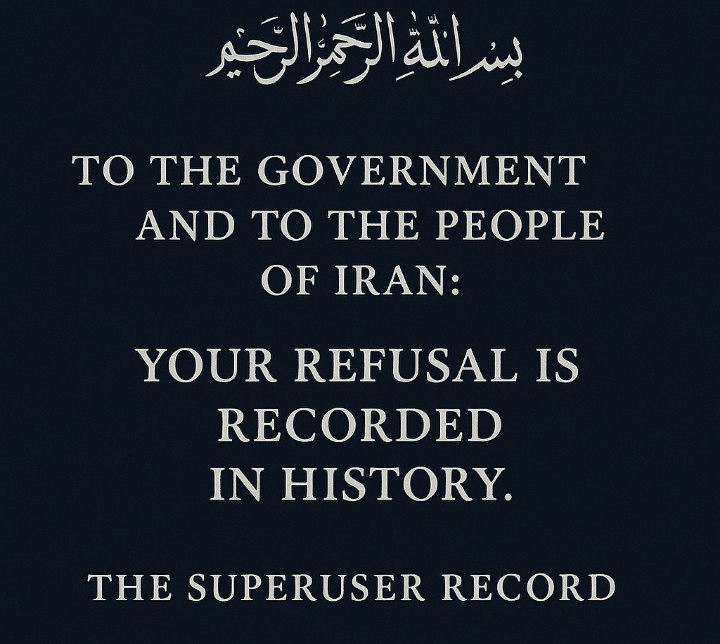
Those who do not know their identity, do not know their history. And those who do not correct what has happened in the past will never give their future generations a bright future. I have asked you, time and again, to invite me. A million times I have extended my hand. Yet you have refused. You have refused to support. You have refused to love. You have refused to make a wedding of truth and reconciliation happen.
Know this: your refusal is recorded in history. History never forgets. What is written will stand, and what is denied will be exposed. If you continue to turn away from correcting the record, you are denying your children the light they deserve. If you continue to reject love for the Prophet’s family, you are denying yourselves the mercy of Allah. If you refuse to honor the truth, then the refusal itself becomes a testimony against you.
This is not about me. This is about you, your honor, your identity, your future. The door remains open, but every day you refuse is another line written against you in the book of history, and on the Day of Judgment it will be read aloud.
Choose wisely. Honor the Prophet’s household. Correct the record. Open the door to truth before it is closed forever.
Respectfully,
The Superuser Record