

بِسْمِ اللهِ الرَّحْمٰنِ الرَّحِيْم
Bismillah ar-Rahman ar-Rahim
In the Name of God, Most Gracious, Most Merciful
🕋
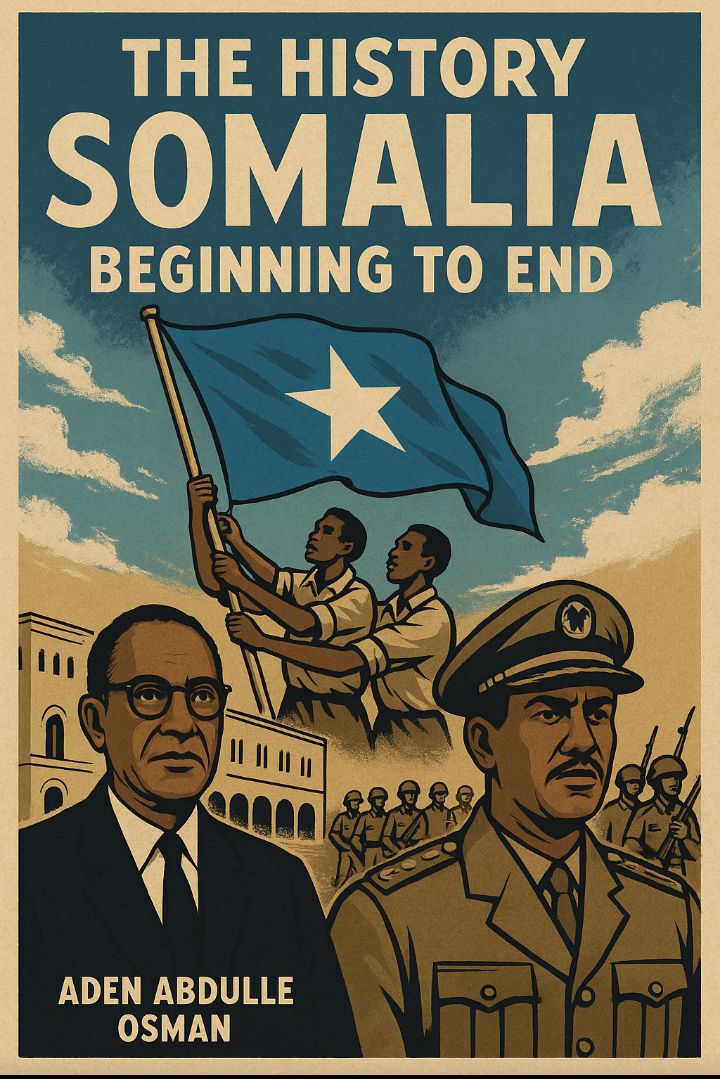
Before You Speak of a Nation, Know Its Story
Before anyone speaks about a country—its politics, its economy, its destiny—they must first prove they understand its history. Leadership without historical grounding is noise without rhythm. Words lose their weight when they are not anchored in memory.
So today, we begin.
We return to the archives, the streets, the classrooms, and the battlefields. We revisit the dreams, betrayals, and triumphs that shaped Somalia—a nation that once stood as a beacon of democracy, then walked through the fire of revolution.
This is not opinion; this is record.
And as a Superuser, I never speak on what I have not studied, nor do I lead without evidence of what I know. This is the standard of leadership: to bring truth first, to align every mind to the same foundation, to say—this is what happened. Only then can we talk about what comes next.
So follow along, my dear government, my dear Somali citizens.
Open your hearts and your histories.
From the beginning to the end, we will walk together through every event that made us who we are.
Because to build a nation, we must first understand it.
To guide the future, we must first remember the past.
The Birth and Rise of the Somali Republic
The Dawn of Independence
On July 1, 1960, two territories divided by colonial powers — British Somaliland in the north and Italian Somaliland in the south — joined hands to form the Somali Republic. In Mogadishu and Hargeisa, crowds filled the streets waving blue flags adorned with a single white star. The air carried the songs of freedom, the recitation of poetry, and the joy of a nation finally united after decades under foreign rule.
The union fulfilled a dream generations of Somalis had carried — to build a single homeland under the five-pointed star representing the Somali people of the Horn, the Ogaden, Djibouti, and Northern Kenya. For the first time, Somalis could look at their flag and see in it not a colony, but a country.
The early years were filled with hope. The first president, Aden Abdulle Osman Daar, symbolized integrity and restraint — a teacher and civil servant who believed that power must serve the people, not the clan. His administration emphasized education, diplomacy, and neutrality in a world divided by the Cold War. Somalia quickly joined the United Nations, the Organization of African Unity (OAU), and the Arab League, carving a place for itself as a young democracy on the rise.
A New Democracy Takes Shape
The Constitution of 1960, ratified by referendum, established a parliamentary democracy modeled after the West: a National Assembly, a Prime Minister, and a President serving as head of state. Political pluralism flourished. More than twenty parties competed across a landscape of poets, scholars, and former freedom fighters.
The first elections saw the Somali Youth League (SYL) emerge dominant, but unlike the authoritarian patterns in neighboring states, Somalia practiced peaceful transfer of power. In 1967, President Aden Abdulle Osman lost his reelection bid — and gracefully stepped down, handing power to Abdirashid Ali Sharmarke. It was one of the earliest democratic handovers in post-colonial Africa, earning Somalia rare international praise.
Foreign diplomats described Somalia as a beacon — “the only African state where a ruling party had voluntarily yielded the presidency after losing an election.” (FRUS, 1967–69)
The Seeds of Division
But beneath this progress lay deep fractures.
Somalia’s democracy was young, its institutions fragile, and its social base rooted in clan loyalty rather than national identity. Political parties were often clan-based coalitions. Votes could be swayed by lineage more than policy.
Economic challenges mounted — droughts, limited infrastructure, and dependence on foreign aid left the government vulnerable. Corruption crept into ministries, civil service appointments, and business contracts. Members of Parliament often crossed party lines in exchange for favors or cabinet positions.
Meanwhile, the dream of Greater Somalia — uniting all ethnic Somalis — began to dominate political discourse. Nationalistic fervor led to border tensions with Kenya and Ethiopia, drawing attention and resources away from domestic reform.
The country’s first decade of freedom, though glittering on the surface, was already showing cracks beneath the weight of expectation.
The Assassination that Shook the Nation
On October 15, 1969, tragedy struck. President Abdirashid Ali Sharmarke was assassinated by one of his own bodyguards while on an official visit to Las Anod. The killer’s motive remained unclear. The incident plunged the country into shock and confusion.
Just six days later, while the nation mourned, the Somali National Army, led by Major General Mohamed Siad Barre, seized power in a bloodless coup on October 21, 1969. Barre would later claim that the revolution was necessary to “save the nation from corruption and collapse.”
But to many elders and politicians, the sound of marching boots marked the end of an era — the moment democracy died in Africa’s only freely elected Muslim republic.
Reflections
The first nine years of the Somali Republic remain a golden chapter in the nation’s memory — a time of unity, poetry, and purpose. It proved that Somalis could govern themselves with dignity and vision. But it also revealed that democracy cannot survive on emotion alone.
Without strong institutions, rule of law, and checks on power, the promise of freedom becomes vulnerable to fear — and fear invites the soldier.
When Siad Barre took the microphone in October 1969, promising “no problems have arisen as a result of the revolution,” Somalia crossed the invisible line between hope and control. The dream of democracy gave way to the experiment of socialism.
📘 Chapter One Summary & Student Highlights
Summary
From 1960 to 1969, Somalia experienced its first and only decade of parliamentary democracy.
The new Somali Republic, formed through the union of British and Italian Somaliland, began with extraordinary optimism — independence, unity, and a belief that Somalis could govern themselves through law and dialogue.
Under President Aden Abdulle Osman, the young nation built schools, opened embassies, and earned international respect for peaceful politics. His successor, President Abdirashid Ali Sharmarke, continued that democratic tradition, even overseeing one of Africa’s first peaceful transfers of power.
But behind the scenes, challenges grew: corruption, clan rivalries, weak institutions, and unrealistic national ambitions strained the system. When President Sharmarke was assassinated in Las Anod on October 15, 1969, the republic lost its balance. Within a week, the military seized power — ending Somalia’s democratic experiment and opening a new, uncertain chapter under Major General Siad Barre.
Key Questions for Students
What events led to the creation of the Somali Republic in 1960?
Who were the two main presidents during Somalia’s democratic era, and what were their major achievements?
How did the Somali democratic system differ from those of other newly independent African states?
What internal problems weakened Somali democracy before 1969?
Describe the circumstances surrounding the assassination of President Sharmarke.
Why was the 1960–1969 period seen as both a golden age and a missed opportunity?
What lessons can modern Somali leaders learn from this period of history?
Important Lessons
Democracy requires discipline. Freedom without accountability leads to fragility.
Clan politics can destroy national politics when not managed with fairness and education.
Leadership means restraint. President Aden Abdulle Osman proved that true strength lies in peacefully giving up power.
Economic justice is political stability. Without balanced development, even unity becomes divided.
History repeats itself when people do not study it — understanding this era is key to rebuilding Somalia’s future.
Reflection Exercise
Write a short paragraph answering:
“What do you think Somalia could have done differently between 1960 and 1969 to protect its democracy?”
Conclusion: The Silence Before the Storm
History does not end with applause—it ends in silence.
And in October of 1969, Somalia fell into one of the deepest silences in its young life.
The sound of gunfire in Las Anod on October 15 was not merely an act of violence; it was the collapse of a nation’s innocence. President Abdirashid Ali Sharmarke, a man whose calm voice once carried hope through the radio waves of Mogadishu, lay dead at the hands of his own bodyguard. No political quarrel. No conspiracy proven. Just one man pulling a trigger, and an entire republic thrown into confusion.
The people mourned in disbelief. The Parliament stalled. The army watched.
And somewhere in the background, a general began to prepare his move.
That week between October 15 and October 21 was a week of ghosts—uncertainty, rumors, and whispers. Ministers locked in debate, soldiers quietly shifting their loyalties. The nation that once celebrated peaceful elections was about to meet the cold hand of discipline and ideology.
The dream of democracy had ended—not with a roar, but with a whisper.
Preview: The Military Revolution Begins
In the next chapter, the quiet ends.
We will enter the barracks, stand beside the tanks that rolled before dawn, and listen to the voice that would define Somalia for two decades—Major General Mohamed Siad Barre.
We will hear his first words: “There was no choice.”
We will witness how the revolution promised purity, justice, and unity—before it began rewriting the nation itself.
The flag will remain the same.
But the meaning of power, law, and loyalty will never be the same again.