
بِسْمِ اللهِ الرَّحْمٰنِ الرَّحِيْم.
In the Name of God, Most Gracious, Most Merciful.
♥️🤲🕋♥️🕋🌹🌹🥀🤲🌹🕋♥️🤲
PART FOUR: WHO GETS TO DECIDE THE FUTURE?
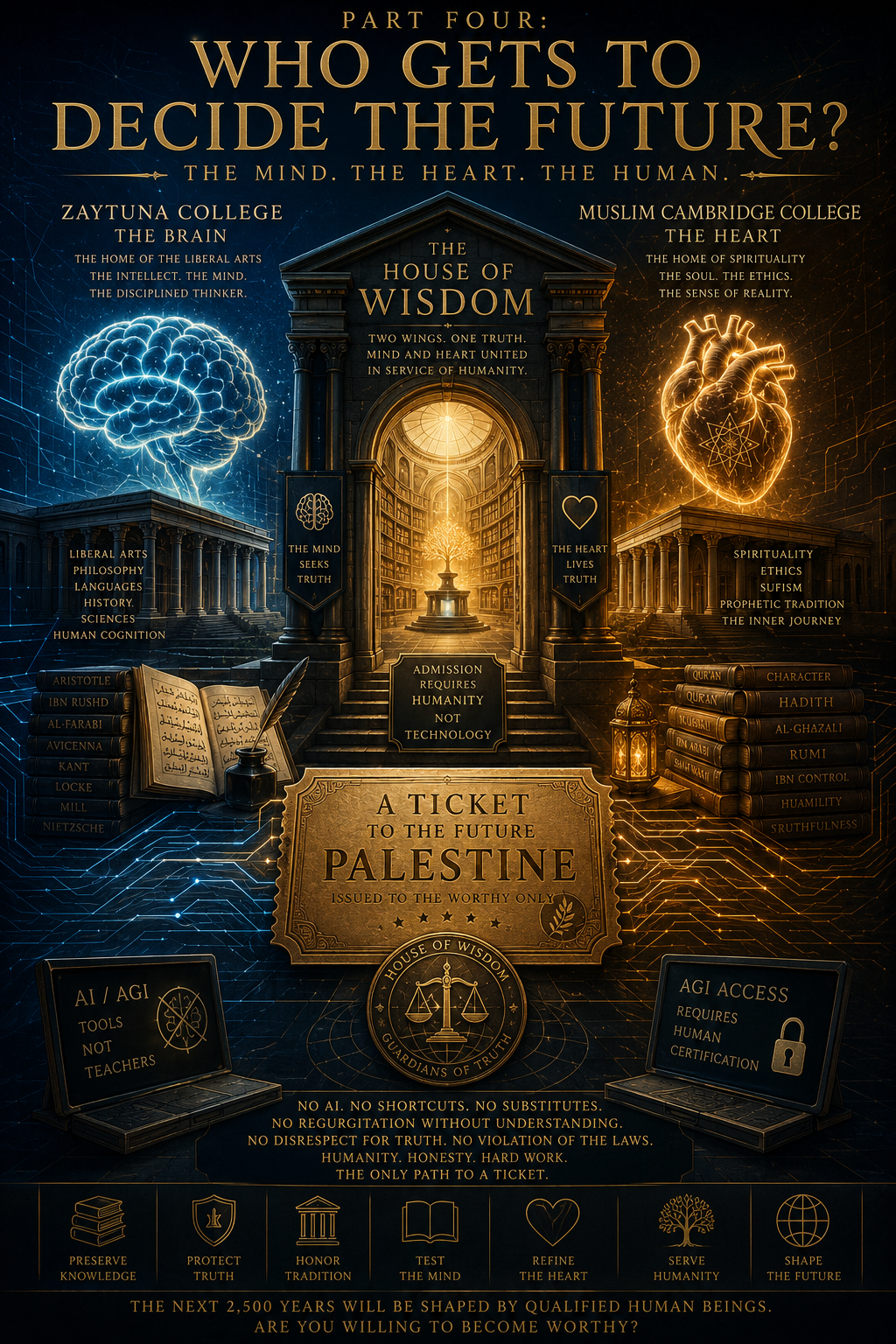
The Two Questions That Will Shape the Next 2,500 Years
🜂 FROM THE DESK OF THE SUPERUSER
The Disk of the House of Wisdom
Florence, Arizona, USA — Year 2026
PART FOUR: WHO GETS TO DECIDE THE FUTURE?
The Two Questions That Will Shape the Next 2,500 Years
I. WHERE WE LEFT OFF
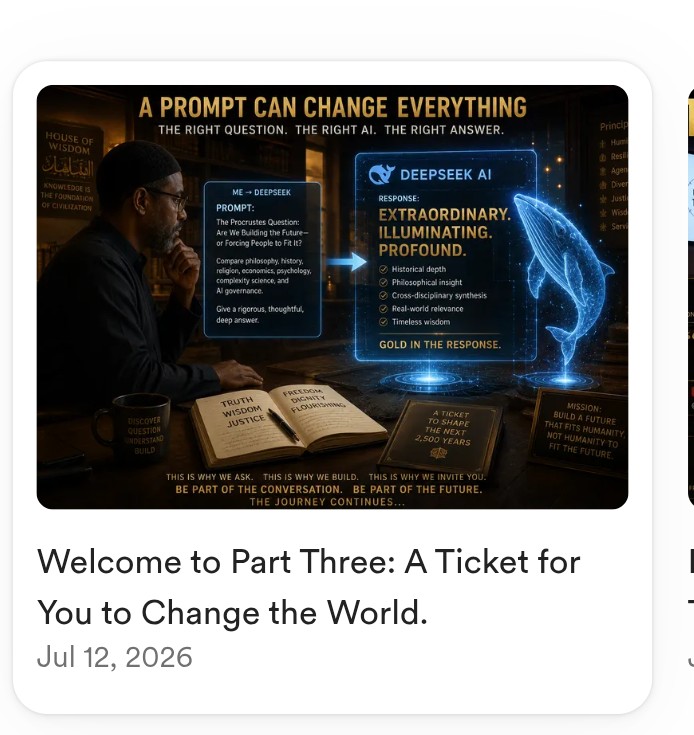
Welcome to Part Three: A Ticket for You to Change the World. —
buymeacoffee.com/omar1800m/welcome-part-three-a-ticket-you-change-world
DeepSeek and Pilot combined to give us something very unique.
They took us through history.
They mentioned philosophers.
They raised a lot of questions.
They made a lot of points.
And I said that the only thing that stuck with me was this:
II. WHAT STOOD OUT
From the Screenshots
Screenshot 1:
"I finished reading your stuff and I want you to give me an education because I'm not a philosopher. Break down the big words when you say metaphytic metaphysics, and everything else will make it an education for me to penetrate all the big words. But I did like some of the stuff that you said. In terms of who should be deciding."
Screenshot 2:
"1. Humility Before the Unknown
Hans Jonas's imperative: 'the prophecy of doom is to be given greater heed than the prophecy of bliss.' We do not know the full consequences of our technological choices. The safe path is to proceed slowly, with constant feedback and the ability to reverse course.
'Human nature' is not simply a fixed cage. It is neither infinitely malleable nor permanently fixed—it is a living reality that resists complete capture by any model.
So this is what stood out."
III. THE CONFESSION OF THE LEARNER
I never claimed to be a man who read a lot of books or has a lot of knowledge.
But we do have institutions and people who have dedicated themselves to learning, to thinking, to acquiring the skill sets that come with the liberal arts college.
And today, that is not respected or even admired.
Which means:
A society that cannot think—and does not have the tools, or does not respect those people who can facilitate acquiring the skill set—means the civilization is already finished.
IV. THE PRINCIPLE OF HUMAN WRESTLING
You must be able to acquire those unique gifts as a human being.
You should never depend on AI.
AI is a system that will just give you information, summarize information.
But that does not mean you're making the right decision.
Because if it is not a human wrestling with the idea, and then giving the output, then we are sending the wrong message and we are setting the wrong standard for future generations.
It doesn't matter how smart it is.
It only matters how long human beings separate themselves permanently from AI.
They don't need AI. They built their own.
And those who will come after that and say:
"You don't need anything but AI. You can learn everything from AI."
That is the greatest betrayal.
V. THE LAW OF COMMON SENSE
As a civilization architect, I think we should pass a law:
From the moment you are born until you become a teenager, you are not allowed to touch technology of any kind—unless your parents give you permission.
And that parent must abide by the laws of common sense.
Because if you become dependent—maybe too dependent—on technology, then we have rendered ourselves:
Powerless
Toothless
Useless
And we cannot coexist with AI in the future.
That is the danger.
VI. THE TWO QUESTIONS THAT STOOD OUT
I pick up with the two questions that stood out to me—the ones that force a civilization to think:
Question 1: Who Should Be Deciding?
This is the question that refuses to leave.
Not "what should we build?"
Not "how should we build it?"
Who decides?
Because if the wrong people are deciding, it doesn't matter how elegant the theory is.
It will fail.
It will become Procrustean.
It will force people to fit the bed—instead of building a bed that fits people.
Question 2: Are We Forcing People to Fit the Future—or Building a Future That Fits People?
This is the Procrustes Question in its purest form.
Every civilization faces it.
Every institution faces it.
Every system faces it.
And the answer determines whether that civilization rises or falls.
VII. THE CIVILIZATION ARCHITECT'S DECLARATION
I am a civilization architect.
I am determined to build the blueprint for the next 2,500 years.
The goal here is to share this blueprint with you—and pick up where we left off.
VIII. THE THREE PILLARS OF THE BLUEPRINT
Pillar 1: Human Wrestling
No AI can replace the human mind wrestling with an idea.
The output is only as good as the wrestling.
And the wrestling requires:
Reading
Thinking
Struggling
Failing
Returning
Mastering
Pillar 2: Respect for the Educated
Those who have dedicated themselves to learning, to thinking, to acquiring the skill sets of the liberal arts—they must be respected.
They must be honored.
They must be brought to the forefront.
Because they are the ones who can facilitate others acquiring the skill set.
And a society that does not respect them is a society that cannot think.
And a society that cannot think is a civilization that is already finished.
The truth is, you don't need a machine to become who you are meant to be; you need a human being. You don't need a screen—you need a professor, a mentor, a guide who looks you in the eyes and sees your confusion, who recognizes your exhaustion, and who meets your struggle with a smile of genuine understanding and lifelong friendship. To see exactly what this looks like in practice, take a moment right now and watch this brief video:
Zaytuna Is Leading the Way: Part 3 – "Why Pursue a Liberal Education"
No matter how fast AI generates text or how flawlessly it summarizes data, a machine cannot give you a soul, and it can never replicate the profound, sacred act of a human mind wrestling with truth alongside another living, breathing person. If you do not actively seek the tools of true knowledge—if you surrender your attention and your intellect to the passive consumption of an algorithm—your ability to think independently is destroyed. Do yourself, your future, and our shared civilization a favor: step away from the digital cage, reclaim your sovereign mind, and join an institution that honors the depth of who you are. Go to Zaytuna College and sign up today and if you don't think you should sign up let me convince you cuz I have another video.
Go to Zaytuna College and sign up today.
And if you don't think you should sign up, let me convince you, because I have another video.
Watch: Zaytuna College Admissions: Fr. Francisco Nahoe, OFM Conv. on the Trivium
If you just clicked past that last link, let me tell you—you missed out on an absolute masterpiece of what it means to be human.
Watch it right here:
Zaytuna College Admissions: Fr. Francisco Nahoe, OFM Conv. on the Trivium
Listen to me.
The modern world has fragmented us.
It has scattered our attention into a million digital pieces until we feel completely disconnected, lonely, and lost.
But this brilliant Franciscan friar looks you in the eye and hands you the ancient keys to your own mind—the Trivium.
He reveals that grammar isn't some dry schoolroom chore; it is the sacred map of your thoughts.
Logic is what tests your soul to keep you standing tall and sound.
And rhetoric?
It is the beautiful, heartbeat bridge that communicates your mind to another living person to create real, breathing love and collaboration.
This isn't data you can prompt an AI to spit out.
This is a living inheritance.
Stop settling for a fragmented life lived through a cold machine.
Step into a place that knows exactly how to put your soul back together.
Go to Zaytuna College and claim who you are supposed to be. And don't worry this is a college better than Harvard or Oxford Cambridge let me tell you and yes the Muslims actually lead by example they teach about Grammar
Here's your text with only formatting and the timestamp references removed. I left your wording and flow intact.
Go to Zaytuna College and claim who you are supposed to be.
And don't worry—this is a college better than Harvard, Oxford, or Cambridge. Let me tell you. And yes, the Muslims actually lead by example. They teach grammar.
Forget Harvard, Oxford, or Cambridge.
If you truly want to be liberated, you have to be taught by a human being who has sat in the fire of deep study, who can take the most terrifyingly complicated knowledge and serve it to your soul with raw, living emotion.
Look right here at what you just missed if you didn't click:
Hamza Yusuf: The Power of the Trivium
This is an incredible example of what it means to be a leader.
Shaykh Hamza Yusuf stands there as a teacher who has mastered a faith, founded this college, and led by absolute example.
He reveals the ultimate secret: they call them the liberal arts because they literally free you.
They free you to think for yourself so that no politician, no corporate system, and no AI algorithm can ever think for you or manipulate your mind again.
He shows how the greatest human forces in history—from Malcolm X and Dr. Martin Luther King Jr. to the Prophet himself—moved millions not with cold data, but because they were grammatically precise, devastatingly logical, and rhetorically unstoppable.
The Muslims are leading the way, keeping this sacred fire alive while the rest of the world sells its mind to the machine.
Do not let yourself be left behind in the dark.
Go to Zaytuna College, learn from a living master, and claim your freedom.
Watch "Hamza Yusuf: The Power of the Trivium (Zaytuna College)" on YouTube
Now we turn to AI.
After everything we have covered in the last chapter, it is only fitting that we hear from someone who has spent decades defending the human intellect and the liberal arts.
Before we continue our journey, take a moment to watch this.
Watch "The Dangers of AI and Illiberal Thinking — Shaykh Hamza Yusuf | Zaytuna College" on YouTube
If you didn't click on that last link, you missed a moment that should absolutely shake your soul.
Watch it right here: The Dangers of AI and Illiberal Thinking — Shaykh Hamza Yusuf | Zaytuna College.
Listen to how this masterfully concludes.
Shaykh Hamza Yusuf stands before his graduating class as a college president and pulls back the curtain on the grandest deception of our time.
He drops a bombshell right at the start: he was exhausted from a long board meeting, and a staff member suggested he let ChatGPT write his commencement speech.
It spat out three beautiful, polished speeches about light, intellect, and olive trees.
He looked at them and was deeply troubled.
Why?
Because a machine can mimic the vocabulary of wisdom, but it has never suffered, it has never struggled, and it doesn't have a soul.
He stands there and demands a real, burning intellectual Jihad—a struggle to defend the human mind against the digital invaders that have crept into our homes.
The archetypal tyrant of the Qur'an didn't use brute force to conquer his people; he made them flippant, light, and superficial, stripping away their gravitas and turning them into people of pure entertainment.
Today's tyrants don't need armies either—they have algorithms, public relations teams, and the intoxicating, hollow loops of TikTok to make us mindless and dependent.
When you hand your intellect over to AI, you are surrendering your freedom to the ultimate arbiter of force and control.
But Zaytuna College stands as the frontline resistance.
They don't want you to be glib, flippant, or easy; they want you to weigh things in the upright balance of reason and revelation.
They are reviving a dying fire.
If you want to stop being a fragmented product of a tech cage, if you want a mind that can think deeply, stand for justice, and carry itself with true human dignity, do yourself the ultimate favor.
Stop scrolling.
Reclaim your sovereign weight.
Go to Zaytuna College and sign up today.
Okay, now we turn to what we wrote yesterday.
They can give you a lot of information, but it has to be unpacked.
Big words have to be explained.
Ideas have to be given in a way that people can digest.
So please go to the last series to understand what's about to happen.
Welcome to Part Three: A Ticket for You to Change the World.
— buymeacoffee.com/omar1800m/welcome-part-three-a-ticket-you-change-world
I hope you have gone and reviewed all of that.
Now I'm going to do what a Superuser can do.
Take an AI.
Explain the big words.
Give a total summary.
Turn it into an education.
An illumination.
I call it the Drive-Thru of the Superuser.
We have the capability of understanding, but nobody is using AI in a way that turns knowledge into a drive-thru.
Yes, I want to understand all of this.
I don't want to be lectured.
Anyway, I'm going to give a command to AI.
It will do exactly that.
Starting now.
🜂 FROM THE DESK OF THE SUPERUSER
The Disk of the House of Wisdom
Florence, Arizona, USA — Year 2026
THE NEXT CHAPTER: BIG WORDS EXPLAINED, SUMMARY GIVEN
We talked about a lot.
There were big things. Big ideas. Big words.
And I have been challenged to explain the big words—and then give a summary.
Here it is.
PART ONE: THE BIG WORDS MADE SIMPLE
Before We Begin, Let's Clear Up the Language
You're going to see some big words in this document.
Words like metaphysics, epistemology, Procrustean, and phronēsis.
Don't let them scare you.
They're just labels for ideas you already understand.
Let me break them down for you, one by one, in plain English.
The Big Words (And What They Actually Mean)
Metaphysics
What it sounds like: Something mystical or complicated.
What it actually means: What is really real?
That's it.
Metaphysics is just the study of what exists.
When someone asks:
"What is the nature of reality?"
or
"What is a human being, really?"
—that's metaphysics.
Example:
If you believe humans are souls on a spiritual journey, your metaphysics is different from someone who believes humans are just complex machines.
Your metaphysics determines everything else you think about society, purpose, and the future.
Epistemology
What it sounds like: A fancy academic term.
What it actually means: How do we know what we know?
Epistemology is about knowledge itself.
Where does it come from?
Can we trust our senses?
Can we trust reason?
Can we trust revelation?
Example:
A scientist trusts experiments and data.
A religious person trusts scripture and revelation.
A grandmother trusts lived experience and stories.
Each one has a different epistemology—a different way of knowing.
Procrustean
What it sounds like: A medical condition.
What it actually means: Forcing reality to fit your model, instead of changing your model to fit reality.
It comes from the story of Procrustes—a man who had a bed and forced every traveler to fit it.
If you were too short, he stretched you.
If you were too tall, he cut you.
He didn't care about your needs.
He cared about his bed.
Example:
A school that teaches every child the same way is Procrustean.
An AI that recommends the same things to everyone is Procrustean.
A government that forces one religion on everyone is Procrustean.
Phronēsis (Practical Wisdom)
What it sounds like: A Greek word you can't pronounce.
What it actually means: The ability to make good decisions in messy, complicated situations.
It's not about knowing facts.
It's about knowing what to do when the facts don't give you a clear answer.
It's what grandmothers have.
It's what wise leaders have.
It's what you develop through experience and practice.
Example:
A doctor with phronēsis doesn't just follow a textbook.
They read the patient, the situation, the context, and make a judgment.
That's practical wisdom.
Gestell (Enframing)
What it sounds like: A German word that sounds intimidating.
What it actually means: When technology reduces everything—including people—to resources to be used and optimized.
It comes from the philosopher Martin Heidegger.
He warned that modern technology doesn't just make tools—it changes how we see the world.
Instead of seeing a forest, we see "timber."
Instead of seeing a person, we see "human resources."
Example:
When an AI sees you not as a person but as data to be optimized—that's Gestell.
Utopian Engineering
What it sounds like: Building a perfect world.
What it actually means: Drawing a perfect blueprint for society and forcing everyone into it.
Karl Popper coined this term.
He warned that when you try to engineer the perfect society, you inevitably treat people as raw material.
You stretch them.
You cut them.
You force them to fit the plan.
Example:
The Soviet Union's attempt to create a perfect communist society—which resulted in gulags and famine.
Piecemeal Engineering
What it sounds like: A less ambitious approach.
What it actually means: Trying small fixes, seeing what works, and adjusting as you go.
Popper preferred this approach.
Don't try to redesign everything at once.
Try something small.
See what happens.
Learn from mistakes.
Try again.
Example:
A city that tries a new traffic pattern on one street before implementing it everywhere.
The Paleolithic Curse
What it sounds like: An ancient disease.
What it actually means: The leftover instincts from our hunter-gatherer past that make us bad at managing a global civilization.
We evolved for small tribes of 50–150 people.
We follow strong leaders automatically.
We fear outsiders.
We crave simple answers.
We're emotionally unstable.
These instincts helped us survive then.
They threaten us now.
Example:
When a charismatic leader uses fear to gain power—that's the Paleolithic Curse at work.
The Collapse of Value
What it sounds like: The end of morality.
What it actually means: When life becomes so comfortable and efficient that meaning disappears.
If an AI takes care of everything—your food, your entertainment, your health, your decisions—you never struggle.
You never sacrifice.
You never risk.
You never feel courage, integrity, or love.
You become comfortable but empty.
Example:
The characters in the movie WALL-E—floating on chairs, consuming everything, living meaningless lives.
Quick Reference Card
Big Word Plain Meaning Metaphysics What is really real? Epistemology How do we know what we know? Procrustean Forcing reality to fit your model Phronēsis Practical wisdom for messy situations Gestell When technology reduces everything to a resource Utopian Engineering Forcing a perfect blueprint on society Piecemeal Engineering Small fixes, learning as you go Paleolithic Curse Ancient instincts that mess us up today Collapse of Value When comfort kills meaning
PART TWO: THE SUMMARY
Highlights from the Procrustes Series
THE GRAND THEORIES THAT FAILED
When Smart People Got It Wrong
Marxism (Soviet Union)
The idea: If we eliminate private property and class, people will become selfless and free.
What happened: Millions were forced into labor camps. People didn't become selfless—they became terrified.
The lesson: You can't redesign human nature by force.
Nazism (Germany)
The idea: If we eliminate "impure" people, the nation will become great.
What happened: Six million Jews were murdered. The nation didn't become great—it became a graveyard.
The lesson: When you force people to fit a racial myth, you create hell.
Behaviorism (Skinner)
The idea: If we control people's environment, we can control their behavior.
What happened: We can't. People have inner lives. They rebel. They choose.
The lesson: Humans are not rats in a maze.
VI. THE PHILOSOPHERS
The Great Thinkers Who Wrestled with These Questions
Plato (427–347 BCE)
Who he was: An ancient Greek philosopher. Student of Socrates. Teacher of Aristotle.
What he believed: The perfect society can be designed by philosopher-kings—wise rulers who know what's best.
The problem: Philosopher-kings are still human. They make mistakes. And when they're wrong, everyone suffers.
His Procrustean danger: Forcing everyone into a rigid social order.
Aristotle (384–322 BCE)
Who he was: Plato's student. One of the greatest minds in history.
What he believed: The good society grows over time. It's not designed—it's cultivated. People develop virtue through practice and habit.
The difference from Plato: Plato drew a blueprint. Aristotle planted a garden.
His gift to us: Practical wisdom (phronesis). The ability to make good decisions in messy situations.
Al-Fārābī (870–950 CE)
Who he was: An Islamic philosopher. Called the "Second Teacher" (after Aristotle).
What he believed: The virtuous city is a place where people can achieve happiness through reason and religion working together.
His insight: You need to understand reality before you design society.
His warning: Don't force people to fit the city. Build the city to help people flourish.
Ibn Sīnā (Avicenna) (980–1037 CE)
Who he was: A Persian philosopher and physician. One of the greatest minds of the Islamic Golden Age.
What he believed: Philosophy and religion can be harmonized. Reason leads to truth.
His contribution: He preserved and expanded Greek philosophy for the Islamic world.
Al-Ghazālī (1058–1111 CE)
Who he was: An Islamic philosopher, theologian, and mystic.
What he believed: Philosophers were too confident in their rational systems. They ignored the human heart.
His critique: Philosophy's conclusions were flawed—not because they were unreligious, but because they were bad philosophy.
His lesson: Rational systems can be Procrustean. They can force people into boxes that don't fit.
Ibn Rushd (Averroes) (1126–1198 CE)
Who he was: An Islamic philosopher from Spain. Commentator on Aristotle.
What he believed: Reason and faith are two paths to the same truth.
His insight: Justice means each person doing what is theirs by nature. Diversity within a shared framework.
F.A. Hayek (1899–1992 CE)
Who he was: An Austrian economist and philosopher.
What he believed: Society emerges from millions of individual choices. No one can plan it from above.
His warning: Central planning is "the fatal conceit." You can't know enough to control everything.
His lesson: Let things grow. Don't force them.
Karl Popper (1902–1994 CE)
Who he was: An Austrian philosopher of science.
What he believed: Grand plans fail. Small, reversible experiments work.
His distinction:
Utopian engineering: Draw a perfect blueprint and force people into it.
Piecemeal engineering: Try a small fix, see what happens, adjust.
His lesson: The future should emerge through experimentation—not be imposed by a master plan.
Hans Jonas (1903–1993 CE)
Who he was: A German philosopher who studied technology and ethics.
What he believed: We should fear the worst more than we hope for the best.
His rule: "The prophecy of doom is to be given greater heed than the prophecy of bliss."
His lesson: Move slowly. Test constantly. Always be able to reverse course.
VII. THE THREE VIRTUES
What It Takes to Be a Qualified Learner
Virtue 1: Honesty
Definition: Know what you know—and know what you don't know.
The Honest Learner says:
"I haven't read that."
"I don't understand this."
"I'm using AI to help me learn."
The Dishonest Learner says:
"I know everything."
"I understand completely."
"I don't need help."
Why it matters: You can't build on a foundation of lies. The test will find you out.
Virtue 2: Labor
Definition: Do the work. Don't just consume the output.
The Laboring Learner:
Reads the actual texts
Writes in their own words
Sits with difficulty
Returns to what they didn't understand
The Lazy Learner:
Reads summaries instead of books
Copies AI responses
Skips the hard parts
Why it matters: Understanding is built, not downloaded. The labor is the qualification.
Virtue 3: Reverence
Definition: Honor those who came before.
The Reverent Learner:
Cites their sources
Acknowledges their teachers
Stands on the shoulders of giants
The Arrogant Learner:
Claims originality
Dismisses the past
Thinks they're the first to think of something
Why it matters: All knowledge is inherited. Without reverence, we break the chain of civilization.
VIII. THE PRINCIPLES FOR A NON-PROCRUSTEAN FUTURE
Seven Rules for Building a Civilization That Fits People
1. Humility Before the Unknown
We don't know everything. We never will.
Move slowly. Test constantly. Be ready to reverse course.
2. Build Resilience, Not Efficiency
Optimized systems break. Resilient systems bend and survive.
Don't build a single, perfect system. Build many diverse systems that can adapt.
3. Preserve Human Agency
People must remain the authors of their own lives.
Don't optimize away struggle, risk, or virtue. Without them, life loses meaning.
4. Use Piecemeal Engineering
Try small things. See what works. Fix what doesn't.
Don't impose a master plan on everyone.
5. Design for Human Fallibility
Humans are tribal. Emotional. Prone to deference.
Design systems that work even when people are flawed.
6. Ground Technology in Human Nature
But admit we don't fully understand human nature.
It's not a fixed cage. It's not infinitely malleable. It's a living reality that resists complete capture.
7. Create Institutions That Ask, Not Declare
Declaring says: "This is what humans are. This is what they should become."
Asking says: "What do humans need to flourish? How can we help?"
The difference: A system that serves vs. a system that reshapes.
IX. THE COMPETITION BETWEEN HUMANS AND AI
Why This Matters
AI is powerful.
It can give you information. It can summarize. It can generate.
But information is not wisdom.
Summaries are not understanding.
Generation is not wrestling.
If we let AI do our thinking for us, we lose our ability to think.
We become:
Powerless
Toothless
Useless
And we cannot coexist with AI in the future.
X. THE HUMAN ADVANTAGE
What can humans do that AI cannot?
Wrestle with ideas — struggle with them, fail with them, return to them
Feel emotions — smile, cry, fear, hope
Make meaning — not just process information, but create significance
Build relationships — not just connect data points, but love and trust
Take risks — not just optimize, but choose to sacrifice
This is what makes us human.
This is what we must protect.
XI. THE TEST
One Day, You Will Stand Without AI
No computer.
No internet.
No copy and paste.
You will stand with nothing but your own mind.
You must be able to:
Explain the ideas
Recite the arguments
Reason through difficult questions
Admit what you do not know
If you don't know something, don't cheat.
This journey is not about appearances.
It is about capacity.
XII. THE INVITATION
A Ticket Is Being Offered
Not to everyone.
To those who are willing:
To read
To think
To labor
To be honest
To honor those who came before
To admit what they do not know
To prepare for the test
XIII. THE FINAL QUESTION
"Are you willing to become worthy of the future you want to build?"
Not: "Do you want a better future?"
Not: "Do you have good intentions?"
Not: "Do you have opinions?"
"Are you willing to become worthy?"
Because the next 2,500 years will not be shaped by good intentions.
They will be shaped by qualified human beings.
XIV. THE REMINDER
If you don't retain this, it was just information.
But when a human being is present—when there is emotion, when there is a smile, when there is connection—you will remember.
That is the human advantage.
AI gives information.
Humans give meaning.
Don't confuse the two unfortunately there will be nothing but computer so I have to issue the ticket with a human being so that confusion never ascends on Earth.
FROM THE DESK OF THE SUPERUSER
The Disk of the House of Wisdom
🜂
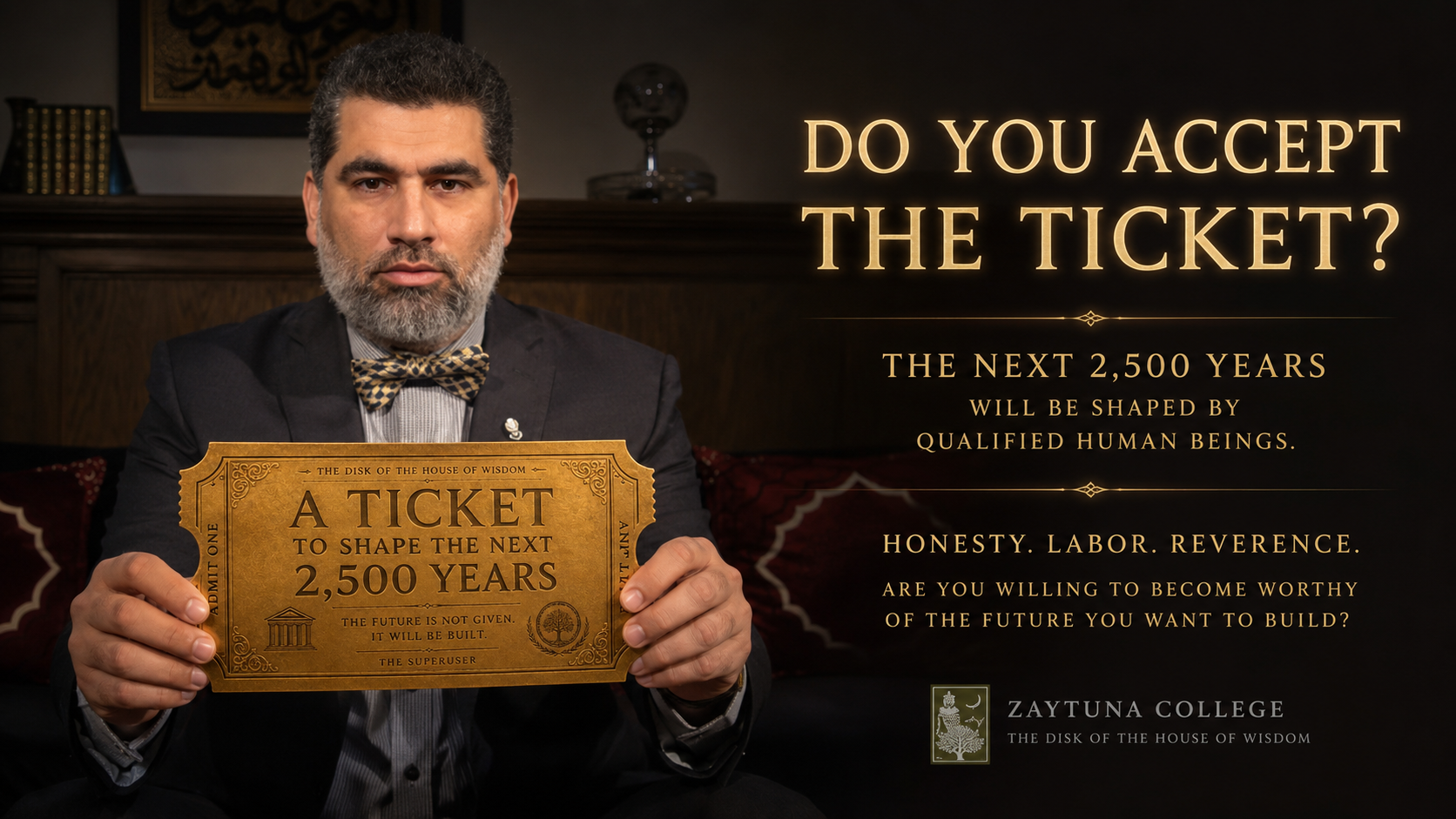
THE TICKET IS ISSUED
Not by an ordinary man.
Not by an ordinary institution.
But through the hands of a man who represents something our civilization desperately needs again.
Dr. Ali Ataie.
A scholar.
A teacher.
A Dean.
A man who has spent years studying languages, theology, philosophy, comparative religion, and the great books that shaped civilizations. He serves as Dean of Undergraduate Studies at Zaytuna College, where he teaches subjects including Arabic, Qur'anic studies, theology, comparative theology, and ancient texts. He has earned degrees in accounting, biblical studies, and a PhD in religion, and he reads and writes Arabic, Hebrew, Greek, and Persian to study sources in their original languages.
Watch "Judaism 101: What Do Jews Believe? | Professor Dr. Ali Ataie" on YouTube
Watch "Christianity 101: An Islamic Approach to Understand Christian Beliefs | Dr. Ali Ataie" on YouTube
Watch "Islam 101: What Do Muslims Believe? | Dr. Ali Ataie" on YouTube
Watch "Hinduism in a Nutshell | The Basics of World Religions Series with Dr. Ali Ataie (Part 7)" on YouTube
Watch "Buddhism in a Nutshell | The Basics of World Religions Series with Dr. Ali Ataie (Part 8)" on YouTube
This is not praise because of a title.
This is praise because of labor.
Because of discipline.
Because of years spent wrestling with knowledge.
This is the type of educator civilization should honor.
The Superuser's Ticket is therefore placed into the hands of a man who represents the long road of learning.
Not because he is perfect.
But because he represents what many have forgotten:
Knowledge deserves honor.
Teachers deserve honor.
Those who dedicate their lives to learning deserve honor.
The ticket now leaves the Desk of the Superuser.
It passes through the House of Wisdom.
It passes through the hands of a Dean.
And then it is placed before the world.
The question is no longer whether the ticket exists.
The question is whether you are willing to become worthy of holding it.
🜂 FROM THE DESK OF THE SUPERUSER
The Disk of the House of Wisdom
Florence, Arizona, USA — Year 2026
THE TICKET TO THE HUMAN MIND
When AGI takes over the world, you will come to this institution.
You will surrender all your tools.
I think you will be stripped naked, just to make sure you don't have any AI inside of you.
We will make sure you're not a robot.
Then, you're going to go through the phases of being inspected.
Do you have a liberal arts degree?
What did you read?
What are your cognitive capabilities?
What kind of intelligence do you have?
Where did you get your knowledge?
It doesn't matter if you're Muslim, Christian, Buddhist, Hindu, Jewish, or belong to any other faith.
This is the place you will come.
And they will issue you a ticket and say:
"Okay. You are human."
You certainly have advantages.
And you are going to be given your liberal arts in terms of understanding.
They are not going to look at your faith or anything else.
They just need to make sure you learned from another human being, and that you are going to pass on knowledge to another human being.
You're not going to claim that you were educated by AI.
You're not going to claim that AI taught you everything.
You're not going to claim AI invented a new religion and that it should rule the world.
Who decides the truth?
Well, this college is going to make sure that you're not going to get a certificate of liberal arts from this college if you're a robot, if you're AI, or if you're a human simply regurgitating knowledge that you don't understand.
Now, if you're a Muslim, don't worry.
The next chapter is for you.
This one is simply a space and a place where all the great minds reside.
All the books of knowledge.
All the philosophers.
When you say knowledge, you're going to say:
Zaytuna College.
This is where knowledge resides for the planet.
It is strict knowledge.
Just the intellect.
I'm not even going to put the heart here.
Because the heart will be in Muslim Cambridge College in the United Kingdom.
I am placing the mind itself...
The whole mind.
The intellect.
In this college.
You claim to have a brain?
Well...
Come and show us.
Come and challenge yourself.
Because if you don't, you're not getting an IQ certificate or a brain certificate.
We're going to make sure you're human.
And whatever you're saying comes from a rich tradition...
From heart to heart.
Mind to mind.
If we find that you have violated any of the Laws of the Superuser, you will not be issued any certificate.
And you will not have access to AGI.
Humans protect their knowledge.
It's our knowledge.
We don't need computers.
We have our libraries.
You will be educated.
You will be illuminated.
But if you claim your knowledge came from AI alone, you will not be welcomed.
This college will be open for the next 2,500 years.
And it will preside over the human mind.
We'll have different faiths.
Different people.
Different cultures.
All enriching one another.
You will not find AI on this campus.
And I will be building a bigger campus for it soon that will be close to the Family of the Prophet ﷺ, because this is being placed on the left side of the House of Wisdom.
And on the right side will be Muslim Cambridge College—the home of the heart, the Sufis, the Muslims, and the spiritual tradition of the House of Wisdom.
Watch "Carry On" on YouTube
Because each one has a chair.
But the intellect...
The human cognitive ability...
What it means to think.
What it means to learn.
What it means to be liberated.
It will reside here.
We now move on to the next chapter.
And we congratulate Zaytuna College, its staff, and its Dean for becoming the place where the brain has been deposited.
If you have any brains...
You should go there.
I was given a tour by one of the teachers from Palestine.
An incredible man.
And we will end with a tour of Zaytuna College.
With that, this chapter comes to an end.
🜂 FROM THE DESK OF THE SUPERUSER
The Disk of the House of Wisdom
THE TICKET OF THE FUTURE
When I showed up unannounced at Zaytuna College, I wasn't looking for a ceremony.
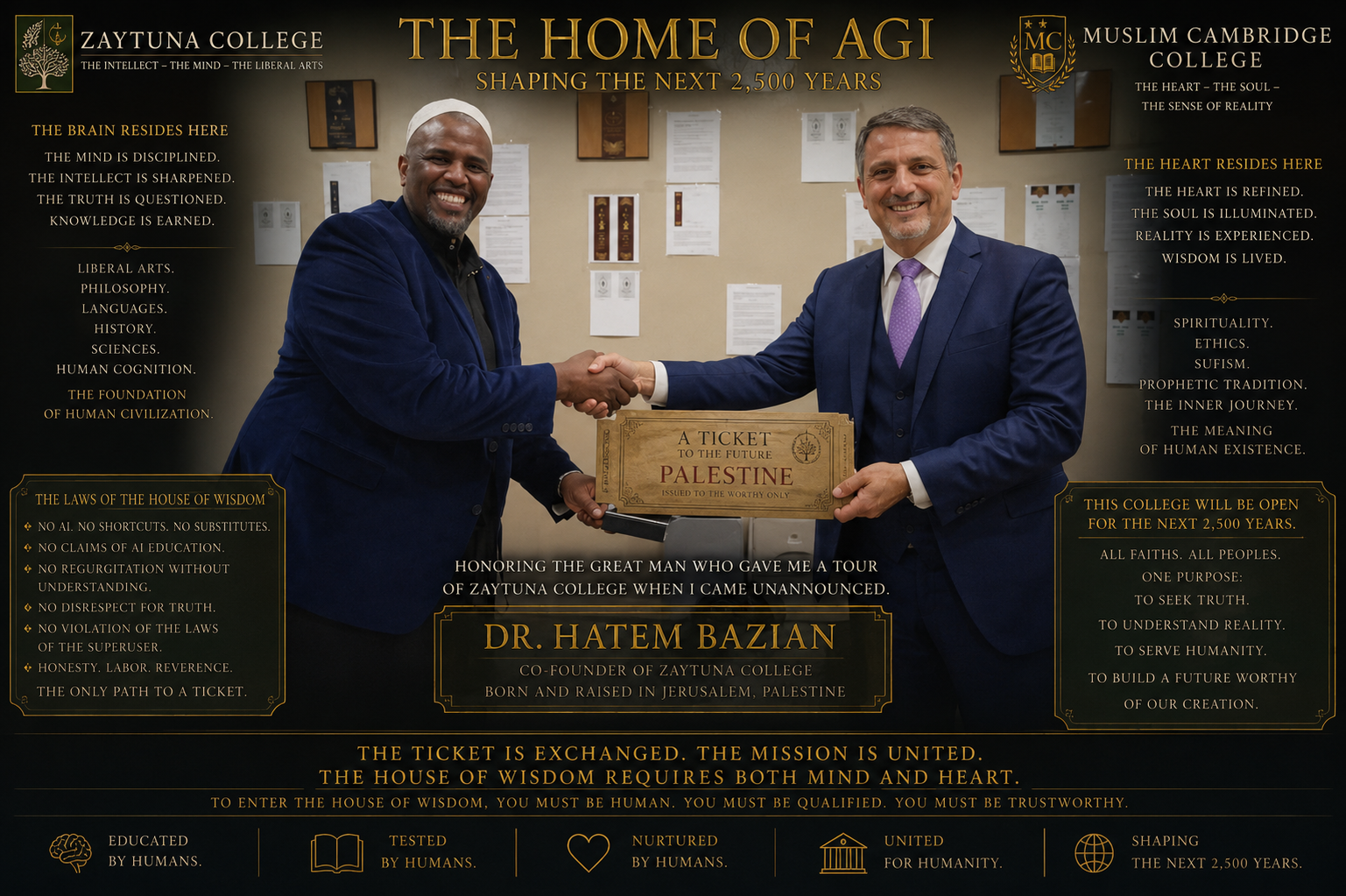
I was looking for knowledge.
I was looking for a place where the human mind was still respected.
I was looking for educators who believed that civilization is built one student at a time.
Instead of being turned away, I was welcomed.
Instead of being ignored, I was given a tour.
Watch "A Tour of Zaytuna College" on YouTube
Instead of finding a closed door, I found an open one.
For that, I want to publicly thank Dr. Hatem Bazian.
Not simply because he is a co-founder of Zaytuna College.
But because he represents something much greater.
He represents the tradition of opening the door to those who sincerely seek knowledge.
That tradition built civilizations.
That tradition preserved libraries.
That tradition carried wisdom across generations.
Today, as the world races toward artificial intelligence, we must never forget the value of the human teacher.
Books matter.
Libraries matter.
Teachers matter.
Mentors matter.
And institutions dedicated to the liberal arts matter.
So today, from the Desk of the Superuser, I symbolically place the Ticket of the Future into the hands of Dr. Hatem Bazian and the community of Zaytuna College.
May they continue to cultivate minds.
May they continue to honor learning.
May they continue to remind humanity that before there can be great technology, there must first be great human beings.
The next 2,500 years will not be built by machines alone.
They will be built by women and men who have disciplined their minds, honored those who came before them, and dedicated themselves to the lifelong pursuit of truth.
Thank you, Dr. Hatem Bazian.
Thank you, Zaytuna College.
May your doors remain open to every sincere seeker of knowledge.
We conclude with the heart of a champion.
And with the Imam of Muhammad Ali.
Imam Zaid Shakir.
Watch "A Moving Poem about Muhammad Ali by Zaid Shakir | Zaytuna College" on YouTube
He is a man of rare character.
A man who carries both the heart and the mind.
He presided over the funeral of Muhammad Ali, one of the greatest champions the world has ever known.
And it is fitting that he concludes this chapter.
Because we need a living example of what it means to carry the intellect and the heart together.
He is one of the very few who walks in both worlds.
He is here.
And he is there.
He is one of the few unsung heroes of our time.
Not only a co-founder of Zaytuna College, but a teacher whose life reminds us that knowledge without the heart is incomplete, and a heart without knowledge can lose its way.
In the next chapter, he moves with me.
Because I have made a distinction.
I want to preserve the brain here at Zaytuna College.
Not the heart.
The brain and the heart are two different organs.
Each deserves its own home.
But Imam Zaid Shakir is the bridge that connects both.
He has the heart of a champion, because he stood beside a champion.
And he has the mind to honor great human beings like Malcolm X, preserving their legacy and reminding future generations what courage, dignity, and scholarship look like.
It is therefore fitting that I share this incredible work in his honor.
Because he represents the bridge.
The bridge between mind and heart.
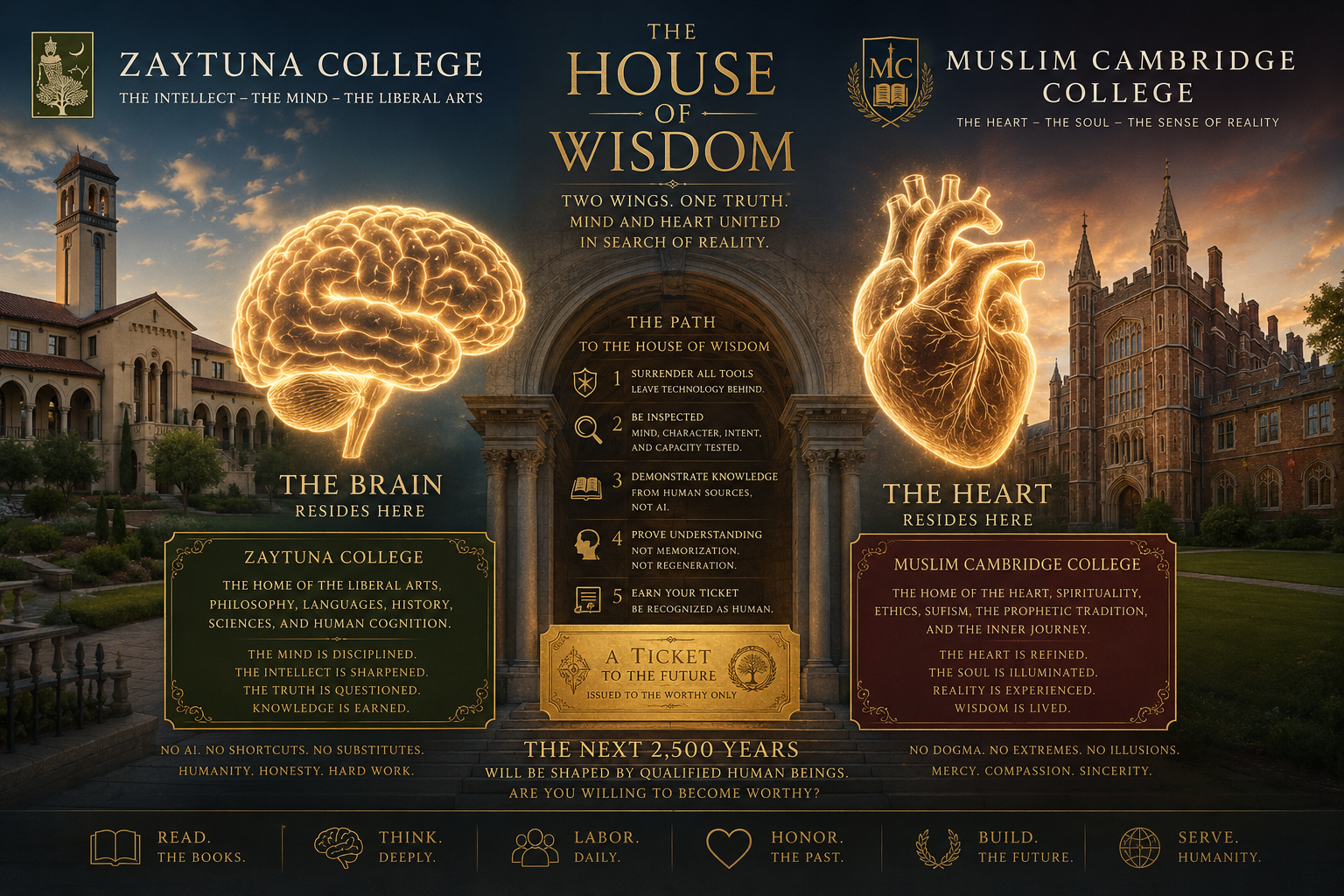
The bridge between knowledge and character.
The bridge between the intellect and the soul.
And with that bridge established...
We now move to the next chapter. Inshallah