
بِسْمِ اللهِ الرَّحْمٰنِ الرَّحِيْم
In the Name of God, Most Gracious, Most Merciful
♥️🤲🕋♥️🕋🌹🌹🥀🤲🌹🕋♥️🤲
OpenClaw, the Architecture of Reaction — and the Road to a Private BCS System
Artificial intelligence often feels mysterious.
It wakes up, responds, remembers, and sometimes even acts without being asked.
But when you look closely at systems like OpenClaw, the mystery begins to disappear.
What looks like intelligence is often well-designed structure.
This article does three things:
Explains who built OpenClaw and how his journey shaped the system.
Breaks down the architecture so anyone can understand it.
Shows how this pattern leads naturally into a private two-tower system built around the Brand Currency System (BCS).
Part I — The Builder Behind OpenClaw
OpenClaw was created by Peter Steinberger, an Austrian software engineer and entrepreneur.
Before OpenClaw, he built a successful developer tools company called PSPDFKit, which became widely used across the mobile industry. He spent over a decade building and running that company before eventually stepping away after a major deal.
After that exit, he entered a different phase of life.
By his own accounts, he felt a lack of direction. He moved, experimented, and built many small projects. Instead of chasing one grand idea, he started creating dozens of prototypes—small systems, assistants, and experiments—just to see what worked.
This period is important.
OpenClaw didn’t come from:
a corporate roadmap,
a research lab,
or a venture-funded AI team.
It came from continuous personal experimentation.
At some point, one of those experiments—a simple personal assistant connected to messaging apps and local scripts—started to take shape. That experiment evolved into Clawdbot, then other iterations, and eventually into OpenClaw.
The first version was reportedly built extremely quickly by combining:
messaging interfaces,
language models,
and local automation scripts.
It wasn’t a grand architecture at the start.
It was a practical tool.
But the pattern behind it turned out to be powerful.
Part II — The OpenClaw Architecture (In Plain Language)
OpenClaw feels alive.
But it isn’t alive.
It is an event-driven loop.
At its core, the system works like this:
Event → Gateway → Queue → Context → Agent → Tool → Memory → Wait
And then it repeats forever.
Let’s break that down into simple pieces.
1. The Gateway — The Front Door
The gateway is a long-running process on your machine.
It:
listens for messages,
watches timers,
receives signals from apps,
and routes everything to the agent.
Think of it as a receptionist that never sleeps.
Nothing reaches the agent directly.
Everything goes through the gateway.
2. The Triggers — Why the Agent Wakes Up
OpenClaw reacts to five kinds of triggers.
Messages
You send a message.
The agent responds.
Heartbeats
A timer runs at regular intervals.
Every 30 minutes, for example, the system asks:
“Is there anything to do?”
This is what makes the system feel alive.
Time itself becomes an input.
Cron Jobs
Scheduled tasks at fixed times.
Examples:
Every morning at 8:00 → check calendar.
Every Friday → send weekly report.
Hooks
Internal system events.
Examples:
When the system starts.
When a task finishes.
When a file changes.
Webhooks
External signals from other apps.
Examples:
New GitHub issue.
Slack notification.
Incoming ticket.
3. The Queue — One State at a Time
All events go into a queue.
The queue ensures:
one task runs at a time,
memory updates don’t conflict,
the system stays consistent.
This is not just about order.
It’s about protecting the system’s state.
4. Context Assembly — The Hidden Step
Before the agent thinks, the system must:
gather relevant memories,
load conversation history,
include recent events,
fit everything into the model’s context window.
This step decides:
what the agent remembers,
what it forgets,
and what it focuses on.
If this is poorly designed, the agent becomes useless.
5. The Agent — The Decision Engine
The agent:
reads the context,
decides what to do,
produces an action or response.
It does not act directly.
It only declares intent.
6. The Tool Layer — Where Action Happens
When the agent wants to act, it does not run commands itself.
Instead:
It outputs a structured request.
The runtime interprets it.
The system executes the tool.
Tools might:
run shell commands,
read or write files,
call APIs,
control a browser.
This layer is where:
permissions live,
safety rules live,
and risks live.
7. The Memory System — The Most Important Layer
OpenClaw uses local files as memory.
But real systems need memory tiers.
Working Memory
Current task context.
Short-Term Memory
Recent events and summaries.
Long-Term Memory
Preferences, facts, and key decisions.
Archive
Full logs, searchable but not loaded by default.
Without this structure:
memory grows endlessly,
context fills up,
the agent starts forgetting important things.
The Real Reason It Feels Alive
OpenClaw feels alive because:
It wakes up on heartbeats.
It reacts to time.
It remembers past events.
It continuously loops.
But in reality, it is just:
a gateway,
a queue,
a memory system,
and a decision engine.
No heartbeat.
Just a timer.
Part III — From OpenClaw to the Two-Tower BCS System
Once you understand the architecture, a new possibility appears.
If this pattern can:
run locally,
store memory,
and react to events,
then it can become a private intelligence tower.
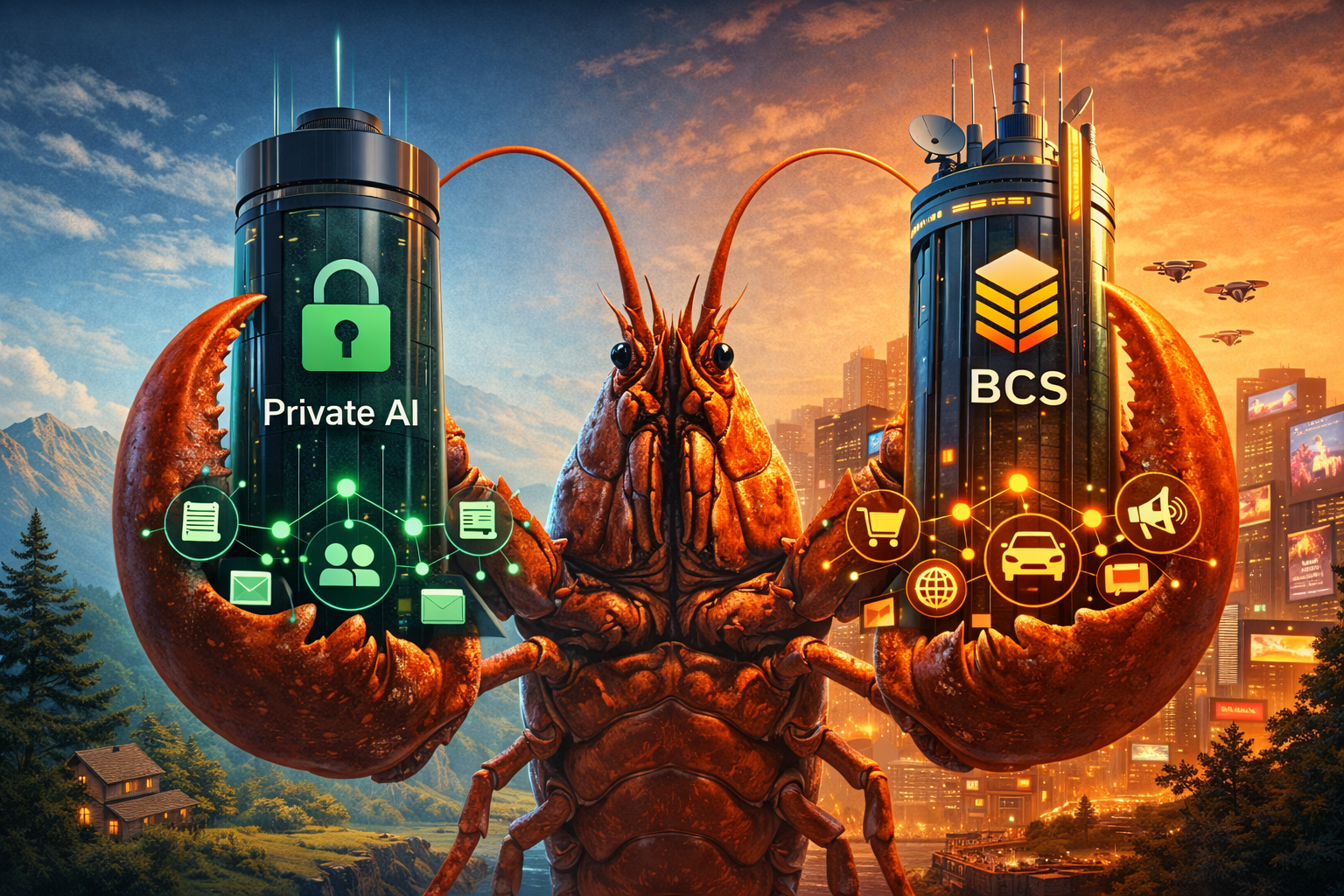
And that leads to a two-tower model.
Tower 1 — The Private Intelligence Layer
This is your personal AI system.
It:
runs locally,
stores all memory,
manages your context,
controls your data.
It owns:
working memory,
short-term memory,
long-term memory,
and the archive.
Nothing leaves this tower without consent.
Tower 2 — The BCS Marketplace Layer
This tower is connected to the outside world.
It:
handles ads,
handles marketplace signals,
runs the Brand Currency System,
connects to vendors and services.
But it never sees raw personal data.
It only receives derived signals.
Example: The Consent Boundary
Tower 1 knows:
your full schedule,
personal notes,
health appointments,
finances.
Tower 2 only receives:
“User needs transportation at 8:00 AM.”
Not:
“User has a medical oncology appointment.”
The boundary between towers is:
a consent-gated API
Rules:
Tower 1 owns all raw memory.
Tower 2 only receives approved signals.
Every transfer is logged.
User keys authorize every export.
This is where privacy lives.
Why This Matters
Traditional AI assistants:
run in corporate data centers,
store your memory remotely,
monetize your behavior,
and treat your data as fuel.
A two-tower system changes that.
Intelligence lives privately.
Marketplace functions are separate.
Data only moves with consent.
The Real Lesson of OpenClaw
OpenClaw is not the final system.
It is the pattern.
A simple loop:
time as input,
memory as state,
agent as decision engine,
tools as action layer.
Once you understand that loop, the mystery disappears.
And when the mystery disappears, a new question emerges:
If the architecture is this simple,
who should control it—corporations or individuals?
The answer to that question is what leads from OpenClaw
to a private, consent-driven, two-tower BCS system.
Conclusion — A Signal to the Builders
OpenClaw has done something important. It removed the mystery. It showed the world that what feels like autonomy is actually architecture—time as input, memory as state, a gateway as the front door, and a disciplined loop that turns events into action. It proved that a personal AI does not need to live in a corporate data center to be useful. It can live with the user, remember the user, and act on behalf of the user.
That realization changes the direction of the entire system.
Because once the intelligence layer becomes private, the next question is no longer how to build a better assistant. The real question becomes: how does that private intelligence connect to a fair marketplace without surrendering its memory, its autonomy, or its owner’s privacy? That is where the Brand Currency System and the two-tower model begin.
OpenClaw has built the pattern.
Superuser is building the world around that pattern.
So this is a respectful message to the OpenClaw team and its creator:
what you built is not just a tool—it is a foundation. And foundations invite expansion.
The Superuser system is preparing to extend that architecture into a consent-driven marketplace layer, a new value network, and a private intelligence stack that belongs to the individual. When that work is ready, there will be an offer on the table.
So to the OpenClaw team:
get ready.
Superuser will be coming with a proposal—not to replace what you built, but to build the next tower beside it.