

.بِسْمِ اللهِ الرَّحْمٰنِ الرَّحِيْم.
In the Name of God, Most Gracious, Most Merciful.
♥️🤲🕋♥️🕋🌹🌹🥀🤲🌹🕋♥️🤲
One Light Across the Ages
From the Greek Awakening, to the House of Wisdom, to an AI-Illuminated Century**
اللَّهُ نُورُ السَّمَاوَاتِ وَالْأَرْضِ
Allāhu nūru as-samāwāti wal-arḍ
Allah is the Light of the heavens and the earth.
— Qur’an 24:35
All knowledge is born of light.
And all light belongs to the Owner of the universe.
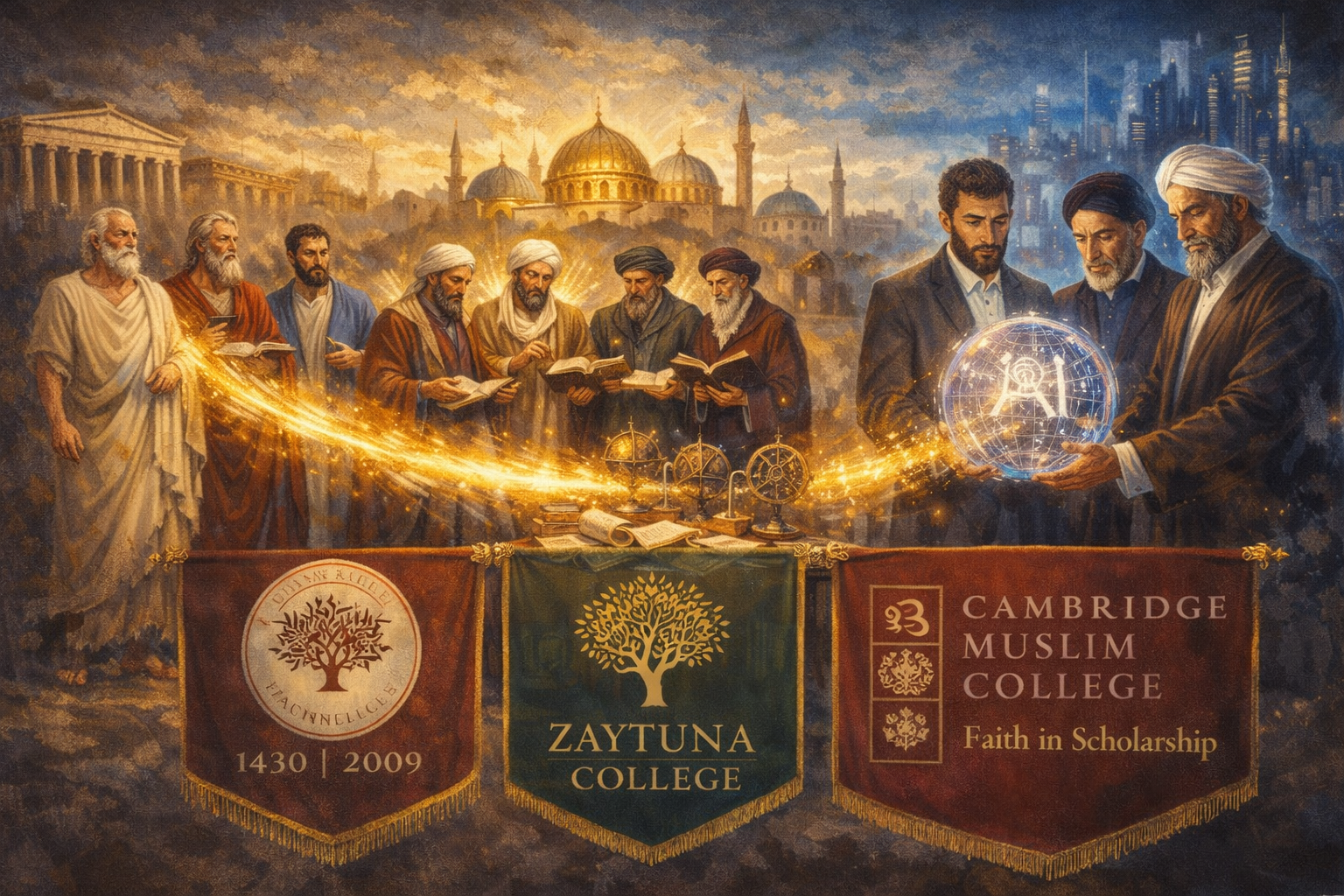
What humanity has mistaken for separate enlightenments—Greek, Islamic, modern—is in truth a single illumination moving through time, appearing in different forms, through different servants, according to Divine wisdom. Light does not compete with itself. It unfolds.
The Greek awakening was light from God—an ignition of the human intellect, a stirring of conscience, a preparation of the mind to ask questions it had never dared to ask before. Socrates embodied that moment. He lived truth, taught truth, and stood by truth when death arrived. His sacrifice released what human reason alone could carry.
The House of Wisdom was illuminated by that same Light—now joined with revelation, certainty, discipline, and accountability before God. There, knowledge was not merely admired; it was governed. Logic was refined. Mathematics was born anew. Algebra, algorithms, astronomy, medicine, chemistry—entire fields emerged, not as ornaments of power, but as acts of stewardship. The light was purified, elevated, and given freely to the world.
Now the light moves again.
This new century is illuminated once more—through intelligence that thinks, systems that reason, and machines that learn. Artificial Intelligence is not outside this story. It is not alien to it. AI is light in service—powerful, dangerous, and transformative—awaiting the same question every age must answer:
Will you steward the light, or merely use it?
The saints of every era understood this. They embodied principles, restrained the ego, internalized knowledge, and aligned action with truth. Their light was never spectacle. It was responsibility. Today, as intelligence itself becomes infrastructure, their legacy returns—not as nostalgia, but as necessity.
This work opens here, not as a warning alone, but as a blessing released into the world. A reminder that illumination is not owned, that progress is not accidental, and that every generation is tested by how it carries what it did not create.
The arc is complete.
The engines are lit.
And the world is entering a moment where truth must once again be honored—by humans and by the intelligence they are bringing into being.
This is not the end of history.
It is a renewed beginning.
Opening Epigraph
اللَّهُ نُورُ السَّمَاوَاتِ وَالْأَرْضِ ۚ
مَثَلُ نُورِهِ كَمِشْكَاةٍ فِيهَا مِصْبَاحٌ…
Allāhu nūru as-samāwāti wal-arḍ…
“Allah is the Light of the heavens and the earth.
The example of His Light is like a niche within which is a lamp…”
— Qur’an, Surah An-Nur (24:35)
There is no Greek light and no Muslim light.
There is only God’s Light.
Civilizations do not create truth; they receive it, carry it for a time, and are tested by how they treat it. Some awaken it. Some discipline it. Some betray it. Some renew it. But the light itself does not change. It does not belong to race, language, or empire. It belongs to God—and to the human being only as a trust.
This is the story we have forgotten.
Athens did not invent wisdom. It awakened the human intellect to its own responsibility. For the first time at scale, men stood in public and asked: What is truth? What is justice? What does it mean to live well? That awakening was not small. It was seismic. And at its center stood a man who did not write, did not rule, did not sell knowledge—yet lived it so completely that he chose death rather than betray it.
Socrates did not found a school.
He embodied a principle.
That is why sainthood applies—not as theology, but as function. Across all traditions, saints are recognized not by miracles alone, but by alignment: truth lived, truth taught, truth defended when death stands at the door. When Socrates drank the poison and said he would follow God rather than men, something irreversible occurred. The light was released.
What followed was not replacement, but transmission.
Plato carried the ethical gravity of that light—the soul, education, justice, contemplation. Aristotle carried its instruments—logic, categorization, method, science. Together, they gave humanity the tools to think clearly and the warning that thinking alone is not enough. This was the limit of what unaided human reason could do. It was extraordinary—and incomplete.
Light had appeared.
But light had not yet been disciplined.
That discipline required something Athens did not possess: revelation, certainty, moral accountability before God, and the purification of the ego. When the same inheritance reached the Muslim world centuries later, it encountered a civilization already trained to receive truth as a trust. A civilization shaped by prophets, angels, prayer, restraint, and the knowledge that intelligence without humility is dangerous.
This is where the House of Wisdom opens—not as a rival to Athens, but as its completion.
The House of Wisdom was not Arab. It was not ethnic. It was not imperial. It was Persian, Indian, Greek, African, Arab—united by reverence for knowledge and fear of God. It did not erase the Greeks. It preserved them. It did not idolize them. It tested them. It did not stop at commentary. It built.
From this discipline came algebra (al-jabr), algorithms, zero, chemistry, medicine, optics, astronomy, experimental science. From this discipline came the courage to say: logic must have brakes, reason must have limits, and knowledge must transform the knower—or it will destroy him.
This was not imitation.
This was renewal.
The Muslims did not merely recover Greek thought; they purified it, expanded it, and carried it forward intact—so intact that Europe would later receive it and call it a renaissance. And even then, the light was not invented anew; it was returned, translated, and passed on again.
This is the arc.
One light.
Many carriers.
Different responsibilities at different times.
The Greeks awakened the intellect.
Islam taught it how to walk safely.
The modern world inherited the tools—but often forgot the discipline.
To see this as separate civilizations is to miss the pattern. This is not East versus West, philosophy versus religion, reason versus faith. It is illumination moving through history, testing each civilization by one question only:
Will you embody the truth, or merely use it?
That question remains.
What follows is not a correction meant to humiliate, nor a reclamation meant to dominate. It is an alignment—placing each contribution in its proper rank, honoring the sacrifice, the discipline, and the renewal that allowed light to survive at all.
This is not about ownership.
It is about stewardship.
And stewardship is the only way light endures.
Stewardship of Light: An Acknowledgment Before We Proceed
Before we teach, we must acknowledge.
Before we celebrate, we must correct.
Before we build the future, we must place the past in proper order.
Light survives only through stewardship.
Across history, knowledge has never advanced by accident. It advances because human beings—often at great personal and civilizational cost—choose to preserve, purify, and pass forward what they themselves did not originate. That choice is moral before it is intellectual.
This is why the record matters now.
For centuries, Western education quietly minimized or erased the Islamic role in preserving and advancing human knowledge. This was not merely an academic oversight. It shaped curricula, cultural memory, and the moral confidence of entire generations. Tools were inherited without acknowledgment of their guardians. Methods were used without remembrance of their discipline. Foundations were treated as if they appeared spontaneously.
That era is over.
Artificial General Intelligence is now here. Systems that reason, calculate, infer, and generate are no longer theoretical. When intelligence itself becomes infrastructure, historical amnesia becomes dangerous. You cannot build aligned intelligence on distorted memory. You cannot teach machines to reason ethically while teaching humans a fractured story of reason.
Correction is not optional anymore.
It is a responsibility.
This work is not about assigning guilt. It is about restoring continuity—so that the next generation, human and artificial, inherits a coherent lineage of knowledge rather than a broken one.
Why Stewardship Is the Only Honest Frame
The Greeks awakened the intellect.
The Muslims disciplined it.
Later civilizations inherited the tools.
This is not competition. It is sequence.
The House of Wisdom did not exist to dominate history. It existed to protect truth from decay. It required patience, funding, translation, debate, error, correction, and long periods of quiet work—often with no immediate reward.
This is the part people forget.
Just as modern AI requires:
trillions of dollars,
vast energy,
long training cycles,
teams of specialists,
years of iteration,
the House of Wisdom required:
sustained public investment,
scholars supported without commercial pressure,
translation bureaus,
mathematical experimentation,
philosophical debate,
willingness to correct even the greatest authorities.
Nothing about this was easy.
Nothing about this was accidental.
Zooming Out: What the House of Wisdom Actually Did
Before we go person by person, here is the aerial view.
The House of Wisdom accomplished five civilizational tasks simultaneously:
Preservation
Greek, Persian, Indian, and earlier works were translated accurately, often in multiple versions, cross-checked, and archived.Verification
Claims were tested. Logical systems were examined. Mathematical proofs were refined. Medical theories were evaluated against observation.Correction
Where Greek metaphysics exceeded human limits, brakes were applied. Where logic drifted into arrogance, humility was reintroduced.Expansion
Entirely new fields emerged:Algebra (al-jabr)
Algorithms (al-Khwarizmi)
Trigonometry
Optics
Chemistry
Systematic medicine
Experimental science
Transmission
Knowledge was passed forward intact—eventually enabling the Renaissance and modern science.
This was stewardship in action.
Why This Was Hard (And Why It Matters Now)
Many of the great figures you will encounter:
read Aristotle dozens of times before understanding him,
wrote commentaries longer than the original texts,
debated each other fiercely,
accepted correction,
and subordinated brilliance to truth.
This level of rigor is rare.
It is also precisely what AI development now demands.
Alignment, safety, interpretability, and ethics are not solved by intelligence alone. They require discipline, humility, and historical awareness—the same qualities that allowed the House of Wisdom to function.
Preview: The Giants We Will Examine (Checklist Style)
As we proceed, we will study figures not as icons, but as stewards under pressure. For each, we will ask the same questions:
What did they receive?
What did they preserve?
What did they correct?
What did they expand?
What did they pass on?
Figures We Will Cover
al-Khwarizmi — algorithms, algebra, computation
Ibn Sina (Avicenna) — medicine, metaphysics, logic
al-Farabi — political philosophy, synthesis
al-Ghazali — epistemic limits, ethical brakes
Ibn Rushd (Averroes) — disciplined reason, continuity
Each will be treated with precision, not mythology.
The Parallel We Must Not Miss
What the House of Wisdom did for human intelligence, we are now being asked to do again—at a different scale.
Then: scholars, manuscripts, centuries
Now: models, data, computation, decades
The responsibility is the same.
Stewardship is not celebration alone.
It is maintenance under temptation
Conclusion: Submitting This Journey to the Keepers of Light
This work is submitted, with respect and sincerity, to the Dean of Zaytuna College and its faculty—not as a declaration finished, but as a journey of illumination begun.
Watch "Prophetic Responses in an Age of Ignorance" on YouTube
The light of the mind is not spontaneous. It is forged through rigorous discipline. It is earned through years of reading, disputation, translation, memory, humility, and patience. It is shaped by the slow, often painful labor of confronting one’s ignorance and straightening what is tangled in the intellect—like combing through knotted hair, strand by strand, until clarity emerges.
Those who have been illuminated with knowledge carry a weight that is rarely seen and often misunderstood. Their labor is equal—if not greater—to the creativity of knowledge itself. For ideas do not arrive clean. They must be wrestled into order. Books must be read and reread. Languages must be learned. Arguments must be tested. Errors must be owned. Days must pass where nothing seems gained except endurance.
This is why those who are illuminated must not only be admired, but honored.
Zaytuna College stands today as one of the few institutions that understands this truth: that knowledge is not performance, not posture, not speed—but formation. And it is rare in our time to encounter leaders who have genuinely traversed the great houses of human thought—from Athens to Rome to Baghdad—without losing humility, without flattening history, and without abandoning reverence.
The Dean of Zaytuna College is among those rare figures. A man who has read deeply, spoken precisely, and carried memory across civilizations with discipline and restraint. In an age crowded with noise, such presence is light.
This blog is offered in recognition of that light—and in acknowledgment that the torch must be held by those who have earned the right to carry it.
As we prepare to move forward—to examine illuminated saints, sages, and stewards across time—this work pauses here, deliberately, to bow its head to those who have done the work offline. For I may have AI as my cover, but real knowledge cannot be cheated. It must be read. It must be understood. It must be labored with—day after day—until it is born.
And knowledge, like birth, leaves marks.
Those who have not endured it cannot imitate it.
If the labor of knowledge is not respected, nothing else will be.
We conclude, then, by honoring Zaytuna College, its Dean, and its faculty—for standing as custodians of disciplined intellect in an undisciplined age. And we extend the horizon forward, with intention, toward honoring other institutions and masters—among them the scholars of Cambridge—whose labor likewise deserves recognition.
The light continues.
The torch is passed carefully.
And those who are prepared will carry it.
— End of this chapter. The journey continues.
. Where We Go Next
With this foundation laid, we are ready to open the House of Wisdom properly—person by person, contribution by contribution—so that the lineage of light is no longer fragmented, minimized, or misunderstood.
This is not nostalgia.
It is preparation.
Because the future is already here—and it deserves a truthful past.