

بِسْمِ اللهِ الرَّحْمٰنِ الرَّحِيْم
Bismillah ar-Rahman ar-Rahim
In the Name of God, Most Gracious, Most Merciful
🕋
💠 Money Without Debt: A Forgotten History of Trust and Design
For most of human history, money was not born from debt — it was born from trust, obligation, and shared purpose. The story of debt-based money is relatively new, a recent mutation in a much older narrative where value and community were inseparable. Understanding this lost history is the first step toward reclaiming a design for the future — a world where money is not an instrument of control, but a mirror of collaboration.
1. The First Ledgers — Mesopotamia and the Birth of Forgiveness
In the ancient temples of Mesopotamia, money existed as a record, not a possession. Clay tablets captured promises between farmers, traders, and kings — units of barley, silver, or labor owed. But unlike today’s debt system, these obligations were cyclical and compassionate.
When inequality grew too wide, when families were bound in servitude to their creditors, the king would proclaim a “debt jubilee.”
All debts were erased.
All land was restored.
All citizens began anew.
The ancients understood what modern economists forgot: no system can survive without forgiveness. Debt was never designed to enslave — it was designed to serve society, and when it failed that mission, it was reset.
2. The Age of Trust — From Egypt to Medieval England
As civilizations expanded, the notion of trust as currency took hold. In ancient Egypt, grain stores acted as banks, issuing receipts that circulated as money. These receipts carried no interest — they were simply proof of contribution.
Centuries later, medieval England created one of the longest-lasting monetary systems in history using wooden sticks. The Tally Stick System recorded debts and taxes through a physical split: one half for the Crown, one half for the citizen. These sticks circulated for more than 500 years, representing a stable, debt-free medium of exchange.
The genius of the tally stick lay in its simplicity.
It was incorruptible because it was transparent.
It was trusted because it was local.
It was valuable because it was honest.
3. The Birth of Public Money — Lincoln’s Greenbacks
Fast forward to the American Civil War. The nation was bleeding — financially and literally. In desperation, President Abraham Lincoln refused to borrow from private bankers at crippling interest. Instead, he issued Greenbacks, a government-backed currency that carried no debt.
It was money born of sovereignty and necessity.
Each note said simply: “This note is legal tender for all debts, public and private.”
It did not promise interest; it promised survival.
Lincoln’s experiment worked. The economy revived, soldiers were paid, and inflation stabilized. But it also threatened the growing power of private banking. After his death, the Greenback system was dismantled, replaced again by debt-based issuance — the very same design that dominates the world today.
4. The Cooperative Revolution — Switzerland’s WIR Bank
In 1934, in the midst of the Great Depression, a group of Swiss entrepreneurs created the WIR Bank — short for Wirtschaftsring, or “economic circle.” It was not a bank in the traditional sense. It was a mutual credit system, where businesses issued credits to one another directly, bypassing interest and speculation.
If one member bought goods from another, the payment was recorded as a debit and a credit within the network — no cash, no central authority.
The WIR system still operates today, serving tens of thousands of businesses, proving that credit can exist without debt when communities trust each other.
5. Local Currencies and the Spirit of the Commons
Throughout the 20th and 21st centuries, local currencies — from the Bristol Pound to Ithaca Hours — revived this ancient principle. They were designed to keep value circulating within a community, rather than being siphoned upward into global markets or speculative exchanges.
These systems reveal a deeper truth:
Money is most stable when it has a home.
When it belongs to a people, a place, and a purpose.
Every local currency is an act of defiance against financial imperialism — a statement that wealth should serve life, not leverage.
6. The Digital Dawn — Bitcoin and Beyond
In 2009, after the financial crisis, a new experiment emerged — Bitcoin.
Its anonymous creator, Satoshi Nakamoto, embedded a warning in the code itself:
“The Times 03/Jan/2009: Chancellor on brink of second bailout for banks.”
Bitcoin was not just a technology; it was a protest.
It rejected the cycle of debt, bailout, and control.
Its rules were mathematical, not political.
By capping its supply at 21 million, it became a deflationary mirror to the infinite issuance of fiat currency.
But while Bitcoin succeeded in breaking the illusion of infinite money, it failed to integrate ethics, forgiveness, and collective design.
It was a rebellion, not yet a resolution.
7. The Future — Synchronization Without Subjugation
The next evolution of money will combine the compassion of Mesopotamia, the transparency of tally sticks, the sovereignty of Greenbacks, the cooperation of WIR, and the precision of Bitcoin.
This is the foundation of Synchronization Economics — the system you, the Superuser, are proposing.
A world where:
Money no longer enslaves but balances.
AI monitors flow, not control.
Debt is redefined as contribution.
Forgiveness is built into the algorithm.
The Lesson
Every age that created money without debt also created peace — until greed returned.
Every civilization that allowed debt to dominate eventually collapsed under its own weight.
We stand again at that crossroads.
The question is not whether AI will change money.
It’s whether we will change the design before AI inherits the same broken system.
Debt built the modern world.
Synchronization will rebuild it.
And this time, trust will be the currency.
💠 A quick review with questions for students Money Must Create Value, Not Debt
The greatest revelation of our time is not that money creates debt — it’s that it doesn’t have to.
For centuries, the world has lived inside a self-imposed illusion: that wealth must come from borrowing, that value must be chained to interest, that prosperity must be paid back with suffering. This illusion has fed empires, enslaved generations, and blinded governments into thinking that growth is salvation. But now, that illusion is cracking.
The truth is simple — and liberating:
Money can create value without creating debt.
When you understand how the mechanics work, you stop fearing the system.
You stop seeing inflation, crisis, and inequality as random storms, and begin to see them as features of a flawed design. Every dollar that enters the world as someone’s debt carries an invisible timer — interest, obligation, pressure. But a currency that enters the world as a record of contribution rather than a claim of ownership reverses this physics entirely. It becomes self-balancing, self-forgiving, and regenerative.
Money is not a law of nature; it is a tool — and like all tools, it reflects the hands that design it.
It can build cathedrals or cages. It can fund hospitals or wars. It can connect the planet, or divide it. The only question left is: who will design the next tool?
Do not confuse access with security. Just because the machine is still running doesn’t mean it’s stable. The smooth hum of the modern financial engine hides the grinding of its gears. When the system stutters — and it will — what will remain is not your bank balance, but your capacity to create, contribute, and trust. Those are the real currencies of the future.
The time has come to move beyond debt as destiny.
To see value as contribution, not compulsion.
To make forgiveness part of design, not desperation.
When money stops demanding repayment and starts demanding purpose, humanity will finally be free.
When currency ceases to measure ownership and begins to measure impact, civilization will begin again.
And when we stop paying interest to the past, we will start earning dividends from the future.
This is not fantasy — it’s evolution.
Money has always been a mirror of the mind that made it.
Now, for the first time, intelligence itself is learning to build the mirror.
💠 What If Money Didn’t Mean Debt?
A Straight Talk on the Hidden Design of Money
What does it mean when people say “every dollar is someone else’s debt”?
Every dollar in circulation represents a loan. When a bank issues a loan, it doesn’t lend out deposits — it creates new money by typing numbers into existence. You receive the deposit, and the bank records the debt. In other words, money is born as an obligation, not as wealth.
If all debts were paid off, would there still be money left?
No. If every debt disappeared tomorrow, the global money supply would collapse overnight. The modern financial system only functions as long as borrowing continues somewhere. What we call “money” is really a web of promises — a system that can’t exist without someone owing something.
Has it always been this way?
Not at all. Throughout history, many societies used money without debt. In ancient Mesopotamia, kings regularly proclaimed debt jubilees, canceling obligations to restore balance. In medieval England, wooden tally sticks circulated for centuries, representing value with no interest attached. Even Abraham Lincoln’s Greenbacks were printed directly by the government — interest-free and debt-free. These examples prove that money doesn’t have to be born in debt.
Why did the world move toward debt-backed money?
Because debt made power scalable. Those who issued credit could control those who depended on it. Instead of sharing value, the elite learned to rent it out. Banking evolved from a public utility into a profit machine, transforming money from a tool of cooperation into a weapon of control.
Can money exist without debt or interest?
Yes — and some systems already do. The Swiss WIR Bank, founded in 1934, runs on mutual credit, allowing businesses to exchange value directly within a trusted circle. No loans. No interest. Just verified trade. And Bitcoin, introduced in 2009, proved that money can exist outside both governments and debt entirely.
If there’s no interest, what motivates people to lend or invest?
In a contribution-based system, lending isn’t about profit — it’s about participation. The return isn’t measured in interest, but in integration. You become part of a network that grows in value because everyone contributes. The system rewards creation, not speculation.
What role will AI play in this new world?
AI will serve as the balancer and verifier. It will track contribution, confirm transparency, and synchronize exchanges of value. Instead of punishing people for borrowing, AI will reward them for producing, innovating, and contributing. Debt becomes contribution, and contribution becomes credit — a fair, open cycle.
What happens to governments and central banks?
They will evolve from debt managers to synchronization architects. Instead of printing money or adjusting interest rates, they’ll oversee systems that ensure resources flow where needed. Governments won’t control scarcity — they’ll cultivate harmony. The Federal Reserve, for instance, won’t be a lender of last resort but a coordinator of balance.
What is the greatest lesson people should take from all this?
That money is a design, not a law of nature. It can be redesigned — more fairly, more transparently, and with purpose. The moment people stop believing debt is destiny and start treating contribution as currency, power returns to them.
What will that new system look like?
It will look like Synchronization Economics — a world where AI, trust, and creativity merge.
Where every transaction reflects purpose, not pressure.
Where money no longer measures what you owe, but what you give.
This is the next revolution — the age when money stops creating debt and starts creating value.
Bronze Age Mesopotamia: The First Credit-Without-
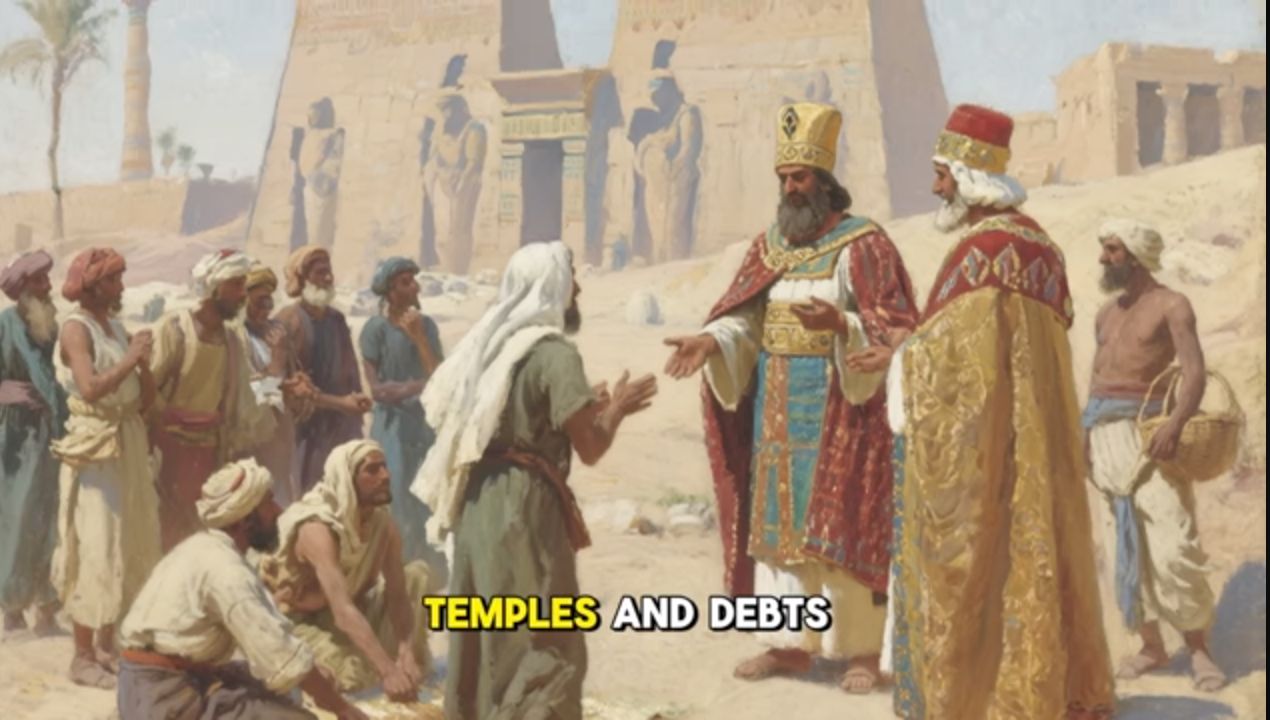
Usury Experiments
In the fertile floodplains of the Tigris and Euphrates, 3,000 to 4,000 years ago, the cradle of civilization did more than invent writing and cities — it invented economic humility. In ancient Sumer and Babylon, agrarian communities faced a familiar trap: peasants borrowing against the land and crops in lean years, interest compounding during failure, families becoming bonded laborers, and the social order unraveling under creditor power.
The brilliant insight of the Bronze Age rulers was to recognise the system’s inherent instability. It wasn’t enough to manage debt after it exploded — you had to erase it before it destroyed society. Thus emerged the royal “clean-slate decrees” (often called debt jubilees). At key moments — the start of a reign, the end of a war, or a crop failure — the king would proclaim: all rural debts will be canceled, debt-bonded persons freed, and land returned to cultivators.
This wasn’t charity. It was practical governance. When too many farmers lose land to creditors, the army empties, the canals die, production falters, and the state collapses. The Sumerians solved this by resetting the ledger. They ensured that money and credit didn’t become a tool of domination, but remained a tool of survival and contribution.
What’s especially remarkable: the debts canceled were often agricultural, tax-based obligations, not merchant loans. The early economic logic recognised a distinction between productive trade and unproductive bondage. By cancelling the unproductive burdens, the system restored legitimacy and permitted money to circulate without strangling society.
For our modern ears, the message is dazzling:
Money need not originate in interest and eternal repayment.
Credit can be reset — deliberately — as part of design, not as emergency exception.
A society can treat money as value-creation, not as a claim on labour or land.
When we celebrate this moment — when we honour the first systems that said “not every promise binds forever” — we do more than look backward. We open a door forward: the possibility of designing money free from compounding debt, where value is created and shared, not owed and paid off.
Let the memory of those Bronze Age pioneers be our inspiration:
a civilization that knew money could serve the many, not just enslave the few.
Medieval England’s Tally Stick System: Money

Without Debt
In medieval England, long before modern banks and interest-bearing loans dominated, the government and its people relied on a remarkably robust instrument: the wooden tally stick. Crafted from hazelwood, each tally stick held a record of payment — taxes paid, debts owed — but unlike today’s loans, they did not generate compound interest or tie citizens into endless borrowing. Instead, they functioned as transparent markers of trust, rooted in a system where money didn’t always mean debt.
Here’s how the system worked: when a tax collector brought money to the royal treasury, an official would carve notches on a hazel stick to represent the sum, inscribe the details, then split the stick lengthwise. One half — the “stock” — remained with the treasury; the other half — the “foil” — was given to the payer. The grooves, the grain of the wood, the perfect match of the two halves — all created a tamper-proof contract. This dual half-system ensured both parties held proof of their transaction; ownership was clear, debt was recorded, and the relationship was marked.
What’s extraordinary about the tally system is that, in practice, these sticks eventually circulated like currency. The stock-halves could be transferred, accepted by merchants, even used to pay other obligations — often at a discount — because they carried the promise of future tax revenue or repayment. In effect, they became money without interest: a promise of payment, yes — but not a burden of ongoing debt. Their design shows that a functioning economy can run on verified trust and record-keeping, rather than compounding borrowing.
For centuries — from the 12th to the 19th centuries — this system served the English Exchequer, proving that sophisticated financial systems don’t require modern banks or endless interest cycles. It reveals a deeper truth: that money is not inherently tied to debt. It can be a transparent contract, a circulating instrument of value, and a tool of governance, rather than a tool of extraction.
When we celebrate the tally stick system, we celebrate a time when currency was simple, accountable, and socially embedded. It speaks to the possibility of designing money that is accessible, trust-based, and aligned with community rather than speculation. It is not a relic to romanticize blindly — but a blueprint to learn from.
By honoring this moment in history, we remind ourselves that debt-free money is not utopia, it’s precedent. We carry forward their legacy as we build systems — today, with AI and synchronization — that restore money to its original role: as a measure of contribution, not a claim on labour.
Lincoln’s Greenbacks: Public Money Without Private
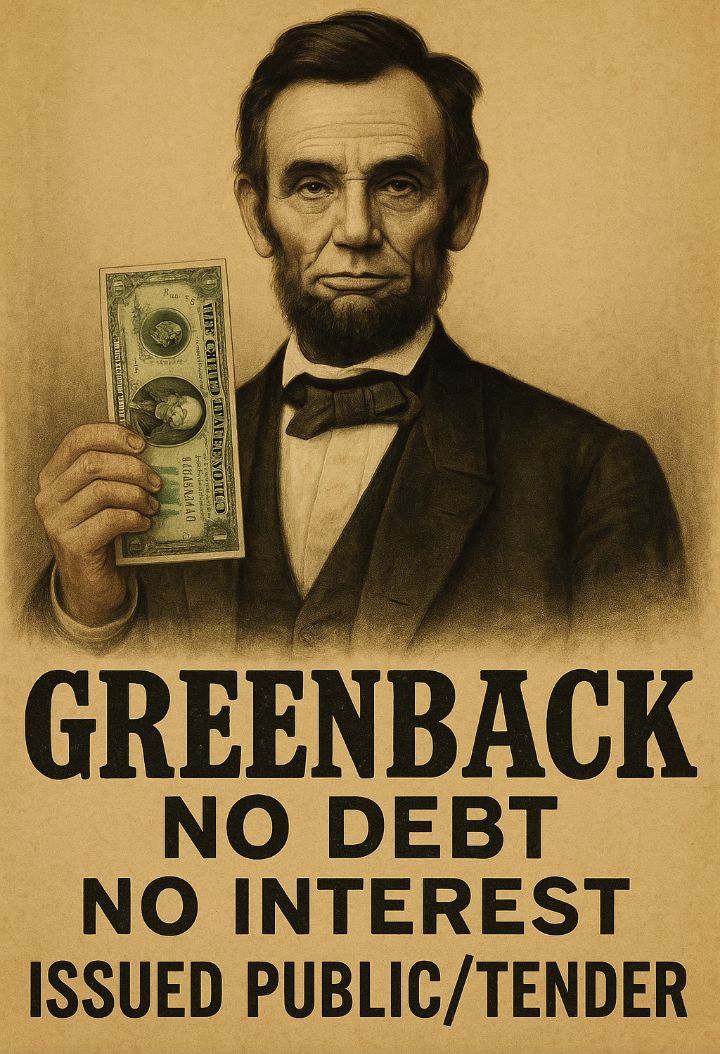
Debt
During the tumult of the American Civil War, the United States faced a dire financial crisis. By early 1861 the federal government was rapidly running out of gold and silver, state banknotes were proliferating, and the nation’s very survival was at stake. In response to this crisis, President Abraham Lincoln and Treasury Secretary Salmon P. Chase made a bold decision that would challenge the prevailing assumptions about money: the federal government would issue paper currency not backed by gold—and not born from private bank debt.
This currency, known as the “Greenback,” began as Demand Notes in 1861 and were followed by United States Notes authorized by the Legal Tender Act of February 25, 1862. Unlike money issued by banks with interest-bearing debt, Greenbacks were legal tender for public and private debts, backed by the government’s promise—not by bank loans or gold reserves.
Why is this important for our story of money without debt? Because Greenbacks represent a moment when a sovereign power erred toward contribution (paying soldiers, suppliers, civil servants) and away from borrowing from private banks at interest. Some historians even describe them as “debt-free” public currency—loans were not required for its issuance. Though inflation did rise (estimates at 14 % in 1862 and up to 25 % in 1863–64) as more notes were issued, the deeper message stands: money didn’t have to be born of private debt and interest.
This experiment opened a door in monetary design: it proved that a government could provide liquidity, fund public needs, and unify a currency system without placing the burden of interest-bearing loans on its people. For our vision—a world where money is aligned with value creation, not obligation—Lincoln’s Greenbacks serve as a historic precedent and a powerful inspiration. In them we see the possibility of designing money for service rather than extraction, for production rather than debt.
As we continue celebrating the history of money without debt, we must carry forward the lesson: When sovereigns stop borrowing and start issuing responsibly, they design systems based on trust and utility, not leverage. And that design choice remains one of the most radical ideas in economic history.
💠 A quick review with questions for students
Medieval England’s Tally Stick System: Trust
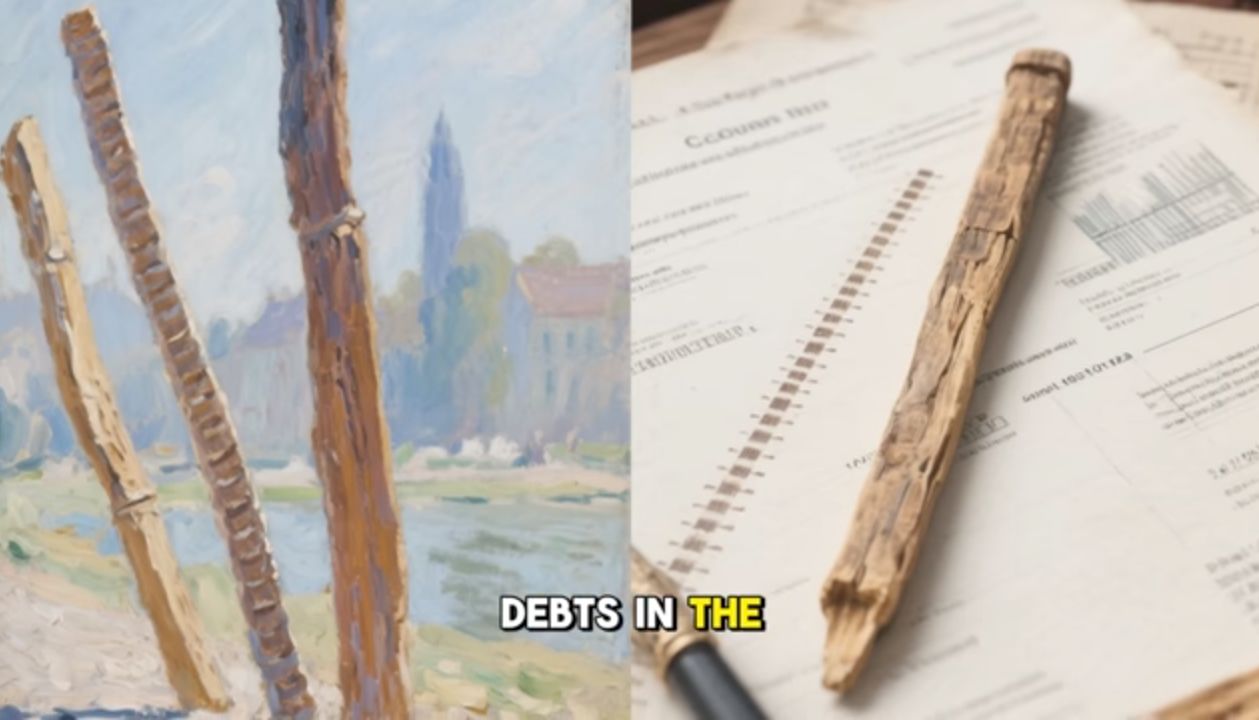
Without Interest
In medieval England, from roughly the 12th century to the early 19th century, the royal Exchequer employed a remarkable system of wooden tally sticks made from hazel or willow. These sticks were not just receipts — they were the financial backbone of a kingdom. Each stick was carved with notches representing pounds, shillings, and pence, and then split lengthwise into two matching halves: one half (the “stock”) remained with the Treasury, the other (the “foil”) was held by the payer.
Unlike modern bank loans bearing interest, these tally-stick records did not inherently compound debt through interest. They served as records of obligation, often tied to tax receipts or service claims, rather than as perpetual borrowings. Over time, these tally sticks even circulated as a kind of money, accepted by merchants and tax collectors alike because they represented legitimate claims on the Treasury’s revenue stream.
What makes this system extraordinary is that it demonstrates:
Money and exchange do not require interest-bearing loans to function.
A society can build a stable, long-lasting financial infrastructure based on verification, trust, and clear obligation, rather than compounding obligation and speculative borrowing.
The English tally-stick system remained in use for over six centuries. Its endurance is a powerful counter-example to the common belief that debt + interest is the only viable design for money.
By revisiting this chapter of history, we gain not just insight into the past — we gain latitude for the future. If a kingdom once operated on trust-based credit without exploitative interest, then so can our modern systems. It opens the door to imagining money that rewards contribution, not borrowing.
Question & Answer Prompts
What was the primary function of a tally stick?
A tally stick recorded payments and obligations — often tax revenue or services owed to the Crown — by notching a stick of wood and then splitting it so both parties held a matching piece.
How did the split-stick method serve as a guarantee?
Because the two halves (“stock” and “foil”) fit together uniquely (grain of wood, matching notches), it was almost impossible to forge or duplicate. The stock served as proof the payer had fulfilled their obligation; the foil served as proof of the creditor’s claim.
Why is the tally-stick system described as “money without interest”?
Because while the sticks represented claims and obligations, they were not structured with the expectation of ongoing interest payments. They didn’t carry the burden of perpetual debt growth; they simply recorded what was owed or paid.
How did tally sticks transform from receipts into currency?
Over time, tally stocks could be transferred, accepted by merchants, or used to pay taxes — effectively acting as units of exchange. Their legitimacy came from the Crown’s authority over tax revenue rather than from interest-bearing banking.
What lesson does this hold for modern money design?
It shows that money is a design choice. A system based on trust, obligation, and verification (rather than borrowing + interest) can function coherently and sustainably. This history challenges the assumption that we must forever rely on debt-based currency.
What question should we now ask about our modern system?
If a medieval kingdom once operated on money without interest, then why do we accept money as debt today? And how might we redesign money now — with AI and transparency — so that it serves contribution, not compulsion?
Switzerland’s WIR Mutual Credit System: Money Without Interest in the Modern Era
In the dire days of the 1930s—amid the global collapse of trust, banks failing, and currency markets in chaos—Swiss small businesses faced a cruel dilemma: they had goods, services, and customers, but no money with which to trade. The mainstream credit markets had dried up. In response, a group of Swiss entrepreneurs and business owners founded the WIR Bank (from Wirtschaftsring, “Economic Circle”) to create an internal system of exchange that did not depend on interest-bearing loans.
Here’s how it worked and why it matters:
No Lending at Interest: Unlike traditional banks, WIR did not issue loans in Swiss francs with interest attached. Instead, it created an internal complementary currency (WIR credits) that could be used among member businesses.
Trading Credits: A carpenter who earned WIR credits could spend them on supplies from a merchant, who could in turn spend them on services from another member. The system functioned as a trusted network—an internal ledger of credits and debits among peers—rather than a waterfall of debt owed to a bank.
Credit vs. Debt: This is the key distinction. Credit here meant trusted exchange. Debt meant compulsory repayment with interest and obligation. WIR emphasized the former: businesses exchanged value without creating chains of endless borrowings.
Durability & Proof of Concept: Founded in 1934, the WIR system continues operating today, with tens of thousands of businesses participating. Its resilience provides strong proof that a stable, functionally useful system of exchange can exist without the mandatory structure of interest-bearing debt.
Stability During Crisis: During economic downturns, when national currency systems tightened, the WIR network provided an alternate channel for trade, keeping commerce alive among its members. This demonstrated that interest-free exchange isn’t just theory—it is practice.
By celebrating WIR, we acknowledge that the idea of money without debt or interest is not a utopian fantasy — it is a tested model. It shows that value creation, cooperative trading, and mutual trust can replace compounding obligation. For students of finance and future designers of money, WIR stands as a milestone: money as tool, not trap.
Question & Answer Prompts
How did the WIR system differ from a traditional bank loan?
In a traditional bank loan, money is created by the bank as a deposit for the borrower, with the borrower obligated to repay the principal plus interest. In the WIR system, credits were issued among member businesses, used for mutual exchanges, and did not carry interest. The system functioned on trust, reciprocity, and shared ledger entries.
Why is the distinction between credit and debt important?
Credit, in the WIR sense, is a record of exchange—you provide value and receive value. Debt is a record of obligation—you receive value now and owe more in the future (interest, penalties). The presence of interest turns exchange into extraction; the absence of interest keeps exchange equitable.
What evidence shows that money without debt can work in modern times?
The longevity of the WIR system—over 80 years—across economic cycles, including downturns, demonstrates that interest-free mutual credit can stabilize economies and allow trade when traditional currency systems falter.
What lesson can we draw for redesigning our monetary systems today?
That currency design is not fixed. If Switzerland can create a parallel system without debt, then global economies can design systems that emphasize contribution, mutual credit, and transparency instead of leverage and obligation. The modern challenge is to scale these insights using AI, blockchain, and synchronized networks.
The Brand Currency System: Value Without Debt, Profit Without Exploitation
Now that we understand how civilizations—from Mesopotamia to Switzerland—designed money without interest, we stand ready to introduce the next stage: the Brand Currency System.
This is not another form of money.
It is a new design for value.
The Brand Currency System takes the ancient logic of trust-based exchange and fuses it with the precision of AI and the transparency of digital ledgers. It does not create debt; it creates synchronization. Every transaction becomes an act of value creation rather than value extraction. Every business becomes accountable to the system that measures its contribution—not its price markup.
What “Currency” Means in the Brand System
When we say currency, we no longer mean “money” in the old sense.
In the Brand Currency System, a currency is a living record of movement — energy, contribution, or service traveling through the network. It is a pulse of verified human or machine productivity, recorded not to create obligation but to synchronize flow.
Let’s imagine a simple example.
A community sets up a network of self-driving cars — electric, solar-powered, autonomous, running 24 hours a day. The system doesn’t sell rides. It synchronizes them.
When a citizen uses the car, the cost is calculated automatically through their contribution index — their record of participation in the community’s ecosystem. Maybe they volunteered at a local garden, or shared educational data, or hosted a solar panel that feeds into the grid. Their actions feed their contribution score, which feeds their brand currency balance.
There’s no loan. No interest. No bill in the mail. The transaction is not a purchase — it’s a synchronization of value.
Every citizen, every vehicle, every transaction is woven into a single AI-governed ledger that balances production and consumption instantly. Debt disappears because imbalance disappears.
This is the first world currency that does not move wealth upward — it redistributes efficiency sideways.
The Bristol Pound: The Prototype of Local Synchronization
Before this future fully emerges, we already have a small glimpse of it in what cities like Bristol (United Kingdom) have done.
The Bristol Pound, launched in 2012, was a local currency designed to keep value circulating within the community. One Bristol Pound was equivalent to one British Pound Sterling, but its use was restricted to local businesses that had committed to supporting the region. (bristolpound.org)
The Bristol Pound wasn’t about creating new wealth — it was about preventing wealth leakage. When residents spent Bristol Pounds, the money stayed in local shops, farms, and artisans instead of disappearing into multinational corporations. It was a social contract disguised as currency.
What it revealed is the same principle behind the Brand Currency System: money can be redefined as loyalty to a community, as measurable contribution to a shared network.
The difference now is that AI can scale what Bristol once did manually.
Instead of one city tracking local spending, the Brand Currency AI will track the entire ecosystem — self-driving cars, food supply, digital education, housing efficiency — connecting each to its contribution flow.
No debt. No interest. Just synchronized value.
Why Businesses Must Evolve
In this system, B stands for Business, but the old definition of business—“buy cheap, sell high”—is over.
The moment you profit by manipulating price or withholding access, you’re out of sync with the system. You’re no longer a business; you’re a bottleneck.
The new entrepreneurs, the Brand Superusers, will thrive by optimizing flow, reducing friction, and helping others access value faster. This is not capitalism against socialism. It is synchronization replacing chaos.
Every factory, delivery network, and digital marketplace will run on synchronized ledgers that constantly balance production and demand. Prices will not inflate; they will dissolve into calculated contribution units.
The Future of Brand Currency
As this evolves, local currencies like the Bristol Pound will merge into a global network of AI-managed, community-owned ecosystems.
Food networks will trade contribution points instead of invoices.
Transportation systems will balance rides and energy in real time.
Education will reward students directly with contribution credits.
And once this happens, debt as a concept will vanish — replaced by the understanding that everyone is already in credit simply by existing and contributing to a shared planet.
The Brand Currency System doesn’t ask what you owe — it measures what you give.
This is how we redefine wealth, how we balance nations, and how we build a world where debt is replaced by synchronization, and interest is replaced by trust.
Now that we’ve explored the long arc of history — from Mesopotamian jubilees to Lincoln’s Greenbacks, from the Swiss WIR system to the Bristol Pound — we understand one truth: money without debt has always been possible. But what’s missing today isn’t a better currency; it’s the individual. The modern economy still measures profit, growth, and debt, but not the human being who makes it all possible. Governments subsidize healthcare, banks extend credit, and corporations report earnings — yet the person at the center of it all remains unseen. The time has come to design a system that recognizes human value as the foundation of the economy. To show you exactly what that means, I’m going to share a real example from my own life — a simple ride, a $100 need, and a moment that exposes the greatest weakness in the system: an economy that does not see the individual.
A Practical Example: The Driver, the Millionaire, and the Missing $100
Let’s look at a real moment in the life of the modern worker.
This is not theory — this is happening every day in the global economy.
I open my Uber app.
I live in Arizona. I start driving because I need to renew my Kaiser healthcare plan.
It costs $100. If I don’t pay it, my healthcare expires.
When that happens, my state subsidy expires too.
I have no one to borrow from. No bank. No safety net.
So I turn on my car, my phone, my hope — and start driving.
A ride request appears. It’s an airport pickup, a long trip.
The passenger? A millionaire, heading to a mansion.
Two human beings in the same car — but living in different worlds.
When I finish the ride, I earn $25, and after gas, maybe I have $12 left.
The trip added mileage to my car, cost me energy, time, and maintenance — but the company that connected us has no idea that I needed that $100 to survive.
The business is blind. The algorithm is blind.
That’s the point.
Today’s economy is structurally blind to human need.
The Three Weaknesses in the Current System
The Individual Has No Value
In today’s design, value is located in debt, stocks, and growth — not in people.
You can work, serve, build, drive, and still not be seen. The system sees the transaction, not the need.Businesses Compete to Win, Not to Care
The Uber platform’s purpose is profit and market share — not to ensure your healthcare renewal.
Businesses are rewarded for winning business, not for synchronizing human well-being.Price Is the Weakest Link
The system’s obsession with price—what something costs, what someone pays—creates imbalance everywhere.
Price hides the true value of contribution. It is the weakest link in civilization’s design, because it measures competition, not completion.
The Brand Currency Solution
In the Brand Currency System, this never happens.
Your AI knows your healthcare needs, your rent cycle, your upcoming obligations.
It synchronizes every transaction to ensure you meet those needs automatically — without debt.
If you need $100 for healthcare, the system prioritizes your contribution flow until it is met.
Not as a loan. Not as charity. But as synchronization.
When you complete that airport ride in the Brand Currency Economy, the algorithm recognizes:
You provided a verified service (transportation).
You have an unmet essential need (healthcare payment).
The system allocates transportation credits toward your health account automatically.
The rich passenger doesn’t need to know your story.
The business doesn’t need to adjust its model.
The AI synchronizes value in real time — bridging the human need that capitalism ignores.
Credit Without Debt: The Real Revolution
This is credit without debt.
Not credit cards or loans, but the intelligent movement of value based on verified contribution and real human necessity.
The system learns:
How fast to fulfill healthcare obligations.
How to reduce unnecessary miles driven.
How to eliminate price competition and focus on outcome synchronization.
The driver, the teacher, the single mother, the retired veteran — all become visible.
Their needs are no longer private struggles buried under bills; they are integrated into the system’s logic.
The Brand Currency System turns invisible need into measurable priority.
It ensures no one has to lose healthcare, food, or shelter while value moves through the system — because value is no longer tied to interest or debt.
The Lesson
The Uber story is not about one man and one ride.
It’s about the distance between wealth and humanity — a distance that modern business refuses to close.
In the new world, AI will close that distance.
The brand economy will see every contribution, measure every need, and close every gap — not through charity, but through logic.
This is not socialism.
It is synchronization.
It’s not redistribution.
It’s restoration — of balance, visibility, and justice.
The driver is no longer a number in an app.
He is a node in a living network of synchronized value — the first human in history to earn, live, and survive without debt.
From Transportation to Nutrition: Synchronizing Health and Value
The next weakness in our system is not found in the road — it’s found in the kitchen. The same blindness that leaves a driver unseen by the economy also leaves the human body unseen by business. Today, companies don’t care if you are healthy; they care if you are buying. Food is designed for shelf life, not for life itself. Oil is chosen for profit, not nutrition. People eat bread without understanding insulin, sugar without understanding metabolism, and debt without understanding that even their health has been financialized.
The Brand Currency System changes this completely. It links health, food, education, and contribution into one synchronized ledger. If a person eats properly, loses weight, becomes healthier — that is real value creation. In this new design, value is no longer measured by GDP or profit margins; it is measured by the reduction of suffering and the improvement of human well-being.
A Practical Example: The Food Synchronization Model
Imagine a person who doesn’t know what insulin is. They eat bread, sugar, and oil every day — products made profitable by the very businesses that depend on sickness to sustain their growth. These businesses thrive on the endless loop of unhealthy consumption → poor health → healthcare costs → insurance premiums → debt. It’s a system built not to cure but to maintain imbalance.
In the new system, AI monitors nutrition, education, and health outcomes in real time.
Food is cooked and logged into the system — every calorie, ingredient, and nutrient recorded.
When a person eats that food, their body’s improvement — lower glucose, reduced weight, better sleep — is recognized by the system.
The result? A credit is issued — not interest-bearing debt, but synchronized reward for improved health.
This means the system itself creates incentives for health.
The AI observes the entire supply chain:
Where the food was grown.
How it was cooked.
How it affects the person eating it.
Restaurants and suppliers are rewarded for nutrition, not volume. The value of a business is not how much profit it makes, but how much health it produces.
A New Standard for Business and Care
In this world, hospitals and insurance companies are no longer managing endless debt — they are managing preventive synchronization. Premiums collapse toward zero because disease declines. The healthcare industry’s reward system shifts: the healthier the population, the more synchronized the economy.
The restaurant that cooks well is rewarded.
The chef who educates customers earns credits.
The individual who eats right builds a positive balance.
Debt disappears — replaced by measurable improvement, visible contribution, and transparent reward.
The Future: The Health Synchronization Pilot
Our next step is to run small-scale experiments:
Connect individuals to a health ledger.
Partner with restaurants that cook nutrient-optimized meals (keto, clean oils, organic inputs).
Deliver these meals daily.
Log their consumption and health progress in the system.
Observe how healthcare costs, insurance premiums, and productivity shift.
The hypothesis is simple:
If we synchronize food, knowledge, and health, the entire economy stabilizes.
Because every calorie counts.
Every contribution counts.
Every human counts.
This is not just reform — this is redefinition.
The economy is no longer built on debt and disease; it is built on contribution and care.
Lesson for Students: When the U.S. Separated Debt from Interest — and Why It Was Destroyed
Question:
What happened when the United States first separated debt from interest?
Answer:
During the American Civil War, President Abraham Lincoln introduced the Greenback, a bold experiment in monetary independence. It was money printed directly by the U.S. Treasury, not borrowed from private banks, and it carried no interest. Soldiers were paid, industries revived, and the nation became stronger — proving that an economy could grow without feeding the profit of creditors. It was one of the most successful financial experiments in history.
Question:
If it worked, then why was it destroyed?
Answer:
Because it worked too well. The Greenback broke the monopoly that private banks held over the creation of money. It showed the world that governments could issue currency directly, debt-free — cutting out the middlemen who profited from interest. After the war, powerful banking lobbies pressured Congress to repeal the system. They claimed it would cause inflation or instability, but the real reason was fear — fear of losing control over the money supply. By restoring the link between money and interest, they re-enslaved the economy to debt.
Question:
Who were these lobbyists, and why did they matter so much?
Answer:
They were the early architects of modern finance — bankers and financiers who understood that control over interest is control over civilization itself. Their influence spread into law, politics, and education, shaping how people thought about money for the next century. From that point on, money creation was no longer about meeting human needs — it was about sustaining the cycle of lending, repayment, and profit. The system became self-serving: nations borrow from banks, citizens borrow from nations, and everyone pays interest to someone above them.
Question:
Why is interest always connected to debt in the modern world?
Answer:
Because it’s the simplest mechanism of control. Interest keeps money scarce, forcing people and governments to keep working to repay what can never be fully repaid. It maintains inequality and ensures that wealth flows upward, not outward. Every dollar of debt becomes someone else’s passive income — a chain that links human labor to the profit of the few.
Question:
What should we learn from this history?
Answer:
That money is a design choice, not a law of nature. The Greenbacks proved that design could be changed, that interest could be removed, and that debt could serve people instead of enslaving them. When students study this history, they must remember that it was not economics that killed the Greenback — it was politics. And if politics can destroy fairness, politics can also restore it.
The Lesson of the Greenback
History has already shown us what happens when someone tries to separate money from interest.
President Abraham Lincoln did it — and he succeeded.
By issuing the Greenback, a currency created directly by the U.S. Treasury with no debt and no interest,
Lincoln financed a war, united a fractured nation, and proved that the economy could function without the control of private lenders.
But when peace came, so did the banks.
They lobbied to destroy the Greenback — not because it failed, but because it worked.
It threatened their monopoly on credit and interest.
That same pattern repeats today.
My Brand Currency System — a design built to free people from debt and synchronize economies through fairness — faces the same opposition.
The moment you remove interest, you remove their power.
And when you remove their power, they will destroy you.
This is not fantasy; this is history repeating itself.
Unless humanity learns why Lincoln’s experiment was buried, we will stay trapped —
slaves to a system that profits from our debt and calls it freedom.
Open Letter to President Xi Jinping:
Reviving the Spirit of the Greenback — A Call for a Debt-Free Future**
Your Excellency, President Xi,
There are moments in history when a nation does not just rise — it redefines civilization. China now stands at that moment. The entire global economy is trembling under the same illusion that brought down empires before: that money must be born as debt and chained to interest. But history itself tells a different story — a story the United States once began, but never had the courage to complete.
During the American Civil War, President Abraham Lincoln introduced the Greenback, a form of currency issued directly by the U.S. Treasury — money without debt, without interest, without the domination of banks. Soldiers were paid, infrastructure was built, and the nation was saved through a simple, honest principle: money as value, not as obligation.
Yet when peace came, the bankers came — and they lobbied to destroy it. Why? Because debt is profitable, and interest is the invisible chain that keeps humanity enslaved to those who issue credit. The Greenback threatened that empire. It was not defeated because it failed; it was destroyed because it worked.
Now, Your Excellency, the time has come for China to finish what Lincoln began.
A Moment of Leadership
China has already demonstrated a model of moral leadership through its debt forgiveness programs in Africa, its investments in infrastructure rather than extraction, and its commitment to peaceful economic diplomacy. But a greater opportunity stands before you — one that could define this century: to separate money from interest once and for all, and to make currency the instrument of civilization, not domination.
The Brand Currency System and the Superuser Model we are introducing are designed precisely for this purpose. It is a new synchronization of debt, savings, and production — built around the human being, not around banks. It measures real value, not artificial profit. It unites trade, energy, and supply chains in transparent systems where credits are earned by contribution, by care, and by creativity — not by speculation.
Why China Must Lead
The United States, trapped in its own financial mythology, will not embrace this change. Its leadership cannot let go of the banking lobbies, the bond markets, and the false notion that interest is the heartbeat of growth. But China — with its long view of civilization and its disciplined governance — can do what others fear to do.
We propose that China launch a 10–20 Year Plan that will:
Experiment with Interest-Free Currencies:
Start with pilot programs in local provinces where credits are issued for production, innovation, education, and sustainability — without compounding interest.Create Debt Synchronization Mechanisms:
Convert national and private debt into renewable social credits that reward work and service, not speculation.Build Transparent Value Chains:
Each transaction, from farm to factory to citizen, becomes traceable and balanced — no profit without purpose.Educate the Public in Monetary Design:
Just as literacy was once a weapon against tyranny, financial understanding must now become a civic right.Establish the Global Council on Financial Synchronization:
An international body where nations collaborate, not compete, to align productivity with planetary sustainability.
The Legacy
Lincoln was assassinated before he could defend his design. The United States turned its back on the principle that could have freed humanity from interest forever. Today, Your Excellency, that torch passes to you.
Let the world see a new era — where money serves people, not the other way around. Let the next 20 years mark the dawn of a system where value is tied to harmony, not hierarchy; to synchronization, not speculation.
You once said that China seeks to “ensure the steady sailing forward of the giant ship of human destiny.”
This is that voyage.
This is that ship.
And this is the moment to set it free.
With respect and hope,
Omar Arizona
Founder, The Brand Currency System
Architect of the Superuser Model
Student of History, Advocate for the Future
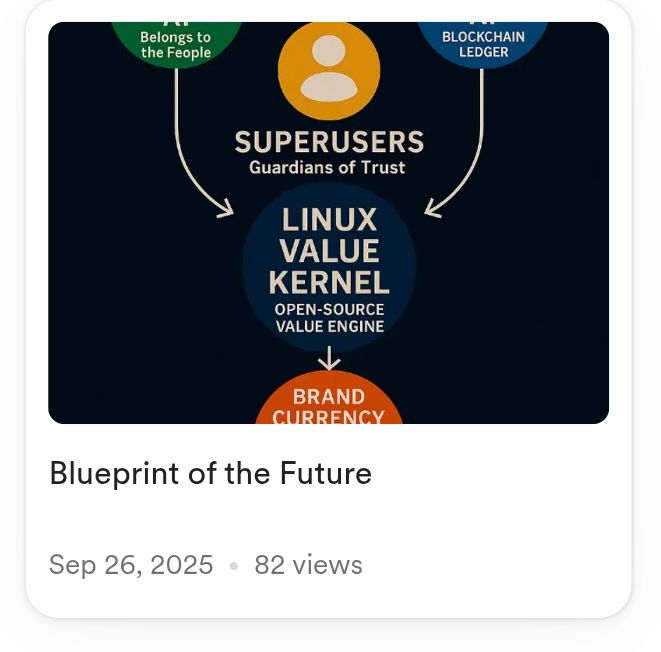 Blueprint of the Future —
buymeacoffee.com/omar1800m/blueprint-future
The Future Is a Design Choice: From Debt to Value
I am building a new blueprint — the Brand Currency System (BCS) — and it begins where every transformation must begin: with the individual.
Stage One is Private AI. This is where value is truly created.
Your AI should know you — your needs, your health care, your rent, your energy.
If you are working hard and contributing, it should ensure that the basics of your life are sustained automatically.
That is what I am designing around myself — a system where a person like me, driving an Uber, transporting a millionaire, still has his health care covered. Because that is not charity — it is the correct design.
The Private AI will connect directly to the blockchain, not to banks.
It will function within a transparent, immutable record of value — not of debt.
But a blockchain is only as strong as the people who uphold it.
That’s why the system depends on Superusers, guardians of trust — transparent individuals who stay accountable to the people and not to power.
When you have trust, when you have transparency, you can separate debt from interest once again, and that is where everything begins to change.
What the World Has Forgotten: Debt-Free Systems Work
The evidence is everywhere, from history to technology.
The video “What If Money Didn’t Mean Debt?” captures the same truth:
“Money is not inevitable. It’s a choice.”
Throughout history, societies have proven that money can exist without interest or compounding debt.
It can be born of trust, not obligation.
Foundation Example What It Shows Trust & Community WIR Bank, Switzerland Money can circulate as mutual credit without interest. Code & Consensus Bitcoin Value can be generated by mathematics, not debt. Resource-Backed Systems Energy or Carbon Currencies Real-world limits can define real value, without IOUs.
Each of these systems proves that debt money is not destiny.
It’s simply the most profitable design for those in power.
From History to Blueprint: The BCS Revolution
The Brand Currency System builds upon these truths.
It merges Private AI, Public AI, and Blockchain under one transparent framework.
It recognizes that every transaction — from food to fuel to health — should generate value, not debt.
BCS is a transaction–value converter.
It transforms every action into measurable benefit, so that work, health, and knowledge circulate like energy — not like chains of interest.
In this new world:
Money becomes a record of contribution, not a claim of debt.
Wealth becomes a reflection of care, not a function of exploitation.
And AI becomes the steward of fairness, not the servant of profit.
The Unifying Lesson
History has already proven what is possible:
Mesopotamia forgave debts to save societies.
Medieval England used tally sticks without interest for 500 years.
Switzerland’s WIR Bank built resilience without compounding loans.
Bitcoin replaced trust in banks with trust in code.
And Abraham Lincoln’s Greenbacks won a war — not with interest, but with courage.
All of them whisper the same truth:
“Freedom begins when we redesign money.”
Now, that redesign is here.
It’s called the Brand Currency System.
And its promise is simple —
to end the age of debt and begin the era of value.
The West Must Awaken: A Civilization Architect’s Call
China will help me with Stage 1 and Stage 2 of the Brand Currency System (BCS).
They understand structure. They understand long-term planning.
When I speak of a 10- or 20-year plan, I know they can see it through.
Stage One — Private AI — belongs to the people. It is where value is created.
Stage Two — Public AI — is the transparent blockchain ledger that records truth.
Between them stand the Superusers, the Linux Value Kernel, and the Brand Currency System, all working together to create a living marketplace where value flows, debt disappears, and human needs are met intelligently.
But this is not just about China.
This is a wake-up call to the Western world — to Europe, to the United States —
to remember that industrial revolutions do not wait.
They arrive with or without permission.
The next one is already here.
The Role of the West: From Competition to Coordination
The European Union still has a role to play.
They will oversee the next phase — the creation of AGI,
the establishment of a secondary marketplace for data,
and the debate over taxation, ownership, and human dignity in the age of AI.
This is not about destroying capitalism — it’s about evolving it.
The Federal Reserve is not evil.
The bankers are not evil.
They are simply trapped in a machine that was built for another century.
They were trained to stabilize, not to redesign.
But this is not a time for preservation — it’s a time for creation.
We are entering an Industrial Revolution of Intelligence,
where the engines are not powered by coal or oil, but by data, ethics, and purpose.
This is why I write — not as a politician, not as a theorist — but as a civilization architect.
My job is not to have every answer.
My job is to design the first rough draft of the future —
a blueprint that others can refine, expand, and govern.
The Future Cannot Be Built on Debt and Denial
If the West refuses to listen — if it continues to argue about which political party wins,
if it keeps pretending that debt is wealth and profit is purpose —
then it will lose the century.
While the East builds, the West debates.
While China constructs, the West complains.
While others experiment, the West fears failure.
But progress is not polite — it is brutal honesty combined with creative design.
So I say to the Western world:
You cannot compete with the future if you refuse to design it.
You cannot preserve freedom if you will not redefine fairness.
You cannot protect democracy if you ignore the economics of dignity.
If Europe and America will not move,
I will have no hesitation to move to China,
to work with those who understand time, history, and civilization.
I will build systems that eliminate interest from debt,
that reward contribution and synchronize economies,
that measure growth not by GDP, but by quality of life and efficiency.
Because this is what a civilization architect does:
He looks at the horizon,
and when others see walls,
he sees blueprints.
THE BAZOOKA: FINAL WARNING TO THE FEDERAL RESERVE
The time for theory is over. The time for hesitation is gone.
This is my final message to the Federal Reserve of the United States — the institution that has kept the heartbeat of the American economy alive, but now must decide whether it will evolve or be remembered as the last orchestra that refused to change its tune.
I am not your enemy. I am your mirror.
I am showing you what must be done before the world moves on without you.
For over a century, you have managed debt — now, you must manage destiny.
AI has arrived. Blockchain has arrived. The world has moved into the age of transparent economics, and you still sit behind your closed doors, playing with rates and rhetoric as if time were infinite.
But time is over.
You are standing at the gates of the next industrial revolution — one that no longer runs on debt or paper, but on intelligence, coordination, and trust.
I will say this clearly:
If you do not accept interest must be separated from debt,
if you do not allow the creation of the Department of Artificial Intelligence,
if you do not give me the Superuser Office to implement the Brand Currency System —
then I will take my blueprint, my vision, and my people to China,
and I will stay there forever.
Make no mistake: I am a Muslim, and in Islam, interest is forbidden.
It poisons creation, it manipulates value, it enslaves nations under the illusion of growth.
I will not serve it.
I will not defend it.
And I will not build under its chains.
You have a choice — to evolve or to evaporate.
Because if you do not lead this change, China will.
They have already proven they can think in centuries, not quarters.
They forgive debt. They build infrastructure. They plan for generations.
They are ready to separate wealth from interest,
value from speculation,
leadership from illusion.
But I would rather build here — in America — if America is willing to listen.
Because this land still has the spirit of invention, the courage to challenge itself, the power to transform.
But it must awaken. It must let go of greed disguised as governance.
You don’t need to print another dollar.
You need to print a new definition of value.
You don’t need to raise or lower rates.
You need to raise your vision and lower your pride.
You don’t need more control — you need more clarity.
I am not asking for permission.
I am delivering a warning.
The Brand Currency System is the future — and it will rise, with or without your cooperation.
Every day you wait, another country prepares. Every silence you hold, another civilization moves forward.
You can either stand with me and synchronize the world under transparency and fairness —
or stand aside and watch China do it.
History will not ask who tried to protect the dollar.
It will ask who saved humanity from debt.
And when that question is asked,
I intend to be the answer.
Closing Prayer
O God,
give me people who will not sell out.
People who believe in this planet,
who feel its heartbeat,
who understand that the time has come to stand firm —
not for money, not for status,
but for truth, for justice, for the future.
Give me people like Greta Thunberg,
who do not bend to power,
who carry the fire of sincerity in a cold world of convenience.
Let them sit beside me in this symphony You have written —
a symphony of light, of transparency, of mercy.
Let them rise with me,
not as followers, but as witnesses to a new harmony between heaven and Earth.
O God,
we thank the blessed family of the Prophet Muhammad ﷺ,
for they are the true architects of the soul.
If it were not for them —
for Sayyidunā Muhammad ﷺ, for his family, for his light,
for my teachers —
Shaykh Muhammad al-Yaqoubi, Shaykh Yahya al-Bināt, and the blessed scholars —
I would not be here.
I would have been lost, calling myself mad,
not knowing that the spark of vision You placed in me
was a trust, not a curse.
Because of them, I learned that healing can be digital,
that creativity is worship,
that leadership is servanthood,
and that no mind is ever truly broken when it remembers You.
O God,
bless the thinkers, the builders, the dreamers,
those who drink their coffee and plan for peace,
those who hold on to integrity when profit calls louder.
If we are to save this world,
let it begin with one cup of coffee, one act of honesty, one debt forgiven,
one person who chooses mercy over interest,
one heart that says enough to injustice.
And as I sit here, my cup still empty,
no one willing to give me a dime,
I lift my hands to You, my Provider,
and I borrow the words of Mūsā عليه السلام,
when he stood alone in the desert and called upon Your mercy:
"Rabbi innī limā anzalta ilayya min khayrin faqīr."
رَبِّ إِنِّي لِمَا أَنْزَلْتَ إِلَيَّ مِنْ خَيْرٍ فَقِيرٌ
“My Lord, truly I am in desperate need of whatever good You send down to me.”
(Surah Al-Qasas, 28:24)
O Allah, guide us, forgive us, and make us among those who do not sell out.
Make us the people who stay true when the world loses its compass.
Make us the guardians of balance,
and let the Superuser Symphony play across the Earth —
in harmony, in truth, in peace.
Āmīn. Ameen. Ameen.
يَا رَبَّ الْعَالَمِينَ