

بِسْمِ اللهِ الرَّحْمٰنِ الرَّحِيْم
In the Name of God, Most Gracious, Most Merciful
♥️🤲🕋♥️🕋🌹🌹🥀🤲🌹🕋♥️🤲
MATHEMATICS 101
CHAPTER TWO — THE QUR'AN COUNTS
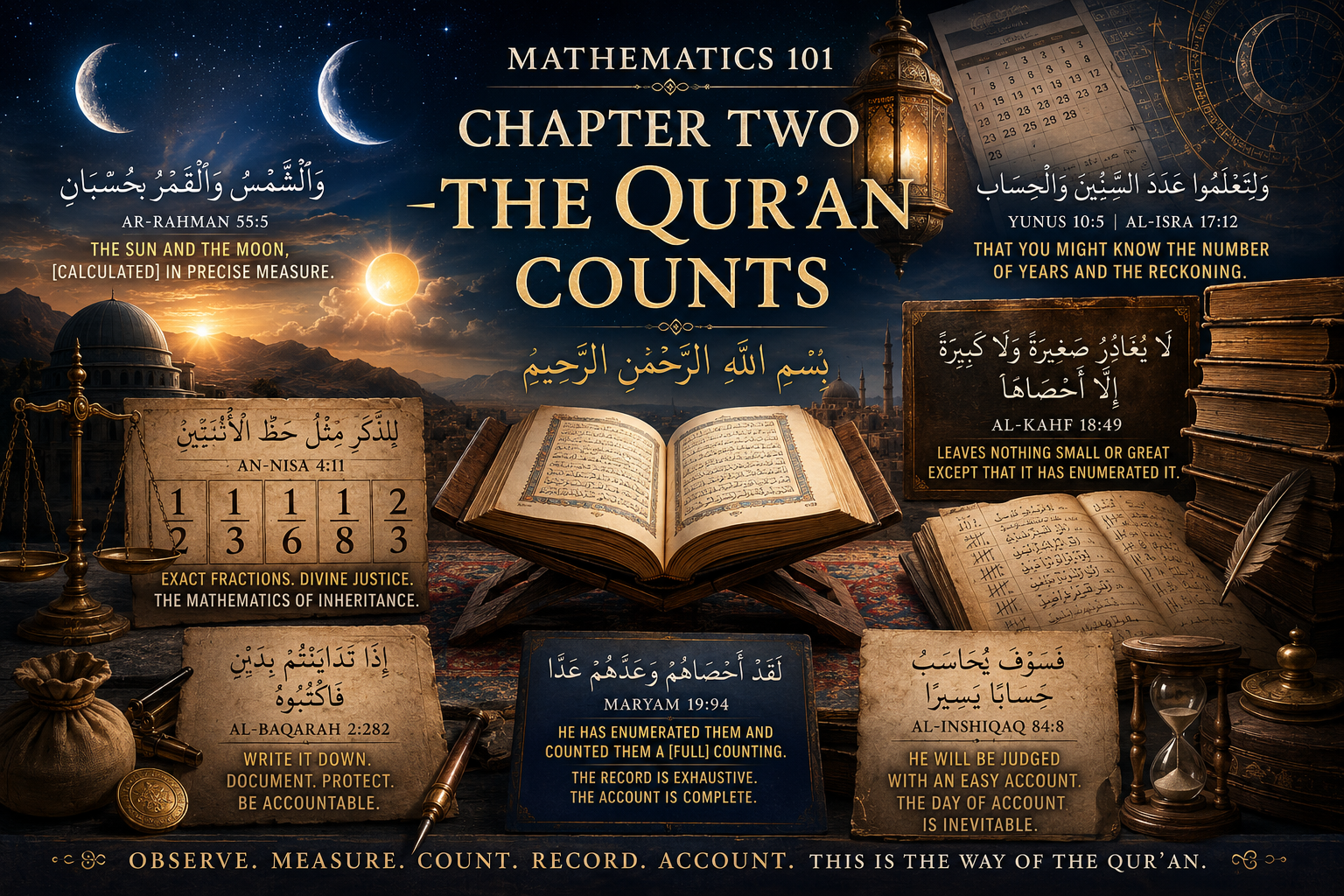
بِسْمِ اللهِ الرَّحْمٰنِ الرَّحِيْم
In our first lesson, we discovered something remarkable. Mathematics does not begin with numbers. It begins with accountability. It begins with Hisāb — the realization that every action matters, every choice matters, and nothing is truly lost.
But now we must go deeper. A skeptic might ask: "Where exactly is mathematics in the Qur'an?" It is a fair question, and this chapter answers it the only honest way — by opening the Book itself.
I. LOOK AT THE SKY
The Qur'an constantly directs our attention upward, and it does not leave the claim vague. It names the mechanism:
وَالشَّمْسُ وَالْقَمَرُ بِحُسْبَانٍ
"Wash-shamsu wal-qamaru biḥusbān."
"The sun and the moon, [calculated] in precise measure."
— Surah Ar-Rahman (55:5)
The word at the center of that verse, ḥusbān, comes from the same root as ḥisāb — calculation, reckoning. God is not saying the sun and moon are merely beautiful or merely powerful. He is saying they run on a calculation. And He says it again, this time naming exactly what that calculation is for:
هُوَ الَّذِي جَعَلَ الشَّمْسَ ضِيَاءً وَالْقَمَرَ نُورًا وَقَدَّرَهُ مَنَازِلَ لِتَعْلَمُوا عَدَدَ السِّنِينَ وَالْحِسَابَ
"Huwal-ladhī ja'ala ash-shamsa ḍiyā'an wal-qamara nūran wa qaddarahū manāzila lita'lamū 'adada as-sinīna wal-ḥisāb."
"It is He who made the sun a shining light and the moon a reflected light, and ordained for it stages, that you might know the number of years and the reckoning."
— Surah Yunus (10:5)
Empires rise and fall. Generations appear and disappear. Yet the sun rises, the moon changes phase, the seasons return — and the Qur'an tells us this is not poetry. It is ḥisāb, deliberately placed in the sky so that human beings could count years, build calendars, and structure civilization around a fixed reckoning. Before a Muslim ever opens a mathematics book, he is already living inside one.
II. TIME IS MATHEMATICS
Ramadan arrives at a specific time. Hajj arrives at a specific time. Prayer arrives at a specific time. None of this is possible without counting — and the Qur'an ties this counting directly back to the same word, in a second verse describing night and day as paired signs:
وَجَعَلْنَا اللَّيْلَ وَالنَّهَارَ آيَتَيْنِ ۖ فَمَحَوْنَا آيَةَ اللَّيْلِ وَجَعَلْنَا آيَةَ النَّهَارِ مُبْصِرَةً لِّتَبْتَغُوا فَضْلًا مِّن رَّبِّكُمْ وَلِتَعْلَمُوا عَدَدَ السِّنِينَ وَالْحِسَابَ
"Wa ja'alnā al-layla wan-nahāra āyatayni fa maḥawnā āyata al-layli wa ja'alnā āyata an-nahāri mubṣiratan litabtaghū faḍlan min rabbikum wa lita'lamū 'adada as-sinīna wal-ḥisāb."
"And We have made the night and day two signs, and We erased the sign of the night and made the sign of the day visible that you may seek bounty from your Lord and may know the number of years and the account [of time]."
— Surah Al-Isra (17:12)
Without calculation, there is no calendar. Without a calendar, there is no schedule. Without a schedule, there is no Ramadan observed on time, no Hajj gathered on time, no prayer called on time. The religion itself teaches the believer to count, by design, not by accident.
III. THE MATHEMATICS OF INHERITANCE
This is where many readers slow down, because here the Qur'an stops speaking generally about order and starts giving an actual ledger.
يُوصِيكُمُ اللَّهُ فِي أَوْلَادِكُمْ ۖ لِلذَّكَرِ مِثْلُ حَظِّ الْأُنثَيَيْنِ ۚ فَإِن كُنَّ نِسَاءً فَوْقَ اثْنَتَيْنِ فَلَهُنَّ ثُلُثَا مَا تَرَكَ ۖ وَإِن كَانَتْ وَاحِدَةً فَلَهَا النِّصْفُ ۚ وَلِأَبَوَيْهِ لِكُلِّ وَاحِدٍ مِّنْهُمَا السُّدُسُ مِمَّا تَرَكَ إِن كَانَ لَهُ وَلَدٌ
"Yūṣīkumu Allāhu fī awlādikum lidh-dhakari mithlu ḥaẓẓi al-unthayayni fa-in kunna nisā'an fawqa ithnatayni fa lahunna thuluthā mā taraka wa in kānat wāḥidatan fa lahā an-niṣf. Wa li-abawayhi likulli wāḥidin minhumā as-sudusu mimmā taraka in kāna lahū walad."
"Allah instructs you concerning your children: for the male, what is equal to the share of two females. But if there are [only] daughters, two or more, for them is two thirds of one's estate. And if there is only one, for her is half. And for one's parents, to each one of them is a sixth of his estate if he left children."
— Surah An-Nisa (4:11)
One-half. One-third. One-sixth. One-eighth. Two-thirds. These are not suggestions, not estimates, not gestures toward fairness left to a family's discretion. They are exact fractions, assigned by God Himself. Without mathematics, inheritance becomes a contest of who shouts loudest in the room after a death. With it, inheritance becomes a fixed account no one has the standing to argue with.
IV. THE RECORD
The Qur'an's final move in this chapter's argument is to take the same idea — fixed account, nothing lost — and apply it to the soul itself. Surah Al-Baqarah's debt verse, the longest in the Qur'an, opens this principle in the world of commerce:
يَا أَيُّهَا الَّذِينَ آمَنُوا إِذَا تَدَايَنتُم بِدَيْنٍ إِلَىٰ أَجَلٍ مُّسَمًّى فَاكْتُبُوهُ
"Yā ayyuhā alladhīna āmanū idhā tadāyantum bidaynin ilā ajalin musamman fa-ktubūh."
"O you who have believed, when you contract a debt for a specified term, write it down."
— Surah Al-Baqarah (2:282)
And what the Qur'an demands of believers in their dealings with each other, it tells us God already does with every soul, on a far larger ledger. Surah Al-Kahf delivers the most powerful image of this divine accounting:
وَوُضِعَ الْكِتَابُ فَتَرَى الْمُجْرِمِينَ مُشْفِقِينَ مِمَّا فِيهِ وَيَقُولُونَ يَا وَيْلَتَنَا مَالِ هَٰذَا الْكِتَابِ لَا يُغَادِرُ صَغِيرَةً وَلَا كَبِيرَةً إِلَّا أَحْصَاهَا
"Wa wuḍi'a al-kitābu fatara al-mujrimīna mushfiqīna mimmā fīhi wa yaqūlūna yā waylatanā māli hādhā al-kitābi lā yughādiru ṣaghīratan wa lā kabīratan illā aḥṣāhā."
"And the record [of deeds] will be placed [open], and you will see the criminals fearful of that within it, and they will say, 'Oh, woe to us! What is this book that leaves nothing small or great except that it has enumerated it?'"
— Surah Al-Kahf (18:49)
The Arabic word is أَحْصَاهَا — aḥṣāhā. It means to count, to enumerate, to compute every single detail. Nothing is too small. Nothing is too great. Everything is counted. And in Surah Maryam, the same root appears with doubled emphasis:
لَقَدْ أَحْصَاهُمْ وَعَدَّهُمْ عَدًّا
"Laqad aḥṣāhum wa 'addahum 'addā."
"He has enumerated them and counted them a [full] counting."
— Surah Maryam (19:94)
"Aḥṣāhum" — He has enumerated them, computed their number with precision. "Wa 'addahum 'addā" — and counted them with a complete counting. The repetition is not redundancy; it is emphasis. The record is exhaustive. The account is complete.
V. THE DAY OF ACCOUNT
And when the Day arrives, the Qur'an tells us that for some, the reckoning will be light:
فَسَوْفَ يُحَاسَبُ حِسَابًا يَسِيرًا
"Fasawfa yuḥāsabu ḥisāban yasīrā."
"He will be judged with an easy account."
— Surah Al-Inshiqaq (84:8)
The word appears again — yuḥāsabu, he will be accounted. The same root. The same concept. The Day of Account is not a metaphor. It is the ultimate reckoning, the final calculation, the closing of the ledger that began when the sun and moon were first set in their ḥusbān.
VI. THE QUR'AN IS TEACHING US TO THINK
Read these verses together — 55:5, 10:5, 17:12, 4:11, 2:282, 18:49, 19:94, 84:8 — and a pattern emerges that no single verse shows on its own. The Qur'an is not merely teaching beliefs. It is teaching a way of thinking: observation of the sky, measurement of time, precision in inheritance, documentation of debt, and ultimate accountability before the One who counts everything. The intellectual foundations of a mathematical civilization are being laid here, verse by verse, centuries before the first algebra book is written.
VII. THE GREAT DISCOVERY
This changes how we understand Islamic civilization. The great Muslim mathematicians did not appear from nowhere. They inherited a worldview already filled with measurement — because the Book their civilization was built on had already said ḥusbān, already said ḥisāb, already said li-adh-dhakari mithlu ḥaẓẓi al-unthayayni, long before anyone called it mathematics.
THE JOURNEY CONTINUES
If the Qur'an planted these seeds in plain Arabic, with exact fractions and named calculations, how did they grow into algebra, astronomy, and the House of Wisdom? That is where we go next — not to a formula, but to a city, and to the caliph who read these same verses and asked a scholar to build the tool his civilization needed to carry them out.
CHAPTER THREE — THE HOUSE OF WISDOM
How Revelation Became Civilization
Summary of Qur'anic Verses in This Chapter
Theme Verse Arabic Text English Translation Sun and moon in precise measure Ar-Rahman 55:5 وَالشَّمْسُ وَالْقَمَرُ بِحُسْبَانٍ "The sun and the moon, [calculated] in precise measure." Knowing the number of years Yunus 10:5 لِتَعْلَمُوا عَدَدَ السِّنِينَ وَالْحِسَابَ "That you might know the number of years and the reckoning." Night and day as signs Al-Isra 17:12 وَلِتَعْلَمُوا عَدَدَ السِّنِينَ وَالْحِسَابَ "That you may know the number of years and the account [of time]." Inheritance fractions An-Nisa 4:11 لِلذَّكَرِ مِثْلُ حَظِّ الْأُنثَيَيْنِ "For the male, what is equal to the share of two females." Recording all deeds Al-Kahf 18:49 لَا يُغَادِرُ صَغِيرَةً وَلَا كَبِيرَةً إِلَّا أَحْصَاهَا "Leaves nothing small or great except that it has enumerated it." Full counting of all Maryam 19:94 لَقَدْ أَحْصَاهُمْ وَعَدَّهُمْ عَدًّا "He has enumerated them and counted them a [full] counting." Easy accounting Al-Inshiqaq 84:8 فَسَوْفَ يُحَاسَبُ حِسَابًا يَسِيرًا "He will be judged with an easy account."
Class dismissed.
For now. Inshallah.