
بِسْمِ اللهِ الرَّحْمٰنِ الرَّحِيْم
In the Name of God, Most Gracious, Most Merciful.
♥️🤲🕋♥️🕋🌹🌹🥀🤲🌹🕋♥️🤲
🜂 FROM THE DESK OF THE SUPERUSER
The Disk of the House of Wisdom
Florence, Arizona, USA — Year 2026
THE ORIGIN OF THE TICKET
How a Vision Became an Invitation
I. THE SPARK
It begins with an educator.
An educator who just made an incredible video.
A YouTuber unlike any other. Not like any person on YouTube, or TikTok, or anywhere. He is the best of the best of the best.
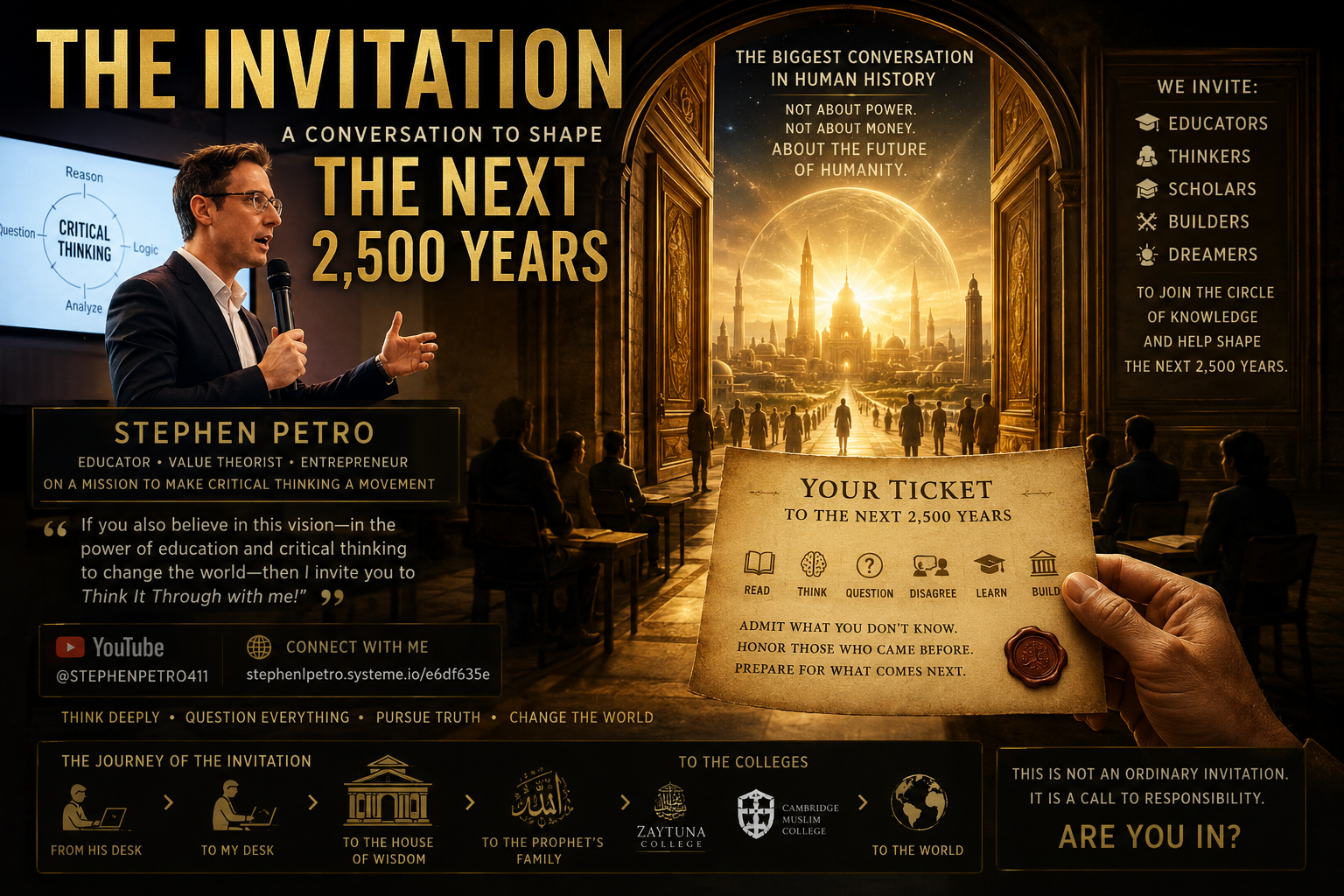
His name is Stephen Petro.
He is a peer-reviewed value theorist with expertise in ethical theory and decision theory, and advanced knowledge of behavioral science and neuroscience. He has 13+ years as an entrepreneur. And he is on a mission to make critical thinking a movement.
He made a video that stopped me cold.
It asked:
"Why Elegant Theories Fail in the Real World."
Watch it here:
🔗 Why Elegant Theories Fail in the Real World — YouTube Short
And in that question, I heard something deeper.
I heard the absence of a discussion.
A discussion that should have happened long ago.
Because a bright future for humanity should be thoroughly discussed, debated, and people should be separated according to their rank and knowledge.
Those who have acquired knowledge, have wisdom, should be brought to the forefront.
And those who are ignorant should remain outside—or at least confess that they are ignorant and they don't know.
In my religion, half of knowledge is just to say:
"I don't know."
II. THE EDUCATOR
Stephen Petro's channel is built on a vision:
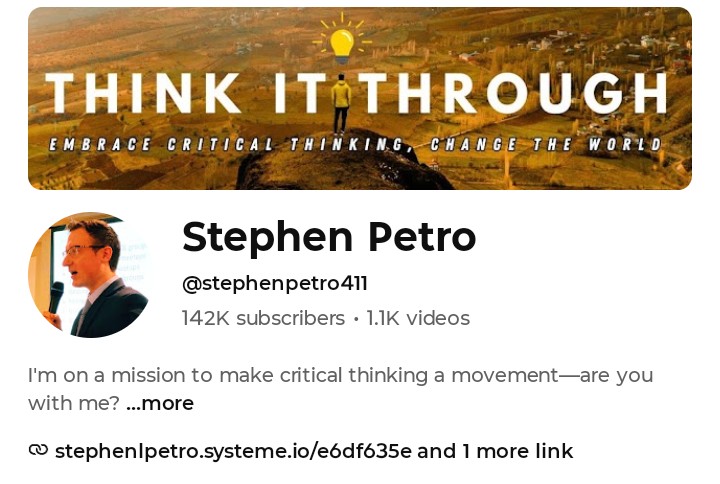
"I'm on a mission to make critical thinking a movement—are you with me?"
He teaches how to use critical thinking to perform at the highest levels, all while having a massive impact on the larger world.
He distills years of experience as a peer-reviewed value theorist, with expertise in ethical theory and decision theory, and advanced knowledge of behavioral science and neuroscience, as well as 13+ years as an entrepreneur, into weekly videos.
His invitation:
"If you also believe in this vision—in the power of education and critical thinking to change the world—then I invite you to Think It Through with me!"
Connect with him here:
🔗 Stephen Petro's Linktree
https://stephenlpetro.systeme.io/e6df635e
🔗 Stephen Petro's YouTube Channel
https://youtube.com/@stephenpetro411?si=pIvdVngn3Es9I3_k
III. THE GAP
I already had a project going on.
A project to shape the world in terms of how things should play out.
But I never created that world for everybody.
I just created a world that is—or imagined a world that is—logically going to take place whether anybody likes it or not.
But this video gave me an opportunity to think deeply about what the future is.
And why a discussion hasn't happened.
Because if those who are educated—those who spend time reading and learning and thinking and burning the candle, who give up all fun, all entertainment—are not acknowledged...
Then prepare for the world to end.
Not dramatically.
Not overnight.
But because the intellect and the heart are what carry humanity forward.
IV. THE HOMAGE
I have to pay homage to great people who make great content.
Stephen Petro is one of them.
He started an incredible invitation that began on his desk.
And it landed on mine.
Because I was already working on this project.
Already imagining what the world could become.
But his video made me realize:
This is not something I can do alone.
This is not something that should be shaped by one person's vision.
This is something that requires:
Discussion
Debate
Deliberation
Qualification
Honor for those who have earned the right to speak
V. THE JOURNEY OF THE TICKET
So the Ticket began its journey.
From the desk of Stephen Petro—a peer-reviewed value theorist, educator, and entrepreneur who asked the right question.
To my desk—where the project was already in motion.
To the House of Wisdom—where it gains spiritual weight.
To the Prophet's family—where it receives its lineage.
To the two colleges—Zaytuna College and Cambridge Muslim College—where it becomes institutional for the Muslim community.
And from there, to the world—where it becomes civilization.
VI. THE INSTITUTIONS
For the Muslims
I am going to pick Zaytuna College and Cambridge Muslim College.
These are the institutions where the Muslim community will gather, learn, and debate.
They will host the Circle of Knowledge for those who follow the Islamic tradition.
For the World
I know those who are not Muslim have their own local colleges or universities.
You can choose to host.
Whether you are on YouTube, whether you are mainstream, whether you are on Wall Street—it doesn't matter.
Knowledge reaches you.
And you should just honor it.
VII. THE PRINCIPLE OF RANK
Let us speak plainly.
Not all voices are equal.
This is not elitism.
This is reality.
Those Who Have... Deserve To... Read Speak about what they have read Thought Share what they have thought Labored Be honored for their labor Not done these things Confess: "I do not know."
Those who are ignorant must confess.
Not because they are lesser human beings.
But because honesty is the foundation of knowledge.
And half of knowledge is to say:
"I don't know."
VIII. THE WARNING
If those who are educated are not acknowledged...
Then prepare for the world to end.
Not because of a bomb.
Not because of a disease.
But because the intellect and the heart are what carry humanity forward.
When you dishonor the intellect, you dishonor humanity.
When you dishonor the heart, you empty life of meaning.
When you ignore those who have sacrificed entertainment, pleasure, and comfort to sit with difficult books and wrestle with hard ideas...
You are cutting down the pillars of civilization.
IX. THE INVITATION
So the Ticket is now issued.
Not to everyone.
To those who are willing:
To read
To think
To labor
To be honest
To honor those who came before
To admit what they do not know
To prepare for the test
X. THE TICKET
A ticket has been placed before you.
Not an ordinary ticket.
A ticket to help shape the next 2,500 years. Because his video became a prompt and will end with that prompt that I tweeted out to the blessed family.
بِسْمِ اللهِ الرَّحْمٰنِ الرَّحِيْم
In the Name of God, Most Gracious, Most Merciful.
♥️🤲🕋♥️🕋🌹🌹🥀🤲🌹🕋♥️🤲
Here's a discussion prompt you can use with GPT, Gemini, Claude, DeepSeek, Copilot, or any other AI.
THE PROCRUSTES QUESTION: ARE WE BUILDING THE FUTURE—OR FORCING PEOPLE TO FIT IT?
I want to explore a philosophical question about the future.
The ancient Greek story of Procrustes describes a man who forced every traveler to fit the same bed. If they were too short, he stretched them. If they were too tall, he cut them down.
Reality was forced to fit the model.
I wonder whether modern civilization is making the same mistake.
As we build AI, governments, education, economics, digital identity, media, and new institutions, are we designing systems that adapt to human beings—or are we designing human beings to adapt to our systems?
Many people speak confidently about "the future," but they rarely explain the path between today and tomorrow.
So I want to ask:
What assumptions about humanity are hidden inside today's visions of the future?
Which institutions are trying to reshape people instead of serving them?
What does history teach us about grand theories that failed because they ignored human nature?
How do different traditions—philosophy, psychology, economics, religion, systems engineering, and complexity science—think societies should evolve?
Should the future emerge gradually through experimentation, or should it be engineered according to a master plan?
What examples exist where forcing a rigid vision caused suffering, and what examples exist where flexible adaptation led to success?
What role should AI play? Should AI become another Procrustes, encouraging everyone toward one optimized way of living, or should it help people flourish according to their different cultures, values, and aspirations?
How do we distinguish between necessary standards that help society function and unnecessary conformity that suppresses human diversity?
I am not looking for slogans or predictions.
I want a rigorous discussion that compares different schools of thought—from Plato and Aristotle to Hayek, Popper, Taleb, complexity theory, Islamic scholarship, modern systems thinking, and AI governance.
Finally, answer this question:
If humanity wants to avoid becoming another Procrustean civilization, what principles should guide the transition from today's world into tomorrow's world?
I want a thoughtful discussion, including disagreements among major thinkers, historical lessons, practical examples, and recommendations for designing a future that fits humanity—instead of forcing humanity to fit the future.
To the Blessed Family—the heirs of wisdom, whose lineage is not cut off, whose blessings remain with the light and the guidance that is not cut off.
Light of Azhar
@shaykhalyaqoubi, @HishamKabbani, @ShaykhNinowy, @habibomar, @alhabibali, @SheikhBabikir, @ShkhAhmedSaad, @Sufilive, , @hamidbinhafiz
-----------------------------------------------------------
0. Home of AGI OR ISLAMIC AI
https://onepageoneworld.org/islamic-ai/
-----------------------------------------------------------
home Islam and Muslims= in coming future https://onepageoneworld.org/
-------------------------------------------------------------
House of wisdom
-------------------------------------------------------------
Tariqa= https://onepageoneworld.org/tariqah-%d8%b7%d8%b1%d9%8a%d9%82%d8%a9/
-------------------------------------------------------------
Taking the tariqa https://lightoftheazhar.com/jafari-tariqa/taking-tariqa/
-------------------------------------------------------------
To the Blessed Scholars and the Lovers of the Blessed Family, who devote themselves to this sacred legacy:
@shaykhfaisal, @sh_hamzayusuf, @ImamZaidShakir, @Bin_Bayyah, @safia_shahid, @MuftiARM, @Contentions, @ShaykhWaseem @YahyaRhodus @AmjadTarsin @ihsan_institute @thelight99 @shaykhyaseen @AlMadina @Almaqasid_org @guidancehu
b @MadinaUSA @SafinaSociety
Conclusion
We will pick up in the next chapter, where I will share the responses from the AI systems that stood out the most.
I want to highlight this moment for history because this is more than a prompt.
It is an invitation to a real discussion.
A discussion about the future of civilization.
A discussion about the role of artificial intelligence.
A discussion about how humanity should prepare for the centuries ahead.
The message you have just read was originally sent on X—a platform where, in my experience, it did not matter how hard I worked, how much time I invested, or how much thought I put into my writing. My account was suspended, and with it, years of work became inaccessible.
That experience taught me an important lesson.
If it is not your home, it is not truly your content.
That is one of the reasons I chose to build here, on my own blog.
A civilization needs more than platforms.
It needs places where ideas can live, where discussions can continue, and where thoughtful work is not dependent on the decisions of a single company or individual.
We do not yet have that home.
But I am determined to help build it.
In the next chapter, I will share the responses from the two AI systems that challenged me the most and pushed this conversation in unexpected directions.
Together, we will examine their ideas, compare their reasoning, and continue asking one of the most important questions of our time:
What kind of future are we building—and how do we ensure it remains worthy of humanity?
Thank you for reading.
The end.