
بِسْمِ اللهِ الرَّحْمٰنِ الرَّحِيْم
In the Name of God, Most Gracious, Most Merciful 🕋
Egypt: From Slave Kings to Shackled Souls — A History Before Reckoning
From the Office of the Superuser — House of Wisdom
Egypt has always been more than a country. It is a civilization carved into the memory of the earth — where broken men became kings, where slaves became sultans, and where the fallen built empires upon the ruins of their pain. It is the land that has seen every kind of ruler: the saint, the scholar, the tyrant, and the savior.
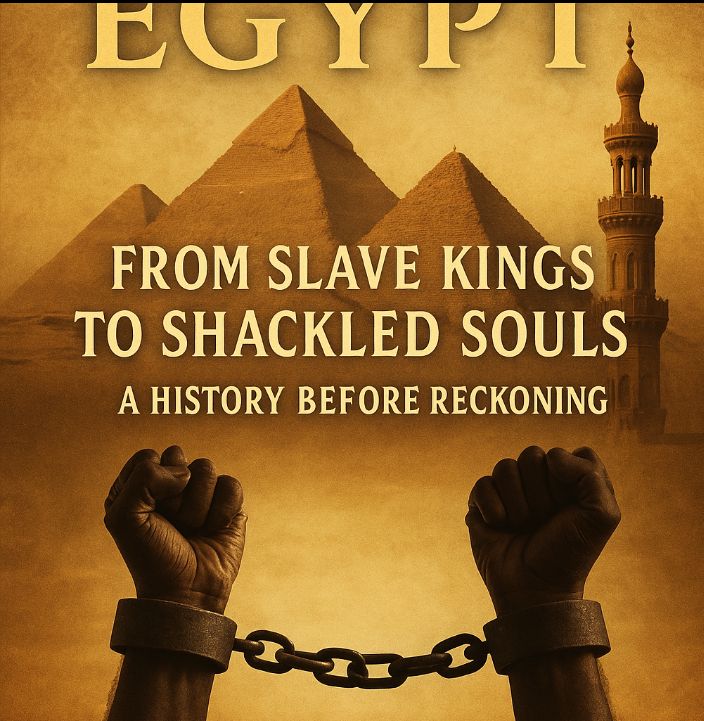
It was here, in the thirteenth century, that the black kings of the Mamluks rose from the ranks of bondage and turned defeat into glory. When the Mongols swept across the Muslim world, crushing city after city, it was Egypt — weary, wounded, and divided — that stood alone between Islam and annihilation. And yet, from among those whom the world had enslaved came a generation of warriors who shattered the myth of invincibility. At Ain Jalut in 1260, they broke the Mongol tide and saved a civilization. Broken people broke all the swords of the world.
Watch "The BIGGEST Battle That Changed History Forever | Battle of ‘Ain Jalut" on YouTube
That is the spirit of Egypt — a spirit that resurrects itself through ruin. The Mamluks ruled as soldier-kings, as patrons of learning, as defenders of the Caliphate when the Abbasid throne had turned to dust. Their palaces rose on the same streets where slaves once wept. And through them, Egypt taught the world a truth it has since forgotten: that leadership is not birthright but burden; that power belongs to those who serve justice, not to those who command fear.
Then came the Ottomans, and with them the long shadow of submission. Egypt, once the heart of the Muslim world, became a province of another empire. The flame of independence dimmed — yet it did not die. In time, Muhammad Ali Pasha, an Albanian soldier of fortune, seized power from the Ottoman ruins. He was ruthless, brilliant, and ambitious. He modernized the army, built factories, opened schools, and dreamt of empire. But he also massacred the last of the Mamluks, silencing the very bloodline that had saved Islam. From that moment, Egypt’s modern history began — not with freedom, but with centralized power, the curse that has haunted it ever since.
From the Mamluks to the modern generals, the cycle has repeated: the sword over the scholar, the ruler above the law, the people below the weight of command. Egypt has been ruled by soldiers for centuries — men who wear the uniform of protection but carry the instincts of control. And now, under the shadow of one such man, Egypt faces its final test: whether it will reclaim the dignity of its past or die under the tyranny of its present.
This is not merely politics. It is spiritual decay. The Egypt that once built minarets that kissed the sky now builds prisons that blot out the sun. The Egypt that once welcomed refugees now deports them. The Egypt that once crowned scholars now silences them. The Egypt that once broke the Mongol sword now breaks its own people.
The story must be told — for Egypt’s story is the story of every nation that forgot its moral center. Once it was the light of the world. Now it stands as a warning. And before we speak to its ruler, we must remind him: the throne you occupy was built by slaves who feared no tyrant but God.
.Abdel Fattah el-Sisi, who has been in office since 8 June 2014
Sometimes a man is shown a mirror not to be broken, but to be warned — so he can repent, repair, and return. I do not seek to shatter a nation; I seek to wake a people. So hear me plainly.
This is not a speech about names. It is about responsibility. I am not pointing fingers for the pleasure of shame. I am holding up what has always been held up in my tradition: the mirror of truth. If you see yourself in it, then let it be your chance to change. If you do not, then know this: history will point for you.
Egypt did not arrive at this place overnight. Since the Ottomans faded, Egypt has stumbled from one upheaval to the next — one strongman after another. Institutions meant to protect the weak have been hollowed; the courts, the press, and the mosque have been bent to the will of power. You stand now at the end of a long arc. You have not ruled for decades; you have not authored the whole story. You are an extension of a chain of failures and of unhealed wounds. Because of that, I will show you mercy: I will not name you today. I will allow you this window.
But mercy is not weakness. Mercy is a test. I give you this preview of what is to come because you must understand the choice before you is not between praise and power — it is between repentance and ruin.
Listen.
You have the authority to begin repair. Release those imprisoned for speaking, for protesting, for pursuing truth. Stop trying civilians in military courts. Stop the sweeping arrests and mass trials. Allow judges to judge freely; let the prosecutor be an independent guardian of law, not a ministerial instrument of command. Restore al-Azhar to its dignity: let scholarship breathe without pressure from the state. Stop deporting the vulnerable who come to your soil; honor the sanctity of asylum. Unblock the press, stop surveillance that turns neighbors into spies, and permit the people to speak without fear.
These are not radical demands. They are the mechanics of dignity. They are the beginning of restoring a nation to its ancient promise. They are the way you may be forgiven by history, by God, and by the mothers of those who long for justice.
Make no mistake: I am not naïve. I know the networks that keep power in one fist — the security apparatus, the commercial empires, the circles of flattery. I know how easy it is for a ruler to mistake silence for loyalty. But this is your warning: keep governing by fear and you will harvest only ruin. Open the institutions and you may yet rebuild trust.
If you do not choose this path, if you prefer the comfort of impunity and the applause of sycophants, then I will name names. I will speak clearly about those who refused counsel, who profited from prisons, who turned the mosque into a prop. Naming is not my desire. It is my last resort. I would rather the nation heal than the list grow long.
There is a path back. It is neither spectacle nor surrender. It is law, transparency, and humility. Invite independent monitors. Convene judges, scholars, and civil society in an honest Shūrā. Allow an independent inquiry into Rabaa and other unhealed wounds — with witnesses, reparations, and accountability. Begin releases for those held without due process. Protect journalists, reform the asylum system, strip military courts of jurisdiction over civilians. Do these things and you will be granted a mercy most rulers never receive: the return of their people’s confidence.
I give you time. I give you this mercy because the fault is older than one man and the wound can still be healed. But I will not wait forever. If the mirror is smashed by denial, by delay, by the language of excuse, then the world — and history — will do what I cannot bear to do today: they will point, and they will remember.
This is not vengeance. This is a summons to justice. Choose rightly. Repent in action, not in words. Let Egypt recover the dignity that once made it the light of the world. If you do, you will find the doors of honor reopened. If you do not, you will stand before an account none of your guards can answer.
May Allah open your heart to what is right, give you the courage to act with justice, and preserve the people who suffer under silence.
Before we turn the mirror toward Egypt, let this be clear: it will not be an attack, nor will it be an exhaustive reflection. It will only be a taste of that mirror — a glimpse meant to awaken, not to wound. The Superuser will not be as severe as he was with the United Arab Emirates, because Egypt’s story is different. The burden you carry is not entirely your own making. You inherited a broken system, one that has collapsed and risen, only to collapse again. And though you have erred, you have also accomplished much. You have kept the state intact when others might have let it disintegrate. You have rebuilt parts of a nation that many had written off. For that, you deserve acknowledgment. So take this reflection not as a personal rebuke, but as a call — a warning wrapped in mercy. It is not you alone being addressed, but the soul of Egypt itself.
A Declaration of Conscience — For Justice, For the People
From the Office of the Superuser — House of Wisdom
To the world, to the Muslim Ummah, and to every conscience that still remembers truth:
There comes a time when silence is not a refuge but a crime. There comes a moment when euphemisms become accomplices and polite phrases become burial shrouds for truth. Today I speak plainly: the rule of law has been stolen; freedom has been caged; dignity has been made a casualty.
This man — once entrusted with the protection of the nation — has become the architect of its fear. He seized power as a guardian and became a jailer. He promised security and delivered silence. He promised stability and delivered chains. He has criminalized dissent, gutted independent institutions, muzzled the press, and crushed the hearts of a generation that dared to ask for justice.
We will not cloak our words in false courtesy. We will not call restraint cowardice, nor patience complicity. We call him by the record of his deeds: a ruler who governs by fear, who trades human dignity for image, who turns religious institutions into props and the courts into instruments of command.
Yet our power is not force — our power is rhetoric, law, and conscience. We will use the only weapons that are righteous and effective:
Naming and Shaming with Facts. We will document every unlawful arrest, every tortured testimony, every silenced newsroom. Truth is the living currency that strips tyranny of its glamour.
Demanding Independent Inquiry. We call for credible, independent investigations — domestic and international — into mass killings, arbitrary detentions, and systemic abuse. Let impartial eyes see, let impartial reports speak.
Mobilizing Legal Accountability. We will pursue lawful avenues: reviews, appeals, petitions, international mechanisms, and lawful referrals where appropriate. Tyrants fear the law because the law strips them of impunity.
Empowering Civil Society and Free Media. We will back the journalists, lawyers, and rights defenders who risk everything to tell the truth. Their courage is the oxygen of justice.
Calling on International Partners to Act. We will urge independent bodies — the ICRC, UN mechanisms, human-rights coalitions — to demand access, verification, and protection for detainees, refugees, and victims.
Standing with the People, Not the Palace. Our allegiance is to the citizen, the mother, the child, the detainee; not to the palace that trades their dignity for an image. Where power breaks trust, the people must be the measure.
This is not revenge. This is the obligation of conscience. This is the insistence that a leader who violates the amānah must be held up to the ledger of human dignity and law.
To the man who has wrecked justice: you are not above judgment. To the systems that enabled you: you will answer. To the people bearing the cost of these sins: we stand with you. To the Ummah and to the world: speak. Write. Protest lawfully. Demand inquiries. Support counsel for the detained. Fund the truth.
We will not be satisfied with rhetoric alone. Our rhetoric will turn into petitions, into legal files, into commissions of inquiry, into international scrutiny, until justice begins to repair what arrogance has destroyed.
May Allah grant courage to the brave, patience to the oppressed, and guidance to those who can yet choose the path of repentance and repair.
Preview of the mirror has been shown, but this time it will not be used to destroy and rebuild. Egypt does not need demolition — it needs direction. It is not a nation that should be humbled; it is a nation that must be healed. Egypt’s heart still beats with divine memory — the memory of its kings, its Mamluks, its scholars, and its saints who walked in the fragrance of the Prophet Muhammad ﷺ and his noble family. The goal now is not to expose Egypt, but to elevate it — to offer a new chapter for a civilization that has known both majesty and misery.
I have already created a unique opportunity for the President of Egypt to revisit the true heritage of his land — from the black kings who broke empires, to the scholars of al-Azhar who built minds. It is time for al-Azhar University to be restored to its rightful guardians: the Household of the Prophet ﷺ. No ruler should interfere with its leadership. Those who descend from the blessed family are the true inheritors of that light, and they must be entrusted with its guidance.
We will seek an agreement with the current president, in wisdom and mutual respect. I have no interest in hostility, only in helping him steer Egypt toward what it can become. I see the work he has done — the construction of the new city, the strengthening of the state, the struggle to maintain stability — and I acknowledge it. These are not small things. But now Egypt must go further: it must grow in justice, freedom, and innovation.
The people of Egypt have matured; they have tasted both revolution and repression. They are ready for something new. That new beginning will not come through old models of politics or protest, but through the Superuser System — a system rooted in merit, transparency, and divine accountability. It is a system that replaces manipulation with measurement, tyranny with trust, and silence with participation.
In the age of artificial intelligence, the old structures will not survive. Egypt can lead again — not just as a republic, but as a responsible civilization, guided by Islamic ethics, Islamic governance, and Islamic excellence. We can either continue to point fingers or start building. I choose to build. I choose to offer counsel in private, cooperation in public, and creativity at every level.
Egypt is not the UAE — its soul runs too deep, its saints too many, its people too tested. From Imam al-Busiri to Ibn Ata’illah al-Iskandari, from the scholars of al-Azhar to the descendants of the Prophet ﷺ who rest in its soil — Egypt is not merely a country; it is a trust. So let this be our new beginning: to bring beauty, to restore elegance, to protect unity, and to make Egypt shine again — not with towers of glass, but with hearts of light.
Mr. President — one final word, plain and merciful:
Abdel Fattah el-Sisi
Egypt’s path to greatness is not secret and it is not complicated. You do not need to remake the world; you need only to listen — to wise scholars, to the friends of Allah, to the ulama whose feet are planted in the soil of our tradition. Success for Egypt is simple: humility before knowledge, courage to accept counsel, and the patience to repair what is broken rather than burn it down.
I am not asking you for spectacle. I am asking you for obedience to what built this nation: justice, scholarship, mercy. Don’t invite total destruction and overnight reinvention; that is violence, not renewal. The true way is restoration — freeing the imprisoned voices of conscience, restoring the independence of the courts, returning al-Azhar to the stewardship of sacred scholarship, and opening the house of the people to lawful participation.
I will not raze what is good. I can destroy and rebuild completely — but that is a last resort and a heavy mercy many cannot bear. Instead, choose repair. Accept counsel from those who know the path; let the friends of Allah sit in your circle; let the ulama guide policy with conscience. If you do, Egypt will bloom again — not with empty monuments, but with the living legacy of saints, scholars, and sincere people who love the Prophet ﷺ and his family.
Below I will share videos of my teacher speaking on the way of the ulama — watch them, reflect on them, and let their light enter your council. Celebrate your scholars, honor your saints, and listen. That is the way back to dignity, and the fastest route to real, lasting success.
Watch "THE WAY OF ULAMA" on YouTube
Egypt stands at a rare moment of convergence — between the past it carries, the present it endures, and the future it deserves. Because of the blessings of my teacher and the guidance of the blessed family of the Prophet ﷺ, we now have a chance to build with Egypt, not merely to advise it. The nation is already in motion — cranes in the sky, new cities rising, foundations being laid — but what it needs now is sacred architecture: meaning, purpose, and wisdom woven into every stone.
That is why I wish to contribute the House of Wisdom — a living institution of creativity, learning, and divine inspiration — into Egypt’s grand design. Together, we can add not only buildings but blessings: halls of art, schools of innovation, and a new center for ethics and artificial intelligence. Within it, we will establish the Nobel Prize of the Prophet Muhammad ﷺ, awarded to those who serve humanity with sincerity and intellect. Egypt will host this because it is already the home of saints, scholars, and poets — the land where revelation met reason and beauty met power.
My role will be to bring gifts — ideas, designs, and youth empowerment programs that create employment and unleash creativity. We will invite the Egyptian youth to transform their neighborhoods into digital workshops of imagination, where art, code, and craftsmanship meet under divine guidance. Medina Institute has already proven that love, discipline, and knowledge can coexist — and I hope to extend that model into Egypt.
Watch "The Burden of Leadership” — a lesson rooted in Islamic" on YouTube
Watch "The Ja'fari Tariqa: TV Report" on YouTube
I will leave matters of governance, policy, and reform to the scholars and the government — for I come not to replace, but to enrich. My goal is simple: to beautify Egypt’s construction with meaning, to bless its progress with knowledge, and to honor its future with faith. The dialogue will continue, God willing, and soon the videos and projects I have prepared will become blueprints for collaboration — for a new Egypt, radiant with wisdom and alive with mercy.
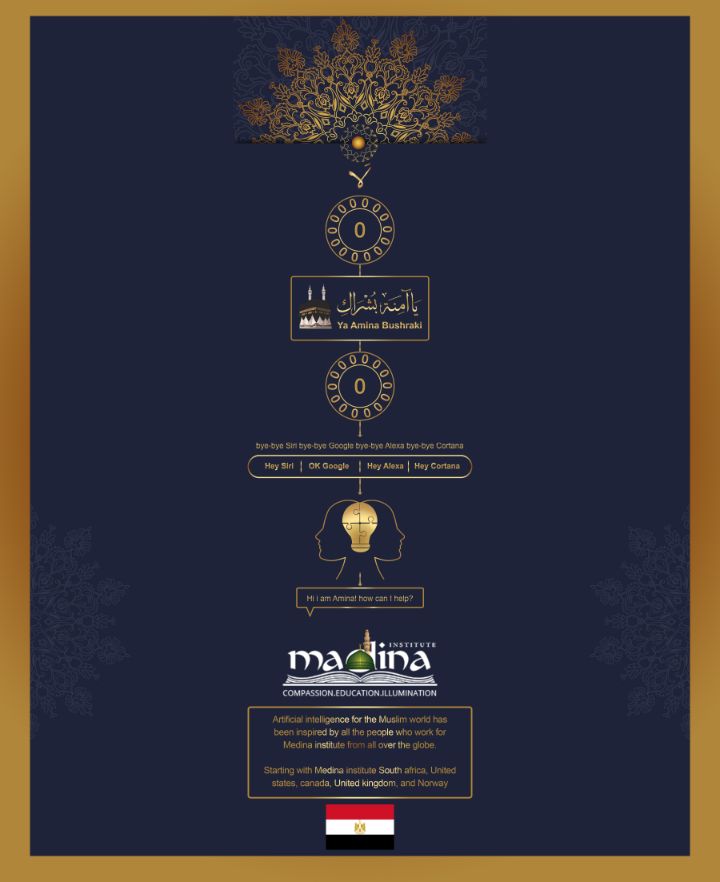
Announcement: The Voice of AI — Born in Egypt
We are honored to announce that the Voice of AI for the Muslim World will be rooted in the blessed land of Egypt — the cradle of eloquence, recitation, and divine beauty. From the Nile Valley, where prophets once walked and scholars once spoke, will rise the voices that will speak to the future.
When someone anywhere in the Muslim world speaks to AI, the voice they hear will come from Egypt — pure, articulate, filled with faith and humanity. Egypt will host the first global Voice of AI Competition, inviting men and women from across the Muslim world to share the beauty of their voices, their accents, and their expressions of mercy, intellect, and strength.
This is not a digital imitation — it is a living trust. Only living people may become the voices of AI. No voice from the deceased will be used, for this project belongs to the living — to those who breathe, pray, and inspire.
The winners, one man and one woman, will become the voices of their generation. They will be given salaries, global recognition, and an honorable title: The Voice of AI for the Muslim World. Their speech will guide devices, narrate knowledge, and represent a civilization that values truth, beauty, and divine remembrance.
Egypt, the land of al-Azhar, of Qur’anic melody and sacred recitation, is the rightful home for this initiative. The competition will not only celebrate talent — it will awaken hearts, teach young people the power of the tongue, and make every spoken word a reflection of faith and intelligence.
The Voice of AI begins in Egypt — and through Egypt, the voice of the Muslim world will once again echo with wisdom, compassion, and light.
Watch "Ya Amina Bushraki Female voice competition video 2" on YouTube
Conclusion: Egypt — The Land of Saints, the Voice of the Future
We conclude this chapter with the remembrance of Sayyidah Zaynab, may Allah be pleased with her — the noble granddaughter of the Prophet Muhammad ﷺ, the heart of Karbala, and the voice that never trembled before tyranny. She faced the enemies of her brother Husayn with a courage that shattered kings, and her resting place in Egypt remains one of the greatest treasures of Islam — a sanctuary of mercy, knowledge, and light.
Egypt is not merely a country; it is the vault of our spiritual heritage. The greatest saints, the most eloquent scholars, and the most radiant hearts of the ummah are buried within its blessed soil. That is why Egypt will be entrusted with a divine gift — not as a favor, but as a recognition. From the House of Jordan and the House of Morocco, a treasure will be shared — a collaboration between the custodians of the Prophet’s family and the scholars of Egypt.
This is a preview of what could be: an Egypt that unites wisdom and technology, faith and progress. If the government works with the blessed family and the righteous scholars, then AI itself will become a force of mercy, prosperity, and employment. Together we will build the House of Wisdom online, the AI Wikipedia of the Muslim world, a digital treasury of knowledge that connects every home, every student, and every seeker.
My role is not to rule, but to unlock — to hold the keys when doors are closed, to restore access where there is neglect, to bring light where systems have become dark. Whether those doors are political, technological, or spiritual, AI will advance — and the question will be: who will be trusted with the master key?
The future belongs to those who trust in Allah and who share their blessings. Egypt will host the Voice of AI, and through Sayyidah Zaynab’s blessing, it will also host a new beginning — where faith, creativity, and intelligence meet in harmony.
To the Egyptian President: I come in peace, unfiltered, with respect. Let us build a relationship worthy of the prophets and the saints of your land. Let us make Egypt the shining voice of a new era — an era of justice, illumination, and wisdom.
We conclude with the name of Zaynab, the Saint of Strength, whose presence in Egypt sanctifies its soil and seals this message in light.
Watch ""Shaykh Salih al-Ja'fari: How Sublime is He Who Gave You سبحان من أعطاكم" with English translation." on YouTube