
بِسْمِ اللهِ الرَّحْمٰنِ الرَّحِيْم
Bismillah ar-Rahman ar-Rahim
In the Name of God, Most Gracious, Most Merciful 🕋
Chapter Five — One Party, One
Dream, One War (1976–1980)
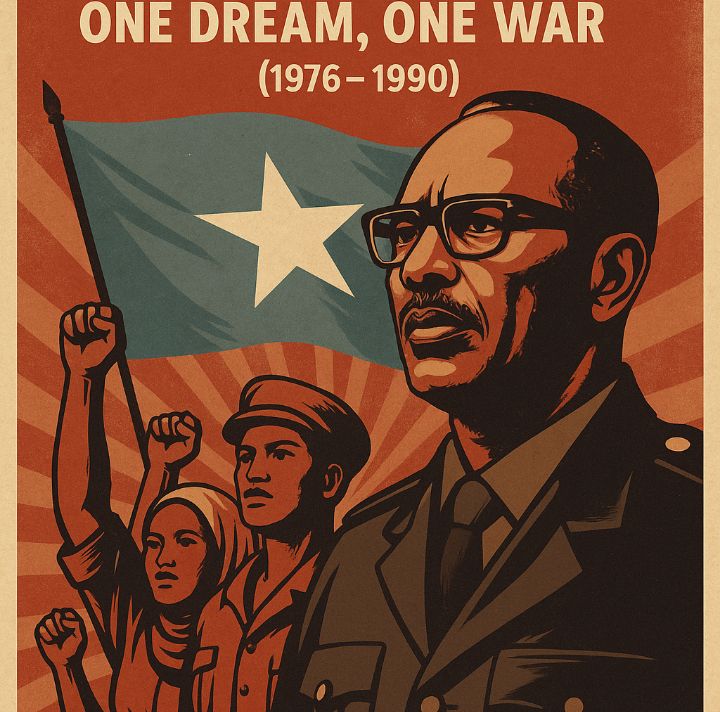
By the mid-1970s, Siad Barre believed his revolution needed a permanent form. The guns of the early years had quieted, and now he sought to turn power into permanence. The Somali Revolutionary Socialist Party (SRSP) was born in 1976 — a single party meant to replace all others, merging the military, the government, and the people into one machine.
Every organization had its place. There were unions for farmers, women, and youth, all answering upward to the same structure. On paper, it was unity. In practice, it was control. The country’s conversations began to sound the same. Speeches, classrooms, and radio songs all echoed one message: one leader, one party, one destiny.
Yet behind that unity lay ambition — the old dream of Greater Somalia. Barre wanted to unite every Somali-speaking land torn apart by colonial borders: the Ogaden in Ethiopia, the North Frontier District in Kenya, and Djibouti to the north. It was a dream many shared, and for a moment, it felt possible. Ethiopia had just gone through its own revolution, and the empire of Haile Selassie had collapsed. The new Ethiopian military regime, the Derg, was still struggling to control its vast lands.
Barre saw an opening. In 1977, the Somali army, alongside the Western Somali Liberation Front (WSLF), crossed the border into the Ogaden. The early victories were breathtaking. Towns fell one after another, and Mogadishu celebrated with songs, flags, and pride. For a few shining months, it looked like the Revolution had finally united the Somali people.
But history turned swiftly. The Soviet Union, once Somalia’s ally, switched sides. They armed and trained Ethiopia’s new regime instead. Thousands of Cuban troops arrived to fight for Ethiopia, and Soviet planes filled the sky with weapons and supplies. Somalia, once supported and celebrated, suddenly stood alone.
By early 1978, the dream was over. Somali troops retreated, defeated and broken. Thousands of soldiers and civilians were killed. Hundreds of thousands of refugees flooded into Somalia from the Ogaden, changing the face of the nation. The Revolution that had once promised unity now faced humiliation and hunger.
Inside the country, despair turned into anger. Some military officers, frustrated by the loss and the growing corruption, attempted a coup in April 1978. It failed. The punishment was swift — executions, disappearances, and a widening circle of fear. Those who escaped fled abroad, planting the seeds of future rebel movements.
Somalia’s alliances also changed overnight. The Soviets were expelled. The Americans were invited in. In 1980, Somalia opened its ports and airfields to the United States in exchange for aid. The country that once preached socialism now turned to capitalism for survival. The IMF arrived with loans and conditions. Subsidies were cut, factories slowed, and poverty spread.
By the end of 1980, the Revolution was a shell of its promise. It had built roads and schools, yes — but it had lost faith and independence. Barre’s speeches still spoke of unity, but the people now heard something different: exhaustion.
The dream of Greater Somalia had turned into a war of survival. The Revolution that began with the slogan “from each according to his ability” ended with the reality of “every man for himself.” The fire of the Ogaden burned not only the borders of Ethiopia but also the soul of Somalia.
The Long 1980s: Debt, Dissent, and Descent
The 1980s began not with revolution, but with quiet exhaustion. Somalia was no longer the proud socialist state of the 1970s, nor the hopeful republic of the 1960s. It had become a country caught between debt and despair, trying to balance loyalty to its leader with the hunger of its people. The world had changed, and Somalia had been left behind.
When the Soviets left after the Ogaden defeat, they took their aid, their engineers, and their promises with them. Barre, desperate to keep the system alive, turned toward the United States, the IMF, and Arab donors. Dollars replaced rubles, but the price was steep. To qualify for loans, Somalia had to obey new economic “reforms”: cutting subsidies, privatizing state industries, and reducing spending on basic services. These measures hit hardest where the country was weakest — in the homes of ordinary people.
Bread prices rose, jobs disappeared, and what was once “scientific socialism” turned into what Somalis began to call “scientific survival.” The rich grew richer through connections, while rural communities, already strained by drought, slid deeper into poverty. The promises of equality that had filled the air in the 1970s now sounded hollow against the cries of mothers who could no longer afford food or medicine.
The state responded to this slow collapse not with compassion, but with control. The National Security Service (NSS) became the true power in the land, spreading fear and suspicion. Every conversation could be reported. Every gathering could be labeled “anti-revolutionary.” Those who spoke out were imprisoned, tortured, or made to disappear. Somalia became a nation of whispers.
Still, beneath the silence, dissent was growing. The survivors of the 1978 coup, living in exile, reorganized into armed movements. The most prominent was the Somali Salvation Democratic Front (SSDF), based in Ethiopia. Later, others followed — the Somali National Movement (SNM) in the north, the Somali Patriotic Movement (SPM) in the south, and eventually the United Somali Congress (USC) near Mogadishu. Each drew strength from grievances that Barre’s government refused to acknowledge: clan favoritism, economic collapse, and repression.
Somalia in the 1980s was also becoming a battlefield of the Cold War once again. The Americans poured in military aid, turning the same ports once used by the Soviets into bases for U.S. operations. Somalia’s location, facing the Red Sea and the Indian Ocean, made it valuable — but not loved. Aid was political, not moral. It propped up a regime that had lost the trust of its own citizens.
The years passed, and the state grew weaker even as the government grew more ruthless. Drought returned. Refugees from Ethiopia’s civil war crossed into Somalia. International debt mounted. By 1987, the façade of unity was crumbling. In the north, cities like Hargeisa and Burao began to rebel. In the south, discontent spread through markets and mosques. The Revolution that once promised equality now ruled through fear and favoritism.
And then came the breaking point. By the late 1980s, the government turned its own army against its people. Entire cities were bombed in the north — a brutal campaign remembered as the Hargeisa Holocaust. Tens of thousands were killed. Hundreds of thousands fled across the borders. The very army that once called itself the guardian of the nation had become its executioner.
By 1989, international support began to fade. Even the United States could no longer justify backing a collapsing, violent state. Protests filled Mogadishu. Clerics, scholars, and students demanded change. But Barre clung to power, trusting his intelligence networks more than his people.
The final years of the 1980s were the silence before the storm. The government was bankrupt, the army divided, and the people broken. The Revolution that began with songs and promises now ended with hunger and gunfire. Somalia, the nation once called the “Star of Africa,” was dimming into darkness.
🇸🇴 STUDENT CHECKLIST — CHAPTER FIVE
One Party, One Dream, One War (1976–1990)
✅ What You Should Know
The Birth of the SRSP (1976) — Siad Barre turned his military government into a single political party: the Somali Revolutionary Socialist Party. This gave him total control over politics, religion, and media.
The Dream of Greater Somalia — Barre’s mission to unite all Somali-speaking territories divided by colonial powers (Ethiopia’s Ogaden, Kenya’s NFD, Djibouti).
The Ogaden War (1977–78) — Somalia invaded Ethiopia with early success but was betrayed when the Soviet Union switched sides to support Ethiopia.
Defeat and Refugees — Somalia’s loss led to the deaths of thousands and over half a million refugees from the Ogaden region entering Somalia.
Failed Coup (1978) — Somali officers, angry at the defeat, tried to overthrow Barre but failed. Many were executed or fled and started rebel groups abroad.
The Shift to the West (1980s) — Somalia broke ties with the Soviet Union, aligned with the U.S., and accepted IMF loans that increased debt and poverty.
The Economic Collapse — Prices rose, corruption deepened, and the poor suffered under austerity measures. Somalia’s socialism turned into “scientific survival.”
The Security State — The National Security Service (NSS) became a tool of fear. Citizens could be arrested for even small criticisms of the government.
Rise of Rebellion (1980s) — Opposition movements like the SSDF, SNM, and USC formed, many based in Ethiopia or Djibouti, preparing to overthrow Barre.
Civilian Suffering — In 1988, government airstrikes on Hargeisa and Burao killed tens of thousands, displacing hundreds of thousands — remembered as the Hargeisa Holocaust.
The Fall of Support (Late 1980s) — The U.S. reduced aid, protests grew in Mogadishu, and the regime faced collapse.
The Beginning of the End (1990) — The Revolution that began with unity and socialism ended in isolation, debt, and civil war.
📚 KEY LESSONS TO LEARN
Ideology cannot feed the hungry.
Somalia’s socialism promised equality, but when the state collapsed, people were left with slogans instead of food.Superpowers use nations, not love them.
The Soviets and Americans both used Somalia for their own interests. True independence means relying on your people and your faith, not outsiders.Debt is a modern form of control.
The IMF “aid” that came in the 1980s forced Somalia to cut essential services, leaving the poor even poorer.Repression builds rebellion.
The government silenced voices instead of listening. Fear kept the peace for a while, but silence always breaks — and when it breaks, it explodes.National dreams must be built on justice, not pride.
The dream of Greater Somalia could have united hearts, but it was pursued through war, not wisdom.The fall of the 1980s is the warning for the future.
When a nation forgets humility before Allah and replaces truth with propaganda, the collapse is not a surprise — it is a consequence.
💬 STUDENT QUESTIONS & ANSWERS
Q1. Why did Siad Barre create the SRSP?
A: To give his military regime a political structure and tighten control over society. It made Somalia a one-party state.
Q2. What was the “Dream of Greater Somalia”?
A: To unite all Somali lands across borders — a national and emotional goal that led to the Ogaden War.
Q3. What caused Somalia to lose the Ogaden War?
A: The Soviet Union switched sides to support Ethiopia, bringing Cuban troops and advanced weapons. Somalia was left isolated.
Q4. What was the main result of the Ogaden War?
A: National defeat, economic exhaustion, and political instability. It shattered the dream of unity and exposed the weakness of the Revolution.
Q5. What happened in Somalia after the war?
A: The economy collapsed, Barre purged the military, and many officers fled to form opposition movements.
Q6. How did Somalia’s economy change in the 1980s?
A: The government turned to the IMF and the West for loans, but this created debt and forced economic cuts that hurt the people.
Q7. Why were Somalis poor in the 1980s even with foreign aid?
A: Most aid went to the military or government elites. The people got little benefit, while corruption and inflation grew.
Q8. What was the Hargeisa Holocaust?
A: The government’s bombing of northern cities in 1988 to crush rebellion — thousands killed and hundreds of thousands displaced.
Q9. What lesson can Somalis learn from the 1980s?
A: Foreign dependence and internal oppression destroy nations faster than war. Only justice, faith, and honesty can rebuild what was lost.
Q10. What was the final condition of Somalia by 1990?
A: Bankrupt, divided, and ruled by fear. The government had no allies left, and the people no longer believed in it. The collapse was near.
🕋 SPIRITUAL LESSONS
A nation that forgets Allah in its leadership loses its barakah (blessing).
True leadership is service, not survival.
When power becomes the goal, the people become its victims.
Education is the armor of a nation. Those who do not learn history repeat its pain.
✍️ REFLECTION QUESTIONS
If you were a Somali citizen in 1977, would you have supported the Ogaden War? Why or why not?
Do you think Somalia could have stayed strong without foreign aid? What would that require?
How can modern Somali leaders avoid the same mistakes as the 1980s?
Why is it dangerous to ignore the lessons of history?
What does Islam teach about pride and power?
📖 SHORT WRITING EXERCISE
Prompt:
“Somalia lost its wealth before it lost its faith, and lost its state before it lost its people.”
Explain what this means using examples from the Revolution, the Ogaden War, and the 1980s collapse.
Conclusion — The Breaking Point and What Comes Next
By the late 1980s, Somalia had turned against itself. The same army that once called itself the shield of the nation became the sword that struck its own people. The skies over Hargeisa and Burao burned, and the trust between the government and the governed vanished forever. The Revolution that promised unity ended in blood and silence.
From this moment, the collapse was only a matter of time. Barre’s regime stood on fear, not faith, and when fear broke, so did the country. Somalia entered the 1990s not as a united state, but as fragments of what once was — each group fighting for survival in the ruins of a broken dream.
But history does not end in ashes. Out of collapse comes reflection, and from reflection, renewal.
The next chapter will take us into 1991 — The Fall, when the government finally disappeared, and the people were left to build life from nothing. It will tell of famine and faith, of survival and hope — of how, even when the state vanished, the Somali spirit refused to die.