
بِسْمِ اللهِ الرَّحْمٰنِ الرَّحِيْم
Chapter 1: Civilization at the Crossroads
We do not enter the future by walking faster — we enter it by choosing differently. At this moment in history, civilization stands between the ashes of what has failed and the untouched soil of what could be. This image is not just art — it is a doorway. A glimpse of the age to come. An invitation to those who still believe that humanity, when guided by wisdom and courage, can rise not just again — but higher than ever before.
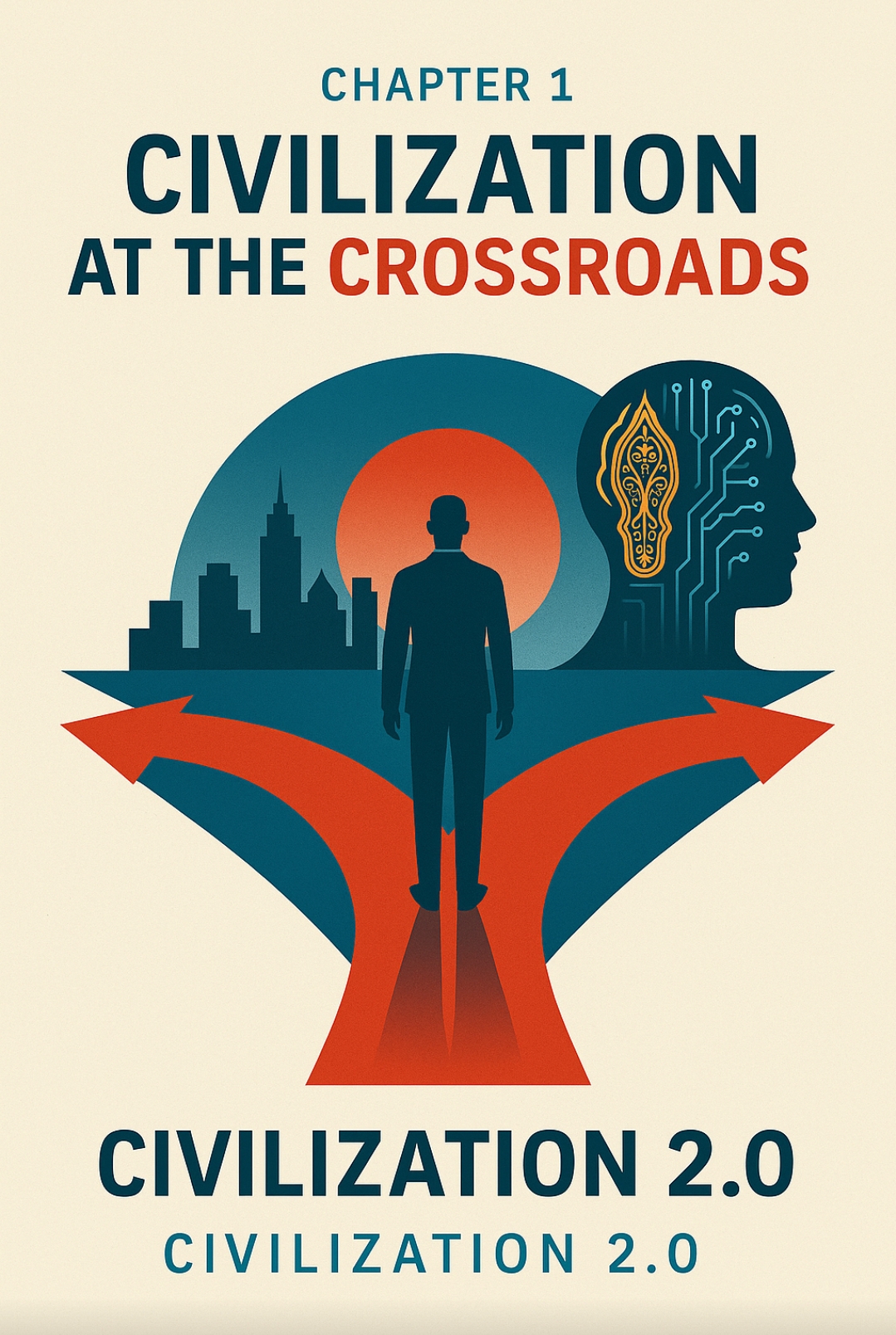
Civilizations do not collapse overnight.
They erode quietly, invisibly at first, until one day a sudden break makes the decay undeniable.
History shows us that most civilizations fall not because of external enemies, but because they fail to adapt when the ground beneath them shifts.
Today, humanity stands at that same precipice.
The tools we have created—artificial intelligence, robotics, decentralized networks—are no longer extensions of human power.
They are new forces, operating at speeds and scales our current systems cannot govern.
Yet our societies remain anchored to outdated systems:
Banking models built for scarcity and exploitation.
Governance systems designed for an era of slow change.
Economic structures reliant on debt and endless consumption.
Cultural frameworks that no longer hold meaning.
We are steering supersonic ships with the rules written for wooden carts.
And the cracks are visible everywhere.
The Three Collapses
We are facing three simultaneous collapses:
The Collapse of Governance:
Slow, reactive governments cannot keep pace with exponential technological change.
Political systems favor short-term survival over long-term civilization stewardship.The Collapse of Economy:
Automation threatens to eliminate entire sectors of labor.
Traditional banking models amplify inequality and instability.The Collapse of Meaning:
Humanity faces a spiritual drought.
In a world of infinite distraction, people forget purpose, lose trust, and drift into nihilism.
No single reform will fix this.
No single election will save us.
The collapse is systemic.
The change must be systemic too.
The Crossroads Before Us
We now face an ancient decision in a modern form:
Do we adapt—or do we collapse?
Incremental reforms will not be enough.
We must architect new systems—rooted in ethics, built for intelligence, and aligned with the sacred.
The future demands a new breed of leaders:
Not rulers.
Not bureaucrats.
Not corporate overlords.
Architects.
Architects who can rebuild governance, economy, and meaning simultaneously.
Architects who understand that a civilization is more than technology or profit.
It is the visible body of an invisible soul.
The Mission of Civilization 2.0
This is the mission of Civilization 2.0:
To design the structures, systems, and spirit that will allow humanity to survive—and thrive—in the age of AI, automation, and exponential change.
We are not merely upgrading tools.
We are rebuilding civilization itself.
Those who understand this will shape the next thousand years.
Those who do not will be left behind in the ruins of a world that refused to evolve.
The crossroads is here.
The choice is ours.
Turn the page.
Build the future.
Stay tuned
Chapter 2: Why We Need Civilization Architects