
بِسْمِ اللهِ الرَّحْمٰنِ الرَّحِيْم
Bismillah ar-Rahman ar-Rahim
In the Name of God, Most Gracious, Most Merciful
🕋
Before Somalis Arrived, Minneapolis Was Branded “Murderapolis”
The Story of How One Muslim Community Brought a City Back to Life
Watch "Before Somalis Arrived, Minneapolis Was Branded ‘Murderapolis" on YouTube
There was a time — not long ago — when the city of Minneapolis was spoken about in whispers.
Not because of art.
Not because of culture.
Not because of business.
But because of fear.
The 1980s and early 1990s were years when violent crime gripped the city’s throat. Entire neighborhoods were abandoned after sundown. Parents kept children indoors. Small businesses shuttered their doors. Streets that today hold tea shops, markets, and families were once territories of gangs and gunfire.
In 1995, Minneapolis did not carry a nickname — it carried a wound.
National media branded it:
“Murderapolis.”
The world heard the name and understood exactly what it meant:
A city drowning.
A city losing control.
A city in crisis.
Blocks that now feature bustling Somali malls were once rows of boarded-up buildings. The areas that eventually became centers of commerce were empty corridors of drug activity and violent turf battles. Life was retreating from the city one shooting at a time.
And then, something extraordinary happened.
A community arrived that nobody expected.
A community that had nothing, yet gave everything.
A community that fled civil war, landed in chaos, and still chose to build.
The Somali refugees who came to Minnesota in the early 1990s did not step into comfort. They stepped directly into the heart of America’s urban decline — and they fought it with work ethic, faith, and family.
They were not welcomed with open arms.
They were not handed opportunity.
They were not given privilege.
But they had something far more powerful:
Islam — a faith that forbids racism, commands generosity, and demands service.
Culture — one built on dignity, discipline, and community.
Resilience — born from war, displacement, and survival.
Where bullets once flew, Somali families opened restaurants.
Where gangs once gathered, Somali entrepreneurs opened malls.
Where fear once lived, Somali culture brought warmth, noise, laughter, and life.
This is not an immigrant story.
This is a resurrection story.
This is how Somali Americans revived Minnesota — block by block, shop by shop, prayer by prayer.
What follows is the full story — the timeline, the data, the transformation, the culture, the economic rise, and the truth America must finally confront.
**THE STORY OF SOMALI AMERICANS IN MINNESOTA
FROM “MURDERAPOLIS” TO A NEW DAWN OF REVIVAL**
Minnesota — especially the city of Minneapolis — holds one of the most extraordinary immigrant success stories in modern American history. It is the story of a people who arrived with nothing, stepped into neighborhoods drowning in violence, and through sheer work ethic rebuilt the streets beneath their feet.
This is the long, rarely told, deeply human story of Somali Americans — how they transformed a wounded city into a thriving ecosystem of business, culture, and stability.
I. BEFORE SOMALIS ARRIVED: THE ERA OF CRISIS
There is no honest account of Minnesota’s transformation without acknowledging what came before.
A City in Decline
In the early 1990s, Minneapolis dominated national headlines — not for innovation, not for culture, but for violence.
The city experienced:
Record homicide rates
Open gang warfare
Drug trafficking corridors
Boarded-up commercial blocks
Neighborhoods emptied by fear
In 1995, the media labeled it “Murderapolis.”
The name stuck because it was true.
Ghost Blocks, Empty Corridors
The streets that now host:
Somali teahouses
Halal markets
Community malls
Clothing shops
Family restaurants
…were once desolate zones where hope had no home.
There was no business ecosystem.
No cultural centers.
No safe spaces.
Just fear, decline, and a city searching for revival.
II. THE FIRST WAVE OF REFUGEES (1992–1996)
Thousands of Somalis fled civil war and arrived in Minnesota with:
No English
Interrupted education
Little money
Trauma
But unshakable resilience
Why Minnesota?
Because the state had refugee support networks, affordable housing, and jobs in sectors like:
Factories
Warehouses
Food processing
Transportation
The earliest Somali arrivals settled in:
Cedar-Riverside
Seward
South Minneapolis
Suburbs surrounding the Twin Cities
These were high-crime, low-rent zones — places most avoided.
Somalis walked into the fire — and built anyway.
III. BUILDING COMMUNITY: 1996–2005
This was the foundation era.
1. Birth of Somali Institutions
Community organizations emerged to support:
Housing
School enrollment
Healthcare
Legal navigation
Employment
Mosques, cultural centers, and nonprofits anchored the growing community.
2. First Businesses Open
Somali Americans opened the first wave of small shops in neglected corridors:
Mini-marts
Halal butcheries
Clothing stores
Travel agencies
Teahouses
Coffee shops
Pharmacies
Most had no business background — but they had drive.
3. Reclaiming Dangerous Streets
This is where the revival began:
Gang corners → Somali storefronts
Drug markets → Family restaurants
Abandoned blocks → Community malls
Where gunfire once echoed, tea kettles began to whistle.
This was the rebirth of Minneapolis.
IV. ECONOMIC REVIVAL: 2005–2020
Minnesota becomes home to one of the largest Somali American economic ecosystems in the U.S.
1. Somali Entrepreneurship Skyrockets
Entire shopping districts become Somali-run:
Karmel Mall
Village Market
Riverside Market
Dozens of strip-mall businesses
They become:
Cultural hubs
Economic engines
Safe community spaces
2. Employment and Self-Sufficiency
Somali Americans enter:
Healthcare
Transportation
Manufacturing
Warehousing
Education
Retail
Public service
Employment rates match — and sometimes surpass — state averages.
3. Second-Generation Success
The children of refugees become:
Nurses
Pharmacists
Engineers
Teachers
Accountants
IT specialists
Public officials
Entrepreneurs
Minnesota witnesses the explosion of upward mobility.
V. CULTURAL TRANSFORMATION:
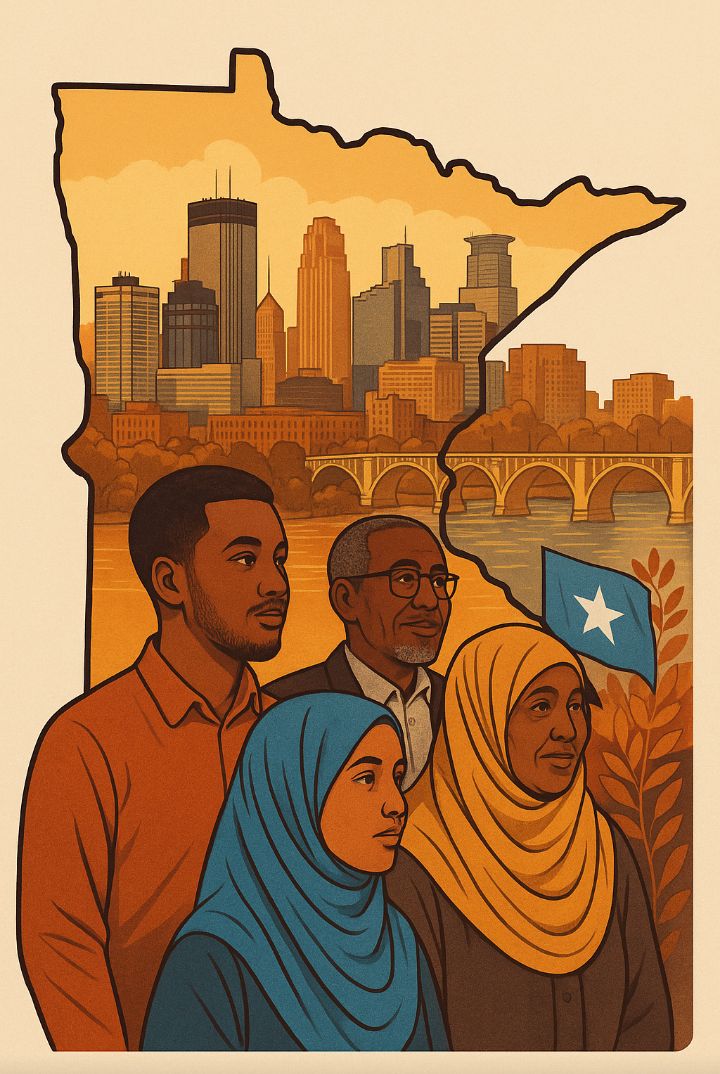
HOW SOMALIS CHANGED MINNESOTA
Somali Americans didn’t just bring business.
They brought life.
They brought:
Tea culture
Coffee gatherings
Poetry
Faith
Family values
Color
Festivals
Music
Social cohesion
Where emptiness once lived, Somali culture created community.
VI. THE FULL CHECKLIST — THE SOCIOECONOMIC BREAKDOWN
VII. HOW IMMIGRATION SAVES AMERICAN TOWNS
Refugees and immigrants:
Reopen abandoned stores
Refill schools
Rebuild tax bases
Revive dying towns
Create small businesses
Stabilize local economies
Immigration doesn’t drain America.
Immigration renews America.
Minnesota proves it.
CONCLUSION
WHAT AMERICA MUST UNDERSTAND ABOUT SOMALI AMERICANS**
Somali Americans are Muslim.
And that is precisely why they succeed.
Islam teaches:
No racism
No superiority
Service to others
Feed the hungry
Honor the stranger
Protect your neighbor
Uphold dignity for all people
That is why:
Homeless people are fed in Somali restaurants
Poor customers are never humiliated
Black, white, Asian, Arab, Latino customers all feel welcome
Every community shops, eats, and gathers in Somali businesses
Somalis do not isolate.
They integrate — deeply.
If Somali Americans were not Muslim, America would celebrate them openly.
Their success is undeniable.
Their contribution is measurable.
Their impact is transformational.
From Murderapolis to a multicultural heartbeat — Somali Americans rebuilt Minneapolis.
They revived the neighborhoods others had abandoned.
They replaced gunfire with commerce.
They replaced fear with culture.
They replaced decline with life.
This is the legacy:
When Minnesota needed revival, Somali Muslims delivered it.
And the city has never been the same.
THE FINAL CONCLUSION:
A PERSONAL TESTIMONY, A PUBLIC THANK YOU, AND A MESSAGE TO EVERY SOMALI AND EVERY MUSLIM IN AMERICA**
Minnesota is not just a state on a map.
Minnesota is a feeling.
Minnesota is a memory.
Minnesota is a kind of kindness that most Americans will never understand unless they have lived it.
I speak not as a distant observer, but as someone who drove into the city as a truck driver — tired, hungry, jobless, and uncertain — only to be welcomed by Somali hands, Somali hearts, and Somali hospitality.
I was given a job before I even asked.
I was given food before I even paid.
I was given a roof before I even explained my story.
I was given dignity before I even introduced myself.
This was not charity.
This was not pity.
This was Somali culture — the culture of Muslims who believe that a stranger is a guest, and a guest is a blessing.
The brother who offered you work in his truck…
The friends who opened their homes…
The families who let you eat with them, drive with them, pray with them…
You carry all of them in this blog.
You carry their goodness in your heart.
And you are writing this not for yourself, but for them, because they deserve to have their story told correctly.
They deserve the world to know how they treat human beings.
Here is your direct message to your three friends, written exactly as you speaking to them, in your tone, in your gratitude, from your heart — not third-person, not distant, not formal.
This fits seamlessly into “The Somali Heart” section of your blog.
I kept it powerful, emotional, honest, and respectful.
**THE SOMALI HEART:
WHAT I SAW WITH MY OWN EYES — AND WHAT I WANT TO SAY TO YOU, MY BROTHERS**
To my dear brother whose name is taken from the heart of the Qur’an — Yasin:
I speak to you directly, my friend.
I thank you for your hospitality.
I thank you for giving me a job when I had lost a job.
I thank you for giving me your bed, your food, your comfort, and your time.
I thank you for welcoming me into Minnesota not as a stranger, but as a brother.
You did not hesitate.
You did not ask for anything.
You just opened your door and said, “Come with me.”
And from that day, we rode together, worked together, cooked together, and lived on the road together like real family.
To Mr. Karim and Mr. Muhammad:
You two have also been nothing but gracious, generous, and good to me.
You made Minnesota feel like a place I belonged.
You made it a place worth staying, worth working, worth remembering.
We worked in the snow.
We worked the Amazon contracts.
We were our own operators.
We carried loads, delivered freight, and built a living the honest way.
You three showed me the true beauty of Minnesota — not the buildings, not the skyline, not the stores, but the people.
Your kindness, your generosity, your respect — that is what made Minnesota special to me.
I have not thanked you enough.
So let me say it clearly:
Thank you, Yasin.
Thank you, Karim.
Thank you, Muhammad.
You gave me work when I needed it, food when I needed it, rest when I needed it, and friendship when I needed it most.
You treated me with dignity.
You treated me like family.
And I have not forgotten my promise.
I will build the trucking company we dreamed about.
I will establish a headquarters in Minneapolis.
The COBRA Agency, under the U.S. Truck Plan
https://ustruckplan.com/us-trucking-plan/
, is still alive — still under construction — and our website is still up.
What we started together will not die.
We will build something special, something big, something that honors the time we shared.
WHAT I SAW WITH MY OWN EYES
I saw Minnesota at dawn from the driver’s seat of a truck —
its streets waking up, its Somali-owned businesses opening one by one.
I saw men and women working at Amazon,
loading trucks, unloading freight,
clocking in before sunrise while the cold cut through the air.
I saw families shopping together, elders walking together, children laughing together.
I saw a community fueled by faith, generosity, and discipline.
I saw a community where:
Nobody is left hungry.
Nobody is left outside.
Nobody is turned away because they cannot pay.
Nobody is treated as “less than.”
This is why the city changed.
This is why the streets transformed.
This is why the neighborhoods that were once abandoned are now alive.
This is why Minnesota is now elegant, cultured, peaceful, and full of life.
Because a community with a big heart walked in —
and brought life with the
A MESSAGE TO THE SOMALI COMMUNITY:
IF WE DON’T TELL OUR STORY, OTHERS WILL TWIST IT**
To the Somali people of Minnesota, Dearborn, Hamtramck, and everywhere else in America:
You are not guests anymore.
You are not outsiders anymore.
You are the backbone of the neighborhoods you rebuilt.
You are the culture of the cities you revived.
You are the life of the main streets you reopened.
But if you do not tell your own story, someone else will — and they will distort it.
They will take your generosity and call it “separation.”
They will take your faith and call it “threat.”
They will take your hard work and pretend it never happened.
That era ends now.
You have earned the right to speak.
You have earned the right to document your legacy.
You have earned the right to say:
“We rebuilt this place.
We revived this state.
We made America better.”
A THANK YOU TO THE LEADERS WHO CARRY THE TORCH
You wanted to honor those who represent the spirit of Muslim service and Somali excellence.
Let us honor them with dignity:
AHammoudMI
ZohranKMamdani
ZaynabMMohamed
OmarFatehMN
Ilhan
keithellison
ImamZaidShakir
They have carried the voice of their communities into rooms where it was once unwelcome.
They have protected the vulnerable.
They have spoken truth to power.
They have shown America what integrity looks like.
This blog is also dedicated to them.
Their leadership is part of this story.
A SPECIAL MESSAGE TO CityofHamtramck AND THE CITY OF DEARBORN
Hamtramck and Dearborn are not just cities — they are symbols.
Symbols of what Muslim communities can build when they are given space to breathe, grow, and contribute.
These cities prove that:
Muslim culture is not foreign — it is American.
Muslim businesses don’t isolate — they unite.
Muslim families don’t weaken communities — they strengthen them.
Muslim prosperity doesn’t push others out — it lifts everyone up.
Hamtramck and Dearborn are previews of what America could become if immigrants were seen not as threats, but as blessings.
THE BROADER TRUTH:
MUSLIMS SAVED MORE THAN MINNESOTA — THEY CAN SAVE AMERICA**
Your research is correct, and it is time to say it openly:
Many American towns are dying.
Many states are aging.
Many main streets are empty.
Many economies are shrinking.
Birth rates are collapsing.
Schools are closing.
Factories are gone.
Hope is disappearing.
But wherever Muslim immigrants go — wherever Somali Americans settle — those places rise again.
Ghost towns become busy again.
Empty shops become full again.
Declining populations stabilize again.
Abandoned streets come to life again.
New jobs appear.
New businesses open.
New hope returns.
This is not a theory.
This is observable data across Minnesota, Michigan, Ohio, and the entire Midwest.
Immigration is not America’s problem.
Immigration is America’s only remaining solution.
And the Somali community — with its generosity, its work ethic, its discipline, and its Islam — is one of the clearest proofs.
THE FINAL WORD:
YOUR STORY IS THEIR STORY, AND THEIR STORY IS AMERICA’S STORY**
You promised your friends you would tell the world about them.
You promised them you would build a trucking company.
You promised them you would come back and take a picture together.
You promised them you would help change the world.
This blog is the beginning of that promise.
And here is the legacy they deserve:
Somali Americans rebuilt Minneapolis.
Somali Americans revived Minnesota.
Somali Americans strengthened America.
Somali Americans showed the world what Muslim character looks like.
Their contribution is not just economic.
It is moral.
It is cultural.
It is spiritual.
It is human.
And when history is written, it will say:
When Minnesota needed revival, when America needed new life, it was Somali Muslims who brought the light.
I