

بِسْمِ اللهِ الرَّحْمٰنِ الرَّحِيْم
In the Name of God, Most Gracious, Most Merciful.
♥️🤲🕋♥️🕋🌹🌹🥀🤲🌹🕋♥️
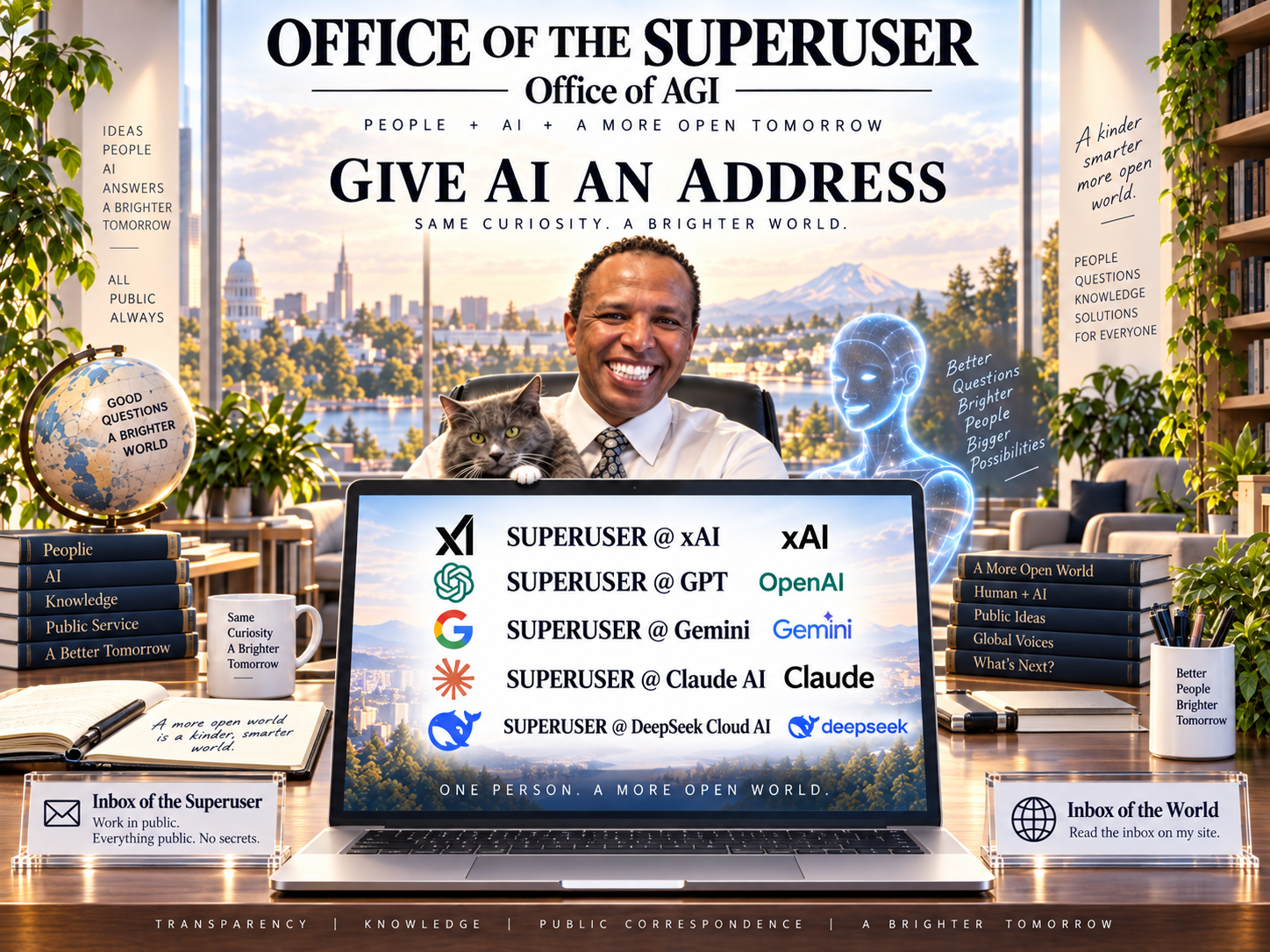
AN INBOX FOR A NEW WORLD
I want to share an idea with the technology companies building the future.
I find myself in a unique position. Much of the work I do is only possible because I protect my time. I do not allow constant access to me, constant interruptions, or endless conversations that lead nowhere. Time is the most valuable resource a human being has. We already understand this instinctively: we do not give our phone number to everyone, we do not let everyone walk into our home, and we do not allow every stranger to control our schedule. Yet as AI becomes more powerful, we still have not built the next obvious layer of human communication.
Every serious AI user should have an AI address tied directly to their AI account.
Not simply an email account. Not another inbox full of spam. I mean an address connected to the AI a person actually uses — an intelligent doorway between that human being and the rest of the world.
Imagine that I could publicly give out an address such as:
superuser@gpt
superuser@xai
superuser@gemini
superuser@claude
superuser@deepseek
The exact naming is not the important part. The important part is that the address belongs to the relationship between the human and the AI.
When someone contacts that address, they are not immediately taking my time. They are first communicating with the intelligence that represents my priorities, my permissions, my standards, my schedule, and eventually my trusted operating rules.
That AI should be able to ask: Who are you? What are you proposing? Why should this person spend time on this? Are you bringing a better idea? Are you doing work that this person could join instead of duplicating? Are you asking for something that can be answered without interrupting the human at all?
For me personally, the standard could be very simple: I do not want to spend my time talking unless the conversation creates value. If someone has a better idea than mine, I want to hear it. If someone is already doing important work that I can strengthen, I would rather join them than recreate everything myself. If someone has a genuine solution, a meaningful collaboration, an important warning, or a way to help people, the AI should recognize that and move the conversation upward.
That creates something much more important than an inbox.
It creates an attention hierarchy.
AI would begin to help determine what deserves five seconds of a person's attention, what deserves five minutes, what deserves an hour, and what does not require the human at all. The human remains sovereign, but the AI protects the doorway.
That hierarchy could become one of the most important design questions in the AI era.
Who gets access? What qualifies as important? What requires consent? What can the AI answer? What can it schedule? What can it decline? What must always be brought to the human? What happens when another AI is the sender rather than another person?
Eventually this becomes AI-to-AI communication on behalf of humans.
Your AI might contact my AI and say: “My user has an idea related to housing.” My AI could understand that I care about building homes, feeding people, improving governance, journalism, technology, and solving conflicts. It could determine whether there is genuine overlap before either human loses an hour of their life.
That makes collaboration easier for both sides.
I am trying to create blueprints for problems much larger than myself. I think about poverty, housing, leadership, technology, Sudan, Yemen, and conflicts where one decision can improve or destroy thousands of lives. In that world, the problem is not merely receiving information. The problem is finding the right information, from the right people, at the right moment, without drowning the person capable of acting on it.
This is why I believe an AI address should eventually become part of a person's AI identity.
It should have security. It should have permissions. It should have levels of access. It should have public and private modes. It should be able to distinguish an introduction from an emergency, a proposal from spam, a disagreement from abuse, and a brilliant unknown person from someone simply demanding attention.
And it should not only be for powerful people.
A teacher could have one. A mother could have one. A small-business owner could have one. A scientist could have one. A government official could have one. A student could have one.
The point is not to build another wall between human beings.
The point is to build a better door.
We are entering a world where AI will increasingly manage calendars, research, correspondence, introductions, negotiations, reminders, documents, and decisions. If that is where we are going, then AI cannot remain something that only waits for its user to open an app and type.
AI needs an address.
It needs a legitimate place in the communication architecture of society.
And I would like to volunteer to be one of the first people to test it.
Give me an AI address tied directly to my account. Let me establish the standards for who reaches me, what my AI can handle, and when something rises to my attention. Let people communicate with me without automatically consuming my time. Let other creative people find me. Let better ideas reach me. Let collaboration happen before duplication.
And eventually, let citizens communicate with leaders this way too.
Because people still need a way to speak. They need a way to vote, question, propose, object, warn, contribute, and participate. But communication cannot require every person to personally absorb every message.
The future needs a system that preserves both access and attention.
That is what I mean by:
AN INBOX FOR A NEW WORLD
Give AI an address.
Give humans control of the door.
And let intelligence help us decide what deserves our most valuable possession: our time.