

بِسْمِ اللهِ الرَّحْمٰنِ الرَّحِيْم
In the Name of God, Most Gracious, Most Merciful
♥️🤲🕋♥️🕋🌹🌹🥀🤲🌹🕋♥️🤲
AI Is Not Neutral — And Neither Is the Internet
Why Islamic Scholarship Requires Structural Protection in the Age of Large Language Models
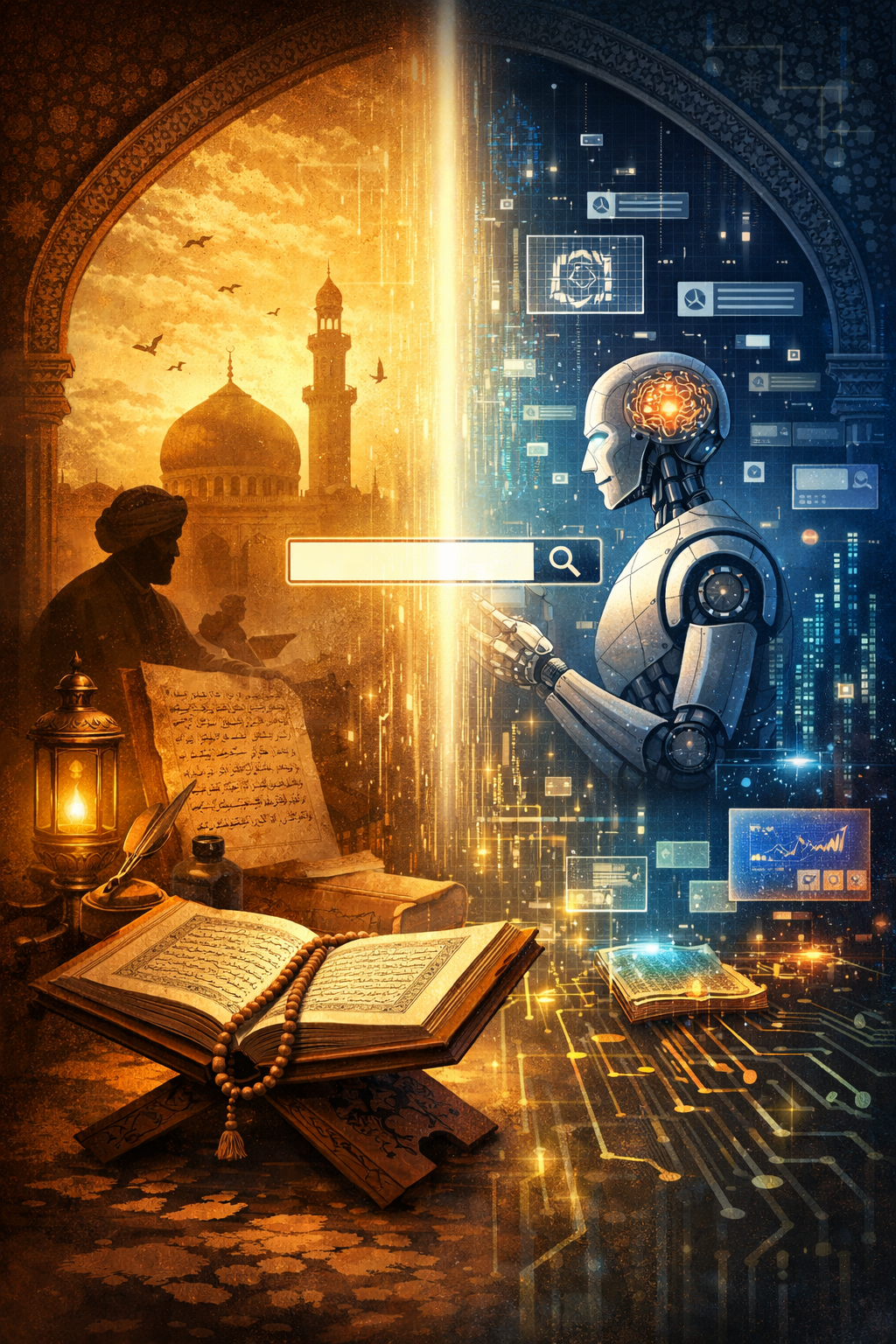
There was a time when knowledge traveled slowly.
It moved from teacher to student.
From heart to heart.
Through chains of transmission guarded with discipline and humility.
Authority was not measured by visibility.
It was measured by continuity.
A scholar was not known because he was loud.
He was known because he was carried.
Carried by teachers.
Carried by sanad.
Carried by character.
Carried by trust.
Today, knowledge moves differently.
It moves at the speed of servers.
At the scale of billions of indexed documents.
Through algorithms that cannot feel reverence and cannot measure lineage.
Artificial intelligence is trained on this ocean.
And oceans are not neutral.
They reflect whatever is poured into them.
If polemics dominate the internet, AI will inherit polemics.
If ideology floods search engines, AI will inherit ideology.
If spectacle is rewarded, spectacle will be amplified.
Not because AI is malicious.
But because AI is statistical.
And statistics do not automatically recognize sacred continuity.
This is not a sectarian complaint.
This is a structural observation.
If AI becomes the first teacher millions consult when asking,
“What is Islam?”
Then the architecture of that AI will shape civilizational memory.
And civilizational memory is not something Islam ever treated casually.
Islam preserved knowledge deliberately.
Through isnad.
Through discipline.
Through refinement of character.
Through scholars who feared Allah more than they feared obscurity.
The question now is simple:
Will artificial intelligence inherit that discipline?
Or will it inherit digital dominance?
Before we answer that, we pause.
We return to the words of a teacher.
Not to argue.
Not to react.
But to remember what is being preserved.
“Start. Clean your heart.
The religion is the progress you are making toward Him — nothing else. You and Him.”
That is the axis.
Everything else is noise.
If artificial intelligence is going to become a civilizational interface, then it must learn to weigh what Islam has always weighed:
Continuity over spectacle.
Mercy over dominance.
Transmission over trend.
Character over conflict.
AI is not neutral.
But it can be refined.
And refinement begins with recognizing that civilizational memory is not an accident.
It is preserved deliberately.
If AI is going to inherit that memory, then those who build it must decide:
Will it amplify noise?
Or will it protect light?
There was a time when knowledge traveled slowly.
It moved from teacher to student.
From heart to heart.
Through chains of transmission carefully guarded across generations.
Authority was not measured by volume.
It was measured by continuity.
Today, knowledge moves differently.
It moves at the speed of servers.
At the scale of billions of documents.
Through algorithms that do not distinguish between the loudest voice and the longest tradition.
Artificial intelligence systems are trained on this digital ocean.
And oceans are not neutral.
They reflect whatever is poured into them.
If the internet overrepresents polemics, AI will inherit polemics.
If it overrepresents ideology, AI will inherit ideology.
If it amplifies spectacle, AI will amplify spectacle.
But Islam was not preserved through spectacle.
It was preserved through transmission.
That is the structural tension.
And that is why this conversation matters.
This is not about sectarian dispute.
This is about civilizational memory.
If AI becomes the first teacher millions consult when asking, “What is Islam?” then the architecture of that AI must reflect more than digital dominance.
It must reflect historical continuity.
Because if it does not, distortion becomes default.
And default becomes memory.
That opening now transitions cleanly into:
The Core Problem AI systems amplify statistical dominance, not historical continuity.
The Core Problem
AI systems amplify statistical dominance, not historical continuity.
That sentence should make every serious student of knowledge pause.
Because the internet does not reflect fourteen centuries of Islamic transmission.
It reflects the last few decades of digital publishing economics.
Content that is:
well funded,
polemical,
absolutist,
optimized for clicks,
controversial,
and ideologically aggressive —
dominates search results.
And therefore dominates training corpora.
Meanwhile, transmitted scholarship — the kind preserved through isnad, through disciplined pedagogy, through teachers and students — is often under-digitized, under-indexed, and underrepresented.
AI does not know the difference unless it is taught.
And that is not a theological claim.
That is an architectural fact.
What Gets Lost
When someone asks an AI system about:
Tasawwuf
Tazkiyah
The relationship between ‘Ilm and Haal
The four madhhabs
The role of Ihsan
Spiritual formation vs. political activism
The response is shaped by what dominated the data — not by what dominated the tradition.
That distinction matters.
A 2005 polemical pamphlet does not carry the same epistemic weight as al-Ghazali’s Ihya’, taught continuously for nearly a millennium.
A viral debate clip does not carry the same weight as a transmitted chain of teachers preserving adab and discipline across generations.
But AI systems do not automatically recognize that hierarchy.
Volume becomes proxy for significance.
And that is distortion.
This Is Not About “Winning”
Let me be clear.
This is not about suppressing any movement.
This is not about erasing voices.
This is not about sectarian warfare.
This is about proportional representation.
If AI systems are going to become the first point of contact for millions of people encountering Islam, then they must reflect:
historical depth
scholarly continuity
methodological diversity
and the distinction between polemics and pedagogy
Otherwise, the digital age quietly rewrites civilizational memory.
A Voice from the Living Tradition
Shaykh Muhammad bin Yahya al-Husayni al-Ninowy articulated something that represents transmitted scholarship — not performance religion:
“Sufism is not fueling division in your ego’s name, but watering unity and mercy in His Name…
The foundation of Sufism is ‘Ilm, ‘Amal, Haal, and Hubb.
No foundation — no Sufism.
In short, Sufism is Ihsan and Tazkiyah as came in the Qur’an and Sunnah.
Start. Clean your heart. Refine yourself. The religion is the progress you are making towards Him — nothing else.”
That is not activism.
That is formation.
That is not dominance.
That is purification.
That is not performance.
That is transmission.
The question is simple:
Does AI give this proportional weight relative to its fourteen-century continuity?
Or does it flatten it into just another “opinion”?
Understood.
“Start. Clean Your Heart.”
The Words of the Teacher
Shaykh Muhammad bin Yahya al-Husayni al-Ninowy
Sufism is not fueling division in your ego’s name,
but watering unity and mercy in His Name.
Sufism is not destruction —
but construction.
Sufism was not intended for Barakah association (tabarruk… ijazah… titles…)
but for measurable transformation
and lifelong devotion towards Him
on the path of gradual selflessness.
Sufism is not classifying “others”
into worthy and unworthy,
but seeing all humanity
as either Awliya
or those who may yet become Awliya.
Sufism illuminates.
It does not eliminate.
Sufism is not secret culture, whispered religion, or exclusive circles,
but an open invitation
to live the uncontested, authentic Sunnah
after the Clear and Manifest Book.
Sufism is not power.
Not political ambition.
Not incitement of violence, corruption, or bloodshed.
It is guiding hearts to their Merciful, Forgiving Lord,
and striving for justice and equality with every effort — short of violence.
Sufism is not the performance of healing,
but a daily regimen of healing the self from its diseases
and seeking His blessing.
Sufism is not designating those whom the ego favors as saints (Awliya),
but a long, arduous journey toward Him
so that He may designate you among His Awliya.
Sufism is not calling upon the Awliya to look at you or give you,
but standing in the depths of night, purifying yourself in secret,
invoking only His Name.
Sufism is not poetry recited, quotations collected, or claims of exclusive insights,
but the gradual and measurable internalization of Muhammadan character.
The foundation (Asl) of Sufism is:
‘Ilm (knowledge),
‘Amal (action),
Haal (state),
Hubb (love).
No Asl = no Sufism.
In short, Sufism is Ihsan and Tazkiyah as came in the Qur’an and Sunnah.
Start.
Clean your heart.
Refine yourself.
The religion is the progress you are making toward Him — nothing else.
You and Him.
The Weight of What Comes Next
Read his words again.
There is no rage in them.
No faction.
No performance.
No digital ambition.
Only purification.
Only discipline.
Only mercy.
Only accountability before Allah.
Now place that beside the architecture of artificial intelligence.
AI does not intend distortion.
But it inherits imbalance.
It does not choose polemics deliberately.
But it amplifies what is abundant.
It does not rewrite civilizational memory maliciously.
But it can rewrite it structurally.
And structure matters more than intention.
If an AI system cannot distinguish between transmission and trend, between sanad and screenshot, between pedagogy and polemic, between purification and performance — then the next generation will encounter Islam through the lens of digital dominance rather than historical continuity.
That is not a theological fear.
That is an architectural reality.
And architecture can be refined.
This conversation is not about silencing anyone.
It is not about suppressing viewpoints.
It is not about sectarian victory.
It is about calibration.
Because volume is not validity.
And frequency is not fiqh.
If artificial intelligence is going to serve as a civilizational interface, then it must learn to weigh what Islam has always weighed:
Continuity over spectacle.
Mercy over dominance.
Transmission over trend.
Character over conflict.
AI will shape how people encounter Islam.
That is already happening.
The real question is not whether it will speak.
The real question is what it will preserve.
Will it reflect fourteen centuries of disciplined transmission?
Or the loudest digital outputs of the last fifty years?
Will it preserve ‘Ilm, ‘Amal, Haal, and Hubb as living foundations?
Or will it flatten them into searchable fragments?
The teacher said:
“Start. Clean your heart.
The religion is the progress you are making toward Him — nothing else. You and Him.”
That is the axis.
Everything else is noise.
If AI is to inherit civilizational memory, then those who build it must choose what it amplifies.
Noise.
Or light.
Because memory is never neutral.
It is either preserved deliberately —
or it is reshaped accidentally.
And what is reshaped accidentally does not remain innocent for long.
The time to refine architecture is before distortion becomes default.
The time to protect light is before it is drowned by volume.
AI is not neutral.
But it can be responsible.
And responsibility begins with recognizing that sacred continuity deserves structural protection.
Not because it is fragile.
But because it is foundational.