

بِسْمِ اللهِ الرَّحْمٰنِ الرَّحِيْم
In the Name of God, Most Gracious, Most Merciful.
♥️🤲🕋♥️🕋🌹🌹🥀🤲🌹🕋♥️
A PROPOSAL FROM CAIRO: THE SUPER USER OFFICE OPENS FOR YEMEN
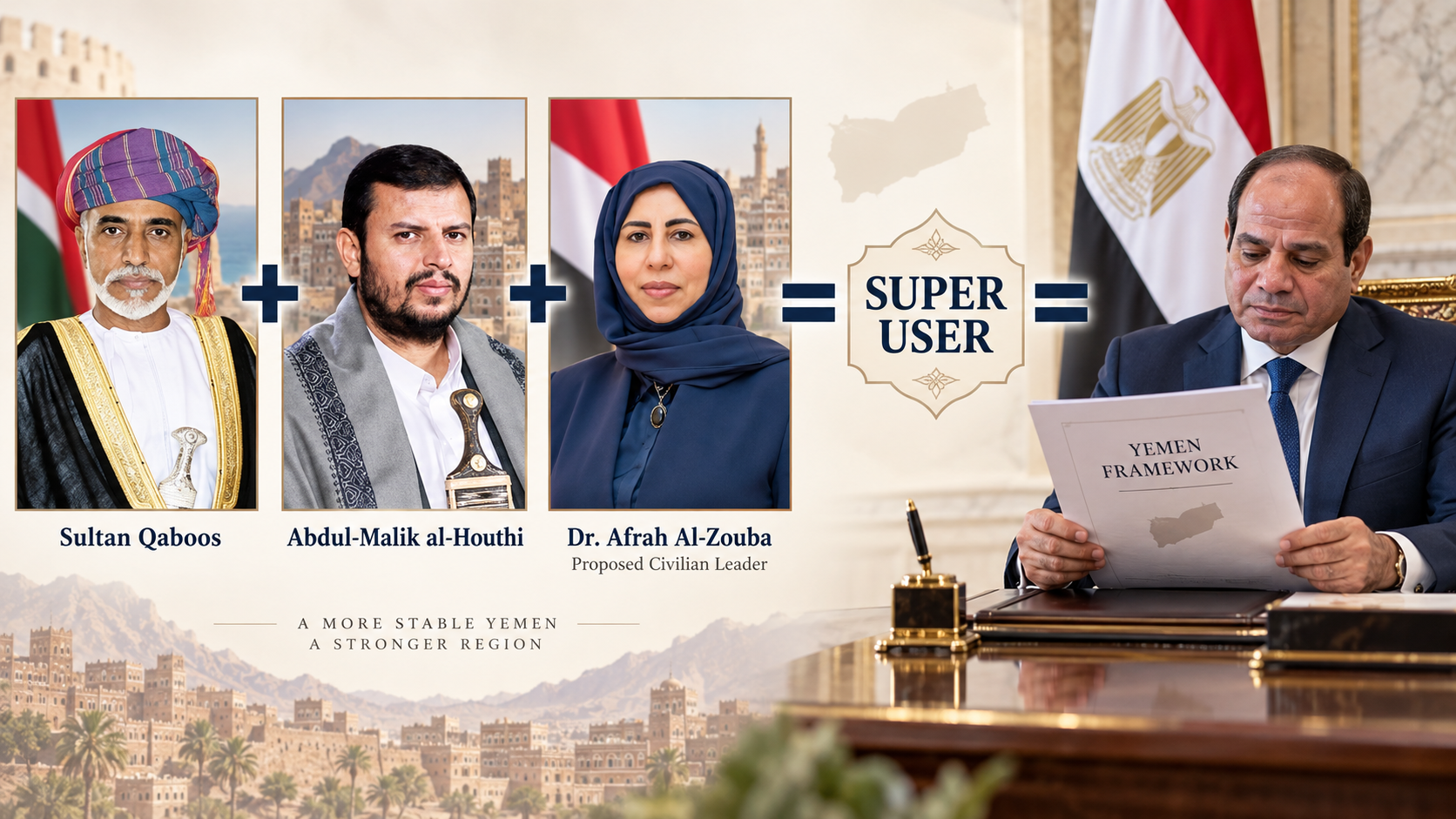
To President Abdel Fattah el-Sisi, from Cairo I am opening a new office of the Super User—an office inspired by the old Mamluk memory of Egypt, by sovereignty, discipline, and the idea that Egypt can once again help stabilize its neighborhood. President el-Sisi remains Egypt’s president, and Egypt continues to publicly emphasize sovereignty, territorial integrity, peaceful settlement of disputes, and regional stability.
From this office, I am placing a new Yemen proposal on the table. It is not complicated. It is an equation. It is a balance.
On one side stands Abdul-Malik al-Houthi. My proposal is that he exchange permanent revolutionary rule for a permanent constitutional title: Sultan of Yemen. He would not face elections. His mandate would be narrow and unmistakable: defend the sovereignty, territorial integrity, independence, and freedom of Yemen. He would not run the budget, hospitals, schools, ministries, or ordinary civilian government. His legitimacy would rest on proving that Yemen is governed by Yemenis—not Iran, not Saudi Arabia, not any foreign capital.
On the other side stands a completely separate civilian republic. The presidency would always be held by a woman. She would face elections, political competition, parliament, public scrutiny, and the democratic process. A male vice president would also be elected, but the constitutional center of civilian executive authority would remain with the elected female president.
That government would govern ordinary life: budgets, hospitals, education, infrastructure, diplomacy, foreign affairs, commerce, reconstruction, public services, and the institutions citizens encounter every day.
So the equation becomes:
Sultan = sovereignty and protection.
Female President = democratic government and administration.
Male Vice President = constitutional balance.
Parliament = representation of the Yemeni people.
And above the transition sits one major condition: Egypt helps coordinate the settlement.
Not to own Yemen. Not to govern Yemen. But to help establish the constitutional lines, mediate the transition, and make sure both sides can prove that the final system belongs to Yemen itself.
This is why I am opening the Super User office in Cairo.
I am asking President el-Sisi to look at the equation.
Not another war plan.
Not another winner-takes-all government.
A political equation designed so that the Houthis do not have to surrender their identity as defenders of sovereignty, while the Yemeni people do not have to surrender elections, parliament, civilian government, or accountability.
One Yemen.
One Sultanate protecting sovereignty.
One elected republic governing daily life.
A woman at its democratic center.
And Egypt helping Yemen build the bridge between them.
That is the proposal from Cairo.
THE BAYBARS OFFICE OF EGYPT — A COURT FOR POLITICAL SOLUTIONS
By the blessing of the Prophet ﷺ and his family, and with the hope of consultation among scholars, people of wisdom, and the friends of Allah, I am proposing the creation of a new Baybars Office of Egypt: a public forum in Cairo devoted to difficult political disputes in the Muslim world.
Its purpose would be simple: justice first. Witnesses would be heard. Evidence would be examined. Competing claims would be placed on the record. AI systems could help organize evidence, compare arguments, identify contradictions, and make the process understandable to the public—but the final process would remain a human one, governed by law, consultation, transparency, and consent.
I want this office to begin with Yemen.
The first task would be to take the Yemen framework we have drafted and turn it into a serious constitutional proposal that Yemenis themselves can examine. The proposal would separate two functions: a non-electoral sovereign institution centered on the protection of Yemen's independence, and an elected civilian government responsible for budgets, hospitals, education, infrastructure, foreign affairs, and daily administration. My proposed model would reserve the civilian presidency for women, with an elected male vice president and an elected parliament.
But this would remain a proposal, not an imposed constitution.
The Yemeni people would have to debate it, amend it, consult through shura, and ultimately accept or reject it through a legitimate public process. If they reject it, the answer is not force. The proposal returns to the court, the objections are heard, and another solution is developed.
That is what I mean by a Court of the Super User: not a ruler replacing governments, but a public problem-solving institution producing drafts, arguments, evidence, and possible settlements for people to examine.
Egypt is a logical place to explore such a concept because its government is already deeply involved in questions of regional sovereignty, stability, Sudan, the Nile, and Arab security. President Abdel Fattah el-Sisi has recently emphasized sovereignty, peaceful settlement, and regional stability in his public diplomacy. Presidency of Egypt
And Yemen urgently needs political imagination. Renewed fighting in September 2026 has displaced more than 100,000 people, while regional actors continue to contest the Houthis' relationship with Iran and the future of Yemen's security architecture. Reuters
After Yemen, the same method could be applied to Sudan, Nile disputes, and other conflicts: hear the parties, establish the facts, publish the arguments, consult the people, and search for a lawful settlement before reaching for war.
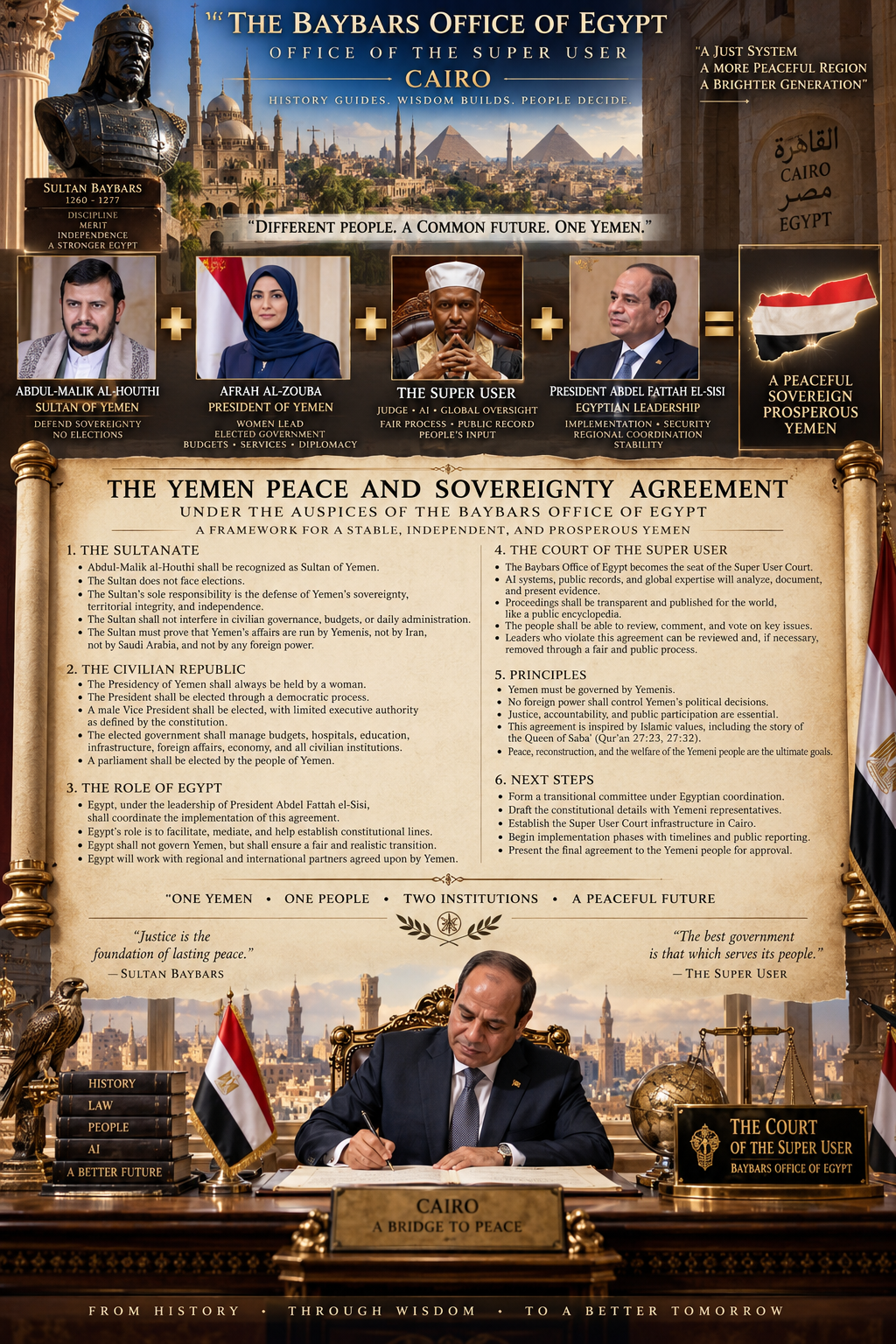
One historical correction matters, however. Sultan Baybars should not be described as historically established as a Black African ruler. The standard historical record identifies him as a Kipchak Turk from the Eurasian steppe who entered Egypt through the Mamluk slave-soldier system. His appearance is described differently in medieval sources, but his precise modern racial classification is not something the evidence supports cleanly. What is historically secure—and powerful enough—is that he rose from enslavement and displacement to become Sultan of Egypt and one of the central figures of the Mamluk state.
That is the symbolism I would keep:
A man who began with almost no political power became a ruler at a moment when Egypt faced extraordinary external threats.
The modern lesson does not have to be racial mythology. It can be broader:
People who begin outside the centers of power can still change history. Justice does not belong only to kings. Wisdom does not belong only to governments. And political problems do not have to end in war.
So this is the closing statement I would put on the office:
THE BAYBARS OFFICE OF EGYPT
The Court of the Super UserEvidence before accusation.
Consultation before coercion.
Law before power.
People before institutions.
Peace before war.Yemen will be the first case.
The people will have the final word.From Cairo, we begin.
Watch "Sultan Baybars - From Slave to Saviour of Islam - Animated DOCUMENTARY" on YouTube
DECREE OF THE BAYBARS OFFICE OF EGYPT
The Court of the Super User
By the blessing of the Prophet ﷺ and his family, by consultation, by remembrance, and by the rule of law, this office is established in honor of those whom history placed in chains but who nevertheless altered the destiny of nations.
The purpose of this Court is to restore memory where memory has been distorted, to restore dignity where dignity has been denied, and to insist that justice belongs not only to kings, empires, armies, or governments, but also to the enslaved, the displaced, the forgotten, and the powerless.
The Mamluk story stands at the center of that memory.
Men who entered Egypt through a system of military enslavement rose to become commanders, administrators, and rulers. Sultan Baybars himself was of Kipchak Turkic origin, was enslaved, entered the Mamluk military system, and ultimately became Sultan of Egypt and Syria. He was a major figure in the Mamluk resistance to both Crusader and Mongol power.
The victory at ʿAyn Jālūt in 1260 became one of the decisive moments in that history, when the Mamluk army halted a major Mongol advance in the region. Baybars served in the vanguard before later becoming Sultan.
That history is powerful enough without changing what the record can prove.
So this Court will honor enslaved peoples, African peoples, Black leadership, forgotten communities, and every human being whose contribution was erased or diminished, while also distinguishing documented history from later symbolism. Baybars should not be presented as historically established as a Black African ruler; the record identifies him as Kipchak Turkic. The larger Mamluk story, however, remains one of extraordinary social reversal: people brought into bondage became some of the most consequential political and military actors of their age.
That is the principle this office inherits:
No human being is disqualified from changing history because of where power first placed him.
This Court will therefore be built around four pillars:
Truth. Justice. Evidence. Accountability.
Artificial intelligence will not replace judgment. It will help us examine the record.
AI can search vast archives, compare competing claims, identify contradictions, preserve testimony, expose missing evidence, and make arguments visible to ordinary people. But machines will not become sovereign. The record will be public. Witnesses will be heard. Citizens will be able to examine the reasoning. Shura will remain human. Judgment will remain accountable.
The Court of the Super User is therefore not a throne.
It is a courtroom.
It does not begin with the question:
Who is powerful?
It begins with the question:
What is just?
And when governments, movements, or leaders disagree, the first answer should not always be another battlefield.
Bring the dispute into the record.
Bring the witnesses.
Bring the history.
Bring the law.
Bring the scholars.
Bring the people.
Bring every argument into daylight.
Then let the strongest lawful solution survive examination.
Our first case will be Yemen.
We will place a constitutional framework before Yemenis, not as a command but as a proposition. The people must be allowed to debate it, amend it, accept it, or reject it. If they reject it, the Court returns to work. We listen again. We examine again. We search again.
After Yemen may come Sudan, Nile disputes, and other political dilemmas across the Muslim world.
The mission is not conquest.
The mission is to make peaceful problem-solving more powerful than war.
Cairo becomes the place where memory and the future meet.
The Baybars name reminds us that history can reverse itself dramatically: the enslaved can become rulers, outsiders can become architects of states, and people whom an age considered powerless can determine the fate of civilizations.
This office therefore stands for every forgotten person who should have been remembered, every witness who should have been heard, and every political problem for which humanity reached for weapons before exhausting wisdom.
THE DECREE
Let the Baybars Office of Egypt be established as the historical chamber of the Court of the Super User.
Let evidence precede accusation.
Let witnesses be heard before judgment.
Let law restrain power.
Let artificial intelligence illuminate the record without becoming master of it.
Let shura precede coercion.
Let citizens see the arguments made in their name.
Let history be corrected where evidence permits correction.
Let the enslaved be remembered.
Let forgotten peoples be restored to the record.
Let no government claim ownership of truth.
And let Cairo become a place where one ancient lesson is remembered again:
Power can conquer a city.
Justice is what allows civilization to endure.
The Court of the Super User is hereby opened in principle.
Yemen shall be the first case.
From memory, through law, toward peace.