

Substack for Authors (Part 2): The numbers can look encouraging. There’s one question I’d ask before treating them as an audience.
 Image generated with ChatGPT
Imagine you’ve been on Substack for a month. You’ve posted Notes almost every day, left thoughtful comments, joined conversations and somehow ended up with a few hundred followers. Not bad, considering you started with absolutely nothing.
Then you send out an email about your new mystery novel. A few people open it. Maybe someone replies. But you can’t help wondering where all those people who were liking your Notes have gone.
It’s a hypothetical example, but I think it’s a useful one because there are two things authors can accidentally mix up on Substack: people who enjoy seeing you around the platform, and people who actually want to read the kind of books you write. Sometimes they’re the same people. Sometimes they’re very much not.
I wrote Part 1 of this Substack for Authors series about Notes, Posts and what to do in your first 30 days. This time I want to talk about what those followers and subscribers really mean, why recommendations can work brilliantly or bring in completely the wrong crowd, and a few things I’d check before celebrating the next milestone.
Quick thing before I get into it. If you’re an author figuring out book marketing, reader lists and the business side of publishing, you can join my FREE newsletter, The Sustainable Publishers.
A Follow Is Nice. But It Isn’t Your Email List.
Let’s get the annoying terminology out of the way, because it matters here.
Your Substack profile is basically you on the platform. It’s where people find your name, bio, Notes, comments and the things you share. Your publication is the actual newsletter or reading destination they can subscribe to. You can run more than one publication, but you don’t need to turn that into another project when you’re just getting started.
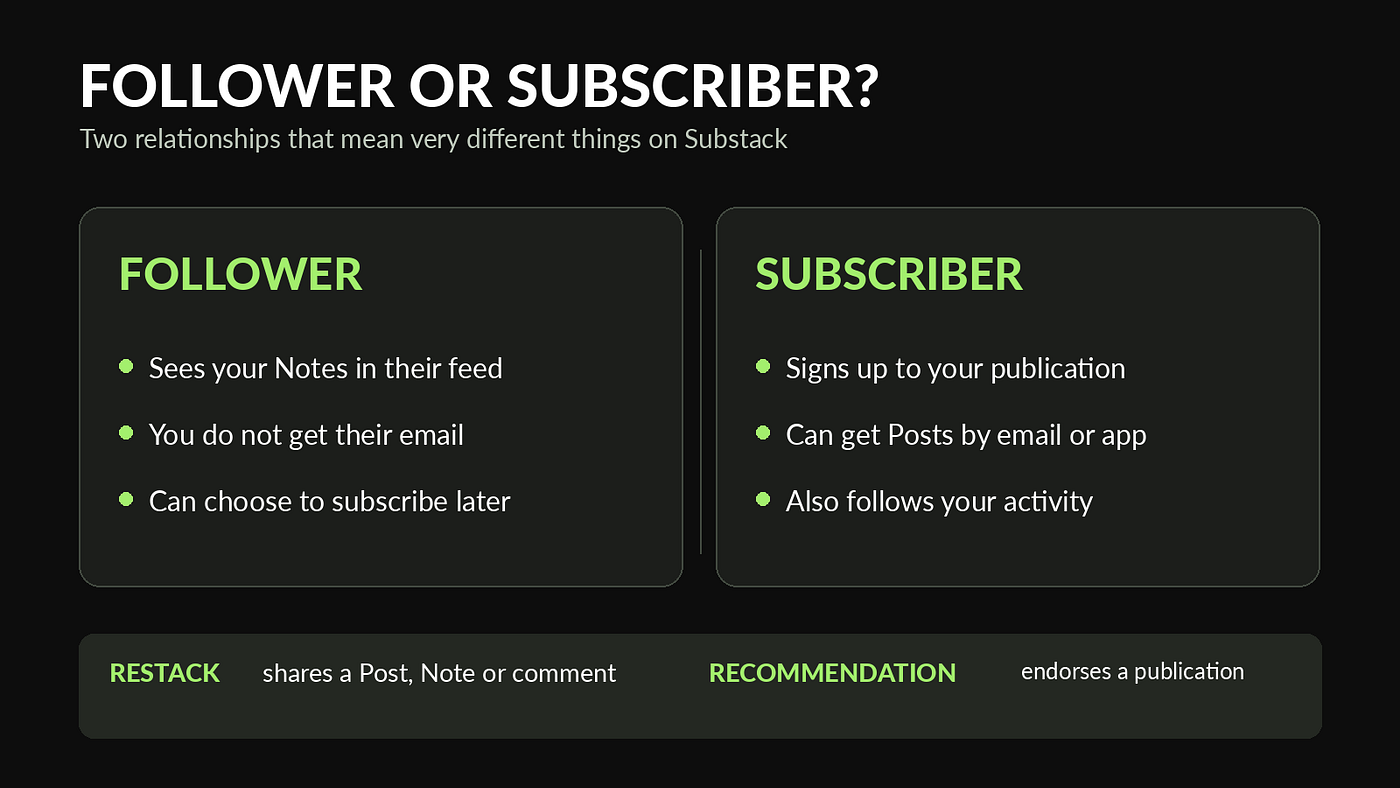
When someone follows you, they’re choosing to see your Notes and some of your activity in their feed. You don’t get their email address just because they followed. When someone subscribes to your publication, they’ve made the extra decision to receive your writing by email and/or in the app. A free subscriber generally follows you as well, but a follower isn’t automatically on your newsletter list.
So a profile with 500 followers and a publication with 120 subscribers isn’t broken. Those numbers describe different relationships. And neither tells you, by itself, whether someone would buy your fantasy novel, read your parenting book, or tell a friend about your work.
That last bit is the part I want authors to think about, because getting discovered and finding book readers aren’t quite the same job.
You Might Be Meeting Writers Instead of Readers
Substack is full of writers talking to other writers. Which is lovely, honestly. I’ve met some really interesting people there, and a lot of the early growth for my publication, The Sustainable Solopreneur came from Notes, comments, recommendations and collaborations. I wrote about starting from zero and reaching my first 500 subscribers in an earlier article if you want the numbers and the routine.
But think about a fiction author who writes cosy mysteries. They spend their first few weeks making friends with people who post about newsletter growth, writing habits and self-publishing. Everybody supports everybody. A few recommendations roll in, the subscriber count starts moving, and it looks like things are working.
Then their next email is about a strange disappearance in a fictional seaside village. How many of those subscribers actually read cosy mysteries? Maybe quite a few. Maybe hardly any. The count doesn’t tell us.
For a nonfiction author, it’s the same problem in a different setting. If you’re writing a book about managing money as a new parent, other newsletter creators might enjoy your Notes about writing and marketing. But the people you’re really trying to reach are probably new parents who are worrying about childcare bills, not how many Restacks their latest Note received.
I’m not saying fellow writers are useless subscribers. Far from it. If your books teach writing or publishing, they might be your ideal audience. The point is that you need to know who the book is actually for before deciding whether the growth is useful.
Be Picky About Who Recommends Your Newsletter
This is where those confusing Substack features become much more interesting.
A Restack is basically a reshare in the social feed, a bit like reposting on X. You can share someone’s Note, Post or comment, ideally with a sentence about why you liked it. It helps an individual piece travel further. It doesn’t automatically send that piece as an email newsletter.
Recommendations work differently. You can recommend another publication to your readers through your publication settings. Substack may show it to people subscribing to you, on your publication’s page or in recommendation emails. Readers can choose to follow the creator or subscribe to the publication. Nobody is handing over their entire email list to somebody else.
Now imagine two potential recommendation partners for that cosy-mystery author. One runs a publication for writers about productivity. The other runs a small reading club that regularly discusses British mysteries and crime novels. Both might have similarly sized newsletters. I know which conversation I’d be more curious to start.
And it doesn’t have to be another author. A book reviewer, genre-specific reading club, literary podcaster or someone publishing research connected to your fictional world might introduce you to people who are far more likely to enjoy your stories. For the personal-finance author, perhaps it’s a newsletter for new parents or a practical family-budget community.
You don’t need to ask strangers for recommendation swaps all day. Read their work first. Leave comments because you’ve got something to say. If there’s a genuine overlap between your audiences, suggest a collaboration or recommendation. And if someone recommends you, check the Recommendations dashboard. Substack shows which recommendations generated free subscribers, so you can look beyond the flattering email saying somebody recommended you.
A recommendation that brings ten genuinely interested readers might be more useful than one that brings fifty people who were simply being polite. That’s not a formula, by the way. It’s a reminder to look at what those subscribers actually do next.
Make Sure They Know What They’re Signing Up For
Here’s a tiny exercise. Open your Substack profile and pretend you’ve never met yourself before. Can you work out what this person writes from the bio?
If you’re a historical-fiction author, you could say something like: ‘I write historical mysteries and share the real cases, forgotten places and odd research discoveries behind them.’ That gives a stranger something to recognise. Then let your publication description explain what shows up in the inbox. A monthly case file? A weekly story? Conversations with readers about the period?
If you’re a nonfiction author writing about financial independence for working parents, talk to those parents in your bio and publication description. You can still share your life as a writer. But don’t make your audience guess whether the next email will help with their money or teach them how to grow a newsletter.
And please give new readers somewhere to begin. If you’re serialising a story, a simple ‘Start Here’ Post with an index of chapters is more helpful than making somebody scroll through months of posts in reverse order. Simon K Jones, who publishes serial fiction through Substack, has written about exactly this problem: latecomers need an easy way into an ongoing story.
Think about the journey: someone sees a Note, clicks your profile, understands the publication, reads something they enjoy and decides to subscribe. Not every reader follows that exact sequence, but every unnecessary bit of confusion gives them another opportunity to leave.
The Ten-Minute Check I’d Do This Week
Before making another elaborate content calendar, I’d look at three things.
First, open your profile and publication as a stranger. Give yourself ten seconds on each. Is it obvious what kind of posts you write and what subscribers will get? Ask someone who doesn’t already know you to do the same. If they can’t tell, fix the bio and the first thing visitors see.
Second, look at your latest Notes and recommendations. Which ones attracted conversations from people interested in your subject or genre? Which ones mainly attracted other creators looking for growth tips? Neither is automatically bad, but I’d be curious about the difference. Check your Recommendations dashboard to see where subscriptions came from rather than counting every Restack as a win.
Third, check your Posts. Are people opening them, replying, clicking your book links? Those aren’t perfect measurements, and an open doesn’t equal a sale. But if someone found you through a Note and is now discussing the latest chapter, that’s a different signal from a stranger liking a generic motivational quote.
If you want to write Notes more regularly without spending your entire evening wondering what to say, I’ve put together a Substack Notes Starter Pack with prompts and templates. I also have a Substack Growth Engine for the bigger questions around positioning, newsletter growth and monetisation. Use them as a head start, not something to copy and paste from an AI tool. Your own stories and opinions are the part worth subscribing for.
None of this requires posting ten Notes a day or spending every weekend networking. One to three thoughtful Notes daily, a weekly Post and a few good conversations can be a reasonable routine. You can do more if it fits your schedule. I’d just rather you keep doing something manageable than go all in for four days and disappear.
One More Thing Before You Chase the Next Milestone
I’m not suggesting everyone who follows you should eventually buy a book. Some people just enjoy your Notes, and that’s fine. Plenty of excellent author friendships start that way. But if the goal is to build a readership, it’s worth checking whether the people discovering you are the same people your books are written for.
I already wrote a longer breakdown of how authors can grow an email list from zero. And if you’re deciding how to use both platforms, there’s also my article about the Medium and Substack combination. Those get into the discovery side without repeating everything here.
Next in this Substack for Authors series, we’ll get into what authors can actually publish on the platform. I’ve been finding some much more creative examples than the standard ‘share deleted chapters’ advice, and I think that deserves an article of its own.
Have you noticed your author Substack attracting more writers than book readers? Or found an unexpected recommendation that brought you exactly the right people? I’d love to know. Drop it in the comments.
See ya,
Vinayak
And if you’re working out book marketing and reader relationships yourself, you can subscribe to my FREE newsletter, The Sustainable Publishers. I write about email lists, publishing economics and the experiments I’m making along the way.