

A theory about why Donnie might want to destabilize Spain — and harm the European Union along the way.
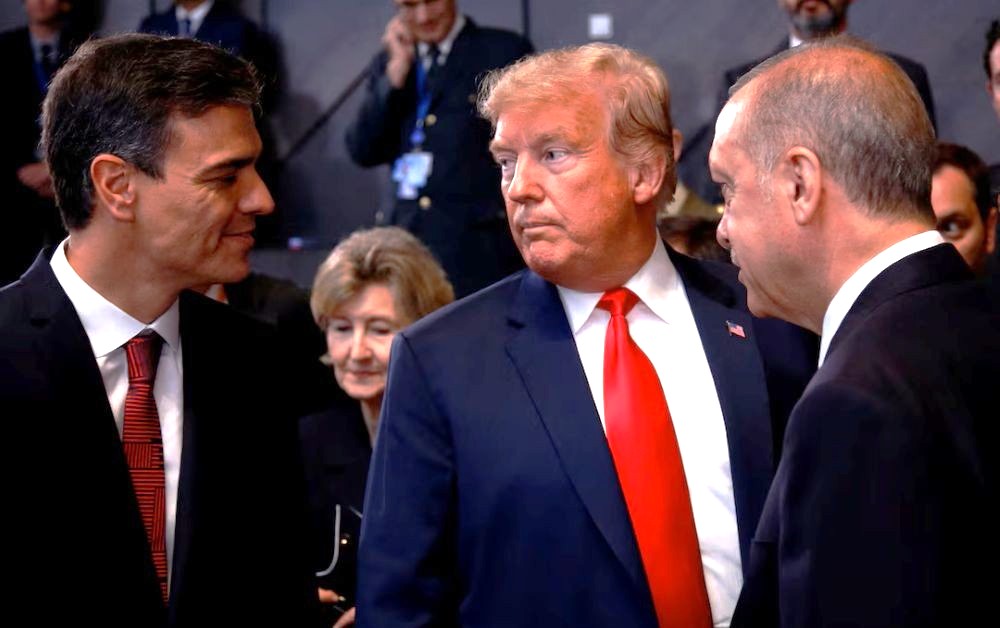 Spanish Prime Minister Pedro Sánchez, U.S. President Donald Trump, Turkish President Recep Tayyip Erdoğan at the Osaka summit in 2019. Photo: Reuters.
I am not saying that Donald Trump is involved in this mess. But looking at the recent developments in Ceuta and at the past incidents in this Spanish enclave – and placing them against the timeline of frictions between the United States president and Spain’s Prime Minister Pedro Sánchez – I am asking whether the circumstances surrounding the Ceuta migrant crisis are unusual enough that the possibility deserves to be explored.
This allegation is extraordinary, I know. So let me be clear from the beginning: I have no evidence proving that Trump ordered, financed or otherwise directed the mass movement of migrants into Ceuta. What follows is a theory — a collection of facts, coincidences, motives, historical patterns, and unanswered questions that, taken together, seem to invite closer scrutiny.
First, however, it is important to understand the place at the center of this story.
Spain in Africa
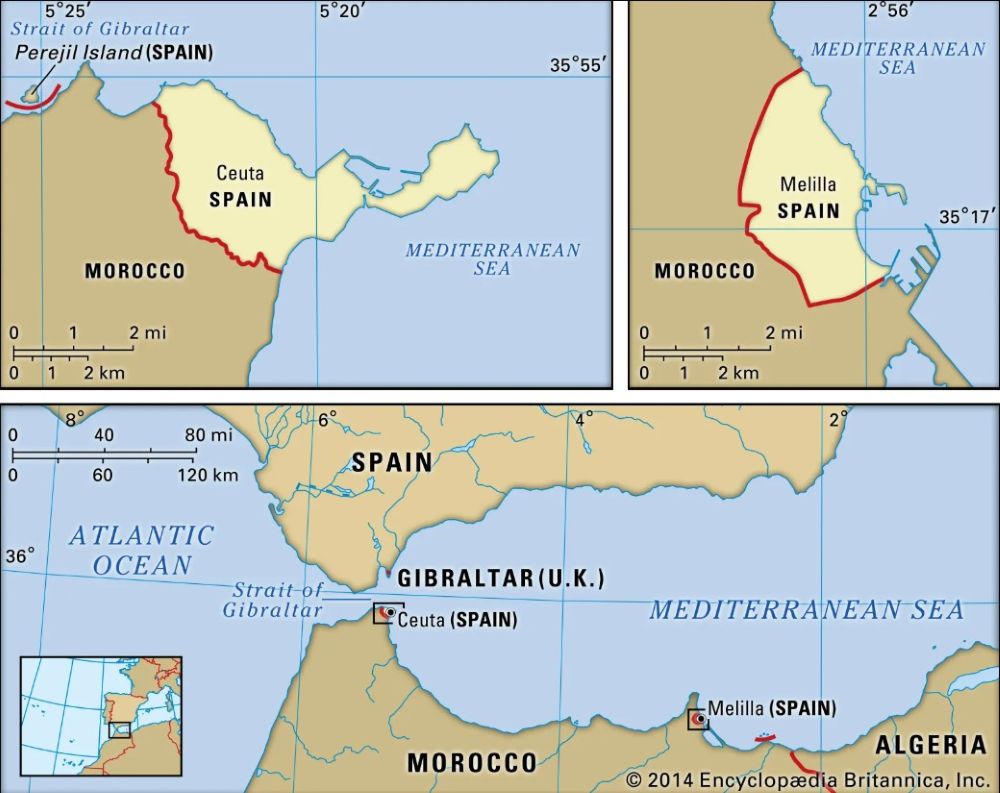
Ceuta is a Spanish autonomous city on the North African coast, bordering Morocco. It covers just 18.6 square kilometers and has a population of 83,179 residents, according to official Spanish statistics. It has been part of the Spanish monarchy since 1580. Spanish, or Castilian, is the official language, while a Moroccan dialect of Arabic is also widely spoken. The population is roughly divided between Christian and Muslim communities. We’ll need these statistics later.
Ceuta is not Spain's only territory on the African mainland. A few hundred kilometers to the east lies Melilla, another Spanish autonomous city surrounded by Moroccan territory. Morocco refers to both as “colonies” of Spain. How the two cities ended up in Spanish possession is a different story.
Our interest in this story is Ceuta and I mentioned the second enclave for a larger geopolitical picture. We’ll need it too.
Migrant Crisis
For several months, this tiny piece of Spanish territory has been in the middle of an artificial migrant crisis. Yes, artificial.
On 30 July, an estimated 72,000 people entered the enclave illegally — the authorities later spoke of more than 80,000 — amid claims that Ceuta was accepting “asylum seekers,” “refugees” and other people supposedly in need of humanitarian protection. They forced their way toward the Spanish territory by land and sea. Within 24 hours, an overwhelming majority returned to Morocco.
The crowds included Moroccans and nationals of Sudan, Somalia and Mali, suggesting that the message drawing people toward Ceuta had traveled across many African countries.
On 15 August, after days of social-media calls for another mass crossing, Moroccan security forces intercepted thousands of people approaching the border, arresting between 100 and 300 of them. Ceuta residents in response trashed a migrant camp outside the city.
The Spanish Problem Becomes a European Problem
Thousands of migrants remain in Ceuta, living in makeshift camps and other temporary accommodation. The situation has increasingly become a source of tension with local residents. In recent days, residents have attacked and burned migrant tents and belongings, prompting police intervention. Spain has also asked the European Union's border agency, Frontex, for assistance in dealing with the continuing consequences of the influx.
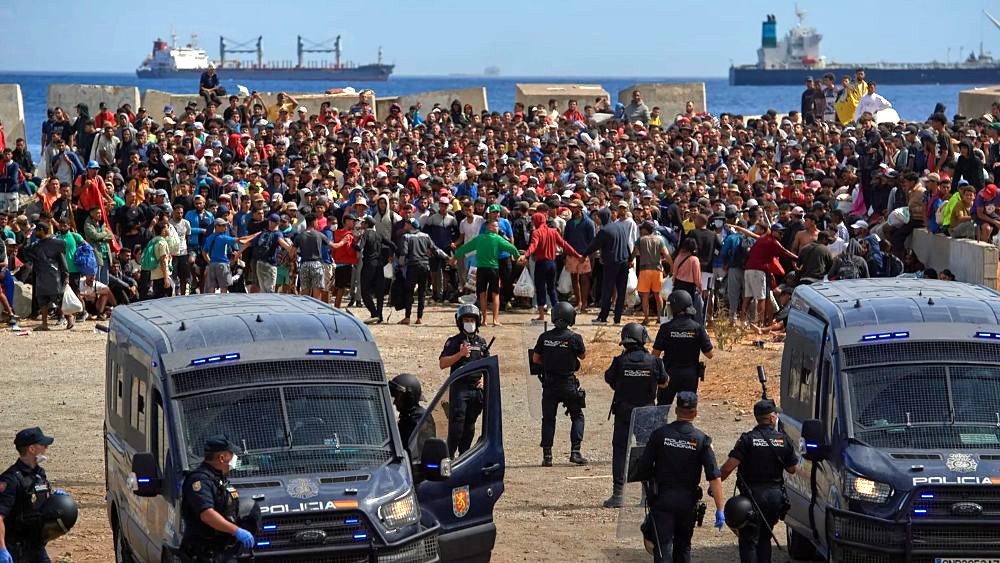 Police and volunteers cordon off crowds of migrants from Morocco. Photo: Euronews
The numbers alone are difficult to comprehend. When the Ceuta population almost doubled from 83,000 permanent residents – already making it one of Europe's most densely populated territories – the number of people per square kilometer soared to 8,400.
A true calamity for a tiny enclave.
And the human cost has been severe. At least 82 people died on the Spanish side of the border during the mass crossing, with additional deaths reported in Morocco, while many others were injured or required medical treatment. What initially looked like a spectacular but short-lived border incident has instead developed into a prolonged political, humanitarian and security problem for Spain.
The Diplomatic Conflict
This year’s incidents in Ceuta are not coincidental. In May 2021, Morocco relaxed or withdrew border control without explanation, letting between 8,000 and 10,000 people entering Ceuta over two days. Most migrants were rapidly returned to Morocco.
The episode occurred during a serious diplomatic dispute between Rabat and Madrid over Polisario Front leader Brahim Ghali, who was the immediate trigger for the 2021 Spain–Morocco crisis. A senior Sahrawi political and military figure, Ghali’s movement seeks independence for Western Sahara, a former Spanish colony inhabited by Sahrawi people. When Spain withdrew in 1975, Morocco took control of most of the territory. The Polisario Front, backed by Algeria, has fought for Sahrawi independence.
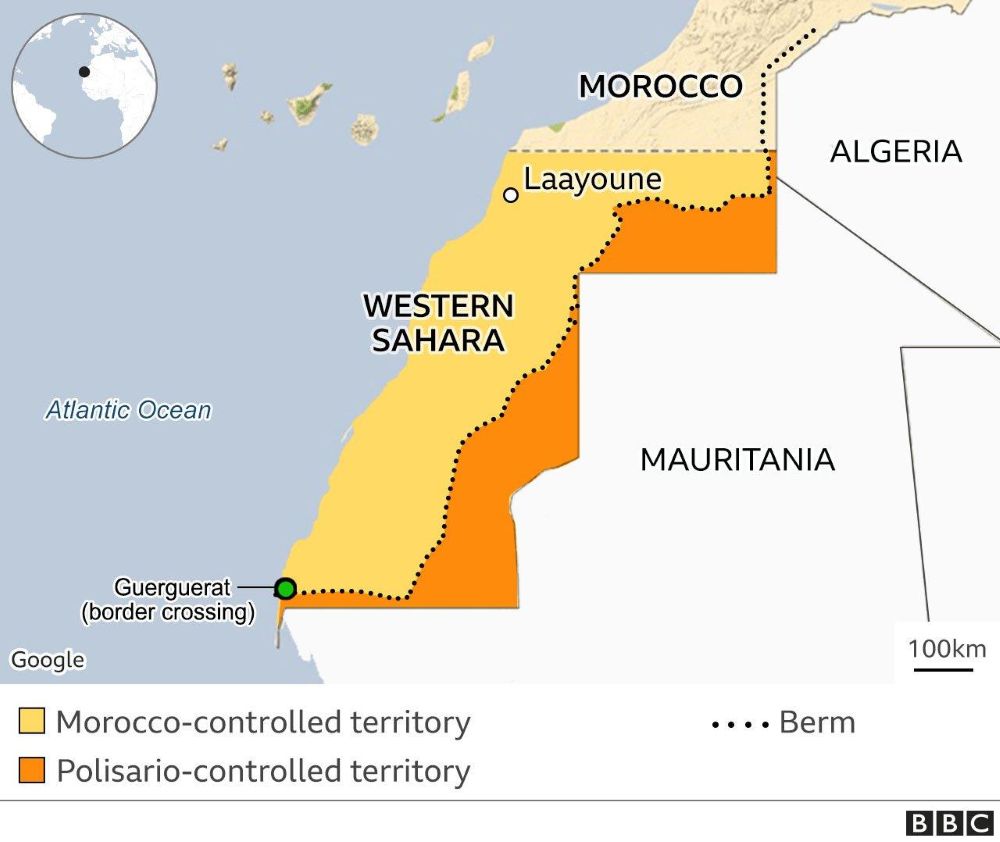 In April 2021, Ghali became seriously ill with COVID-19. Spain secretly allowed him to enter the country and admitted him to a hospital in Logroño for treatment. This infuriated Morocco.
Morocco accused Spain of “supporting separatism,” Spain accused Morocco of using migration as political pressure.
And this is where I kindly introduce Donald Trump into the story.
Five months prior to the 2021 incident, Trump's administration had recognized Moroccan sovereignty over Western Sahara, a decision that strengthened Rabat’s position and was part of the broader geopolitical background to the Spain–Morocco confrontation.
So, there is a precedent for using Ceuta's border to put pressure on Spain. The 2026 episode, however, is different — radically different in scale, circumstances and apparent organization.
Why Western Sahara Matters
Trump's decision was not a minor diplomatic gesture.
For Morocco, Western Sahara is a national cause and one of the country's most important foreign-policy objectives. Washington's recognition of Moroccan sovereignty, therefore, represented a major diplomatic prize. In exchange, Morocco agreed to establish diplomatic relations with Israel under the framework of the Abraham Accords.
The decision also altered the balance of the Western Sahara dispute. Until then, the United States, like most of the international community, had avoided formally recognizing Moroccan sovereignty over the territory. Trump broke with that position.
For Spain, the decision created an awkward geopolitical situation. Madrid has historically supported a negotiated settlement of the Western Sahara dispute under the United Nations framework, while simultaneously trying to maintain a functional relationship with Morocco — an increasingly important partner on migration, trade and security.
The 2021 Ceuta crisis demonstrated just how vulnerable that relationship could be.
But there is an important distinction between the two episodes.
In 2021, there was an obvious and publicly identifiable dispute between Morocco and Spain. Morocco was angry about Ghali's hospitalization and its officials admitted that the border crisis was connected to Spain's treatment of the Polisario leader.
In 2026, the picture is considerably murkier.
There was no equivalent Ghali affair immediately preceding the mass crossing. Instead, there was an extraordinary combination of circumstances: an enormous movement of people toward Spanish territory, social-media campaigns apparently encouraging another attempt, migrants arriving from several African countries, the rapid return of most of those who crossed, and — perhaps most intriguingly — a period of increasingly bitter friction between Donald Trump and Pedro Sánchez, the Spanish prime minister.
This does not prove a connection, but it raises a question that is difficult to dismiss outright:
Could the 2026 Ceuta crisis have been deliberately engineered or exploited for political purposes — and, if so, who would have had the motive, the resources and the capability to do it?
This is where the theory begins.
To be continued…