

From battlefields to resource networks, Ukraine is turning Russia’s worldwide networks into a vulnerability.
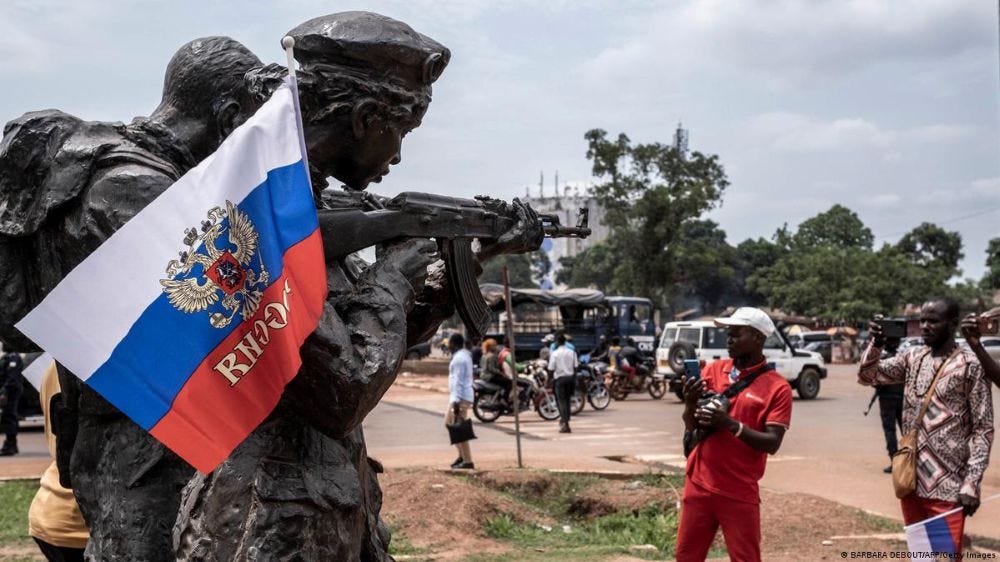 A monument in Bangui, Central African Republic, dedicated to Russian military instructors.
Vladimir Putin and his allies have repeatedly warned that Ukraine’s resistance and Western support for Kyiv could transform the conflict into a global war involving major powers. Western leaders rejected that argument as Russian propaganda — but concerns about escalation initially limited the support Kyiv received.
When Ukraine asked for a no-fly zone, the West refused. When Kyiv requested stronger maritime protection, the response was cautious. When Ukraine sought permission to use long-range weapons against targets inside Russia, Western governments hesitated, fearing that Moscow could interpret it as a direct attack by NATO.
But those red lines have slowly disappeared.
Ukraine has crossed one boundary after another. Western weapons are now used on the battlefield. Ukrainian drones strike deep inside Russia. Military targets thousands of kilometers from the front line are no longer considered untouchable.
The war has reached Moscow, St. Petersburg, industrial cities in the Urals and other regions that once seemed protected from the conflict. What was considered impossible at the beginning of the invasion has become routine.

Now Ukraine appears to be taking the confrontation even further — into regions that are not official battlefields of the Russo-Ukrainian war.
Africa is one of them.
Why has Kyiv decided so? Follow the rationale.
Moving up the chain
Russia has always counted on one overwhelming advantage: resources. Vast reserves of oil, gas, minerals and other commodities have given Moscow the financial foundation to maintain its military ambitions and project power far beyond its borders.
But resources alone do not guarantee strength.
Russia’s system is weakened by corruption, opaque decision-making and networks built around personal loyalty rather than efficiency. A significant share of its global influence depends on fragile arrangements — political allies, security contractors, local elites and resource deals that operate far from public scrutiny.
Ukraine appears to have recognized this vulnerability.
Instead of trying to compete with Russia’s raw material advantage, Kyiv has sought to expose and exploit the weaknesses of the system built around it. If Russia’s power comes from a network of resources, money and influence, then that network itself becomes a potential battlefield.

At first, Ukraine fought the war where every invaded country fights: on the battlefield at home.
The initial targets were Russian soldiers, armored vehicles, artillery positions and command centers. But armies are not defeated only by destroying the forces standing in front of you. They are defeated by cutting the invisible chains that keep those forces alive.
A tank is not just a machine on tracks. It requires fuel, spare parts, ammunition, maintenance crews and factories thousands of kilometers away. A soldier on the front line depends on supply routes, energy networks, industrial production and the economy that finances the entire system.
Ukraine gradually moved up that chain.
First came strikes against Russian troops and military positions. Then came attacks on ammunition depots, logistics hubs and supply routes. After that, Ukrainian drones began reaching fuel storage facilities, oil refineries and energy infrastructure inside Russia itself.
The logic was simple: why only destroy the weapon when you can target what allows the weapon to exist? Why focus only on the fighter carrying a rifle when you can cut off the ammunition factory that supplies him, the refinery that fuels his vehicle, or the infrastructure that powers the industrial machine behind him?
 The strategy was to move from the battlefield toward the foundations beneath it.
And now Ukraine appears to be extending this logic even further — from military infrastructure to the economic networks that sustain Russia’s ability to wage war.
For Moscow, those foundations are not located only inside Russia. They stretch across the world, including countries where Russia has built influence through military partnerships, political alliances and access to natural resources.
Africa as a new theater of war
Thanks to allies among dictators and authoritarian rulers, Africa has been a natural choice for Moscow’s military and economic buildup on the continent. For years, Russia expanded its presence there through the Wagner Group and later through Russia’s Africa Corps. Moscow offered security assistance to governments facing internal conflicts while gaining access to valuable resources, including gold and other commodities that helped finance its global ambitions.
Ukraine appears to have identified these networks as another part of Russia’s war machine.
So, instead of attacking only the final link — the Russian fighter on the battlefield — Kyiv is attempting to strike deeper into the chain: the sources of money, resources and influence that allow Moscow to project power abroad.
The most dramatic example came in Mali in 2024, where Tuareg rebels inflicted a major defeat on forces that included Wagner fighters. Dozens of Russian personnel were killed, heavy military equipment was destroyed. Ukraine’s military intelligence later suggested that it had provided information that contributed to the operation.

The battle was a test. And its outcome demonstrated a new reality: Russia’s war machine can be challenged far beyond Ukraine’s borders, not only where Russian troops were fighting, but also where Moscow built the foundations supporting them.
This increasingly looks like a second front, although unconventional. There is no need for Ukraine to deploy an army to Africa, because modern wars are not fought only by troops in uniform. Intelligence networks, local allies, proxy forces and irregular groups can all become instruments of strategic competition.
Russia used this approach for years to expand its influence beyond its borders.
Now Ukraine appears to be turning that same logic against Moscow — attacking not only Russia’s weapons, but the systems that make those weapons possible. What once was an advantage is now vulnerability.
Similar reports emerged later from Sudan, where Ukrainian-linked operations allegedly targeted Russian-associated forces, and from Libya, where Moscow has built a military presence through its partnerships with forces loyal to Khalifa Haftar.
In July 2026, Tuareg rebels from the Azawad Liberation Front (FLA), operating alongside the al-Qaeda-linked Jama’at Nusrat al-Islam wal-Muslimin (JNIM), launched a coordinated offensive against Malian government forces and Russia’s Africa Corps. The rebels also attacked Russian-Malian military convoys, including one reportedly transporting more than 200 Russian military personnel and over 100 Malian soldiers.
On 18 July, another major convoy, apparently a logistics column carrying supplies and likely fuel, was ambushed in the Gao region. Both the FLA and JNIM claimed heavy losses for Malian troops and Russian-backed forces. Ukraine is believed to be the intel supplier.

The level of Ukrainian involvement varies by country, but the broader pattern is clear: Kyiv is attempting to weaken Russia’s global network, not only its forces fighting inside Ukraine.
Comparison with WWII
There is an interesting historical parallel with World War II, however.
The defeat of Nazi Germany was not decided only on the main battlefields of Europe. One of the early turning points came in North Africa, where the Allies fought for strategic resources, supply routes and access to oil, rather than territories. By striking the foundations that supported the Axis war machine, they began weakening Germany’s ability to sustain a global conflict.
Later, the Allies expanded this approach by targeting the industrial backbone of Nazi Germany itself — oil production, railways, factories and supply chains — to make it difficult for the enemy system to continue functioning.
The difference today is that Ukraine is attempting to apply a similar logic against a nuclear-armed state through drones, intelligence operations and local partners rather than massive bombing campaigns.
Whether Ukraine can realistically deprive Russia of its entire resource base is debatable. Russia’s economy is too large and diversified. But the defending party does not really need to destroy Russia’s entire economic system to achieve an effect. Crippling it will work just fine.
By striking the vulnerable connections along the supply chains, Ukraine is crippling it and is increasing immensely the cost of war for Russia.
Putin warned that his war could become global. It is now. Definitely not the way he had expected.