
For almost a century, scientists thought they had a reasonably simple picture of the Universe.
 iStockphoto
Interesting news for astrophysics lovers who follow topics related to the expansion of cosmos.
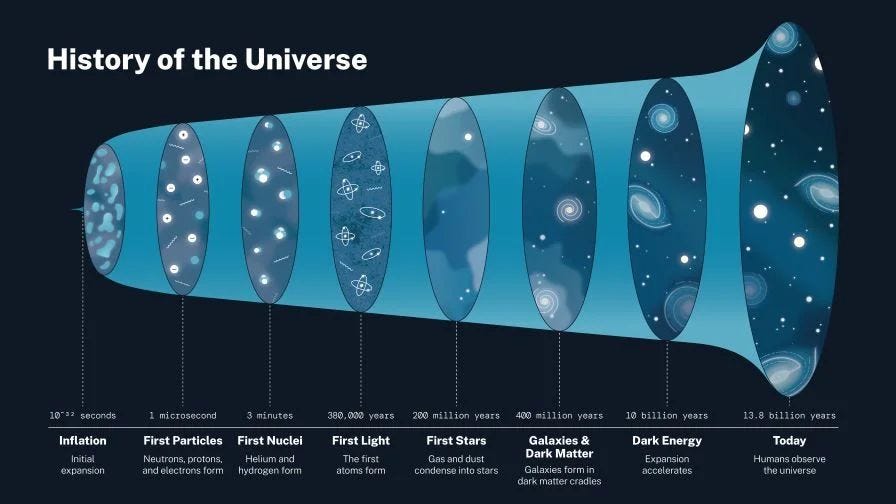
We know that it all began with the Big Bang 13.8 billion years ago — space has been expanding ever since and galaxies are generally steadily moving away from one another as space itself stretches. The farther away a galaxy is, the faster it appears to recede.
But the more precisely astronomers attempt to measure that expansion, the stranger the picture becomes.
Two of the most powerful space telescopes ever built — Hubble and James Webb — have confirmed that different measurements of the Universe’s expansion do not agree. At the same time, a giant survey of millions of galaxies indicates that the force driving cosmic expansion may itself be changing. Wait, what?
First things first. Astronomers currently use the so-called Hubble constant, which describes how fast the Universe is expanding today. There are two main ways to estimate it.
One looks back toward the beginning of the Universe. By studying the cosmic microwave background, the faint afterglow of the Big Bang, scientists can calculate today’s expansion rate from the standard cosmological model. Data from the European Space Agency’s Planck satellite give roughly 67–68 kilometers per second per megaparsec.
 The other method looks much closer to us.
Astronomers use pulsating stars called Cepheid variables to measure cosmic distances and build what is known as the cosmic distance ladder. This method gives a significantly higher value, around 73–74 km/s/Mpc.
For years, scientists wondered whether the difference was simply a measurement error.
Perhaps Hubble’s images were being distorted because too many stars were packed together. Perhaps neighboring stars were making Cepheids appear brighter than they really were.
Then the James Webb Telescope entered the scene.
Webb’s infrared vision is better suited to separating stars in crowded regions. Astronomers used it to repeat key measurements made by Hubble.
The result did not make the problem disappear.
It made it harder to dismiss.
In a study published in The Astrophysical Journal Letters, Adam Riess and colleagues used Webb to examine about 1,000 Cepheid stars in five galaxies, reaching as far as 130 million light-years away. Webb’s measurements agreed with Hubble’s, strongly ruling out stellar crowding as the explanation for the discrepancy.
In other words, Hubble was apparently not simply getting the wrong answer.
The Hubble tension — the disagreement between the local measurement and the rate inferred from the early Universe — is real.
Riess has said that once measurement errors are ruled out, scientists are left with the possibility that they have misunderstood something fundamental about the Universe.
That does not prove that the Universe expands at one speed in one direction and another in another. Rather, different parts of the cosmic story are producing different answers: the nearby Universe gives a faster expansion rate, while observations of the early Universe combined with the standard model predict a slower one.
And that is where another extraordinary experiment complicates the story.
The Dark Energy Spectroscopic Instrument, or DESI, a telescope on a mountain in Arizona uses 5,000 tiny robotic fibers to collect light from thousands of objects and build a giant three-dimensional map of the cosmos.
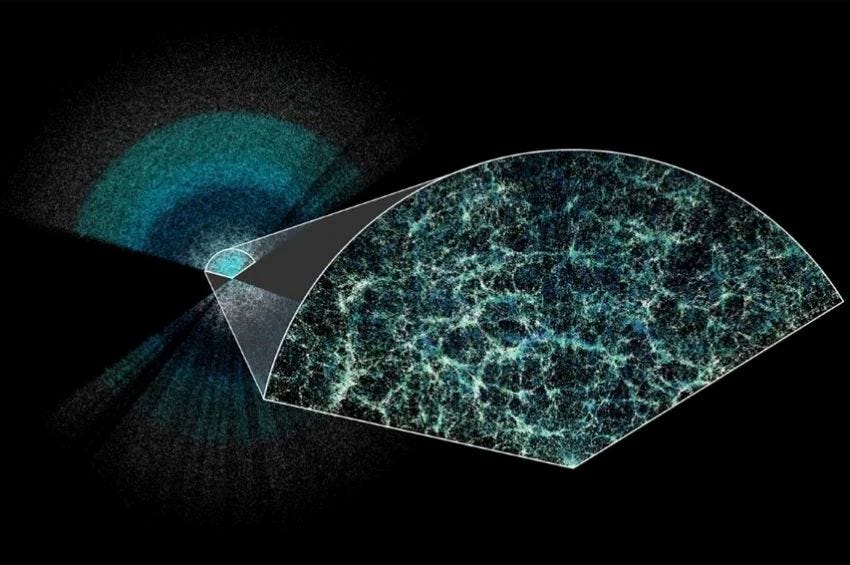 A fraction of the map of the Universe. DESI/NASA
DESI measures galaxies and quasars across immense distances, allowing scientists to reconstruct how the Universe expanded over billions of years.
One of its key tools is the baryon acoustic oscillation, or BAO — a pattern left behind by pressure waves in the young Universe. Because its original scale is known, scientists can use it as a kind of cosmic ruler.
By finding that ruler at different distances, DESI can measure how the Universe was expanding at different moments in its history.
The scale is simply enormous. DESI has mapped millions of galaxies and quasars, tracing cosmic expansion across roughly 11 billion years.
And it has found something unexpected.
According to the Lambda-CDM model — the standard model scientists use to describe how the Universe began, evolved, and is structured today — dark energy acts like a constant property of space and drives the accelerated expansion of the Universe.
But when DESI’s measurements are combined with observations of the cosmic microwave background, supernovae and gravitational lensing, the data show a growing preference for models in which dark energy changes with time.
The evidence is not yet strong enough to call this a discovery. Depending on which datasets are combined, the preference for evolving dark energy ranges from about 2.8 to 4.2 sigma, below the 5-sigma threshold normally required for a definitive discovery. Sigma (σ) is a statistical measure that describes how unusual a result is compared with what a particular model predicts. In simple terms, scientists use it to express how strong the evidence is.
So, scientists cannot yet say that dark energy is definitely changing over time. But the signal is becoming harder to ignore. As DESI is continuing to expand its map, astronomers acquire more data to investigate the expansion history in greater detail, using enormous numbers of galaxies and quasars.
Just to recap. Hubble and Webb tell us that the expansion rate measured in the nearby Universe does not agree with the rate inferred from the early Universe. Then, DESI suggests that even the way this expansion has changed over time may not fit the simplest version of the standard model.
On the other hand, German physicist Christof Wetterich has proposed a cosmology in which the Universe is not actually expanding in the conventional sense. Instead, the masses of particles increase with time, producing effects that can resemble cosmic expansion. His theory remains a minority view as most cosmologists are not ready to abandon the standard model: Lambda-CDM still explains an extraordinary amount of what we observe.
But the questions remain.
Are scientists measuring the expansion of our Universe correctly — or does the cosmos obey rules we have not yet discovered?
***
Sources and references:
Wetterich’s alternative cosmology
https://www.nature.com/articles/nature.2013.13379
Hubble/Webb study — The Astrophysical Journal Letters:
https://iopscience.iop.org/article/10.3847/2041-8213/ad1ddd
Public explanation of the Hubble/Webb findings — EurekAlert:
https://www.eurekalert.org/news-releases/1037233
Wetterich’s alternative cosmology — Nature:
https://www.nature.com/articles/nature.2013.13379
DESI study:
https://ui.adsabs.harvard.edu/abs/2024arXiv240403001D/abstract
DESI previous papers/data:
https://data.desi.lbl.gov/doc/papers/