

Desperation grows by the day as Russia is using the civilians as a human shield against Ukrainian attacks.
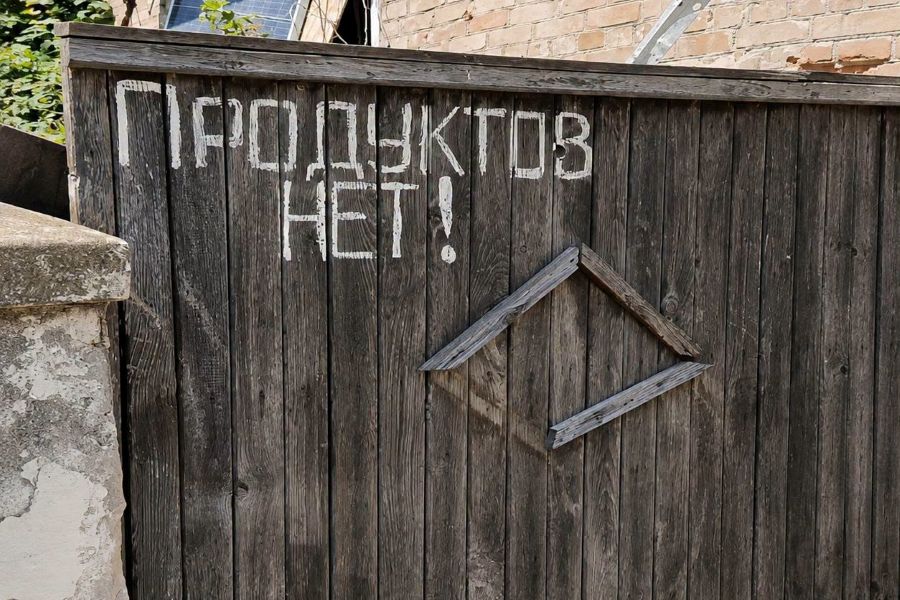 One resident wrote "No food!" for Russian troops. Image credit: Kherson Plus
Around 2,000 civilians, including nearly 50 children, remain trapped between the Russian military and the Ukrainian frontline in occupied Oleshky, a small town on the left bank of the Dnipro River opposite the larger Kherson. Food, medicine, electricity and water are running out, while attempts to establish a humanitarian corridor have failed many times.
Since this situation was first raised in a report by the United Nations Human Rights Monitoring Mission in Ukraine, things have worsened to the point of mass starvation, according to new independent accounts.
The Russian command refuses to let the residents leave to safety. Repeated requests from Kyiv to save the surviving civilians are landing on deaf ears.
Oleshky has been under Russian occupation since the beginning of the full-scale invasion in February 2022. Residents have been asking for evacuation for more than a year, but reaching Ukrainian-controlled territory is extremely dangerous. The surrounding area is mined, Russian troops control the roads, and drones monitor movement. People who attempt to leave also risk detention or mobilization at Russian checkpoints, a Human Rights Watch report said.
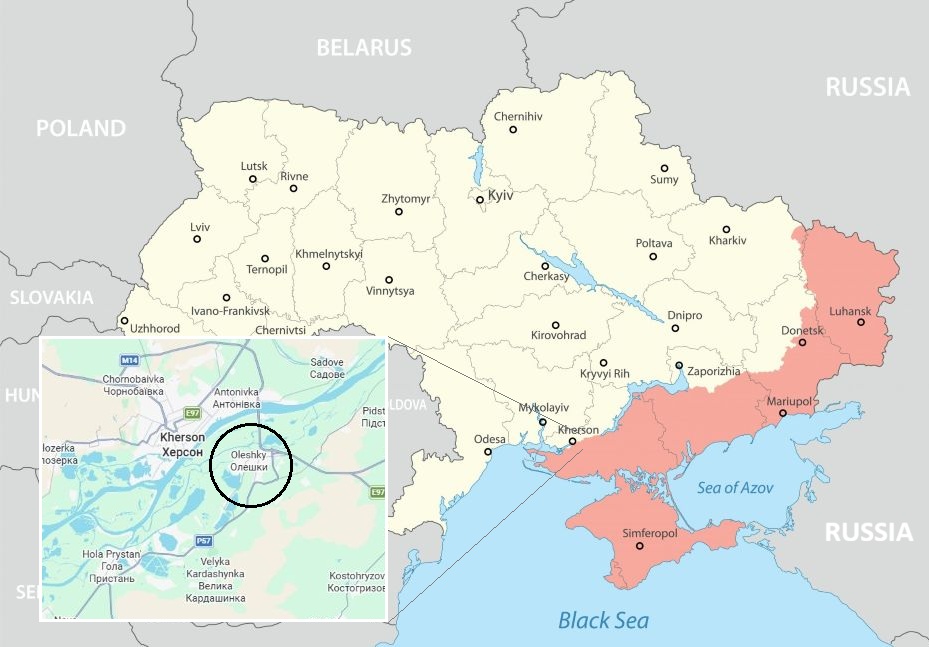 A map of Ukraine locating the town of Oleshky. Credit: author using Google Maps and AdobeStock images
The last conventional humanitarian aid reached Oleshky on 26 May. A subsequent attempt to deliver supplies ended in disaster. On 2 June, four vehicles carrying food and other aid approached the town. While the drivers were checking the road for mines, one exploded, injuring all four. One man died while being taken to hospital. Another injured driver had to be transported through Oleshky in a garden wheelbarrow because there was no other option.
After that, conventional deliveries effectively stopped.
A town running out of food
Residents have survived by eating vegetables from their gardens, searching abandoned homes and cellars and bartering whatever possessions they still have. But by autumn, those resources were disappearing.
Some residents now make desperate journeys to Radensk, an occupied village about 20 kilometers away where shops and a market still operate. The journey can take six to eight hours each way and is particularly dangerous for the elderly. The route is mined and exposed to shelling and drones. Some people walk more than 20 kilometers despite severe malnutrition and exhaustion simply to buy food.
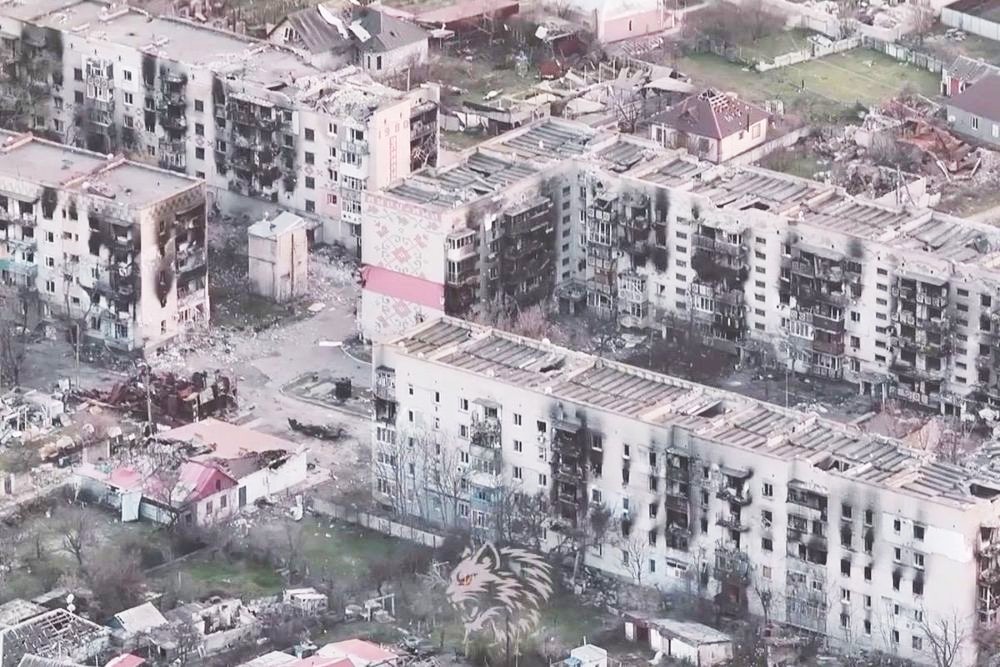 The aerial view of Oleshky. Image credit: Ukrainian military
Prices in Oleshky have become extreme. Vegetables costing around 100 rubles per kilogram in Radensk can reportedly cost 1,000 rubles ($12) in Oleshky. Eggs that cost 150–300 rubles per dozen in Radensk can reach about 300 rubles ($3.5) per egg in Oleshky. A chicken can cost around 5,000 rubles, while canned meat can reach 2,000 rubles.
Rubles had been imposed on Oleshky residents as the default currency – who are effectively Ukrainian citizens – by the former Russian occupation administration attempting to integrate the region into the Russian financial system. Ukrainian hryvnas had been banned and withdrawn.
However, cash may no longer help soon. People have started trading in kind.
Barter has become essential, with roughly 80% of local transactions reportedly taking place through exchanges rather than cash. Those who have money sometimes pay intermediaries to travel to Radensk for supplies, but the dangerous journey makes the service extremely expensive.
For some families, even this is no longer possible. One resident, 46-year-old Andriy, told witnesses interviewed by Novaya Gazeta that his remaining money had to be divided between food and medicine. He eventually gave his last savings to an intermediary and asked him to buy medicine first, using whatever remained for food.
 CLICK ON IMAGE TO OPEN THIS STORY
Hunger and violence
Andriy has remained in Oleshky since February 2022. He says Russian forces abducted and tortured him early in the occupation and threatened to kill him if he tried to leave again. His elderly parents refuse to leave without him, so the entire family is trapped.
Residents also report that Russian soldiers themselves are struggling with supply shortages. Some allegedly enter the town through the woods and loot abandoned or occupied houses. Residents accuse soldiers of killing people who resist and subsequently destroying houses with drones, apparently to conceal evidence.
The town's hospital is approaching collapse. The few remaining doctors can treat some wounded people, including those suffering severe injuries and amputations, but drugs are scarce. Food has also become so limited that medical workers have asked residents to donate grain so that they could bake bread to feed hospital patients.
 CLICK ON IMAGE TO OPEN THIS STORY
The hospital's staff are themselves trying to leave, raising the possibility that one of the last functioning institutions in Oleshky could soon disappear.
Volunteers who helped evacuate Oleshky residents said some have arrived in Ukrainian-controlled territory severely malnourished, with many elderly people weighing barely 50 kilograms. Others reach Radensk with bleeding feet after walking for hours in search of food. Volunteers receive messages from parents saying that their children are hungry.
A town without basic services
Those who manage to escape leave behind a town where almost every basic service has disappeared.
Electricity has been unavailable for a prolonged period, with critical facilities depending on generators. But gasoline supplies have also effectively stopped. The morgue has reportedly become overwhelmed with decomposing bodies because forensic examinations can only be performed in Skadovsk, about 70 kilometers away.
One resident who eventually escaped with his wife said they had only about 300 grams of buckwheat, 200 grams of spaghetti and two cans of stewed meat left before their journey. They ate everything before leaving because they needed energy to survive the escape.
 CLICK ON IMAGE TO OPEN THIS STORY
Ukraine resorts to drones
With conventional humanitarian deliveries impossible, Ukrainian forces have begun using drones to drop food into Oleshky.
Kherson regional military administration chief Oleksandr Prokudin confirmed that approximately 2,000 civilians have remained in the town, including almost 50 children. He accuses Russia of denying the civilians the basic needs while preventing them from leaving.
Ukrainian drone airdrops have reportedly delivered about four tons of food. Packages containing canned meat, pasta, grains and other supplies have been found by residents. The presence of Ukrainian drones sometimes forces Russian soldiers to hide, giving civilians an opportunity to collect the packages. But some food has also been taken by Russian troops.
The deliveries provide temporary relief but cannot solve the fundamental problem. They cannot restore electricity, medicine or normal food distribution, and they do not give civilians a safe way out.
Russia rejects an evacuation corridor
Ukrainian Human Rights Ombudsman Dmytro Lubinets says Ukraine has repeatedly proposed evacuating Oleshky's civilians through a humanitarian corridor. According to him, the two sides discussed possible routes and even a temporary suspension of fighting to allow the evacuation.
Ukraine proposed removing the entire civilian population by land in a single operation. Russia, however, rejected the proposals.
Lubinets argues that Moscow has a military interest in keeping civilians in Oleshky because their presence makes Ukrainian military operations more difficult. In his assessment, the residents are effectively being used as a human shield.
The Kremlin offers a different explanation. Spokesman Dmitry Peskov acknowledged the critical humanitarian situation but blamed Ukrainian drone attacks for obstructing the delivery of food and medicine. His version of events is contradicted by witness accounts blaming the occupants for the ordeal.
For Oleshky's remaining civilians, the circle is closing. They are surviving on gardens, abandoned food, rainwater, barter and increasingly dangerous journeys for supplies, while occasional Ukrainian drone deliveries provide only temporary relief.
With winter approaching, hunger is becoming another weapon of the Russo-Ukrainian war. The 2,000 Oleshky residents may not survive the combination of starvation, disease, cold, lack of electricity, inadequate medical care and continuing military activity.
Consider becoming my supporter or acquiring membership for as much as you can afford. Your donation means a lot to me. Thank you.