

A new movie may shape how the world remembers the war.
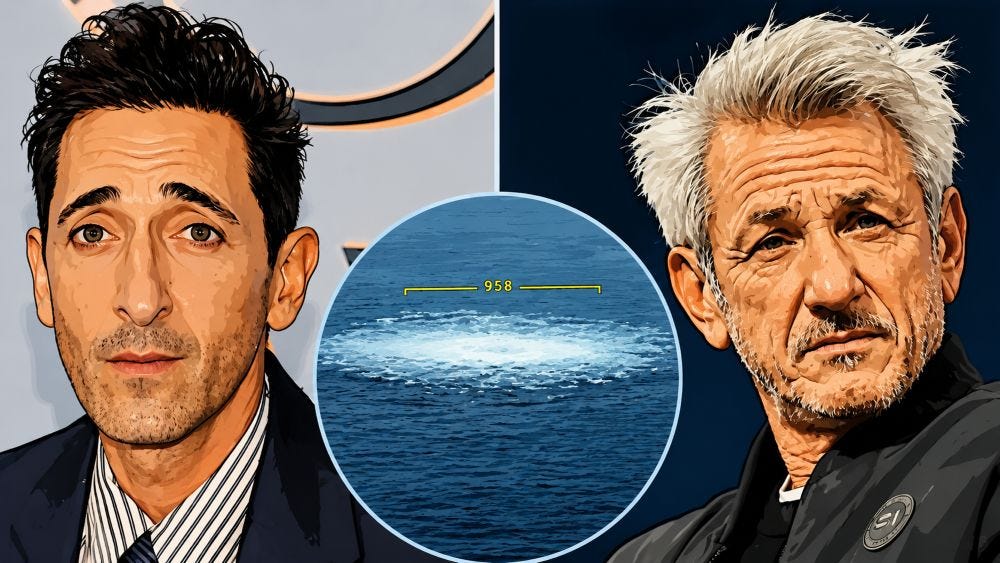 Hollywood director Doug Liman has begun filming a political thriller about the 2022 sabotage of the Nord Stream gas pipelines in the Baltic Sea — one of the biggest unresolved mysteries of the Russia-Ukraine war, with Oscar winners Adrien Brody and Sean Penn starring.
Doug Liman, the filmmaker behind The Bourne Identity, Mr. & Mrs. Smith and Edge of Tomorrow, named the new movie Snake Island. It is being filmed in Croatia, including central Zagreb, where streets have been transformed into a wartime setting with barricades, sandbags and extras wearing Ukrainian military uniforms. The production is also scheduled to film around Pula on Croatia’s Adriatic coast.
The movie follows a covert team of Ukrainian divers going on a dangerous underwater mission to destroy the pipelines. That is an interesting premise. Nobody has officially admitted responsibility for the Nord Stream explosions. Yet one of Hollywood’s most recognizable filmmakers is now making a major political thriller in which Ukrainian divers are the protagonists of the operation.
The choice of actors in leading roles makes the project even more interesting.
Sean Penn has been one of Hollywood’s most outspoken supporters of Ukraine since Russia’s full-scale invasion in February 2022. He has visited Ukraine several times, met President Volodymyr Zelenskyy and Ukrainian military personnel, and worked on a documentary about the war. In March 2026, he returned to Kyiv instead of attending the Oscars, where he received his third Academy Award for One Battle After Another.
Adrien Brody has also publicly expressed support for Ukraine.
Thanks to this movie, Ukraine will be getting a boost that any government dreams of: a Hollywood production capable of attracting international sympathy and perhaps material support — even though the plot might not reflect its official stance on the Nord Stream incident. Eventually, it would also advertise Ukrainian diving specialists, portraying them as capable, daring and effective operators in a major covert operation against Russia.
The timing is particularly interesting.
For years, responsibility for the September 2022 explosions has remained disputed. Several investigations and competing theories have circulated, but no government has publicly claimed responsibility.
Germany, however, has increasingly focused on Ukrainian suspects.
In June, German prosecutors formally charged Ukrainian national and military diver Serhii Kuznetsov in connection with the sabotage. Prosecutors allege that he entered Germany through Poland and was part of a covert team that used a rented yacht to reach the area near the Danish island of Bornholm, where explosives were allegedly placed on the pipelines.
The details matter because the German investigation and the movie appear to converge on essentially the same basic scenario: a team of Ukrainian divers conducting a clandestine underwater operation against Nord Stream.
The film is, of course, a screenwriter’s fiction. It does not demonstrate what actually happened. But cinema has a different kind of power from a prosecutor’s office.
A criminal investigation produces documents, suspects and evidence. A successful Hollywood movie produces an image of events that millions of people may remember as if they had witnessed them.
That is why Snake Island deserves attention beyond the entertainment pages.
Kyiv’s reaction
There is an important distinction here.
The Ukrainian government has not officially announced that Ukrainian forces destroyed Nord Stream. Nor does a Hollywood screenplay constitute an admission by Kyiv, which has an opportunity to say no — but apparently doesn’t.
However, if a film openly depicts Ukrainian divers carrying out the operation, while Ukraine does not publicly object to that portrayal, the silence itself becomes politically interesting.
Kyiv has previously had every reason to reject accusations that it was responsible for an attack on critical European infrastructure. Yet Snake Island is being produced around precisely that premise, with Ukrainian military uniforms and Ukrainian operatives at the center of the story.
If Ukraine wanted to make clear that this interpretation was completely unacceptable, it could at least distance itself from the production.
While it does not prove Ukrainian responsibility, the movie nonetheless serves as an unusual form of soft-power for Kyiv – one of Hollywood's major filmmakers is effectively presenting the Ukrainian-diver theory as the basis for an action thriller.
Why call the movie Snake Island?
This is the strangest part.
The Nord Stream pipelines are in the Baltic Sea. Snake Island — Zmiinyi Ostrov in Ukrainian — is in the Black Sea, off the coast of Ukraine. Before World War Two it was Romanian territory but Joseph Stalin forced Bucharest to cede it to the Soviet Union as reparations for allying with Nazi Germany.
The island became one of the most famous symbols of the war after Russian forces occupied it at the beginning of the full-scale invasion and Ukraine eventually recaptured it months later.
Perhaps the filmmakers hope the name would immediately resonate with anyone following the war, in spite of no obvious geographical connection to the Nord Stream operation. Or perhaps it refers metaphorically to the Russo-Ukrainian war. Or perhaps there is something in the screenplay that connects the two events.
It’s not clear at this point.
What is unusual about this movie is the scale, speed and nature of the Western cinematic response to a war that is still being fought — and in which no Western country is directly a combatant.
Ukraine may be the first modern war in which the cinematic battle has become international almost simultaneously with the military one. Ukrainian filmmakers, Western documentarians and now Hollywood are producing stories about a conflict whose outcome is still unknown.
Hollywood has chosen a side
The plot details of Snake Island are being kept largely under wraps. But the participation of Sean Penn and Adrien Brody is significant. Both have publicly expressed support for Ukraine, while Penn in particular has made his involvement in the Ukrainian cause unmistakable. That doesn’t mean the film represents the official Ukrainian position. In fact, the opposite may be true: its central premise appears to be that Ukrainian operatives carried out an attack that Kyiv has never admitted responsibility for.
But cinema does not need to establish legal responsibility to shape public perception. If millions of viewers eventually watch a film in which Ukrainian divers are portrayed as the people who carried out one of the most spectacular covert operations of the war, that image may become more influential than the eventual findings of an investigation.
That is the true power of Hollywood. What happened is important, truth matters. But what people remember matters more.