

The world is heading toward a global struggle for human capital, while most young people will live in developing countries.
The world is approaching a major demographic transformation. Over the next 25 years, the number of young people is projected to boom in many developing countries, while many wealthy societies will experience a shrinking number of youths and accelerating population ageing.
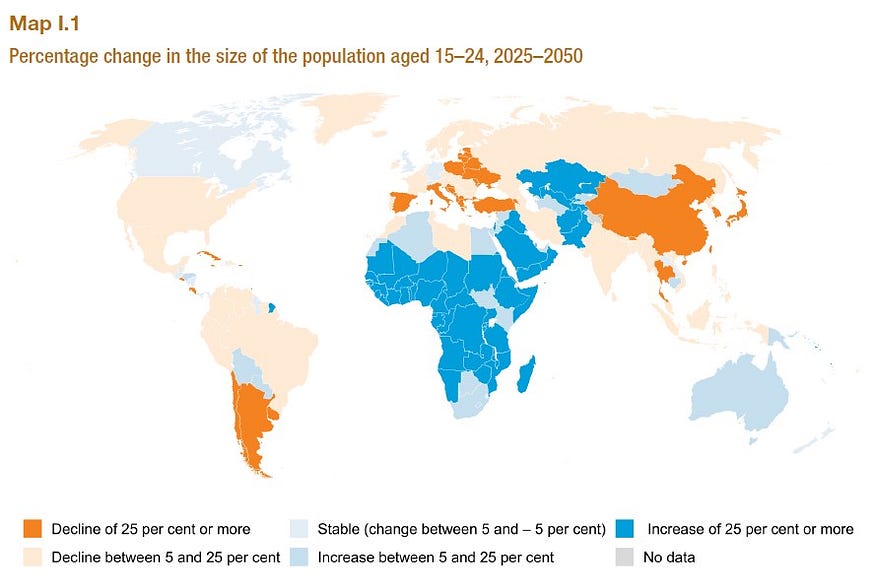
According to a new report by the United Nations Department of Economic and Social Affairs (UN DESA), by 2050 nearly 70% of the world’s young people will live in low- and lower-middle-income countries (LLMICs), compared with 59% in 2025.
The implications will be significant.
This shift could transform the economies of individual societies, but also the global labor market, migration patterns and political relations between countries.
But what exactly should we expect from this demographic realignment? Are there reasons for worry? The answer is not simple.
In the light of this anticipated evolution, countries with growing youth populations will need to provide education, jobs and public services for increasingly large generations. Countries with ageing populations will face a different challenge: maintaining economic productivity and essential services with a smaller number of young people entering the workforce.
These two demographic trends could create a new form of international competition — for educated, skilled and economically active people.
There are several ideas in connection with the 2026 report.
 CLICK ON THIS IMAGE TO OPEN MORE RELEVANT STORIES
1. Developed countries will compete for workers
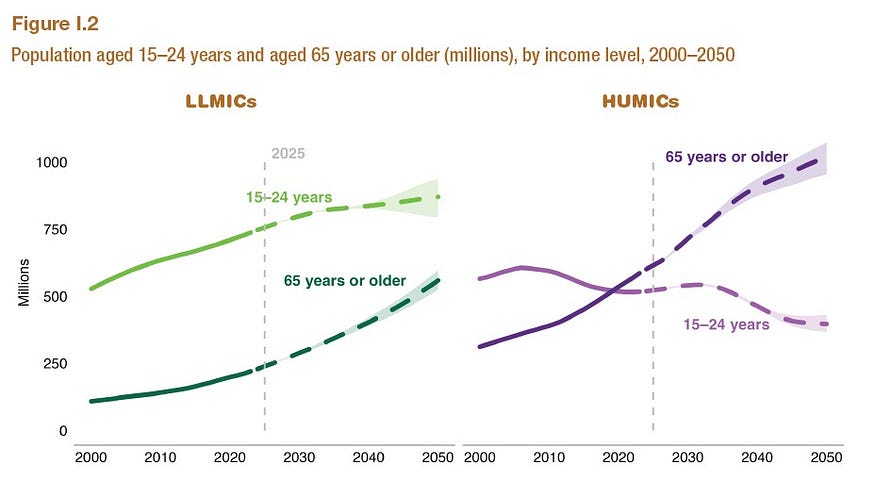
The demographic trends outlined in the U.N. report point toward a growing imbalance between countries with ageing populations and those with expanding youth populations. In high- and upper-middle-income countries, the number of people aged 15–24 is projected to decline by almost 24% between 2025 and 2050, falling below 400 million. At the same time, the number of people aged 65 and older in these countries is expected to approach three times the number of young people by mid-century. This changing age structure could place pressure on labor supply and public finances.
Meanwhile, low- and lower-middle-income countries are expected to see their youth population grow by 16%, reaching nearly 880 million.
As older populations increase the demand for healthcare, social services and pension support, many developed economies may need to attract workers from abroad to sustain economic activity and compensate for shrinking younger cohorts. But their demand will not be limited to highly educated professionals. Healthcare, construction, agriculture, transport, manufacturing and other sectors may also require workers of non-graduate qualifications, including those with vocational training or fewer formal education.
Wealthier countries, in particular, may expand work permits, facilitate the recognition of foreign diplomas, offer scholarships and create pathways from study to employment and permanent residence for incoming workers.
Immigration is not the only response, however. It will remain one of several possible responses, alongside automation, productivity improvements, later retirement and a larger labor-force participation.
On the other hand, poorer countries face a different but closely connected challenge. Their expanding youth populations could provide a substantial workforce and create opportunities for economic growth, but only if the education systems, labor markets and public infrastructure can absorb and prepare for the new generations.
2. Developing countries will face pressure to retain their human capital
The report emphasizes that a growing youth population can become a demographic dividend only when young people have access to education, healthcare, skills development and decent employment. Without those investments, population growth may intensify unemployment, poverty and social exclusion rather than generate broad-based economic gains.
Governments seeking to retain skilled and educated young people will need to offer more than financial incentives. Investment in productive industries, research, technology, transport, healthcare and education could help create better-paid jobs, support entrepreneurship and improve living standards.
Access to technology and international investment will be particularly important for countries seeking to move beyond low-productivity activities and create higher-value employment.
But this also creates a strategic dilemma. Educating a larger generation requires substantial public investment, but once young people acquire valuable qualifications, they may find better-paid jobs and more attractive living conditions abroad. Governments could therefore face growing pressure to make domestic opportunities competitive with those offered by wealthier countries.
Possible responses include improving wages and working conditions, supporting research and entrepreneurship, investing in infrastructure, strengthening public services and creating career paths for skilled professionals. Some governments may also seek to engage their diasporas through investment, research partnerships, temporary return programs and knowledge transfer.
Yet the capacity to implement these measures will vary considerably. Countries with limited public resources, weak institutions, unstable economies or insufficient job creation may struggle to retain their educated populations, even when they expand access to education. The report’s discussion of the demographic dividend makes this a central issue: increasing the number of young people is not enough if the economy cannot productively employ them.
There is also a potential tension between individual opportunity and national development strategies. Young people may reasonably see migration as a way to improve their lives, while their countries of origin may view the departure of trained workers as a loss of publicly funded human capital.
Importantly, policies aimed at retention have better chances when they expand people’s choices rather than restrict their freedom to move.
 CLICK ON THIS IMAGE TO OPEN MORE RELEVANT STORIES
3. Migration may expand beyond highly skilled workers
The international competition for educated and skilled workers seems to be only one part of the likely migration picture. The report projects that youth populations will grow substantially in many LLMICs, including countries where education systems, labor markets and public services already face structural challenges. In 22 LLMICs, the population aged 15–24 is projected to increase by at least 50% between 2025 and 2050.
If employment creation and economic development do not keep pace with the expansion of the working-age population, some young people may look abroad for opportunities — or turn to crime. Among those choosing to emigrate, there may be university graduates and trained professionals, but also people with limited formal education or vocational skills who are seeking work, security or a higher standard of living.
The distinction matters because migration systems often select people according to qualifications, language ability, occupational demand and the availability of legal pathways. Highly skilled workers may be recruited through targeted programs, while people seeking lower-skilled employment may encounter more restrictive entry requirements, temporary contracts or fewer routes to long-term residence.
The report specifically warns that irregular migration can expose young people to exploitation and smuggling. It also mentions the importance of sustainable livelihoods in home countries, so that migration becomes a genuine choice rather than a response to a lack of viable alternatives.
A potential outcome, therefore, is a widening divide between migration channels: organized recruitment of workers whose qualifications match destination-country needs, alongside less secure migration by people who have fewer resources or fewer opportunities to qualify for regular entry.
This is a plausible scenario, however, not a fixed forecast. Its scale will depend on labor demand, immigration policy, economic development and the availability of legal routes.
4. Immigration could become a source of social and political tension
The report identifies migration as a potential source of mutual benefit for countries of origin and destination, while emphasizing the importance of migrant rights, good governance and social inclusion. It does not, however, predict how public opinion in destination countries will respond to increased migration.
One possible tension arises when the economic rationale for attracting workers differs from how some residents perceive immigration. Employers and governments may regard foreign workers as necessary to fill vacancies, sustain services or support economic activity. Some members of the host population, meanwhile, may fear competition for jobs, downward pressure on wages, pressure on housing and public services, or changes to familiar cultural and national identities.
Europe’s failure to assimilate and integrate large groups of immigrants from Asia and Africa over the past decades is a good example that could be exploited against prospective newcomers.
These concerns should not be treated as universal attitudes among residents of developed countries. Public responses to immigration vary across countries and communities, and can differ according to the scale and pace of migration, local economic conditions, personal experience, political leadership and the effectiveness of integration policies.
Nor does the presence of highly qualified migrants eliminate all possible sources of friction: professional credentials, language, workplace recognition and access to housing can remain significant issues.
The political challenge may become more pronounced if immigration is perceived to be poorly managed, if the costs and benefits are unevenly distributed, or if governments fail to explain how migration policy relates to labor-market needs and public services. Conversely, effective integration, fair employment conditions, investment in local communities and transparent migration rules may help reduce tensions.
The important question is not simply whether people in destination countries will welcome or reject migrants. It is whether institutions can manage migration in ways that address legitimate economic and social concerns of local citizens while protecting the rights and dignity of foreigners.
5. A possible political crisis in ageing societies
There is also a political component visible when you analyze the report. If labor demand encourages governments to increase immigration while parts of the electorate oppose it, migration could become a prominent and divisive political issue. Parties and movements — especially right-wing — may mobilize around concerns about employment, national identity, border control, cultural change and pressure on public services. Political disagreements could intensify where demographic needs, business interests, public opinion and government policy pull in different directions.
A crisis scenario could develop if several pressures converge: labor shortages in essential sectors, inadequate housing and infrastructure, weak integration mechanisms, economic insecurity among local workers, and a loss of public confidence in government management. In such circumstances, disputes over immigration could become entangled with wider dissatisfaction about inequality, public services and political representation.
 CLICK ON THIS IMAGE TO OPEN MORE RELEVANT STORIES
6. The developing world could face a different kind of crisis
While wealthier countries may face labor shortages and the political challenges of immigration, countries with rapidly growing youth populations may confront the risks of failing to provide enough education, employment and essential services.
A large generation entering adulthood without realistic prospects for economic independence may experience prolonged unemployment, insecure work, poverty or exclusion from public life. These conditions can undermine trust in institutions and increase pressure for political and economic change, on one hand, and fuel a surge in crime, on the other hand. The report identifies poverty, inequality and social exclusion as risks when youth population growth is not matched by investment and opportunity.
The consequences may extend beyond national borders. Where young people see few prospects at home, migration can become an increasingly important livelihood strategy. Countries may lose trained professionals and entrepreneurs, while communities may become dependent on remittances or family members working abroad.
The central risk is therefore not youth population growth in itself, but a mismatch between demographic change and economic opportunity. If education expands without corresponding job creation, or if economic growth fails to translate into decent work and improved living standards, the demographic dividend may remain unrealized.
The future is… intriguing
These are several of my concerns I wanted to share after reading the UN DESA report. So, what do we have?
The growth of the young population could transform both developed and developing countries, but not in identical ways. Ageing societies may increasingly seek workers from abroad, while countries with expanding youth populations will need to create enough education, employment and social opportunities to meet the aspirations of their younger generations. These needs could encourage competition for skilled workers, increase migration across different skill levels and intensify debates about national identity, labor-market access and integration.
My proposed scenario involving a social and political crisis in some developed countries is one possible outcome if migration pressures, economic insecurity, weak integration and political polarization reinforce one another. It is not, however, a conclusion established by the report. The same demographic trends could also lead to new forms of international cooperation, investment in human capital, technological adaptation and more structured migration systems.
The decisive factor will be how governments and societies respond to the demographic realities. The report’s findings point to a common requirement across countries: investing in young people, protecting their rights, expanding decent work and enabling them to participate in decisions that shape their lives.
The global competition for human capital may grow, but whether it produces cooperation or conflict will depend on the policies and institutions built around it.