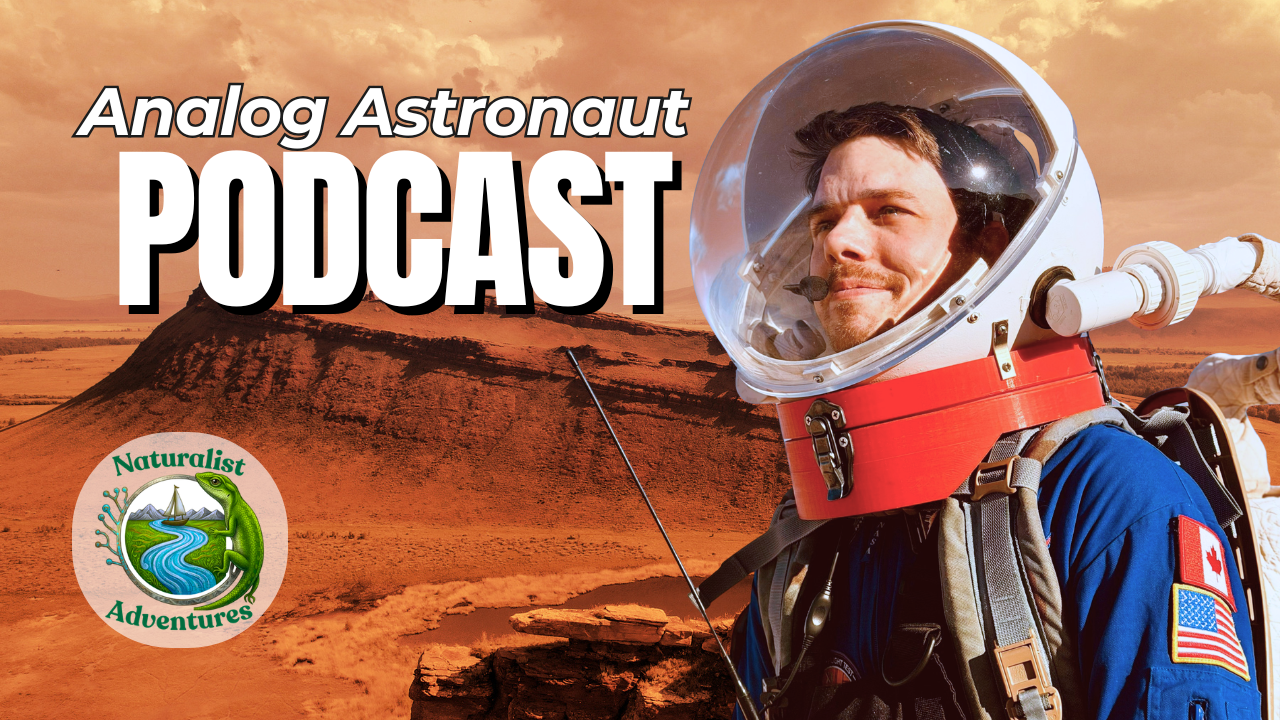

Tom Bickmore ran a live Q&A with over a thousand students built around a simulated Mars communication delay; the kind of time gap where you ask a question and wait over 20 minutes just to hear back. His experiment explored what it might look like to keep a human connection despite the isolation of life on Mars.
The experiment, along with stories that made me forget he was ever still on Earth, set the tone for the whole conversation.
Tom (known to his students as Teacher Tom) teaches rocket science and engineering to kids ages 8–18 across 42 countries, with over 7,000 teaching hours and 1,700 students to his name. He's also an analog astronaut who recently returned from a simulated Mars mission at the Mars Desert Research Station (MDRS) in Utah.
What I'm most excited to share isn't just the technical side of his mission, it's how the experience changed the way he thinks about and sees the world.
For those familiar with my previous interviews, I usually write them as blog posts. This time I'm trying something different: a podcast-style interview. It's my first time using several new tools, so please forgive the technical glitches.
Huge thanks to Tom for being my first podcast interviewee! I had a lot of fun working on this project and talking with Tom, who was patient as we faced some technical issues.
You can check out the full video and transcript below.
Transcript
Opening
0:00 Tom: We've not yet confirmed that anywhere else has trees. Yes, diamonds are valuable, but wood is a billion trillion times more valuable than diamonds in just our solar system, because there's only one place to get wood. And on some planets, it may be raining diamonds, literally.
0:20 Millie: I'm Millie and everything's connected if you look close enough.
What "Getting Back from Mars" Means
0:31 Millie: So for the audience who might not know what it means to get back from Mars, could you explain what that means and where you spent several weeks?
0:43 Tom: Yeah. So I was at the Mars Desert Research Station as an analog astronaut, and this is the longest-running Mars simulation on the planet. Earth, to be specific. It's on the planet Earth, and it's designed to test and train people and science and equipment for actual Mars missions in the future.
I was there for two weeks living as if I was on Mars, with all sorts of procedures and equipment and things that were all designed to simulate Mars as well as we can in most ways. There are certain things that different analog facilities around the world train for.
Going in and out of the building, there's an airlock and you have to wait five minutes in the airlock between getting in and then actually entering the building, which is not convenient, but helps practice for that situation on Mars. And when you go outside, you wear a spacesuit. They're semi-homemade spacesuits that simulate it in many ways, the parts that matter the most, but not in every single way, because these probably cost a couple hundred dollars a piece as opposed to a billion dollars a piece.
So with any analog there are going to be certain compromises and certain things that they're very strict on, because of the type of thing they're studying.
2:36 Millie: In the past, I interviewed another analog astronaut with Recess, which is the platform I found you through. He was training on a boat, so I interviewed him while he was on a boat. There were several nuances with that, because while you're on a boat the internet connection isn't great. So I remember that being an interesting interview. But yeah, I've done some research into those analog missions and it sounds really cool, especially the one you were on.
So I heard you're the main communicator for your crew. What does that mean, and did you choose that role?
Tom's Assigned Role
3:11 Tom: There are two different ways to apply to MDRS, the Mars Desert Research Station. You can apply as a whole group or you can apply as an individual. Most people that go there go as pre-organized groups that have trained together, but I didn't have a pre-organized group to apply with, so I applied as an individual and I was assigned to a crew.
That crew already had an actual aerospace engineer assigned to the crew engineer spot, which I personally had applied for, thinking that would be the most fun. But because he already had the spot, I ended up getting assigned as the crew journalist, because I did apply saying I'm happy to fill any spot. But I quickly realized that it was actually better to be the journalist, because the journalist has to report on everything everybody's doing, which meant that I got to be part of more experiments than if I were just the engineer.
It also worked out because the experiment I was doing was a communications experiment, and I still got to help with the engineering and help with everything else. So the crew engineer does have more other responsibilities, like taking care of the facility, that I'd be happy to do, but at the same time that's just more things to do instead of the experiments themselves. So it ended up working out. I'm very glad I was the journalist.
Responsibilities: Journalist, Astronomer, and Communications Officer
4:54 Millie: Yeah, that's really cool. Do you have any other unexpected responsibilities as that role, or anything else that you were a part of?
5:05 Tom: Well, I actually ended up having three roles. The journalist, which every day you have to fill out a journalist report mission log and share it with the appropriate places. For our crew, I was sharing it on most social media sites, trying to get it out there for more people to be aware of it, because it is important to share the experiments that are happening.
It's not just "I'm going to do this experiment so that I can build a Mars base myself someday," because it's not an individual thing. It's a worldwide effort to build a Mars base. So the more this can be shared, the better the experiments can actually perform, especially with the one that we needed more people participating with, the communications delay live meeting experiment that we did, which of course we'll get to later.
There's the mission logs, and then there's also photos of the day. You have to send in a certain number of photos, hopefully capturing a little bit of each experiment, and not just the experiment itself, but people doing the experiment. Which sometimes is hard. Like you need to get a picture of a seed that's starting to sprout and the person that planted the seed in the same shot, so you could see both of them, and not have it be the same shot every day.
So that was actually challenging. How do I get people and their experiment at the same time, in a way that actually shows what the experiment is?
I was also assigned as the crew astronomer, so I had to train on how the telescopes work and the procedures to make sure that we don't break probably tens of thousands of dollars worth of equipment.
And I also got assigned a couple of days into the mission as the communications officer, simply because we all realized that I could both interpret what was coming over the radio a little bit better, and I could talk clearly through the radio, because I've got a ham radio license and experience with radios and stuff like that. So they said, okay, you're assigned the communications officer. Essentially, if we get a radio call, you're primarily the one to answer it and help interpret if general radio static or whatever was getting in the way.
Turns out I ended up using that experience a little bit more later in a great non-dangerous emergency situation, so that was fun. We'll get to that later too. Yeah, it was a lot of fun being the journalist and being able to communicate for our crew to the world.
Radio as a Skill
8:26 Millie: Yeah, definitely. And it's amazing how just talking on a radio, walkie-talkie, whatever, is actually a skill that you can develop. You can tell who has the skill or not when you're talking to them on the radio. It seems basic when you've been doing it for a summer or something like that, like oh yeah, it's just how you talk on the radio. But then somebody new tries to talk and you're like, oh wait, I used to do that. It really is a skill.
Building the Crew
8:52 Millie: Tell me a bit about the rest of the crew. How did you get on with this crew, and had you ever worked with them before?
8:59 Tom: This crew was all applying as individuals, though two of them had at least met before and worked with each other a little bit before. It was mostly just a group chat. Once we were assigned together there was a group chat talking with each other and planning stuff. All of our experiments overlapped a little bit here and there, so it did really feel like a good group crew.
It was interesting meeting up right outside the hotel that they'd been staying at, to get picked up, and trying to fit everybody and their luggage and their experiments all into one crew transport shuttle that looks a lot like an old Suburban, and driving out. So that was the first getting-to-know-each-other type of thing beyond a group chat. And we worked surprisingly well together. Everybody was there to do science and have a good time, and it was a lot of fun and a great learning experience.
We had people from five different countries, four different continents. Sometimes you get five countries but they're all touching each other, so it's like, yeah, no big deal, we watch the same TV shows, we go to the same stores, type of thing. But this was four different continents coming together, so it was very interesting and a lot of fun and a great experience.
Cultural Exchange and the Science of Martian Bricks
10:40 Millie: What was this cultural exchange like, and how was it getting to know these different people?
10:47 Tom: Our commander was from Spain, and she'd been on five or six different analog missions before that. The crew engineer is Aaron from Virginia, well originally Seattle, but came in from Virginia where he's working for an aerospace company with top secret clearance and doing cool stuff that of course he can't share. But we just have to assume it's cool because it's top secret.
And we have Janavi from India, who's a scientist working in a lab to develop a way to build bricks out of Martian regolith. So I was part of her experiment. There was collecting some of the local dirt, which is very similar to Martian regolith, to test a few different things with building bricks out of that.
It turns out one of the main problems with building bricks from the dirt on Mars, or regolith, the non-living dirt, is that it's not living. There's no bacteria in the soil on Mars, and it turns out bacteria makes bricks stronger.
The soil on Mars has a chemical called perchlorate in it, and perchlorates kill bacteria. So not only can we not grow stuff directly on Mars, but even if we brought the dirt inside a greenhouse, you'd have to wash the dirt before you can grow stuff in it. Plants and bricks both want bacteria growing in the dirt. So you want a way to not have to wash your dirt thoroughly, because that uses a lot of water and then you have to recycle the water and all that sort of stuff.
So we were experimenting with certain things that you can add that protect the bacteria from the perchlorates, using guar gum, to be able to make bricks that are stronger.
And therefore you can build a structure out of bricks on Mars, and then you basically have a balloon inside that to keep the air pressure in, and the structure protects the balloon so you don't accidentally pop it. Things like that will make it possible to build bigger things on Mars, so you're not stuck in a tiny little thing like we were.
The thing I missed the least on Mars was the size of the bedroom, which most bathrooms are bigger than. The bed was roughly the size of a bathtub.
13:57 Millie: Yeah, that sounds pretty small and cramped.
13:59 Tom: So if we've got more bricks on Mars, we can have bigger bedrooms and an overall better experience.
Water Conservation
14:07 Millie: Yeah. So I know that within this mission you had a constrained amount of water. Could you explain how that worked, what the water went to, and did it affect anything in ways that surprised you?
14:21 Tom: That's probably one of the things that subconsciously stuck the most, the water conservation. Because there's a tank of water outside the hab that was where we got our water from, and if it ran out then we would have no water. Pretty simple. It's not like we saw that you used a little bit more water so we're going to have to turn it off on you. No, it wasn't mission control being stingy or anything. It was, here's the water you have, don't run out before you're done.
And so the first couple of days we were in a little bit of a panic, because the crew engineer goes and measures exactly how much water we have left in the tank each day, and he said yeah, we're going to run out a couple of days before the end of the mission at the current rate we're using it, so we need to find new ways to not use water. And that was before anybody had a shower even. So we're like, wait, we're not going to have any showers at this rate. What's going on here?
So we had to pay attention to every drop of water we used. Just filling up a water bottle almost felt guilty. Like, wait, I know I need to drink this, but I'm using water. So it was tough. And the majority of our food was freeze-dried, so we had to add water to the food before we could even eat it. And the only things we were using water for were food and drink, washing dishes, and an RV toilet, which uses barely any water, and then hopefully showers.
And surprisingly, washing dishes used more water than anything else. We had to get creative. The first day we just did the normal roommate type thing where you wash your dishes when you're done with them. But then we realized we'd just used a whole lot of water.
We thought, okay, let's try tomorrow, leave all the dishes until the end of the day and then wash them all at once and see if that uses less water. Well, it turns out stuff dries on. It takes more water to clean it off later. So after a couple of days experimenting with that, we came up with other options.
The system we came up with was: try and clean out your dishes as much as you can just with your spoon. And then we had a cup of water and soap and a little scrubby pad that we would just dip in and pre-wash all the dishes with that one cup of water first, so they're basically all clean, and then very carefully rinse them off with as little water as possible.
That ended up working okay, but it was tricky getting the hang of it. And even now, whenever I dump some water down the drain, I'm like, oh wait, it's okay now. But it still feels weird a month later to see water going down the drain, not used for as many things as possible. When you rinse one dish, dump it into the next dish so that dish can use the same water again.
Food and Freeze-Dried Meals
17:48 Millie: So obviously before you wash the dishes you have to use them. What types of food were you eating in the habitat, and was it what you expected?
18:07 Tom: A lot of the food, everything has to be shelf stable, meaning stuff that would survive a trip to Mars. Some of it is stuff you'd find in your cupboard. There was crackers, trail mix, various nuts, and pancake mix, which ended up being part of our cultural exchange, because it turns out not everyone in the world uses pancake mix and has had chocolate chip pancakes before. So that ended up being a little bit of a tradition, because different people from other parts of the world were suddenly interested in pancakes more often because it was this cool new thing.
There was also flour and yeast and stuff like that, which I would make into bread for the crew since I've made quite a bit of bread in my younger days.
But then there was a whole collection of freeze-dried stuff, and a lot of people aren't familiar with freeze-dried stuff. It's not the same thing as dehydrated stuff. Most people have had something that was dehydrated and they're like, yeah, I could kind of tell that it used to be carrots, but it felt too hard and flavorless, and I never want to try it again. There are certain things that dehydrate well and certain things that don't.
But the thing about freeze-dried is you freeze it and then have it in a vacuum chamber. As you thaw it, the water, which is ice since it's frozen, sublimates rather than evaporates. So it goes straight from ice to water vapor, which gets sucked out because it's a vacuum chamber. The structure of everything stays the same, and it actually doesn't noticeably change the nutrients or the flavor or the texture.
When you dehydrate something it shrinks down. When you freeze-dry something you take the water out without changing it in other ways. So you add the water back, let it sit, and depending on what it is it could be two minutes or twenty minutes, and you basically can't tell it's not fresh.
That's a big improvement for things in space, especially things going really far like Mars, where you can have those fresh things with the same nutrients and the same flavor, but it'll last thirty years before you open the can.
So a lot of people have it in their food storage for hard times or zombie apocalypse or whatever it is you're storing food for. I actually grew up with some of that. I have a sister that sold freeze-dried food, so we'd get samples and buy stuff just to try it out sometimes.
It can be surprisingly good. It's not as simple as some things, but at the same time it's way easier in other ways. One of my favorite things was just to go grab a handful of freeze-dried chicken, just pre-cooked chicken chunks, throw it in a mug with a little bit of seasoning and some hot water, and I've basically got chicken soup in five minutes. I didn't have to cut up any raw chicken or fry it or do any of those other things. So it can be way easier to make a meal if you know what you're doing with freeze-dried stuff.
And of course, we all smuggled a few things to Mars too.
22:20 Tom: I smuggled a blender to Mars. Donated it to Mars, just left it there. But I used that to grind up some freeze-dried beef and mix it with the black bean burger mix, so that they were held together by the glueyness of the oatmeal and the beans but flavored like proper ground beef. And we harvested some lettuce from the GreenHab that a previous crew had planted, and used some other things, freeze-dried cheese and stuff like that, and we made some pretty good burgers. That was one of the favorite freeze-dried or shelf-stable meals that we came up with.
23:15 Millie: Good use of materials. So I was reading through your mission logs and in them you reference sols. Before I go into some more specific questions, could you explain what you mean by a sol?
What a "Sol" Means
23:27 Tom: So sol is short for solar day, meaning a day but counted by how often the sun rises on that planet. On Mars we could say days, but it gets confusing because you're talking Martian day or Earth day. It's both more and less confusing with Mars because Earth has 24 hours in a day, and on Mars you have about 24 and a half hours in a day. So it's very close, but not quite.
Which means for the first week you don't really notice. You're off by three hours by the end of the week. But then after a couple of months you've had a different number of days, and so that gets really confusing. So when they talk about it on Mars, they talk about sols instead of days.
We didn't bother adding the extra half hour a day because it just simplifies synchronizing with the sun and stuff like that. Some planets it's more extreme, like 247 Earth days to one sol on another planet. So that gets more complicated, but with Mars it's fairly simple.
Sol 11: Flat Tire in the Canyon
24:43 Millie: So on Sol 11, you told a story about how you got a flat tire in a canyon. Can you retell that story?
24:54 Tom: This was fun, especially since a couple of days before I'd had to experiment with the battery as well. We were trying to get to a particular destination on the map that, according to the map, was approximately how far you could get on 50% battery, because the rule is you can only drive outward until your battery hits 50% on your electric rover, and then you have to turn around and come back.
But the thing about batteries is the top 50% goes away faster than the bottom 50% when the battery meter is measuring voltage. Whereas with the rovers, we drove until we hit 50% battery and we were still a whole kilometer short of where we were going. So we did our thing where we ended up with the rovers on Sol 9, but when we got back we still had 37% battery. So we spent 50% on the way out and only 13% on the way back, which seemed suspicious. Yeah, it was a little bit more uphill on the way out than on the way back, but not by a whole lot. So I was like, okay, the top 50% of the gauge is going to be a lot less than half.
So on Sol 11, we're going out and we're just hitting 50%. But maybe we can go a little bit more, get to 49%, and then I'm following the crew astrobiologist and scientist, and I see them suddenly swerve off the path and hit a pile of dirt. I thought, well, that was interesting.
I instantly see one of them jump out and back away as if they're panicking to see what the problem was. And the other one, I could hear even through my spacesuit, the emergency brake being pulled. So they must not be in rough shape if they're setting the emergency brake and calmly stepping out. So I wasn't panicking. I just thought, well, that was interesting, and I'm glad everybody's safe. I actually had a smile on my face.
What had happened is there was a little rock embedded in the road that was kind of sharp, and they just barely snagged the edge of it with the edge of their tire. It twisted the tire so that basically all the rover's momentum went into the sharp part of the rock, and it just stabbed right through the side of the tire. And with having turned their wheels sideways, it pushed all their momentum sideways and so they jumped off the path into a bit of dirt.
The reason one of them had jumped out so quickly was because the tire was hissing out air just like in the movies. It only took about 20 seconds to be completely flat. She was driving, heard a sudden crash, heard a sudden hiss, and she was thinking, is that gas, is it going to explode? So she jumped out and ran away. It was an electric rover, so no actual problem with that. But it was quite clear that there would not be a way to drive this rover out.
With a front tire when it's flat, it insists that you turn that way because of all the extra drag on that side. So there wasn't a way to drive out, and we were in a little canyon, so there was no reception with the radios at all, or with cell phones at all. So that was a bit of a problem.
Luckily, you're required to take two rovers on any EVA so that you can get out if there's a problem. So I left them with their rover. First I climbed the nearest hill and tried to communicate, but we were far enough away, and the elevation and stuff, that we couldn't even hit one of the repeaters that's supposed to let our radios reach back to the hab. So I left them there and drove partway out, climbed up another hill, tried to communicate, nothing. Accidentally dropped one of my gloves on top of that hill, then drove to the next place, realized I was missing a glove, tried another spot.
Finally I drove a good, well it was about a mile as the crow flies, but probably a mile and a half with all the zigzag windy canyons, to get to where I could reach the hab. I could hear the hab coming back. I guess they heard me a little bit before I got there, but I couldn't hear them back. So I'm on top of a small mountain hill thing, standing on top of my rover, holding my radio in the air, and I finally get communication. And I also have communication back into the canyon, just not a direct line between them, but I could get around the corner of the mountain.
So I arranged the rescue party to come get us and kept them updated on what was going on. The thing is, a simple patch kit wouldn't fix it. Even a tire shop won't ever fix the sidewall of a tire, and it was an extensive hole. And there are no spare tires with the rovers.
So Mission Support had to take a wheel off one of their rovers and bring it out. They brought a whole truck out, but their truck couldn't get where these rovers could get, and there were some places where the road was washed out by erosion. So I ended up saying, you can try, I'll stay here as a relay, let me know if you need me to drive you in with my rover. That's what ended up happening. So I had to drive Mission Support back in there.
The thing is, my rover was at 48% battery when I was with them. I drove back up the hill, so I was at around 30-something percent. But then I had to drive back down in there and back out. So we were expecting there was a good chance I'd have to get towed home with an empty battery on the way back.
But again, the bottom half of the battery ends up working a little bit better, and going downhill I only used 1% battery to get down to where they were. We replaced the wheel, and then on the way back out I went up to get where I'd dropped my glove.
Which was good, because the area we were exploring was called the Sea of Shells. If you look at it from a map it kind of looks like a seashell, with the way the waves of the hills are and stuff like that. But it turns out it's because this used to be a seabed. And on top of that hill, the ground was entirely made up of fossilized seashells. Which was really awesome.
32:40 Millie: Yeah.
32:40 Tom: And you can just scoop up a handful of fossilized seashells, and because they're seashells and not bones, you're free to take them. So that was pretty cool. And because I knew that it was seashells up there when I'd gone up there and accidentally dropped my glove, my glove was a great excuse to get everybody else to go up and see them.
Then we eventually got out. It took 1% battery to get down to them again, but it took another 13% to get back up the hill. So I was a bit nervous, but managed to get home with still a couple percent battery on the rover.
All in all, we took only about 30 minutes longer than planned, because we technically got the flat tire on the way out. We got back in time for another communications experiment with the Launchpad on YouTube, so that was great. But it was a great exercise in communications where sometimes you have to set somebody up as a new portable repeater.
The crew after us, one of their things they were planning on experimenting with was having a radio repeater attached to a balloon that they could put up, so that they could communicate from anywhere, because it's where the antenna is that makes more of a difference than pretty much anything else. Being able to have a repeater follow you around wherever you want is pretty cool.
If I go back to MDRS I'll probably build a repeater to bring with me, to be able to leave on top of a hill before I go down into canyons, if there's not already more repeaters in place by then.
34:49 Millie: So would you do anything different? I know you said having a repeater, but if you didn't have that repeater and you were back in a similar situation, is there anything you would have done differently?
35:03 Tom: For that situation, it was as simple as somebody missing a small rock on the trail. And it was actually that they stopped right before the rock to wait for me to catch up, because I was about 30 seconds behind right before that, there's some pretty rough terrain to get through at times. And so I just caught up to them after losing sight for about 20 seconds or something like that. So they waited for me, saw that I was there, they started going again, and the rock was just right in front of their vehicle. Which is a good thing because they didn't have time to get up to speed, but it also meant it was just right in front of them so they couldn't see it. Visibility is limited with a spacesuit on.
So overall, to prevent that from happening, I'm not sure what there is. But to improve the rover experience overall, or the radio experience, I wouldn't mind mounting the antenna on top of the helmet. Because one of the things I noticed while I was the relay is that sometimes it was easy to hear them and sometimes it wasn't. That's probably because the radios are strapped to our chests, and if you're not looking exactly the right way, and with how twisty-turny those canyons are, they probably didn't even know what direction to look for where I was. I'm pretty sure our radio signals were actually bouncing off of canyon walls to get to them in the first place.
But if the radio antenna is sticking up the top of the helmet, then you're going to have a better signal no matter what way you look. So some improvements like that would have made communication a little bit easier. But I'm really happy with how it played out. I don't know if I'd say I'm happy that it happened, but I'm happy that I was there to help when it did.
37:14 Millie: Yeah, it just seems like a realistic simulation of things that might happen on Mars.
A Live Segment on Spanish TV
37:21 Millie: So I know you appeared on a Spanish TV show during your time at the Mars Desert Research Station. How did this opportunity come about?
37:28 Tom: Our commander being from Spain, Merillo had done several analog missions previously and had been on this TV show before. So she had a friend at the station and said, hey, I'm doing another analog, this one's an even cooler facility than some of the other ones I've been in, come check it out. And so they said, let's do a whole live segment on TV.
Due to the time zone differences, in Spain it was about 1:00 p.m. and for us it was about 4:00 a.m. So most of it was just the commander talking to them, because it's in Spanish, and most of us could understand a little bit of Spanish but not really speak it fluently. So she did all the talking for the most part, and gave a little tour of some of the things that we do, and basically the rest of us were just there to smile and wave on that particular one.
When the Simulation Felt Real
38:47 Millie: Yeah. So while you were on this mission, was there a moment that you forgot that this was a simulation, or where it felt like you were actually on Mars?
38:57 Tom: Pulling up to the station was cool. I'd seen pictures of the outside many times, and pictures of the inside and stuff like that. But walking into the hab and looking out the window for the first time, it's a round porthole window. There's a coating on the inside of the window for blocking UV light, and it also gives it just a little bit of an orange tint, which means it just looks a little bit more like Mars outside. And just looking out the window and seeing the Martian landscape and the science dome and the GreenHab and the observatory out the window, it just like, brain clicked. You're on Mars, in a strangely powerful way. It looked like watching the movie The Martian, but even more realistic. It was just, wow, that's real, I'm on Mars.
And we adjusted our language a little bit to match it. Part of calling it a sol instead of a day helps you feel like you're on Mars, because a lot of this is a psychological experiment as well. It's not just how annoyed do people get when they have to wait five minutes going in and out the front door, but the whole psychological effect. And it's strange. Certain things made it just feel more and more real. Other things would make it feel a little bit less real at times.
The land right around MDRS is research land from the government that other people aren't allowed to stop on. But there's other state land that other people are technically allowed to go to, that we're allowed to go to as well. So occasionally while driving the rovers on EVA we would see a car go by, and it'd be like, look, another pressurized rover full of aliens. So we'd refer to anybody that wasn't from the station as aliens, because that would explain why they're not in a spacesuit. Just a funny way to try and keep in simulation without being too weird about it.
It was fun. You definitely have to use your imagination for some parts of it, but other parts of it just really felt a lot like Mars.
41:47 Tom: Between us we spoke seven different languages. We spoke primarily in English because that was the one that everybody shared. But there were a lot of words that when you're talking to somebody not that familiar with English, you wouldn't use the complicated space terms. But because everybody was into the space industry to an extent, we used those complicated terms, and then we'd get stuck on smaller, more normal words. So it was interesting seeing what was easier and what was harder. The more technical stuff was actually easier than the less technical stuff at times. Yeah, that was fun.
The Main Experiment: Live Communication with a Time Delay
42:43 Millie: Yeah. So shifting gears into the main experiment you performed. I know your main experiment was about delayed live communication. What did you find, and can you explain a bit more about that for anyone who's listening and might not know what you did?
43:01 Tom: The speed of light is the speed limit of the universe. We can't get anything to go faster than the speed of light. We can blink a flashlight to send Morse code, or we can blink a radio, which is basically the same thing as a flashlight just in colors we can't see. We can send radio waves back and forth. They go the speed of light because they're just a color of light we can't see.
But even at the speed of light, which seems incomprehensibly fast when we're doing short distances like between places on our own planet, the speed of light actually seems slow when you're going between two planets. When Earth and Mars are the closest, it still takes about four minutes for the signal to get from Earth to Mars. And when Mars is furthest away, it takes 22 minutes for a signal to get from Earth to Mars, and possibly longer at that point because the sun's in between it blocks stuff, so you actually have to go around it through a satellite relay, and so that's a longer trip.
So that means if we were to have a conversation where I say hi, how's it going, and you say good, how are you, by the time that exchange has happened it could have been an hour. Which gets in the way of natural-style communication where I ask a question and then I wait for you to answer, and you answer, and then I respond to whatever you said. It doesn't work when there's that long of a gap in between.
As far as I know, almost everyone else that has done Mars simulations has either skipped that part and not had a communication delay, or they've just given up and they send emails back and forth. Most people don't bother trying continuous back-and-forth between Earth and Mars, even in simulation. I found zero evidence online of anybody ever trying this before. They just give up and send files back and forth with a little bit of a delay on the sending.
I felt like there should be a way to make it work anyway. At first I thought, maybe I'll just try and teach a class where I'm talking the whole time but I don't get what people are saying back constantly. But that felt like it might be a little bit chaotic, because if somebody asks a question, I have to listen to them asking the question, and it might end up that me pausing there means that later there will be me pausing when nobody's talking on their end, and so there will just be a bunch of awkward pauses. But that's kind of where everybody else stops.
I kept thinking about it and thought, what if we just take pre-scheduled turns? Because, using five minutes of a delay as an example, if you and I were to schedule a conversation between Earth and Mars and start at exactly the same time, if I start talking and you start talking both at the same time, it'll take five minutes before we start hearing each other. And as soon as we start hearing each other, or when we see the five-minute mark hit, then we stop and we listen to the five minutes that the other person was talking. And as soon as we're both done listening to that five minutes, then it's our turn to talk.
Technically, we're always going to be talking at the same time and always listening at the same time, but we'll never interrupt each other in the process. And so you can have that constant communication. When you ask a question, it will take me five minutes to hear it, and then you another five minutes to hear my answer. So it's a whole ten minutes after you ask the question before you get an answer. So the first couple of things we say back and forth will not be in response to each other, but that entire conversation, we could talk for an hour and have had six different turns each of talking, and four of those turns would have been responding to things that each other had said. So it's an actual conversation.
And the entire time we can see each other, know that we're still there, see that we have an influence on each other. So I could have done an experiment with a video call with another analog astronaut, and it would have probably felt a little bit more scripted, because it's two professionals proving that this is possible. But I wanted a more honest other side of the conversation.
So I got a bunch of my students and we hosted an event where the students were on Earth and my crew was on Mars, and we were taking turns but with ten minutes at a time instead of five minutes. Because we weren't actually having a ten-minute delay in each direction, we just had our stream delayed twenty minutes on the way out, which meant that we had to start talking before the meeting started. But the timing still works out for constant communication both ways.
There were a couple of weird bugs. For some reason they couldn't hear us for the first minute and a half of us talking, even though we hadn't changed anything after that minute and a half. It just randomly started working. But we were able to get through it because we had those people on Earth to cover for us, who were live with the rest of the kids. We had thousands of kids watching on Earth, and we had the people on Mars answering questions back and forth.
And according to the surveys that people submitted, everybody felt like it was an actual live conversation, not a pre-recorded video that was just being played every now and then. They could ask a question and we would answer it. Knowing that if I tell you a funny story, I will see you laugh approximately ten minutes later after I tell that story, and seeing you laugh, I'm like, oh yeah, she's laughing at the funny story I told. That type of thing makes it feel like an actual human conversation, which is very different from watching a YouTube video or something pre-recorded.
Because pre-recorded you could have stopped and erased something and gone back. But if it's live both ways, it has to be as close to genuine as you can get, because you can't rewind, you can't edit, you can't do all those things. It's an actual back-and-forth conversation.
And that's something that's going to be really important when we actually have people on Mars, because one of the biggest things practiced with these analog missions around the world is the isolation. And that's one of the things people are most worried about in some of these long-term space missions.
There were studies done back in the space race to the moon where people were thinking, if our country loses the race to the moon, we have to go to Mars to win a bigger race. So they started putting people in small rooms together for months on end to see if they would survive a trip to Mars, and things usually didn't go well. People get sick of each other after months being stuck in the same room.
These analog missions have been testing how to deal with that isolation a lot, but I can't find any record of NASA or anybody else ever testing live interaction back and forth to deal with that isolation. It doesn't feel as isolating when you can have an actual live conversation back and forth, even if there's a weird delay and you have to take turns talking. It's still live.
So yeah, I personally think it's a very important experiment that luckily reached a decent-sized audience, and hopefully more people will continue to experiment with it going forward. But I can't find any record of anybody doing it. AI can't find any record of anybody doing it. So I'm partially confused, like why would nobody try it? It's actually pretty simple to set up and test. You couldn't use Zoom between Earth and Mars simply because Zoom is set up so that if the other person's not connecting it says there's a problem. But there are definitely ways to do it.
Thousands of Students Tuning In
53:06 Millie: I know you mentioned you had a huge amount of participants within this experiment. How do you feel about having that kind of response to what you're doing?
53:20 Tom: At first I thought it was just going to be a couple of my students just to test a couple of things out, maybe a couple of times. But when we happened to reach the right person at Outschool who could make it a much bigger thing, that was exciting.
And we got in contact with Let's Talk Science, who got me the tomato seeds that have actually spent time on the space station. They were originally planning on having a whole extra set of experiments just with them, but it was going to be the same week that the Artemis 2 launch was scheduled, and Let's Talk Science had another live event with Jeremy Hansen, who was about to fly to the moon.
So being bumped from doing the experiment with them by somebody going to the moon, I mean that's not too bad a reason to be cancelled. The fact that I was technically competing, I mean obviously I lost the competition, but I was technically competing for a live event with Jeremy Hansen. And of course that mission got delayed, so it could have happened anyway. But they just invited their 40,000 classrooms across Canada to our one main event, and so it ended up just being an awesome thing. More kids were able to get involved and interested and see that space is closer than they think.
Mars vs. the Moon: Where Are We Headed?
55:06 Millie: So as you said, space is closer. As we look to expand into space for travel and for setting up colonies, what are your thoughts on the Mars-focused missions versus the moon? Do you think next we're going to go to Mars or to the moon, or to both?
55:26 Tom: That is a great question that has been very widely discussed recently, because SpaceX from its founding has been focusing on building a city on Mars.
There are kind of two or three main perspectives on why to expand into space. You've got Elon Musk and SpaceX, and many others as well, who want to build a city on Mars as a backup plan in case Earth gets destroyed, either by humans or by an asteroid or by whatever. The fun catchphrase for that is, there aren't any dinosaurs right now because they didn't have a space program. If the dinosaurs had a space program, maybe they'd still be around, either redirecting the asteroid or having moved off planet.
Then you've got Blue Origin and Jeff Bezos. The motto of Blue Origin is "for the benefit of Earth," and they want to move the industries of Earth off planet. Not to get rid of Earth or to move away from Earth, but to save Earth from ourselves. They want to put factories in space and mining in space. There are plenty of asteroids out there with all the materials that we mine for on Earth, and nobody really cares if you go eat an asteroid with a big machine. But mining can damage the Earth the way it's done in a lot of places.
So if we can replace that entirely, not saying "to save the Earth we're all going to live in tents and not have technology," because most people aren't on board with that, but instead saying, you get all the technology you want and Earth is preserved as if it's a state park, a global park that you can't pollute and you can't harm things on, then let's preserve Earth, because Earth is the best planet we've ever seen.
We have not found anything close to Earth, especially in our solar system, but even exoplanets that we've seen. We've not yet confirmed that anywhere else has trees. Yes, diamonds are valuable, but wood is a billion trillion times more valuable than diamonds in just our solar system, because there's only one place to get wood. And on some planets it may be raining diamonds, literally.
Elon Musk was so much into Mars at first that he wanted NASA to do Mars missions just to inspire people, and because that's cool. He figured out about 25 years ago that nobody was planning on going to Mars in the near future. So he tried to buy a rocket from Russia and launch a tiny greenhouse to Mars, just to have a little camera on a tiny greenhouse on Mars, just to show life on Mars and help inspire people to actually do something with it. But he didn't have success in buying a rocket, because every time he talked to the people about buying one, the price just kept going up. So he ended up founding SpaceX. But SpaceX's main goal has always been building a city on Mars.
Just about a month ago, SpaceX said they're shifting their main focus from Mars to first building a self-sustaining city on the moon. Which came as a big shock to some people, but not to everybody. The thing is, the moon is a great way to practice for Mars, because anything that'll work on the moon will most likely work on Mars. But you can launch to the moon every few days and it only takes three days to get there. You can only launch to Mars every 26 months and it takes six to nine months to get there. So it's a lot easier to practice on the moon, which will actually probably get us to Mars faster.
We'll start going to Mars not as fast, but we'll finish getting to Mars sooner in a way. We'll have more stuff figured out when we actually go. So I think it makes sense to start practicing with the moon.
I tell my students all the time that our class reunions are going to be on the moon, because by the time twenty years from now, most likely you'll be able to vacation on the moon.
There are half a dozen new space stations that are actually being built right now. Next year we're definitely going to have at least one more space station. Within ten years we should have four or five new space stations, and most new space stations specifically mention the ability to book it as a hotel. At least part of them are going to be for people to vacation, and that's going to be at a substantially lower price than the International Space Station.
Starship is in development, and other rockets that are going to be able to take more than four people at a time. If you're taking 100 people at a time to space, then it's going to be a lot cheaper. So a trip to a space hotel for a couple of days will be roughly the same as the price of going on a cruise, which, yeah, not everybody can afford a cruise, but a couple of million people a year do. That's a big difference from the fact that we've had only about 650 people ever go to space in all of history.
So things are going to be changing quite a bit. And that's one of the things that when students come to my classes, a lot of them don't realize before they participate that space is so much closer than they think. Both physically, it's only a one-hour drive down the highway if the highway were straight up, and they're going to be able to go to space sooner than they think. And they're able to actually start participating in the space industry right now.
If you want to get involved in the space industry, you can. I've got students that have literally named actual orbital rocket launches that took satellites to orbit. Catch Me If You Can, from Rocket Lab, was a name suggested by one of my students, and the CEO of Rocket Lab tweeted back to him like, hey, that's a good idea, you just named the next launch. That's kind of a big deal, and it's going to make a difference in his life going forward.
I've had students that have actually sent experiments to space with the Cubes in Space program. And one of my students was on the very first crew at MDRS that was high school students, the first analog mission that was not over 18. So that's a big deal.
And I'm really looking forward to the possibility of actually taking a group of my students to MDRS as a dedicated mission of just my students, which would be incredible, and show the world just how great these kids are.
How to Get Involved in Analog Missions
1:04:00 Millie: Yeah. So for the Mars Desert Research Station, are simulations like that and analog missions widely available to participants, or is it more of a niche thing that requires specialized training? How do you get into that?
1:04:20 Tom: That is a great question. There are a couple of dozen analog simulations around the world and most of them you can apply for. Some of them are more private, like NASA has some that only NASA uses, for example. But there are some that NASA uses for a few months of the year and then other people can book at other times. Some have more strict supervision. Some are more open, where you set what rules you're following for the most part, so long as you don't break the facility.
Some you can only apply as a group, so you'd have to put together a team first. But several of them, like MDRS and Lunares in Poland, which is a moon-based one, you're able to apply as an individual.
I don't know of any that you can apply to before you're 18 as an individual yet, but they may be opening up to that more soon. For MDRS they do occasional high school groups, so sending in at least an email saying you want to apply for that type of thing is definitely an option for teenagers. It may not go anywhere because there's such a limited number doing it so far, but it's worth a shot. At least they'll know who to contact when they do it in the future.
Once you're 18, there are quite a number that are open to you. MDRS is more focused on having the facilities there for you to bring a research project. When you apply, you basically apply saying here's what I can contribute, and here's what experiment I want to be able to do there.
For some of them it's they just need you to be a lab rat in their experiment. All of them are studying the participants to some degree, and there are studies where you fill out a psychological questionnaire every day while you're there. These feed into a big study that's been going on for decades, seeing what conditions cause people to have different mental states throughout different lengths of mission. You've got your individual experiments, your group experiments, and the overall experiment of what groups did well, what groups didn't, and what factors were involved. Was it the different diet? The different sleep schedule? The weather? All of these things are reported every day in the mission logs.
But it's definitely possible for anybody to apply, and you can prepare yourself to fit the application better the more research you do. Getting a ham radio license will mean you know more about the electronics and communications, and that will help in case your crew gets a flat tire in a canyon on Mars. First aid training means you'll be able to be the health and safety officer more easily, or just help the crew more in the case of an emergency.
Different things like that will help. And making sure you don't have any addictions that will make it hard when you get there, whether the addiction is energy drinks, social media, or whatever it is. Being able to run your own simulation sometimes, just deciding you're not going to have a phone for a week, just to see how you would do.
There's currently a mission on at MDRS right now from France. It's a group of students from France that are there for an entire month and they have no phones for the entire month. Which for 20-year-olds, some would rather die. But is that phone really more important than making it so you can be an astronaut someday? So it's definitely interesting.
Biggest Surprises: From Water Conservation to Networking on Mars
1:10:09 Millie: Yeah. So overall, from this experience at the Mars Desert Research Station, was there anything that surprised you most about the experience, or something that you didn't see coming?
1:10:18 Tom: Yes. I was of course surprised at how real it felt. I knew I was going to be pretending to be on Mars, but looking out the window for the first time was a shock of how real it looked. And just those little things each day that made it feel like, oh yeah, we're on Mars. It was surprising how many of those little things there were.
But what surprised me the most, in a way, was right at the end. We were literally loading up the transport shuttle with our luggage to head back to Grand Junction and the airport. A couple of people walked over from Mission Support, now that our simulation was officially over and we were outside without spacesuits. They were going to be there the next day for the next mission.
And we started talking, and I realized that the next mission included Cody Reeder from Cody's Lab on YouTube. He's a scientist, chemist, geologist, all of that combined. He's actually built his own Mars habitat in the desert that he's had running for several years, with a whole water recycling system and greenhouses that have automatic cycling to water the plants and track carbon dioxide and all sorts of crazy stuff. A brilliant guy with a lot of cool stuff, and I've been watching him for years. One of my YouTube heroes, you might say.
And there was also another YouTuber that actually builds space-grade spacesuits for fun, and somebody that had helped with the Biosphere 2 experiment, which is a really serious analog from a few years back. They had a big biodome out of glass where you don't get oxygen from outside, the oxygen you breathe comes from the plants that you plant. So you have to keep the plants healthy to be able to breathe. It was a year-long experiment, kind of a big deal.
So these really cool people started chatting, and I was telling them about different things I had observed there that they should be aware of with the experiments they were planning, and they actually invited me to join their mission. That was definitely a surprise. I had a flight to catch if it didn't work out, so I'm in the shuttle driving to the airport, they say yeah, let's do it. But I find out that due to procedure with the facility, you can't just jump into a mission that easily. Unfortunately, even though the commander of the next mission was one of the board members of the Mars Society that runs the facility, he wasn't part of the MDRS board of directors. So it didn't end up working out last minute.
But there were two powerful experiences that made me feel a whole lot like the Martian. One was when I was a relay, looking in any direction, and I could not see any sign of civilization except for the tire tracks of our rovers and one little post marking where there was a turn on the trail. So other than one little signpost, nothing in any direction suggested any sign of civilization. That was like, wow, I am alone on Mars. This is really weird.
And then when we were talking about how I was likely going to be driven back to the hab and be alone in the hab on Mars, with my crew flying away, that felt a lot like the Martian as well. Like, wait, I just actually got left on Mars.
So that was a big surprise. I didn't end up getting to work with them for that new mission, but we are still in contact. They want to do another mission next year and said I could probably be part of that, and maybe other collaborations before then. So it's going to be fun.
1:15:54 Millie: Yeah, that sounds like a pretty crazy opportunity. It's definitely those networking connections coming into play. And I'll definitely have to check out that YouTube channel you mentioned. It sounds really cool. I like watching channels about chemistry and sciences and space.
1:16:14 Tom: Yeah, Cody's Lab does a surprising variety of things on his channel, and he does it so casually that if you just saw a 30-second clip of it, you might think, wow, this guy's going to blow himself up. But when you watch a couple of videos, you're like, wow, this guy's a genius. You can tell when people are trying to teach something they care about and are passionate about, and that makes you want to learn, even without high-quality special effects and all the animations on top. He can teach stuff with a whiteboard more effectively than a lot of the AI videos that are coming out now, because you can tell he cares about what he's doing.
And that's what I found has made the most difference in my own teaching. I only teach things that I care about. And that's how I'm able to help kids learn stuff.
1:17:26 Millie: So thanks to Tom Bickmore for sharing his mission with me. If you want to learn more about Crew 328, I'll link his mission logs below. I'm Millie and thanks for watching.