

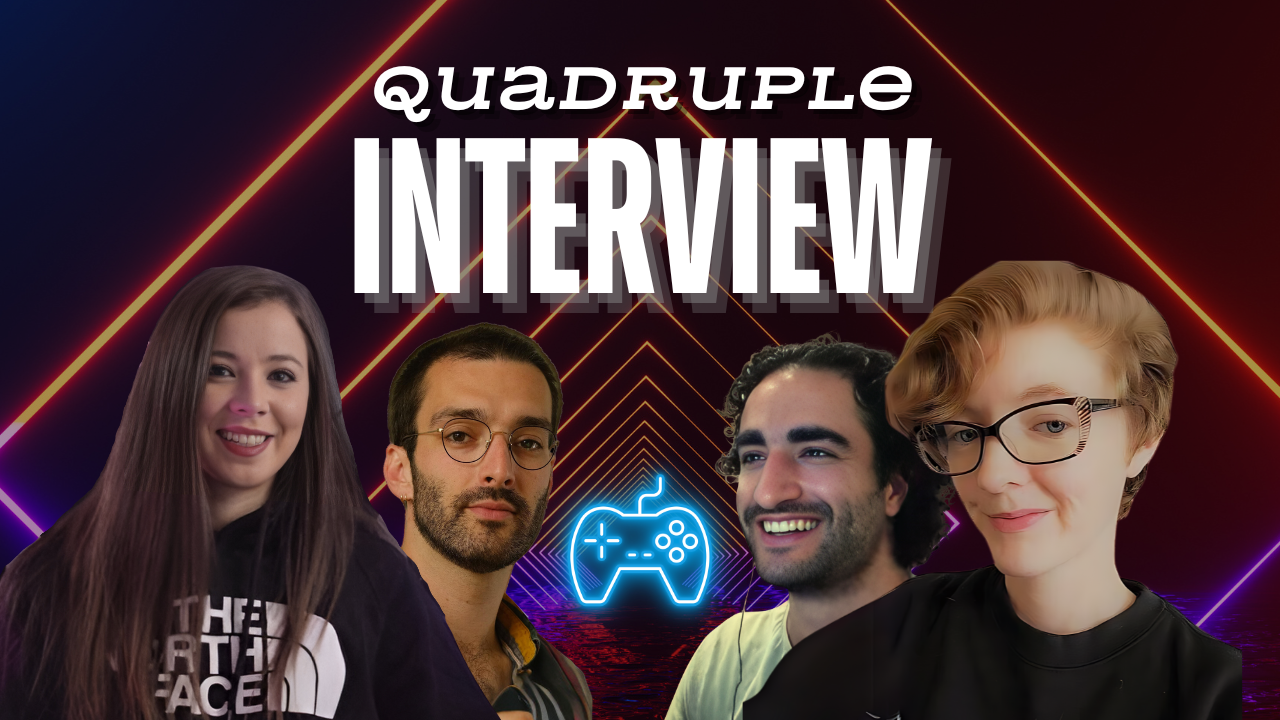
A couple of weeks ago, I went from playing a video game to chatting with four unique individuals who designed and developed the very games I like to play. It wasn’t your average week—more like a course on how games and technology are changing education in ways I never imagined. And now, I get to share it all with you! Whether you're into regular gaming or just curious about how games can be used as educational tools, stick around because these interviews blew my mind.
But first, how did I even get here…
Well, as many of you might know, I love science.
At the beginning of summer, I had already finished all of my middle school science curriculums, and I was thirsty for more!
Around the same time, my writing mentor moved to a new platform, (Recess), where kids come together and learn through playing games. I didn’t take too much interest at first because I was there for the writing, and I don’t play many video games. However, one day, I noticed a new class was posted with a thumbnail that read “Evolve or Perish,” and it piqued my interest.
The introductory video on the Thrive game course I took at Recess
I signed up for this class, and over the course of six weeks, I played the game Thrive. I ate many chunks of iron, produced a lot of ATP, gathered ammonia and phosphate, and even became macroscopic! It was a blast, and I was learning so much!
Eventually, I started wondering if learning through games is the education of the future, but I don’t have much knowledge about game design so I thought I would ask.
Introducing the Interviewees
When you’re curious about how games are made or how technology is transforming education, who better to ask than the people actually building them? I had the chance to sit down with some brilliant minds in the world of edtech and game design, and what they shared was eye-opening.
Meet the awesome interviewees who agreed to chat with me:
Makan Gilani, creator of Synthetic Selection (check out this awesome preview of his game)
Jacob Shulman, co-founder of Jippity (my brother takes a Jippity coding class and gave me a tutorial before the interview)
Kristen Montesano, game developer at Blooket (I use Blooket all the time for my AF classes), co-founder of Jippity, and lead developer at Synthesis
Aleena Yunuba, software engineer at Synthesis (I met Aleena years ago when I first started homeschooling, and Synthesis was my first educational online class)
Here are some of the themes that arose from our conversations:
Balancing Complexity, Engagement, and Fun in Game Design
How do game developers balance educational content while still keeping the game fun?
In my experience playing Thrive, the introduction was really overwhelming because of the complexity of the game components and all of the new vocabulary. Aleena emphasized that at Synthesis, they work on having the games unravel as you go, so you start by simply practicing the skill, and then layer complexity on top of that, ramping up the difficulty throughout the game—which makes total sense and would make the introduction to Thrive a lot less overwhelming.
In order to play Thrive, I had to overcome the complexity by learning to tune out the irrelevant information, with the help of my guide, Tobias. I think Thrive is meant to be complex and realistic, but if their target audience is kids, they could simplify the introduction to make it easier to understand, or it should be played with a guide (which I fortunately had) who can help with a kid’s comprehension.
Kristen discussed the challenge of keeping multiplayer games fun while balancing other design goals, like promoting collaboration among players. When designing a game, the goal might be to have players communicate and assign tasks to each other, but the challenge arises when only a few players engage, leaving others out. If the fun relies on interaction between teammates, it's crucial to ensure that everyone has an opportunity to participate. However, it's difficult for designers to control this, as they can't oversee every game session. Balancing these elements to ensure all players have fun, especially in multiplayer games, presents unique challenges.
While educational games often aim to teach, they must also capture and sustain interest, especially for younger audiences. Introducing content gradually, or with the help of guides, ensures that players aren’t immediately discouraged. Developers like Kristen face an even greater challenge in multiplayer environments, where ensuring collaboration and participation among all players is crucial to keeping the game fun. A well-balanced game creates an environment where players can immerse themselves in learning and teamwork without feeling like they’re being taught or forced into a role.
How VR, AR, and AI are Revolutionizing EdTech
Now that I understood layering complexity and the challenges of multiplayer models, I wanted to know how VR (Virtual Reality), AR (Augmented Reality), and AI (Artificial Intelligence) will affect the fields of educational technology (edtech) and game design.
There was agreement that VR and AR are going to have a more immediate impact on the world of gaming, but less quickly on education.
Makan explained that programmers will have to learn new techniques to work with VR and AR, like having to draw the game twice (for each lens in the headset) and finding ways to fit all their code into a tiny chip (unless you want a giant, heavy helmet on your head). He believes it will take a while to master this:
"You're going to need to re-explore all of the things we take for granted in games now. When computer games first came out, people didn't know how to design them... There were decades of exploration, testing, failure, and eventual success that established the standards. So I think it's going to take a while for the [programmers] to catch up to where we [currently are]." - Makan Gilani
When it comes to AI, its uses are evolving much quicker in educational game development than VR/AR. For example, Jippity is an AI coding platform that helps kids code their own games without learning full coding languages. My little brother’s been able to build several smash-hit games using Jippity without struggling through the coding process. Jacob explains that “…AI could be really helpful for supporting the skills that are not your strengths.”
He went on to say that while a beginning game designer may not reach the level of expertise seen in big games, like Zelda, they can still create something fun and functional with minimal experience. The point of Jippity is to help people get started with game creation, even if they've never coded before. In just an hour, a beginner can have a simple game up and running. The key takeaway is to not be intimidated—just dive in and start creating.
I didn’t know that VR and AR were so much more challenging to incorporate as opposed to using AI. This makes a lot of sense because creating things for VR and AR complicates the process, whereas implementing AI lets you focus on the big picture while simplifying the process.
Practical Experience vs Formal Degrees
Do you need a PhD to become a game developer? What skills does it take?
I was captivated by one of Makan’s stories:
Makan was in a programming class and wasn't very engaged, but when it came to the final project, he could create anything he wanted to. He spent a lot of his time working on the game, even though he wasn't great at programming. The game worked, but the code was messy—basically held together with "duct tape." After the class evaluated each other's projects, his teacher suspected that Makan had cheated because he wasn't attentive in class. However, when the teacher looked at his code, it was so badly written that he knew only Makan could've done it.
Makan’s passion for making games is what drove him to become a better programmer, even though the class itself didn’t provide that confidence. His advice is to just start making things. People often get caught up in details like which programming language is more efficient, but that only matters for high-level projects. If you're making a game, just make it run and improve from there.
"Just make things," was advice given by several of the people I interviewed. However, this doesn’t mean you shouldn’t get a degree. Here are Aleena’s thoughts:
"What you're gaining from your undergraduate degree is the freedom and the ability to go out, meet new people [and] build your skills in areas that are interesting to you."
Rather than simply getting a degree in game development, Aleena suggests focusing on another subject that excites you. In game design specifically, she advises getting a degree in a subject like evolution or history, and then building a game based on that topic.
Aleena’s advice about combining game design with a subject you're passionate about really resonated with me and shifted my perspective on what it takes to become a game developer. Rather than focusing solely on programming, expanding your knowledge in other areas can fuel creativity and make your games unique.
Makan’s experience also highlights that technical perfection isn’t the starting point—it’s the outcome of perseverance. You don’t need to master every skill right away. Instead, the ability to create something, even if imperfect, and improve over time is far more valuable. Ultimately, becoming a successful game developer is about continuously learning, whether through a degree or your own curiosity.
Final Thoughts
Reflecting on these interviews, a few key themes stood out to me.
First, creating anything, whether it’s a game or a blog post, requires a deep understanding of your audience. It’s important of knowing who you're designing for, and how crucial it is to create something that both engages and challenges users.
Secondly, I learned passion drives innovation. What really struck me about my conversations with these developers was how their curiosity and love for their craft pushed them to learn new skills and think creatively.
Thirdly, I was surprised by the role that evolving technologies like AI are playing in game development. It makes me wonder—how far will this go? Could we be entering an era where anyone can create a game, regardless of their background?
Lastly, creating games is not just about mastering technical skills. Curiosity about the world can fuel creativity and lead to more meaningful projects.
In the end, whether you're aspiring to be a game developer, a biologist, or anything in between, the message is the same: Stay curious, keep experimenting, and don’t be afraid to fail.
If you haven’t already, check out my post on interviewing Ben Cowen, a Sonar expert, for more career inspiration as I continue this journey to discover my future path.
A special thank you to Makan, Jacob, Kristen, and Aleena for sharing their invaluable insights, and to the people in my network who helped connect me with these brilliant minds.