

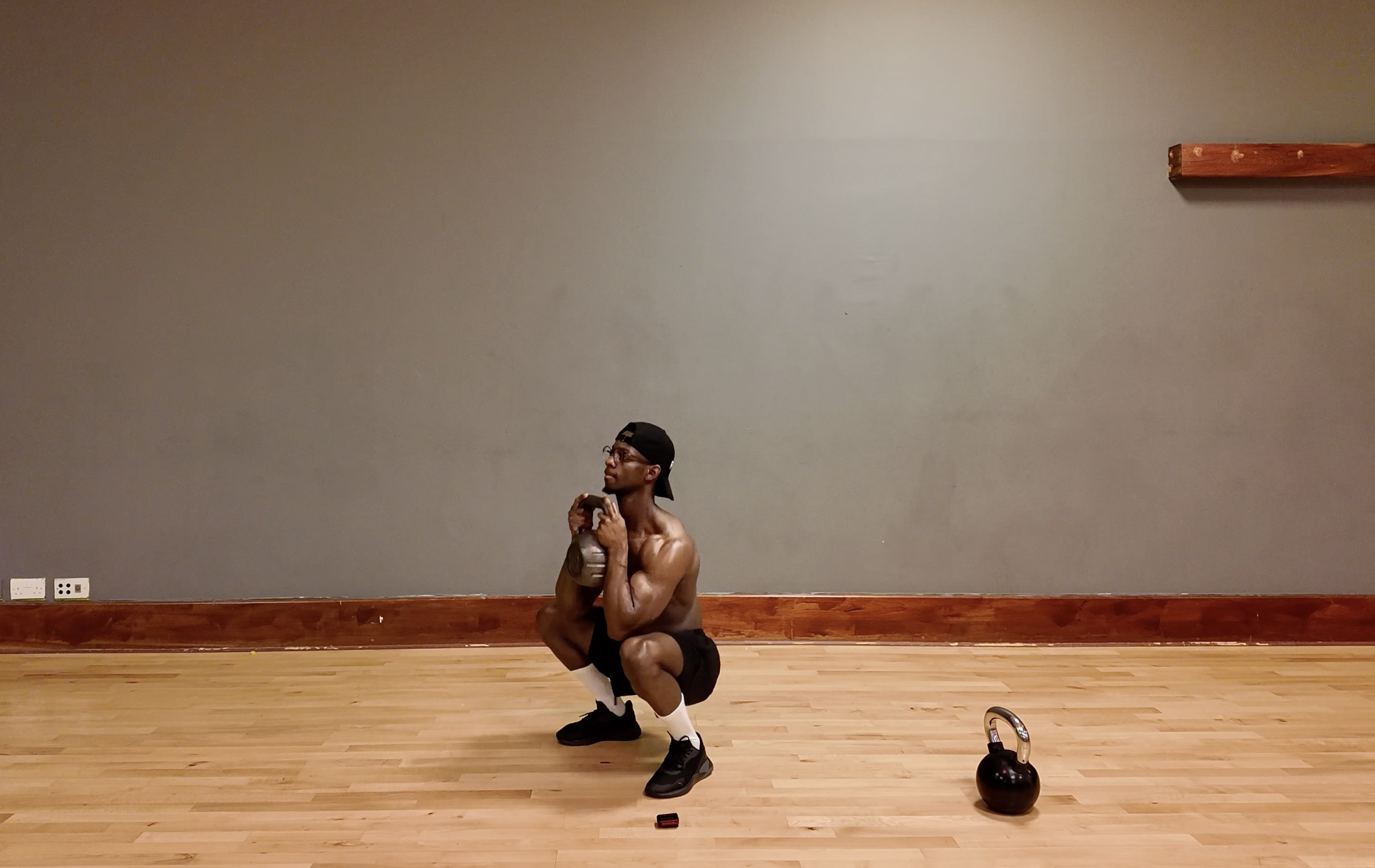
The goblet squat is one of the best kettlebell exercises for beginners. It builds lower-body strength, improves mobility, and reinforces proper squat mechanics. Holding the kettlebell in front of your chest encourages an upright posture and engages your core, making it an excellent way to learn squatting with good form.
This guide will walk you through the correct technique, common mistakes to avoid, and tips to progress safely.
WHAT IS A GOBLET SQUAT?
A goblet squat is a squat variation where you hold a kettlebell (or dumbbell) close to your chest with both hands. Unlike a traditional squat, the front-loaded position helps keep your torso upright, reducing stress on the lower back and improving balance.
STEP-BY-STEP GUIDE TO THE GOBLET SQUAT.
1. SETTING UP YOUR STANCE
Feet Position: Stand with your feet shoulder-width apart or slightly wider, with your toes pointing slightly outward (about 10-15 degrees).
Grip on the Kettlebell: Hold the kettlebell close to your chest with both hands, gripping the sides of the handle (by the horns). Your elbows should be tucked in, pointing slightly downward.
Engage Your Core: Brace your core as if preparing to take a punch. This will help stabilize your spine throughout the movement.
2. INITIATING THE SQUAT
Hinge and Sit Down: Begin by pushing your hips back slightly, then bend your knees as you lower your body. Imagine sitting down into a chair.
Keep Your Chest Up: The weight in front helps maintain an upright posture, but you must still actively engage your upper back to prevent rounding.
Knees Out: Your knees should track over your toes, not collapse inward.
3. REACHING DEPTH
Go as Low as You Can Comfortably: Ideally, aim to lower your hips below knee level (parallel or deeper), but only if your mobility allows it.
Keep Heels on the Ground: Avoid lifting your heels; your weight should be evenly distributed across your entire foot.
Elbows Inside Knees: At the bottom position, your elbows should be close to or inside your knees, which can help open up your hips.
4. STANDING BACK UP
Drive Through Your Heels: Push through your heels and midfoot to stand back up, keeping your chest tall.
Squeeze Your Glutes: Engage your glutes at the top to complete the movement.
Keep the Kettlebell Close: Maintain control over the weight and avoid excessive movement of your arms.
KEY POINTS TO REMEMBER:
1. Upright Posture: Keep your chest lifted to avoid leaning forward.
2. Core Engagement: Brace your core throughout the movement for stability.
3. Knee Tracking: Your knees should follow the direction of your toes.
4. Full Range of Motion: Squat as low as your mobility allows while maintaining form.
5. Controlled Movement: Avoid rushing; move with control both down and up.
COMMON MISTAKES AND HOW TO FIX THEM
1. ROUNDING THE BACK
Mistake: Letting the kettlebell pull you forward, causing your back to round.
Fix: Engage your core and keep your chest up throughout the squat.
2. KNEES COLLAPSING INWARD
Mistake: Letting your knees cave in instead of keeping them in line with your toes.
Fix: Actively push your knees outward during the squat.
3. LIFTING THE HEELS
Mistake: Rising onto your toes instead of keeping your feet flat.
Fix: Focus on keeping your weight evenly distributed across your entire foot.
4. NOT SQUATTING DEEP ENOUGH
Mistake: Stopping too high due to poor mobility or lack of strength.
Fix: Work on flexibility and depth gradually while maintaining good form.
PROGRESSION TIPS FOR BEGINNERS:
Start with Bodyweight Squats: If the movement feels difficult, practice without a kettlebell first.
Use a Box for Guidance: Squat down to a box or bench to ensure consistent depth.
Improve Ankle and Hip Mobility: Stretch and foam roll tight muscles if you struggle to squat deeply.
Gradually Increase Weight: Once you’re comfortable, increase the kettlebell weight to build strength.
BENEFITS OF THE GOBLET SQUAT
1. Improves Squat Mechanics: Encourages proper posture and balance.
2. Strengthens the Legs and Core: Builds lower-body power while engaging the core.
3. Enhances Mobility: Helps increase flexibility in the hips, knees, and ankles.
4. Safer for Beginners: Less stress on the lower back compared to back squats.
5. Functional Movement: Mimics real-life actions like sitting and standing.
By mastering the goblet squat with proper form, you’ll build strength, improve mobility, and create a strong foundation for more advanced kettlebell exercises. Take your time, focus on quality over quantity, and progress at your own pace.
Thank you for reading.
My name is Mwechezi, and I’m here to help you make fitness simple, effective, and sustainable.
Drop your questions or goals in the comments, and let’s keep the conversation going. See you in the next post.