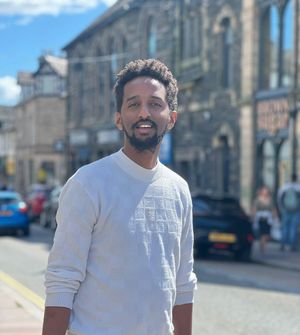
What Does It Mean to Be Bilen?: An Eritrean essay on the inheritance you almost lose, but choose to reclaim.
Intro: I am Bilen, and I am Eritrean. I have never understood those two things to be in tension. Being Eritrean is enough, it asks for no apology and leaves no debt. At the same time, unity is not built by forgetting who we are. It is built by remembering well. Nine peoples who each know their own language, their own memory and their own inheritance do not dilute one another when they come together. They braid. That is why the thing they make cannot be broken in spirit. Unity in diversity.
There is a particular kind of silence that teaches you something about yourself. I met it one grey afternoon in a university common room in the United Kingdom. Across a small table sat a doctoral student of anthropology, a man who knew his ancestry very well.
We had drifted, as strangers far from home do, toward the question of origins. When he spoke, he didn’t just name a country. He named a people, a lineage, a cluster of villages, a set of values he could trace back through his grandparents. He knew the names. He knew the stories behind the names. He spoke of who he was with the unhurried confidence.
Then it was my turn. I was not worried, because I love to talk about Eritrea. I spoke of our long road to nationhood. I spoke of a formidable, improbable resilience, and of nine peoples folded into one small country on the Red Sea. I was, I think, rather good.
He listened. Then he asked the gentle, unguarded question that would keep me awake that night.
“Do you come from a particular people?” he said. “A clan, a tribe, something more specific?”
I looked at him and answered with real pride.
“Yes,” I said. “I’m Bilen.”
And then I stopped.
The silence arrived. I had reached the end of what I knew. I could have told him that the Bilen live mostly around a town called Keren. That we are one of Eritrea’s 9 ethnic groups. That we have our own language, and that both Christians and Muslims are part of us. After that, nothing. Only the smooth wall of my own ignorance, and the uncomfortable knowledge that if he asked one question deeper than the label, I would have to confess that I did not really know a lot.
Mercifully, he did not ask the deeper question. We moved on. But the thing had been done.
That night, in the quiet of my room, I sat with a strange discovery. Behind a word I had spoken all my life lay an empty room. I had carried “Bilen” like an identity card. It is useful, official and mine, but I didn’t read what was printed on the other side.

There is a saying in Tigrinya, the language of the elders where I grew up, that returned to me then with the force of an accusation:
ማይ ካብ ምንጩ ፡ሰብ ካብ ሱሩ። (Water from its source, a person from their root.)
At first hearing it is a small piece of folk wisdom about manners and family. Sit with it, though, and it grows on you. To know whose child you are is orientation. Lose it, the proverb implies, and you do not merely forget a few facts but you lose your belonging, the thread that ties you to the people who made you. I had not lost my belonging. I had something stranger and more modern, belonging without knowledge. A name with all most nothing inside it.
How does a man become a stranger to his own people? In my case the answer is a single word: Asmara. I grew up in the capital, in a city that is of great mixtures. My neighbours, my classmates, my closest friends were mostly of other origins. Tigrinya, in the main. The city raised me well, but it raised me in everyone’s culture and no one’s in particular. And so the specific inheritance passed me by. I do not speak Blin. I do not know the much Bilen songs. I cannot perform Bilin dances. The proud declaration in that foreign room was, I realised, almost the whole of my knowledge.
Law can take the back seat for a while, I thought. It is time to study something even interesting, identity.
So I began to ask the question that this essay is named for. Not “who are the Bilen,” that is a matter for an encyclopaedia. The harder question, what does it mean to be one of them? The answer, I would learn, runs longer and stranger than I expected. And it does not begin in Keren, but on a high plateau hundreds of kilometres to the south, in a kingdom that no longer exists.
To be continued..........
N.B Is it Bilen, Bilin or Blen? Do I have an answer for that? Come on.