
In Print on Demand (POD) and e-commerce, customers cannot physically touch, wear, test, or inspect a product before purchasing. They rely almost entirely on what they see online.
That is where product mockups become one of the most important parts of your visual marketing strategy.
A high-quality mockup helps transform a simple design file into a realistic product presentation. Instead of showing customers a flat PNG design, you can show how that design may look on a T-shirt, hoodie, mug, poster, phone case, packaging, or other products in a realistic environment.
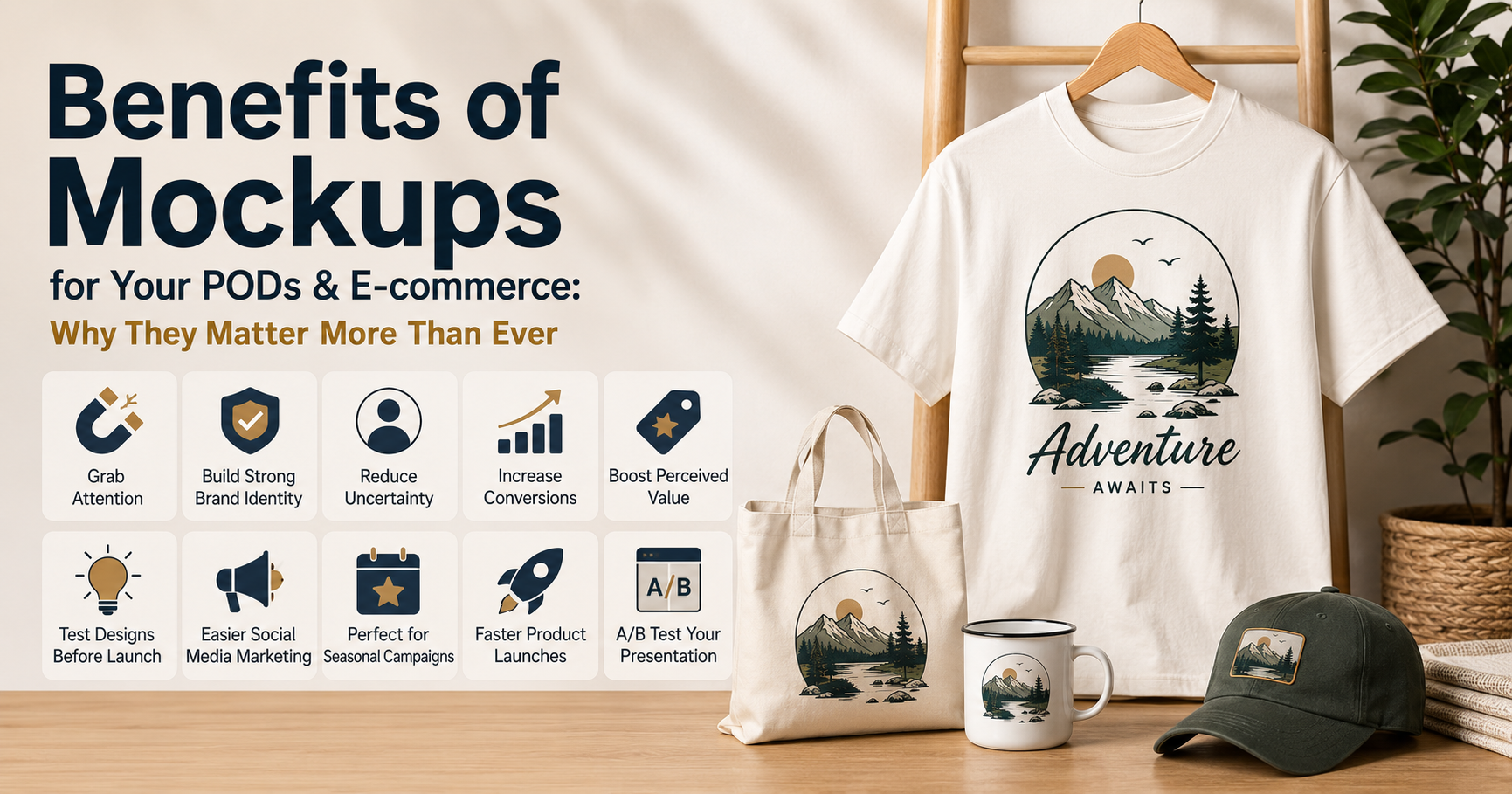
The benefits of mockups for your PODs & e-commerce go far beyond making products look attractive. Mockups can improve product presentation, strengthen branding, help customers understand a product, support marketing campaigns, and potentially make shoppers more confident about purchasing.
For POD sellers and e-commerce brands competing in visually crowded marketplaces, strong product visualization can become a major competitive advantage.
What Is a Product Mockup?
A product mockup is a visual representation that shows how a design, logo, artwork, or branding concept may appear on a real product.
For example, instead of displaying a T-shirt design like this:
Flat artwork file → Transparent PNG → No product context
A mockup transforms the presentation into:
Artwork → Realistic T-shirt → Model or lifestyle scene → Professional product image
The same concept applies to:
T-shirts and apparel
Hoodies and sweatshirts
Tote bags
Mugs
Posters and wall art
Phone cases
Packaging
Cosmetics
Accessories
Home décor
Sportswear
Baby products
For POD stores, mockups bridge the gap between a digital design and the customer's imagination.
Why Are Mockups Important for POD Stores?
1. Mockups Help Customers Visualize the Final Product
One of the biggest benefits of mockups for your POD stores is that they help customers understand what they are buying.
A customer may love a design, but a flat artwork preview does not answer important questions such as:
How large will the design appear?
Where will the artwork be positioned?
What does the garment look like when worn?
How does the product look from a distance?
Does the design suit the product color?
Does it fit the customer's personal style?
A realistic mockup provides visual answers before the customer needs to ask.
Example
Imagine two online stores selling the same Halloween T-shirt design.
Store A:
Shows only the transparent PNG artwork.
Store B:
Shows the design on a realistic oversized cream T-shirt worn by a model in a seasonal Halloween lifestyle environment.
Even if the actual product is similar, Store B creates a stronger visual experience because the customer can immediately imagine themselves wearing the product.
The product has context.
And context helps products feel more real.
2. Better Mockups Can Improve Product Perception
Product presentation influences how customers perceive a brand and its products.
A design displayed on a poorly edited or unrealistic mockup may unintentionally make the product appear cheap, low-quality, or unprofessional.
On the other hand, a realistic and well-composed mockup can communicate:
Premium quality
Professional branding
Attention to detail
Modern design
Lifestyle relevance
Strong brand identity
This is particularly important in POD because many sellers may offer similar product categories.
The difference often comes down to how the product is presented.
User Story: From Generic Listings to a Cohesive Brand
Consider a small POD seller launching motivational gym T-shirts.
Initially, every listing used the same front-facing flat garment image. The designs were visible, but the store felt like a collection of isolated products.
The seller then created a more intentional mockup strategy:
Front product view for clarity
Model-wearing image for scale
Close-up image for print visibility
Gym lifestyle scene for emotional context
Back view when relevant
Suddenly, the store did not just look like a design catalog.
It started to feel like a fitness apparel brand.
This is one of the most valuable benefits of mockups for e-commerce: they help transform individual products into a recognizable visual brand experience.
Benefits of Mockups for Your PODs & E-commerce
 3. Mockups Make Product Listings More Engaging
Online shoppers make quick visual decisions.
Before reading a long product description, many customers first look at:
The main product image
The product style
The design placement
The overall visual quality
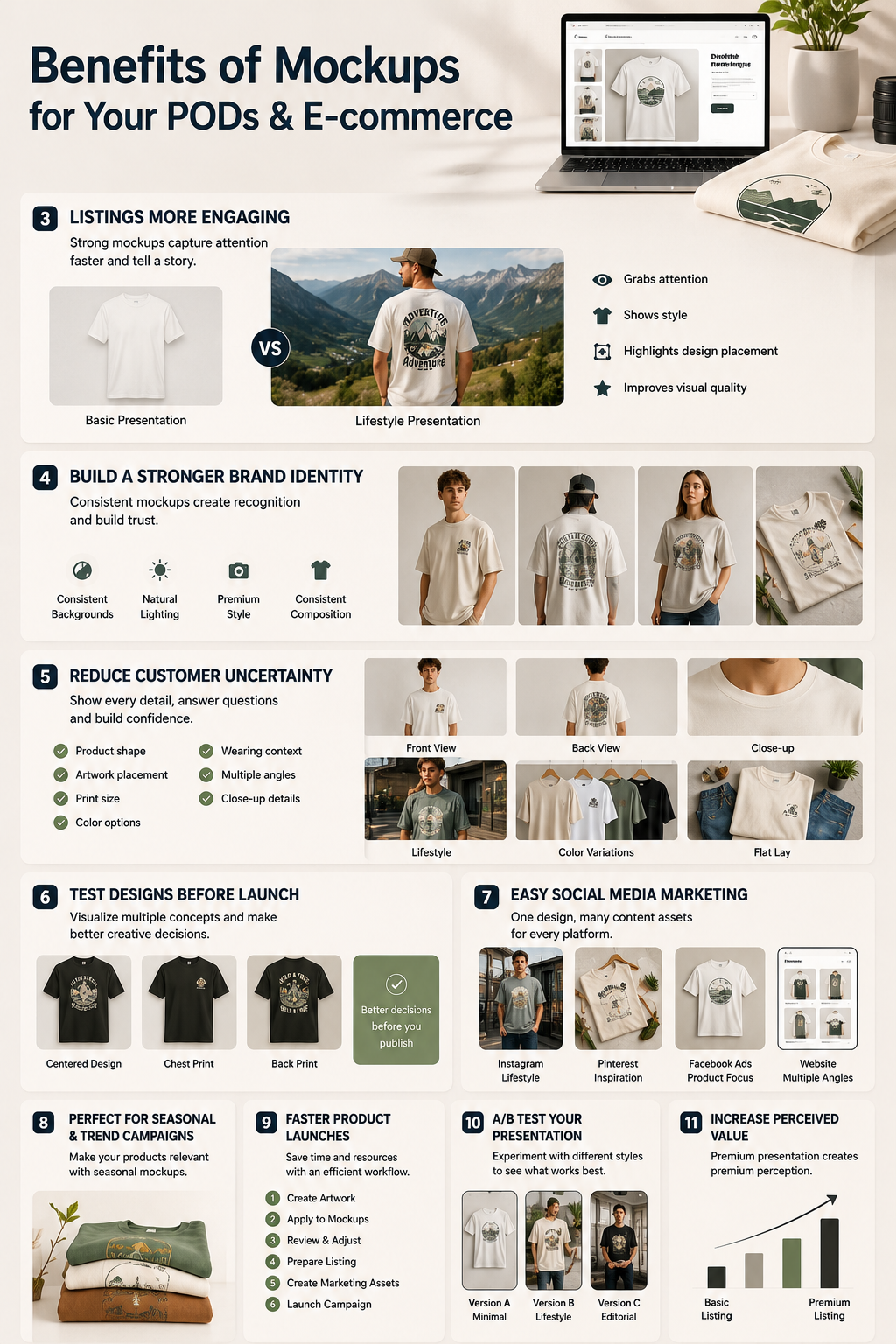
A strong mockup can capture attention faster than a plain product preview.
For example, a basic white hoodie against a blank background may communicate the product.
A lifestyle mockup of someone wearing that hoodie in a relevant environment communicates the product and a story.
This difference matters.
Example
A travel-themed T-shirt can be presented in two ways:
Basic Presentation:
T-shirt floating against a plain background.
Lifestyle Presentation:
A traveler wearing the T-shirt near a mountain viewpoint with realistic natural lighting.
The second presentation helps customers associate the product with an experience and lifestyle.
4. Mockups Help Build a Stronger Brand Identity
Consistency is one of the most important elements of e-commerce branding.
If every product image has:
Different lighting
Different visual quality
Random backgrounds
Inconsistent camera angles
Unrelated models
The store may feel unorganized.
A consistent mockup strategy can help create visual recognition.
For example, a POD brand may decide to use:
Minimal neutral backgrounds
Soft natural lighting
Premium editorial photography style
Oversized apparel styling
Consistent camera composition
Over time, customers begin recognizing the visual identity of the store.
Mockups Become Part of Brand Design
Many sellers think branding only means:
Logo
Brand colors
Typography
But product photography and mockup presentation are also part of branding.
Your mockups can communicate your brand personality before a customer reads a single word.
5. Mockups Can Help Reduce Customer Uncertainty
Customers hesitate when they are unsure about what they will receive.
A realistic mockup can help clarify visual expectations by showing:
Product shape
Artwork placement
Relative print size
Color combinations
Wearing context
Product styling
For apparel products, multiple mockups can be especially useful.
Recommended Apparel Mockup Set
A strong product listing might include:
Front view
Back view
Close-up print detail
Lifestyle image
Different product color variation
Flat lay or folded product image
Each image answers a different customer question.
The goal is not simply to add more images.
The goal is to reduce uncertainty.
6. Mockups Help POD Sellers Test Designs Before Launching
One of the most practical benefits of mockups for your POD stores is product testing.
Before investing significant time in promoting a design, sellers can visualize multiple concepts.
For example, a seller may create three variations of the same graphic:
Large centered design
Small chest print
Vintage oversized back print
Using mockups, the seller can compare how each concept looks in a realistic environment.
Real Use Case
A streetwear seller creates a new graphic.
The design looks excellent on a flat artboard.
However, once applied to an oversized T-shirt mockup, the seller realizes the artwork is too small and visually disappears when viewed from a normal distance.
Instead of discovering this problem after launching the product, the seller can adjust the design before publishing the listing.
Mockups can therefore support better creative decisions during product development.
7. Mockups Make Social Media Marketing Easier
A single product design can be transformed into multiple marketing assets using different mockup scenes.
For example, one T-shirt design could be presented as:
Studio product image
Model lifestyle image
Streetwear editorial scene
Close-up fabric detail
Seasonal campaign image
Social media advertisement
This allows POD sellers to create more content without needing a physical photoshoot for every design variation.
Example Content Strategy
For one product launch:
Instagram: Lifestyle mockup
Pinterest: Vertical product inspiration image
Facebook Ads: Clean product-focused mockup
Website: Multiple product-angle images
Email Campaign: Seasonal lifestyle presentation
The same product becomes visually adaptable across different marketing channels.
8. Mockups Are Useful for Seasonal and Trend-Based Campaigns
POD businesses often depend on seasonal opportunities.
Examples include:
Halloween
Christmas
Valentine's Day
Mother's Day
Father's Day
Back to School
Summer
Sports events
Local celebrations
A seasonal mockup can make an ordinary product feel more relevant to a campaign.
Case Example: Halloween Apparel
Imagine a POD seller launching a collection of cute Halloween designs.
Instead of showing every T-shirt against a plain white background, the seller uses mockups featuring:
Soft spooky studio sets
Pumpkins
Autumn colors
Subtle Halloween decorations
Cozy lighting
The product becomes part of the seasonal experience.
This can make campaign visuals feel more intentional and cohesive.
However, it is important that the mockup does not overpower the product. The design and garment should always remain easy to inspect.
9. Mockups Support Faster Product Launches
Traditional product photography requires time and resources.
Depending on the product, it may involve:
Samples
Shipping
Models
Studio space
Photography
Editing
For a growing POD store with many designs, creating original photography for every variation may not always be practical.
Mockups can help sellers prepare visual assets earlier in the product development process.
Example Workflow
Step 1: Create artwork
Step 2: Apply artwork to realistic mockups
Step 3: Review placement and visual balance
Step 4: Prepare product listing images
Step 5: Create social marketing assets
Step 6: Launch campaign
This can make the creative workflow more efficient.
10. Mockups Allow Better A/B Testing of Product Presentation
Sometimes the design is not the problem.
The presentation may be.
A seller can experiment with different mockup styles to understand which presentation better matches the target audience.
For example:
Version A
Minimal studio mockup.
Version B
Lifestyle model mockup.
Version C
Close-up premium fashion editorial mockup.
Different audiences may respond differently depending on the product category.
A luxury apparel brand may benefit from editorial-style imagery.
A casual family POD brand may perform better with friendly lifestyle scenes.
The mockup strategy should support the audience, not simply follow visual trends.
11. Mockups Can Increase the Perceived Value of a Product
The way a product is presented can influence perceived value.
Consider a simple graphic T-shirt.
The actual manufacturing cost may remain the same, but the perceived experience can change depending on presentation.
Basic Listing
Flat garment
Plain design placement
Low-detail image
Premium Listing
Realistic garment texture
Natural folds
High-quality lighting
Thoughtful composition
Lifestyle context
Consistent brand presentation
The product itself may not have changed.
But the customer's perception of the product experience may change significantly.
This is why mockups are particularly valuable for visually competitive e-commerce categories.
How to Use Mockey AI for POD and E-commerce Mockups
 For sellers who need to create multiple product visuals efficiently, AI-powered mockup tools can become part of the content workflow.
Mockey AI can be used as a mockup creation tool to help visualize designs on different product presentations and create marketing-ready product imagery.
A useful workflow may look like this:
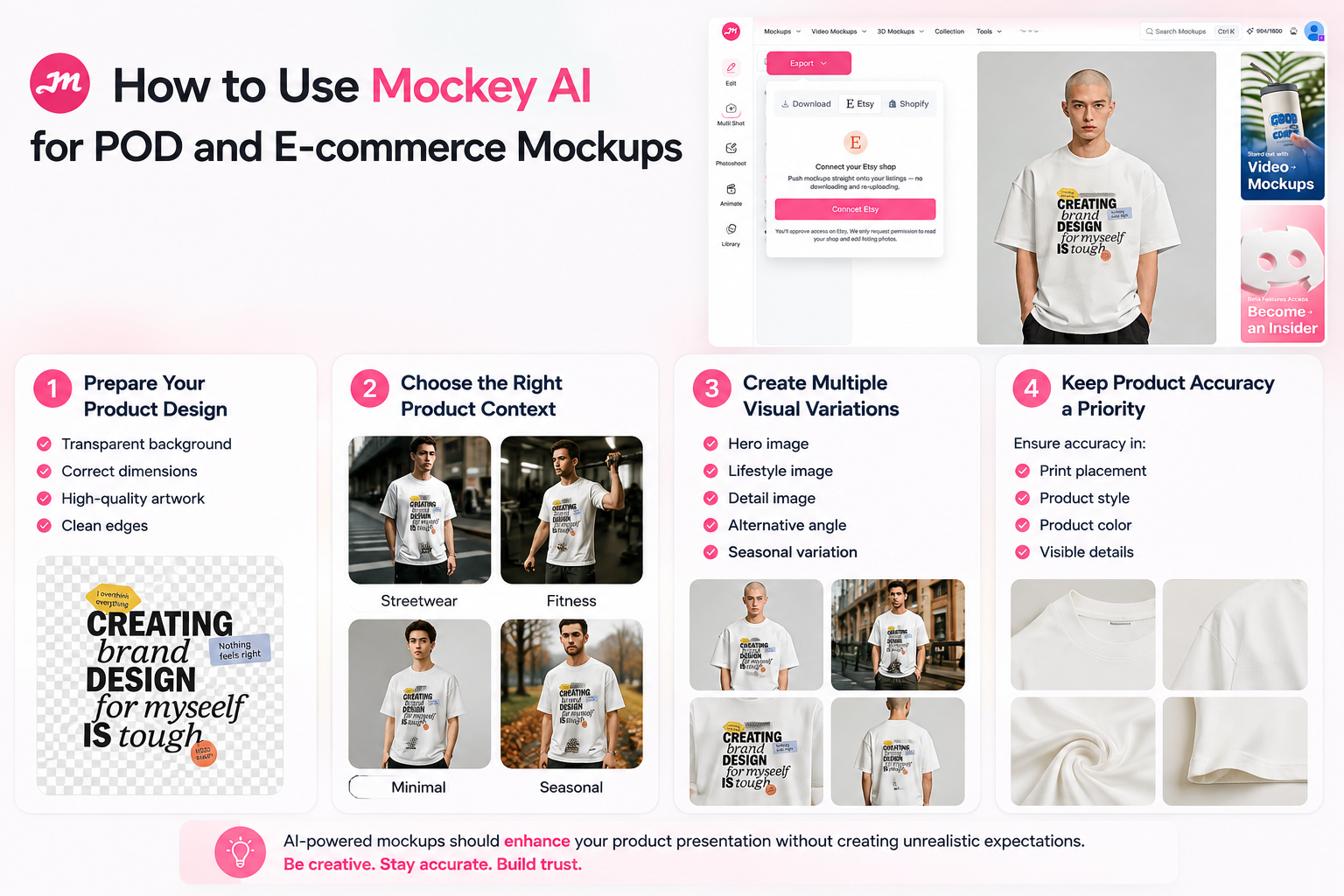
Step 1: Prepare Your Product Design
Start with a clean, high-resolution design.
Check:
Transparent background
Correct dimensions
High-quality artwork
Clean edges
Step 2: Choose the Right Product Context
Match the mockup with the product audience.
For example:
Streetwear designs: Urban or editorial styling
Baby products: Soft and friendly environments
Fitness apparel: Active lifestyle context
Minimal brands: Clean studio compositions
Seasonal products: Relevant seasonal settings
Step 3: Create Multiple Visual Variations
Do not depend on only one product image.
Create:
Hero image
Lifestyle image
Detail image
Alternative angle
Seasonal variation
Step 4: Keep Product Accuracy a Priority
AI-generated or digital mockups should not mislead customers.
The product should accurately represent:
Approximate print placement
Product style
Product color
Visible construction details
Marketing visuals should enhance the presentation without creating unrealistic expectations.
A Small POD Brand Launching 20 Designs
Let's imagine a small POD business launching 20 new graphic T-shirts.
Without a mockup strategy, the store might upload:
20 flat product images.
The result:
Limited visual variety
Weak social media assets
Minimal brand personality
Less product context
Now consider a mockup-first strategy.
Each design receives:
One clean front-facing image
One lifestyle model image
One close-up detail
One campaign-specific image
Now, 20 designs can create approximately 80 visual assets.
These assets can support:
Product listings
Social posts
Advertisements
Email marketing
Seasonal campaigns
Pinterest content
The key advantage is not simply having more images.
It is creating more ways for customers to discover, understand, and connect with the product.
Best Types of Mockups for E-commerce Stores
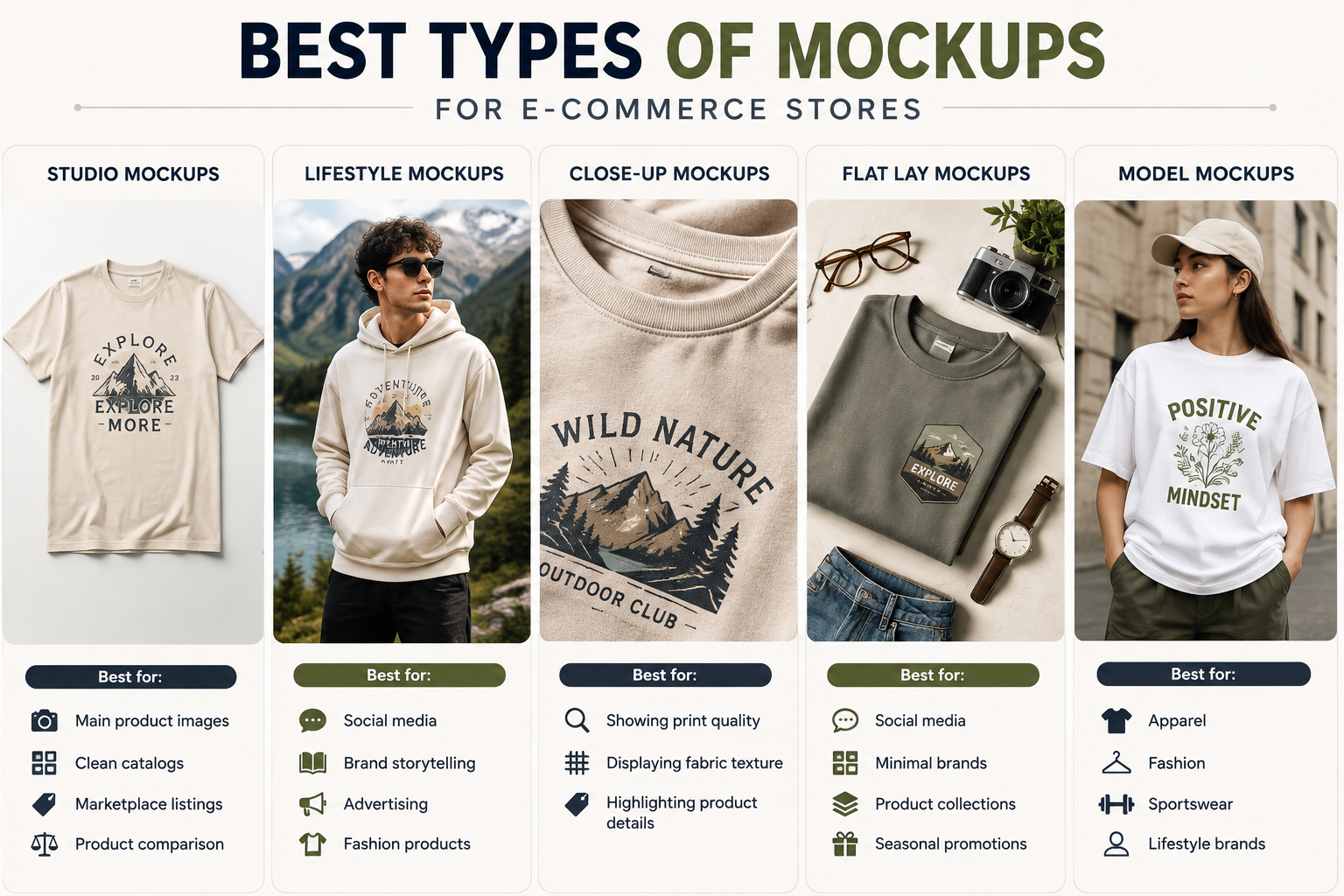 Studio Mockups
Best for:
Main product images
Clean catalogs
Marketplace listings
Product comparison
Studio mockups focus attention directly on the product.
Lifestyle Mockups
Best for:
Social media
Brand storytelling
Advertising
Fashion products
These mockups help customers imagine the product in real-life situations.
Close-Up Mockups
Best for:
Showing print quality
Displaying fabric texture
Highlighting product details
These are particularly useful when customers want to inspect craftsmanship or artwork.
Flat Lay Mockups
Best for:
Social media
Minimal brands
Product collections
Seasonal promotions
Flat lays can create visually organized product presentations.
Model Mockups
Best for:
Apparel
Fashion
Sportswear
Lifestyle brands
They provide scale and help customers understand how products may look when worn.
Frequently Asked Questions
What are the biggest benefits of mockups for POD stores?
Mockups help POD sellers visualize products, improve product presentation, create marketing assets, strengthen branding, and give customers a clearer idea of how a design may look on a finished product.
Are mockups important for e-commerce?
Yes. Since online shoppers cannot physically inspect products before purchasing, product visuals play an important role in communicating appearance, style, scale, and context.
How many mockups should a POD product have?
There is no universal number, but many products benefit from multiple perspectives. A useful combination may include a clear product image, a lifestyle image, and a close-up detail image.
Can mockups be used for social media marketing?
Yes. A single product can be presented in different mockup styles for social media posts, advertising campaigns, seasonal promotions, and other marketing channels.
What makes a good product mockup?
A good product mockup should be realistic, visually clear, relevant to the target audience, consistent with the brand, and accurate enough to avoid misleading customers about the final product.
Can AI tools help create e-commerce mockups?
AI-powered mockup tools can help sellers create and experiment with product visuals more efficiently. Tools such as Mockey AI can fit into workflows for generating product mockups and exploring different presentation styles.
Final Thoughts
The biggest benefits of mockups for your PODs & e-commerce business come from their ability to turn a product idea into a visual experience.
A mockup can help a customer:
Understand the product
Visualize using or wearing it
Connect with the lifestyle around it
Recognize your brand style
Feel more confident exploring the product
For a POD seller, the design may be the starting point.
But the presentation often determines how that design is experienced online.
The most effective approach is to treat mockups as part of your overall product strategy—not simply as decorative images.
Use clear product visuals for accuracy. Use lifestyle mockups for storytelling. Use close-ups for detail. Use consistent styling for branding.
When combined strategically, mockups can help transform a basic product listing into a stronger and more complete e-commerce experience.