

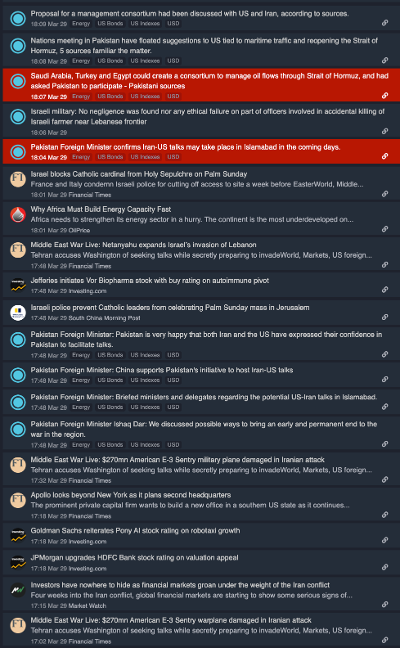
 Analysis of the news presented in the feed points to a moment ofextreme volatilityand a possible geopolitical reconfiguration in the Middle East. We are facing a "two-way" scenario: a direct military escalation contrasted by an aggressive diplomatic offensive on Pakistani soil.
Below, I present a detailed analysis of the macroeconomic impact and current market sentiment:
I. Geopolitical Analysis and Sentiment (Detailed)
1. The Axis of Escalation: Direct Confrontation and Religious Tensions
The news ofdamage suffered by a US military E-3 Sentry aircraft ($270M)An Iranian attack is the point of greatest immediate risk. Direct attacks on US assets usually generate kinetic responses, which keeps the geopolitical risk premium high.
● Lebanon:The expansion of Israel's invasion of Lebanon, as reported by the Financial Times, suggests that the northern front is far from stabilizing.
● Religious Factor:The blockade of Catholic leaders in Jerusalem on Palm Sunday adds a layer of social and diplomatic instability with Europe (France and Italy have already condemned the action), which could weaken unconditional Western support for Israel.
2. The Diplomatic Axis: The "Pivot" of Islamabad
Pakistan emerges as the unlikely mediator. The confirmation of talks between Iran and the US in Islamabad is awhite swan(unexpected positive event).
● Consortium of the Strait of Hormuz:The proposal for a consortium managed by Saudi Arabia, Turkey, and Egypt to control oil flows represents a paradigm shift. If regional countries take ownership of energy security, dependence on the US military presence could decrease, stabilizing Brent prices in the long term.
II. IMPACT ON ASSETS AND CORRELATIONS
Active
Expected Impact
Justification
DXY (Dollar)
📈 Bullish
Asset refuge (Safe Haven) in the face of the uncertainty of the conflict and the attack on the E-3 Sentry.
EURUSD
📉 Bearish
Energy pressure in Europe and diplomatic condemnation of Israel by France/Italy are increasing risk aversion in the bloc.
Gold / Silver
📈 Bullish
The "groan" of financial markets under the weight of the Iranian conflict is pushing investors towards precious metals.
Oil & Gas
🎢 Volatile
High pressure due to the Strait of Hormuz, but with the potential for a decrease if the Türkiye-Egypt-Saudi consortium moves forward.
Yields (USA)
📈 Bullish
The risk of persistent inflation due to logistics and energy costs is keeping rates high (Hawkish).
Specific Correlations:
● USDCHF:The Swiss franc is expected to gain strength as a safe haven, but the USD could overtake it if the "total war" narrative gains traction.
● GBPUSD:Under negative pressure, following the EURUSD, especially as the market assesses the impact of global inflation in the UK.
● EURGBP:It may exhibit erratic movements depending on the aggressiveness of European condemnations of the situation in Jerusalem.
III. Tactical Conclusion
The market is in a state of"Contained Panic"On one hand, we have the physical damage to American assets (Bearish risk), on the other, the hope for immediate negotiations in Pakistan (Bullish risk).
Verdict: Short-term bias is Risk-Off
The attack on the E-3 Sentry aircraft is a retaliatory trigger that the market has not yet fully priced in. Extreme caution is recommended in assets correlated with the Euro, and focus should be on the resilience of the Dollar and Gold.