

The original Hydra came from Greek mythology: the Lernaean Hydra. It made its lair near the lake of Lerna in the Argolid; the lake of Lerna was also supposed to be an entrance to the Underworld in Greek mythology. This Hydra would be slain by Heracles/Hercules as part of his Twelve Labours.
The original Hydra was the offspring of Typhon and Echidna, two serpentine abominations who were the parents of quite a few of the monsters in Greek mythology. Typhon and Echidna were both often portrayed as half human/half snake hybrids; sometimes Typhon had wings too. Echidna was alternatively described as a beautiful nymph with a snake lower half, and other times as a hideous and poisonous monstrosity. So their depiction varied quite a lot depending on the source material.
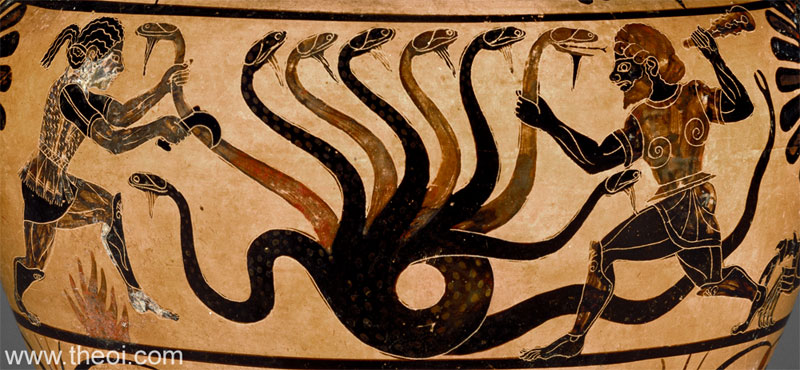
Image sourced from Theoi Greek Mythology
While hydras in modern depictions tend to be something draconic looking or amphibious-adjacent, the original Lernaean Hydra was usually depicted as a snake with nine heads. Again, it varies heavily depending on the source material; some sources say it had powerful venom, or breath so poisonous it could kill people, and one says it was a single snake with many offspring rather than a singular creature. Often its blood was dangerous as well, or it had more than one tail.
The number of heads it had also varied wildly, with most sources saying six or nine, but its characteristic regeneration ability to grow two heads when one was severed is probably its most well-known ability.
The story of Hercules has him cover his mouth and nose with a cloth to stave off the poisonous breath of the Hydra and then wade into combat, typically with a sword, but sometime with a club or sickle. Either way, fire is involved in most depictions because he has to cut off its heads and cauterize the stumps to inhibit regeneration. The monster could not die so long as it had at least one head. Some sources had the head regenerate itself, others had it regrow two instead. The most common depiction seems to be growing two though.
How Hercules kills the Hydra varies. Some stories have it involve his nephew Iolaus scorching the stumps of the Hydra after each decapitation, having gained wisdom from Athena on how to combat the Hydra this way. This story also has Hera send a giant crab (for some reason?) and Hercules ends the fight by decapitating the Hydra’s main head with a golden sword he was gifted by Athena.
Another version of his fight against the Hydra has him using the beast’s own poison blood to burn the stumps and prevent regeneration. According to this version, Hera made Hydra into the namesake constellation to immortalize it after it was slain, and the giant crab into the constellation Cancer.
In more modern depictions of hydras, rather than being one creature, they are often a species. Typically included in fantasy works, they are often portrayed as draconic rather than serpentine, sometimes even breathing fire. They do sometimes have acid blood/breath, and are often swamp-dwellers, and regeneration is not an uncommon trait either, so while books and video games have adapted the idea of a hydra to their own tastes, they seem to never deviate too much from the original serpentine source material.